
Free Kick Rules in Football: What the Law Actually Says
This post contains affiliate links. As an Amazon Associate, we earn from qualifying purchases.
Free kick rules in football require the ball to be still, opponents at least 9.15 m (10 yds) away, and the kicker not to touch it twice before another player does. Direct kicks can score straight away; indirect kicks cannot, and a wall of three or more defenders keeps attackers at least 1 m away.
The 1 m gap around a wall in the free kick rules in football still catches professionals out. The 9.15 m figure is older and gets policed so loosely that one Bundesliga study found no encroachment punished in 1,833 kicks. That distance between the written Law and what referees enforce runs through everything below.
What follows: the distance rules, direct versus indirect kicks, the second-touch cases, the order of events when a kick is taken, and what the data says about vanishing spray. School and youth rulebooks get their own section, since their numbers differ.
Key Takeaways
- A foul that happens outside the area stays a free kick, so location of the foul decides everything, even if the fouled player falls inside the box.
- A kicker’s second touch before anyone else touches the ball gives the opponents an indirect free kick, plus a yellow or red card if it stops a promising attack or denies an obvious goal-scoring opportunity.
- An attacker inside 1 m of a wall of three or more defenders when the kick is taken costs the team the kick. Crystal Palace lost a goal to this in August 2025.
- In the Bundesliga study, spray cut massive violations from 16.7% to 10.7% but left overall violations at roughly 25%.
Do You Have to Give 10 Yards on a Free Kick?
Yes, with one exception: opponents must stay at least 9.15 m (10 yds) from the ball until it’s in play. The exception is a defender standing on their own goal line between the posts, which matters when a kick is awarded close to goal.
Under Law 13, opposing players must stay at least 9.15 m (10 yds) from the ball at a free kick, except a defender standing on the goal line between the posts. Where three or more defenders form a wall, attackers must stay at least 1 m (1 yd) from that wall until the ball is in play.
When the defending team takes a free kick inside its own penalty area, the ball is in play the moment it’s kicked. Since 1 June 2019 it no longer has to leave the area first. Opponents still have to be outside the area. One who deliberately stays in and intercepts a quick kick has the goal disallowed, and the kick is retaken.
Being too close doesn’t trigger one fixed punishment. Law 13’s own Q&A lays out several outcomes:
- Opponent interferes with the kick: a yellow card, even if the kicker only feinted.
- Quick kick intercepted inside 9.15 m: play continues, because the kicker took the risk.
- Ball still reaches an unpressured teammate: the referee may play advantage, then caution or warn the offender at the next stoppage.
- Opponent blocks a quick restart: a yellow card for delaying the restart.
So is failing to retreat always a booking? A NISOA referee-training article lists failure to move back 10 yds as a cautionable offence. IFAB’s Q&A shows the caution isn’t automatic. I’d trust the Law text over the training summary, and the Law text leaves the referee room to judge.
The Japan FA calls the 10 yards perhaps the least respected law in football (a July 2024 JFAnews piece). Its writer describes defenders standing in front of the ball and walls creeping forward until the referee intervenes. The sensible response when defending free kicks is to be set at the line before the whistle. Stalling earns a yellow card, not a favour.
Direct vs Indirect: Where the Ball Can Go Straight In
The only real difference is what happens when the kick flies straight into a goal. The direct vs indirect free kicks split shows up in three outcomes.
| Situation | Direct free kick | Indirect free kick |
|---|---|---|
| Straight into opponents’ goal | Goal | Goal kick to defenders |
| Straight into kicker’s own goal | Corner to opponents | Corner to opponents |
| Typical offence | Careless, reckless or excessive-force foul | Offside, or a kicker’s second touch |
Why can’t an indirect kick score on its own? The Laws require another player to touch the ball before a goal counts, and the same logic stops anyone scoring against their own team from a restart. A kick that goes in untouched gives a goal kick (opponents’ goal) or a corner (own goal).
The referee signals an indirect kick by raising an arm above the head. Referees forget, and the Law has an answer for it.
The part nobody mentions: When the arm stays down and an “indirect” kick goes straight into the opponents’ goal, the kick is retaken. If the keeper touched the ball on the way in, the goal is disallowed and the kick is also retaken, because the referee’s mistake probably caused the save attempt.
Offside is also punished with an indirect free kick. Near the goal line, it gets odd. If a defender kicks the ball back and the keeper handles it, the indirect kick is taken from the nearest point on the goal-area line parallel to the goal line. Defenders can then stand on the goal line, closer than 9.15 m, between the posts.
The 1 m Wall Rule That Erased Eze’s Goal at Stamford Bridge
On 17 August 2025, Eberechi Eze curled a 13th-minute free kick past Robert Sanchez, and Crystal Palace thought they led at Chelsea. Then VAR James Bell called referee Darren England to the pitchside monitor. England announced to the stadium: “After review, the Crystal Palace No 6 [Guehi] is less than one metre away from the wall as the shot is taken. Therefore, it’s an indirect free-kick and a disallowed goal.”
Sky Sports reported that Guehi had also pushed Moises Caicedo, creating a gap for the ball. The stated reason was distance, not the push. That gap is why the rule exists: a body in the wall’s way can open a lane the defenders can’t close.
The Law is specific. Where three or more defenders form a wall, attackers stay at least 1 m away until the ball is in play. The edge cases matter:
- Attacker moves in after the ball has clearly moved: no offence, and the goal stands.
- Defender lying or kneeling behind the wall: no offence by the defender. He can count as part of the wall where three defenders stand closely together.
- Offence at the moment of the kick: an indirect free kick to the defending team, from where the offender stood.
Enforcement is the messy part. Sky said Reece James’s 95th-minute free kick against Bournemouth in January 2025 stood although Cucurella and Tosin were within a metre of the wall. Sky argued it should have been ruled out. Same law, seven months apart.
Palace manager Oliver Glasner said the Premier League “has to be careful” disallowing such goals, but added: “we have to accept it because that’s the rule.” Chris Sutton called the decision “extremely harsh”, while Roy Keane said attacking teams “need to be aware of this rule.”
I’m with Keane on the law and Sutton on the mood. If your set-piece routine needs a screen, rehearse it with a measured metre, because the referee won’t judge by eye the way your training ground did.
A defensive wall of three triggers the rule. Two defenders don’t. That’s a coaching detail worth knowing.
Can You Touch the Ball Twice on a Free Kick?
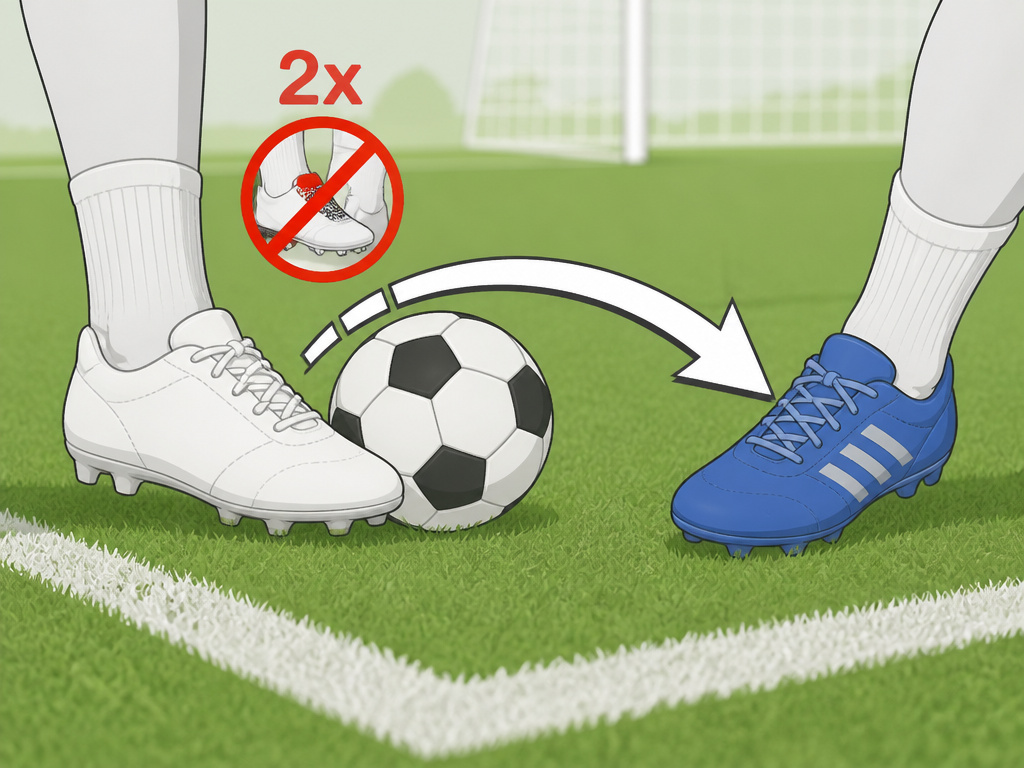
No. If the kicker touches the ball again after it’s in play and before another player touches it, the opponents get an indirect free kick. The restart is a gift, so the Law allows one touch, then somebody else.
Picture a kick close to the box that clangs off the crossbar and spins back to the kicker. He taps it to a teammate who scores. The goal is disallowed, and the defending team gets an indirect free kick, because the kicker played it a second time.
The card scenarios
The second touch itself is only an indirect free kick. The card depends on what it stopped:
- Promising attack stopped: yellow card.
- Obvious goal-scoring opportunity denied: red card. IFAB’s example is a defender who takes a free kick, then kicks the ball out for a corner when an attacker would have reached it.
- Second touch sends the ball into his own goal: disallowed, indirect free kick to the opponents.
- Trick to dodge the back-pass rule (flicking the ball up for a header back to the keeper): yellow card to the initiator, plus an indirect free kick.
Two other cases catch coaches out. A kick that goes into the kicker’s own goal off a keeper’s touch is an own goal. Deliberately kicking the ball at an opponent to play it again is allowed unless it’s careless, reckless or uses excessive force.
I’d rather see a clean one-touch layoff than a clever dummy. Keep your routine in the Law.
Five Steps in Order, and the Quick Kick Gamble
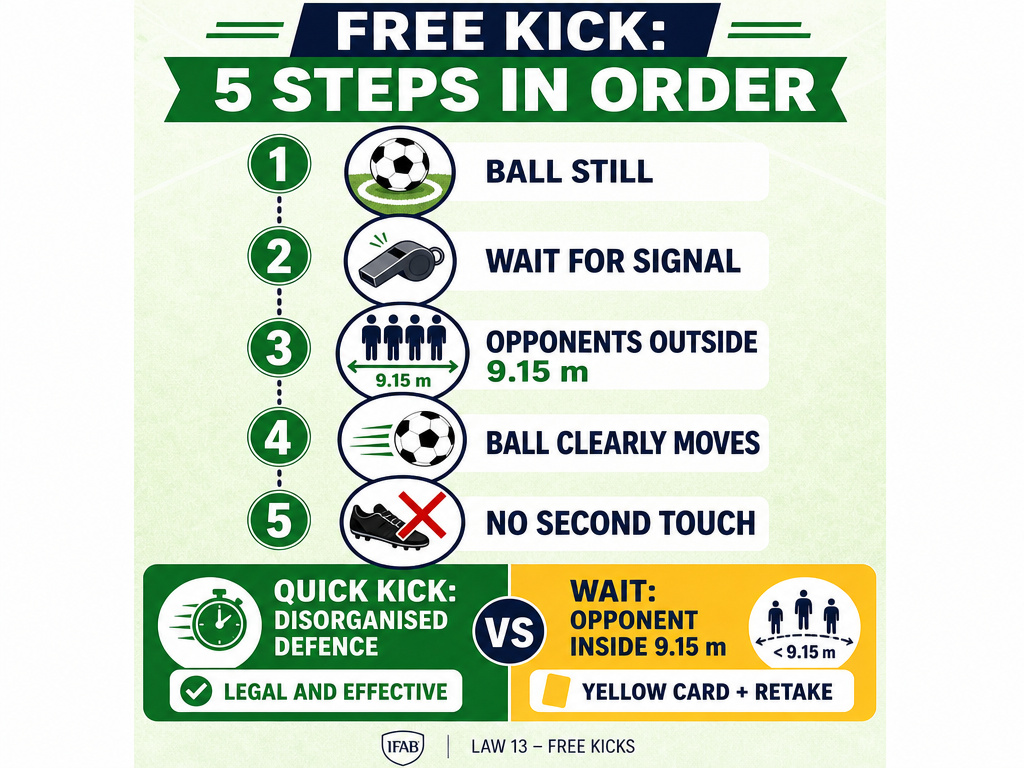
Some readers write asking me to skip straight to clever free kick routines. I tell them the clever stuff doesn’t stick until the basic restart rules do. Every routine is built on one touch, a still ball and a legal distance.
The five steps
- Place the ball at the right spot, and keep it still. Fouls are penalised where they happen. A kick taken while the ball moves is stopped and retaken.
- Wait for the signal if the referee asked. Kicking early after the referee told players to wait means a retake and a yellow card for unsporting behaviour.
- Let opponents retreat 9.15 m. Feinting to kick is allowed. An opponent who interferes inside the distance is cautioned.
- Kick so the ball clearly moves. That’s when it’s in play, and attackers near the wall can then move without penalty.
- Don’t touch it again. A second touch before anyone else means an indirect free kick to the opponents.
For the kicker’s side of the craft, taking a free kick well is a separate skill from knowing these steps.
Where this goes sideways: Moving the ball a few metres closer to goal. If the opponent then kicks it away, he gets a yellow card for delaying, but the kick is taken from the original spot, so the attacker has gained nothing.
| Situation | Decision |
|---|---|
| Ball moving when kicked | Retake |
| Attacker inside 1 m of wall, kick taken | Indirect free kick to defenders |
| Attacker moves in after ball clearly moves | Goal stands |
| Opponent inside 9.15 m intercepts quick kick | Play on |
| Defender kneels behind the wall | No offence |
Quick free kick vs waiting for the wall
Quick wins when the defence is disorganised and the referee hasn’t asked anyone to wait. That’s my stance, and quick restarts are underused because attackers treat the pause as theirs to fill. Waiting wins when an opponent is already inside 9.15 m and has the ball in reach: the interception stands, since the kicker took the risk.
What 1,833 Bundesliga Free Kicks Say About Vanishing Spray
The best evidence on enforcement comes from a peer-reviewed study on free kick violations by Kolbinger and Link (SpringerPlus, 2016). It covered 1,833 Bundesliga free kicks from 2013/14 and 2014/15. Referees used spray on 42.5% (308/725) of kicks after its introduction.
Watch one on TV: a thin foam line appears on the grass, and then it fades. The sample is Bundesliga only and now dated, so treat the findings as a snapshot.
| Measure | No spray | Spray |
|---|---|---|
| Any distance violation | 25.4% | 25.8% |
| Massive violations | 16.7% | 10.7% |
| Mean distance error | 0.70 m | 0.65 m |
The first and third rows were not significant. Only the massive-violation drop was (p = .032). Goals from free kicks went from 8.6% to 9.3%, also not significant.
Here the sources split. The JFA article calls the spray “indispensable” because defenders previously advanced the wall after being told to retreat, and kickers moved the ball. The study found overall violations unchanged. Both can hold: spray may curb the worst cases without fixing everyday creep.
The study also reports that no kick was retaken and no yellow card shown for encroachment in the whole sample. The Law requires a caution when an opponent interferes, so either nobody interfered in a way that counted, or referees weren’t applying the sanction. The authors argue the sanction should change or enforcement should improve.
I wouldn’t tell anyone spray “fixed” the 10-yard rule. The data doesn’t back that, and the long-term evidence is thin.
Free Kick or Penalty Kick? The Foul’s Location Decides
A foul by a defender inside his own penalty area that would be a direct free kick elsewhere becomes a penalty. A foul outside the area is a free kick even if the fouled attacker falls inside the box, because offences are penalised where they occur.
The penalty kick rules have their own procedure. A free kick has no such freedom: the ball must be stationary, the wall stays at distance, and feinting is permitted.
Free Kick Rules in Football at Youth and School Level
Youth and school football can change the numbers. In the Japan FA article, which cites the Laws of the Game 2024-25, 8-a-side football at U-12 uses a 7 m distance. In 11-a-side it is always 9.15 m.
High school rules in the United States come from NFHS. A 2017-18 summary on the UHSAA 2017-18 soccer rule changes page says all free kicks except penalty kicks may be taken in any direction, and a goal can’t be scored directly from a kickoff into the kicking team’s own goal. A 2013 NISOA article says NFHS restarts a stoppage with an indirect free kick if one team clearly had possession, where FIFA uses a drop ball. I couldn’t check the current NFHS rulebook, so confirm with your state association.
What changed in 2026/27
IFAB’s 2026/27 amendments took effect on 1 July 2026, and Concacaf confirmed they apply to its competitions from 20 July 2026. They include an offence before the ball is in play at a corner or free kick that leads to a goal or penalty.
Frequently Asked Questions
What are the rules for free kick in football?
The ball must be stationary, opponents at least 9.15 m (10 yds) away, and the kicker can’t touch it twice. Direct kicks can score, indirect kicks need a second player’s touch, and attackers stay 1 m from a wall of three or more.
What is the NFL free kick rule?
The NFL has a separate free kick in American football, a kickoff-style restart that’s rarely used. The rules here apply to association football only, so check the NFL rulebook for details.
Can you touch the ball twice in a free kick?
No. A second touch before another player is an indirect free kick to the opponents. It becomes a yellow card if it stops a promising attack and a red card if it denies an obvious goal-scoring opportunity.
Do you have to give 10 yards on a free kick?
Yes, 9.15 m (10 yds) in 11-a-side football. The exception is a defender on their own goal line between the posts. The Japan FA lists 7 m for 8-a-side at U-12.
What if the referee forgets the indirect signal?
If the ball goes straight into the opponents’ goal, the same team retakes the kick. If the goalkeeper touched it before it went in, the goal is disallowed and the kick is also retaken.
The Bottom Line
Here’s your threshold: when a team has three or more players in a wall, put a tape measure on the 1 m gap before the next training session. Crystal Palace lost a goal to that gap at Chelsea in August 2025.
The concession is that the 9.15 m rule is hard to enforce. The data shows referees rarely punish it. Don’t build your plan on a retake that rarely comes.
For any 11-a-side game, walk the wall back to 9.15 m, tell attackers to stay 1 m off a three-man wall, and take the quick kick only when no opponent is inside the distance.
Is the 10-yard rule really the least respected law in the game?
