
Derby Della Madonnina History Explained
This post contains affiliate links. As an Amazon Associate, we earn from qualifying purchases.
The Derby della Madonnina is the fierce, historic football rivalry between AC Milan and Inter Milan, two clubs that share the same city and stadium. Its history stretches back to Inter’s founding by a breakaway group from AC Milan in 1908 over a dispute about signing foreign players. Named after the golden Madonnina statue atop Milan Cathedral, the derby has seen everything from a 10-year winless streak for AC Milan to a Champions League tie abandoned due to flares, cementing its status as one of the world’s most iconic football clashes.
Most derbies are about geography. This one is about identity. The derby della madonnina history explained is a story that started with an argument in a restaurant and grew into a battle fought in the same stadium for over a century. It isn’t just about who wins; it’s about why the fans in the Curva Nord and the Curva Sud see the same city in two completely different colours.
What follows is the story of that split, the shared home that amplifies the noise, the players who became legends by crossing the divide, and the matches that decided titles and broke records. By the end, you’ll understand why a fixture between two clubs from the same postcode stops a nation.
Key Takeaways
- The rivalry began on 9 March 1908 when Inter was founded by AC Milan dissidents at the L’Orologio di Milano restaurant, opposing Milan’s restrictions on foreign players.
- Andriy Shevchenko holds the all-time derby scoring record with 14 goals, while Paolo Maldini made the most appearances with 53.
- AC Milan endured a brutal 10-year winless streak from 1928 to 1938, a period featuring 10 Inter wins, 7 draws, and 0 Milan victories.
- For new fans, the essential derbies to know are the 6-5 thriller in 1949, the abandoned 2005 Champions League quarter-final, and the 2023 Champions League semi-final.
The 1908 Split: A Rivalry Born in a Restaurant
The story doesn’t start with a match. It starts with a rule and a walkout. The derby della madonnina history explained begins with a dispute about signing foreign players that led to Inter’s founding in 1908. AC Milan was founded on 13 December 1899. A faction within the club disagreed with AC Milan’s stance on foreign players.
The breakaway faction founded Inter at the L’Orologio di Milano restaurant. On 9 March 1908, Inter was founded at the L’Orologio di Milano restaurant.
That founding principle is still etched into the club’s name. Inter’s identity as the open, international club was forged in direct opposition to AC Milan’s more insular stance at the time. This wasn’t just a new team; it was a philosophical schism. Milan had already won their first trophy, the Medaglia del Re (King’s Medal), back in January 1900. Inter, the upstart, would win their first Italian Football Championship in 1910, just two years after forming.
Now, about that first game. Sources disagree, and that’s part of the folklore. Sources disagree on the first derby: one points to the Chiasso Cup final on 18 October 1908, while another marks the first official league meeting as 10 January 1909. Whether you side with the friendly cup or the competitive fixture says a lot about which side of Milan you’re on. This foundational dispute is a perfect example of how local passions shape the narrative of football derbies.
San Siro: A Shared Home, Divided Soul
Most major biggest rivalries have the decency to host games in different stadiums. Not this one. The first derby at San Siro was played on 19 September 1926. That first derby there set a wild precedent: Inter won 6-3. Sharing a ground is the rivalry’s most unique and intense feature, a key part of the derby della madonnina history explained. It turns every match into a true derby, same pitch, same stands, completely different worlds.
The division is physical. Inter ultras occupy the San Siro’s Curva Nord (North End). AC Milan ultras occupy the Curva Sud (South End). The noise doesn’t mix, it collides.
This setup creates surreal scenarios, especially in Europe. In the 2002-03 and 2004-05 UEFA Champions League knockout ties, the two clubs played each other ‘home and away’ at the same stadium. Milan was designated the home team for one leg, Inter for the other. The fans swapped ends, the signage changed, but the walls stayed the same.
| Aspect | AC Milan | Inter Milan |
|---|---|---|
| Founded | 13 December 1899 | 9 March 1908 |
| Club Colours | Red and Black (Rossoneri) | Blue and Black (Nerazzurri) |
| San Siro End | Curva Sud (South) | Curva Nord (North) |
| European Cups | 7 | 3 |
Legends, Records, and Iconic Moments
The derby’s history is written by its heroes and its outliers. The numbers tell a story of relentless competition.
The standout performers in this fixture are clear. Andriy Shevchenko stands alone with 14 derby goals. Just behind him is the man who belonged to both sides: Giuseppe Meazza, who scored 13 (12 for Inter, one for Milan). For longevity, look to the captains. Paolo Maldini is untouchable with 53 derby appearances for Milan. Inter’s legends Javier Zanetti (45) and Giuseppe Bergomi (40) follow. Then there’s Walter Samuel, the Inter defender who started with a perfect 10 wins from his first 10 derby appearances.
The fastest-ever goal in the Derby della Madonnina was scored by Inter’s Sandro Mazzola after just 13 seconds on 24 February 1963. The youngest scorer is Edoardo Mariani (16 years, 359 days in 1910), while the oldest is Zlatan Ibrahimović (39 years, 115 days in 2021).
Some matches transcend the stat sheet. For drama, the highest-scoring derby was on 6 November 1949, an absurd 6-5 win for Inter. For infamy, the 2004-05 Champions League quarter-final second leg was abandoned on 12 April 2005 after Inter fans threw flares onto the pitch; UEFA awarded Milan a 3–0 victory. For historical impact, look to 22 April 2024. Inter’s 2–1 win that day confirmed their 20th league title, the first Scudetto ever decided in a Derby della Madonnina. It was also Inter’s sixth successive win over Milan, matching the longest winning streak in the fixture’s history.
These milestone matches sit alongside other global famous football rivalries like El Clásico and the Old Firm in defining their nations’ football culture.
The Tactical and Cultural Evolution
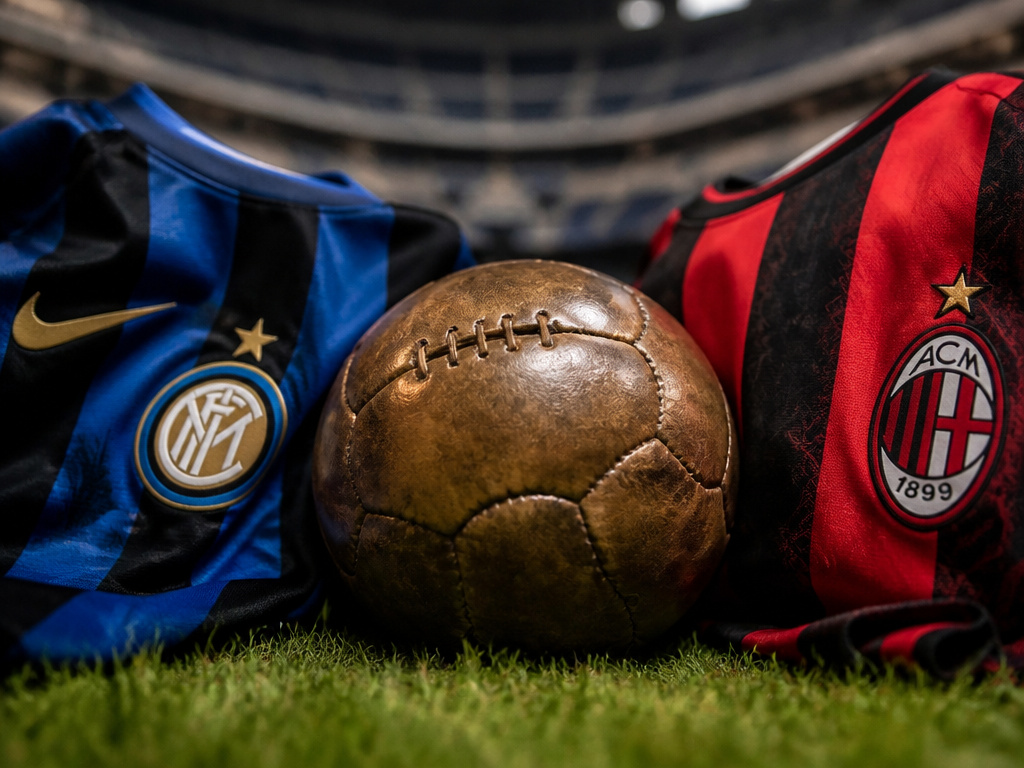
The derby has been a mirror for football’s changing styles. In the 1960s, it was a battle of ideologies. Inter, under Helenio Herrera, who holds the records for most Inter derby appearances (20) and victories (8) by a coach, epitomized pragmatic, defensive catenaccio. Milan, with Gianni Rivera pulling the strings, represented a more fluid, attacking ideal.
The rivalry’s peak often coincides with European success. The clubs have met in UEFA Champions League knockout ties, including in 2002-03, 2004-05, and 2022-23. Inter won the most recent, the 2022–23 semi-final, 2-0 and 1-0. This continental stage elevates the derby from a local dispute to a global spectacle, much like when the Superclásico captivates audiences worldwide.
Where this goes sideways: Assuming the historical class narrative still dictates fan bases. Modern fandom is passed down through generations, not professions. The true divide is in the colours you wear, not the job you do.
The one constant is the stadium. The shared home forces an intimacy that other iconic derbies don’t have. There’s no escaping your cousin. Every triumph is sweeter, every defeat more bitter, because you have to live in the same house.
Pronunciation and Fan Culture: A Quick Guide
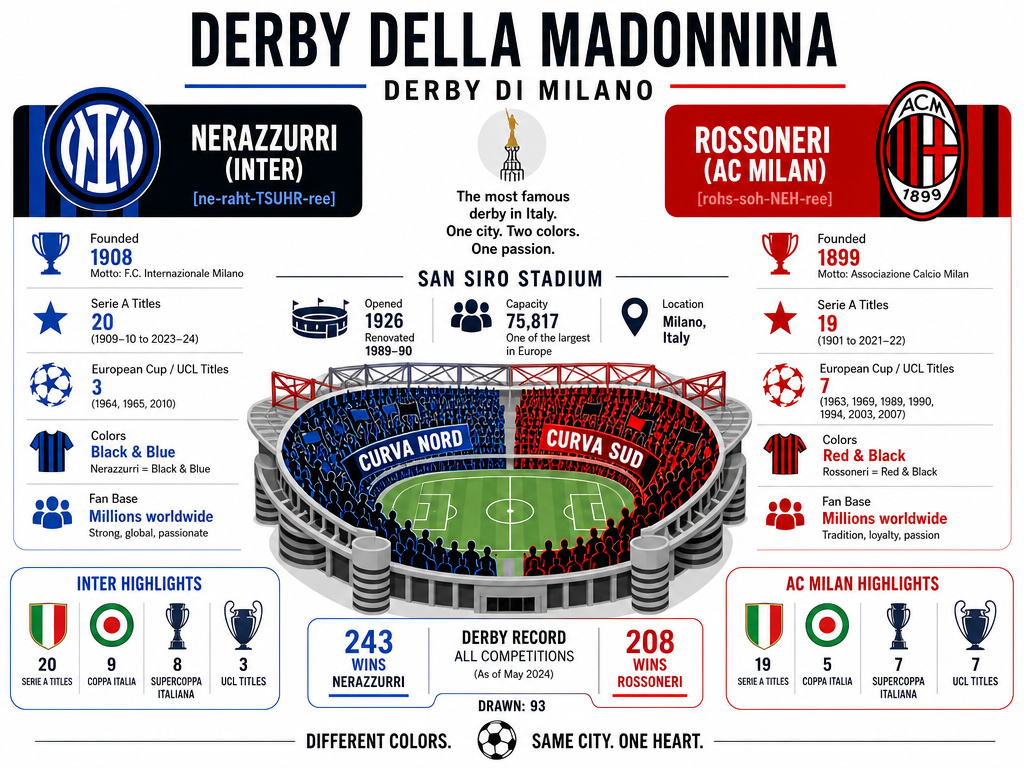
Here are the essential details to know. It’s pronounced “Derby della Madonnina” (der-bee del-la ma-don-nee-na). Italians also call it the “Derby di Milano.”
You’ll hear fans use these nicknames:
- Nerazzurri: (Neh-ratz-zoo-ree) Means “black and blues.” This is Inter.
- Rossoneri: (Ross-oh-neh-ree) Means “red and blacks.” This is AC Milan.
The atmosphere is defined by the ultras in the Curva Nord and Curva Sud. Their choreographed displays, endless chanting, and sheer volume make San Siro shake. The atmosphere is defined by the ultras in the Curva Nord and Curva Sud. The passion is in the display, not in violence.
What was the original class divide between Milan and Inter?
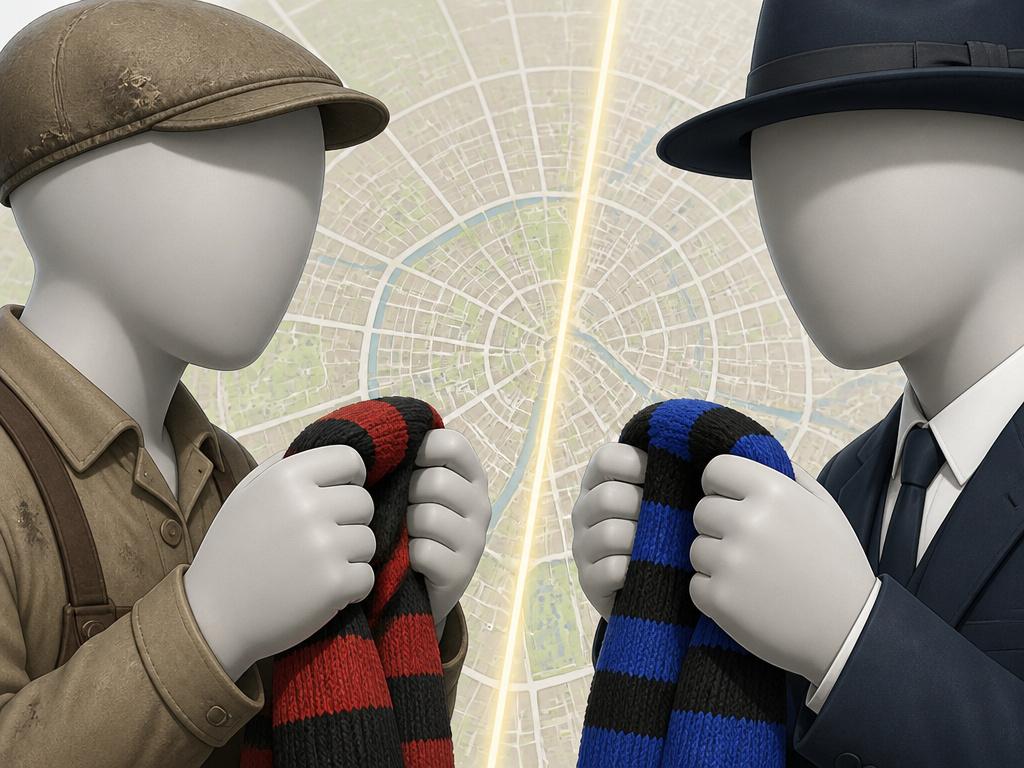
The rivalry’s roots are not just sporting, but social. AC Milan, founded in 1899, was initially seen as the club of the city’s working class and artisans. The split that created Inter in 1908 came from a faction within Milan that wanted to continue signing foreign players, a group often characterized as more bourgeois and internationalist. This early division created a lasting identity, with Inter representing the more affluent and Milan the traditional working base, a cultural fault line that still informs the passion of the fans today, even as modern football has blurred such clear distinctions.
Frequently Asked Questions
What is the meaning of “Derby della Madonnina”?
The derby is named after the Madonnina, the small golden statue of the Virgin Mary on top of Milan Cathedral. “Della Madonnina” translates to “of the Little Madonna.” It’s a local term of endearment for the statue that watches over the city, symbolizing how the rivalry divides Milan itself.
Why does AC Milan have a devil on the logo?
The devil, or “Il Diavolo,” on AC Milan’s logo isn’t about malice. It comes from a club legend. In the early 1900s, a British player noted that the red and black stripes made the team look “devilish.” The nickname stuck, and the club eventually embraced it, incorporating the devil into its crest as a symbol of fighting spirit and fearlessness.
What do Italians call Inter Milan?
Italians almost always refer to the club simply as “Inter.” The full name is Football Club Internazionale Milano, but “Inter Milan” is primarily an English-language construction. Locals and fans are “Interisti” (Inter supporters) and the team is the “Nerazzurri” (the Black and Blues).
Who has the better head-to-head record?
The record is remarkably close, as you’d expect from a 115-year rivalry. Competitive match totals fluctuate with each season, but historically, Inter holds a slight edge in wins. However, AC Milan has historically had the upper hand in European Cup/Champions League titles, with 7 to Inter’s 3. For the most precise, up-to-date tally, the Wikipedia Derby della Madonnina entry is the definitive statistical reference.
Before You Go
The Derby della Madonnina is a rivalry that refuses to be simple. It’s one house with two families, a single stadium with two hearts. Its history is a collection of arguments, about the first match, about identity, about which shade of black and blue or red and black truly represents Milan.
If you want to understand it, don’t just watch the highlights. Watch the Curva Nord and the Curva Sud for ninety minutes. Listen to the noise. That collision of sound is the real story. It’s the sound of a 1908 disagreement that never ended, played out on the same patch of grass, twice a year, forever. For a deeper dive into the factual backbone of this story, the Milan derby Wikipedia article catalogues every twist in remarkable detail.
The next time Inter and Milan meet, you’ll know you’re not just watching a football match. You’re watching a city argue with itself in the most beautiful way possible.
