
How Serie a Works: The Italian League Format Explained
This post contains affiliate links. As an Amazon Associate, we earn from qualifying purchases.
Serie A is Italy’s top-tier professional football league, organized by Lega Serie A and contested by 20 clubs in a double round-robin format. Each team plays 38 matches from August to May. Three points are awarded for a win and one for a draw. The champion wins the Scudetto, the bottom three clubs are relegated to Serie B, and the top finishers qualify for European competitions.
The head-to-head record is the first tie-breaker after points, which makes the Italian league table read differently than others. The league also has a specific, rare play-off rule for ties involving the championship or the final relegation spot, a piece of drama most other top leagues don’t have. This is a key part of how Serie A works.
What follows is a walkthrough of how Serie A works, its unique rules, and the specific stakes at the top and bottom of the table. This section explains the 20-team format, the promotion and relegation system, how Italy’s European places are distributed, and the historical clubs that define the competition.
Key Takeaways
- Serie A uses a head-to-head record as its first tie-breaker, not overall goal difference.
- The bottom three clubs (18th, 19th, 20th) are relegated directly to Serie B each season.
- Sources disagree on the format: the FIGC NOIF suggests a two-legged play-off for Lega Nazionale Professionisti competitions, while other guides state a single match at a neutral venue may be used.
- The league’s asymmetrical calendar, introduced in 2021-22, means the second half of fixtures is not a mirror of the first.
What Is Serie A? The Basic Format
Serie A is a single group of 20 teams, a structure confirmed in the Italian Football Federation’s (FIGC) official rulebook, the Norme Organizative Interne (NOIF).
Each club plays every other team twice, once at home and once away, for a total of 38 matches per season. That creates a full schedule of matches running from late August to late May.
The competition is organized by Lega Serie A, a private association of the clubs, which also runs the Coppa Italia and the Supercoppa Italiana. Its statute confirms the sporting season runs from 1 July to 30 June, and that the championship’s structure is regulated by federal FIGC rules.
The points system is straightforward: three points for a win, one for a draw, zero for a loss. The team with the most points after 38 rounds is crowned champion of Italy.
The Stakes: Promotion, Relegation & The Scudetto
The rewards and punishments are clearly defined in the FIGC’s regulations. At the top, the team finishing first is proclaimed “Campione d’Italia” and earns the right to wear the Scudetto, a small Italian flag shield, on its kit the following season.
At the bottom, the consequences are severe and automatic. According to the FIGC NOIF, the clubs finishing in 18th, 19th, and 20th place are relegated to Serie B. They are replaced by the top three finishers from Serie B, which is a 22-team league. The first, second, and third-placed teams in Serie B are promoted directly to Serie A.
This system of promotion and relegation creates a massive financial chasm between the divisions. The collective broadcasting revenue in Serie A dwarfs that of Serie B, making survival each season a multi-million euro imperative. A club’s stay in the top flight is never guaranteed.
| Position | Outcome |
|---|---|
| 1st | Champion (Wins Scudetto) |
| 2nd – 4th | UEFA Champions League qualification |
| 5th – 7th | Europa League / Conference League qualification |
| 18th | Relegation to Serie B |
| 19th | Relegation to Serie B |
| 20th | Relegation to Serie B |
How The League Table Is Decided: Tie-Breakers & Play-Offs
This is where Serie A gets interesting. Reading the league table requires understanding its unique tie-breaking hierarchy. For most positions, if teams are level on points, the order is decided by:
- Head-to-head points
- Head-to-head goal difference
- Overall goal difference
- Goals scored
This means two teams could finish with identical points and goal difference, but the one that won their two league meetings would finish higher. It’s a system that emphasises direct confrontation.
Where this goes sideways: The rules change for the title and the final relegation spot. If two teams are tied for 1st place or 17th place, the FIGC NOIF states a play-off is used to decide the “sporting title.”
Sources disagree on the exact format. The official NOIF suggests a two-legged play-off for Lega Nazionale Professionisti competitions. However, common practice and other guides state that a single match at a neutral venue is now used. This play-off is exceptionally rare, it’s the league’s version of sudden-death drama.
If more than two teams are tied for a decisive position, a mini-table using the standard tiebreakers is created to determine which two clubs contest the play-off.
How European Qualification Works
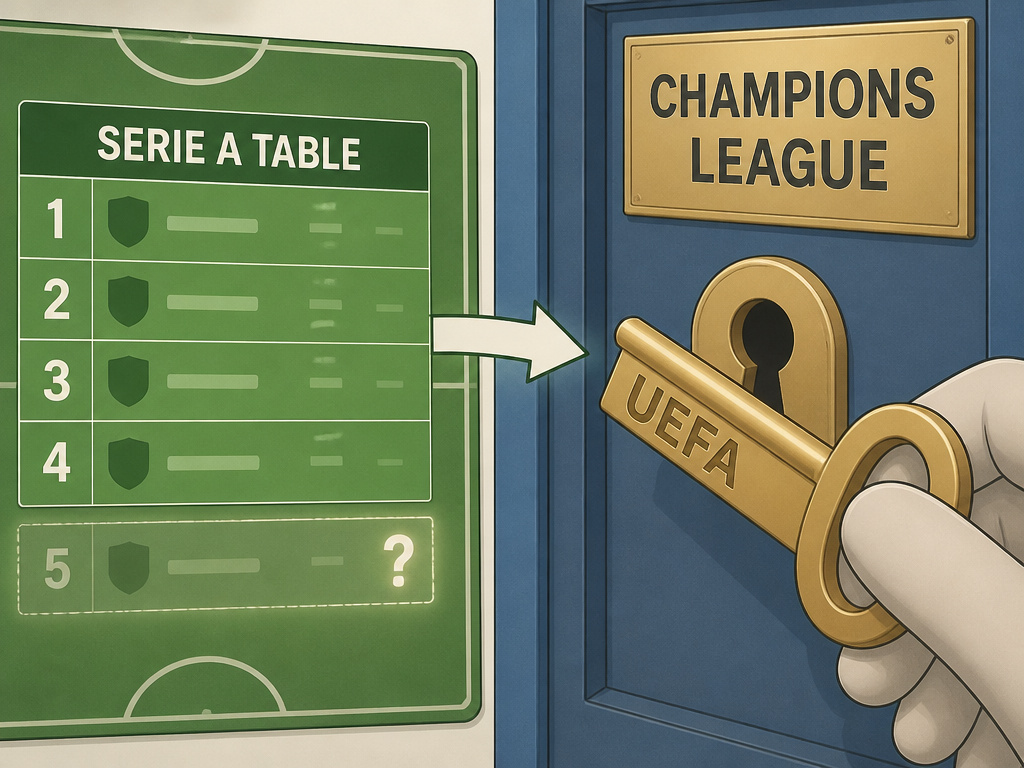
Finishing high in Serie A provides access to continental competition and significant revenue. The distribution of European places is tied to Italy’s coefficient ranking with UEFA.
- UEFA Champions League (4 places): 1st, 2nd, 3rd, and 4th in Serie A.
There’s a key domino effect here. If the Coppa Italia winner has already qualified for the Champions League through their league position (which is common), their Europa League spot passes to the next-best eligible finisher in Serie A.
Italy can also earn a fifth Champions League qualification spot if its clubs perform exceptionally well across all European competitions in the previous season, finishing among the top two UEFA associations. This extra place is not guaranteed and changes annually.
A League of Giants: History & Dominant Clubs
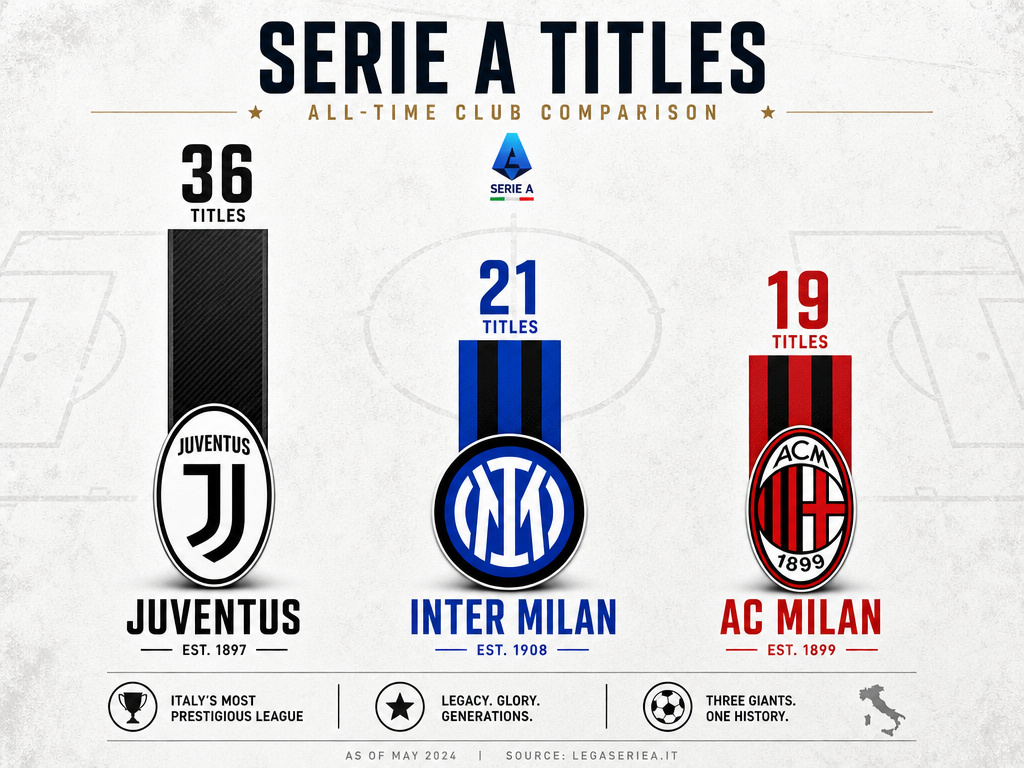
The modern Serie A dates to the 1929-30 season, but the Italian football championship has been contested since 1898. A handful of clubs have dominated its history, and their rivalries define the league’s landscape.
- Juventus: The most successful club, with 36 league titles.
- Inter Milan: Has 21 titles.
- AC Milan: Has 19 titles.
This trio has been the consistent power centre. Other clubs like Napoli, Roma, and Fiorentina have won titles, but the historical table is led by these three giants. The competition’s rich history includes legendary sides like the “Il Grande Torino” team of the 1940s and the AC Milan and Inter teams of various European dynasties.
Serie A vs. Other Major Leagues
Watch a Serie A match after a Premier League game and the difference is tangible. The pace is often slower, more deliberate. It’s a league where tactical shape and defensive organization are celebrated as art forms. A clean sheet here can feel like a victory in itself.
The financial gap with the Premier League is vast, which is a key difference in how Serie A works and influences transfer spending. But this constraint has often made Serie A a hub for clever coaching and smart recruitment. While the English game thrives on intensity, the Italian game frequently rewards patience and tactical nuance. The Europa League and the newer Europa Conference League have become important targets for the league’s strong middle class, offering a path to continental prestige and revenue.
Frequently Asked Questions
How many teams get promoted from Serie B to Serie A?
Three teams are promoted from Serie B each season. Three teams are promoted from Serie B each season: the clubs finishing in 1st, 2nd, and 3rd place are promoted directly to Serie A.
Can Serie A have a play-off for the championship?
Yes. If two teams finish the season level on points for first place, the rules call for a championship play-off. Sources disagree on the format: the FIGC NOIF suggests a two-legged play-off for Lega Nazionale Professionisti competitions, while other guides state a single match at a neutral venue may be used. This has not happened for the title in the modern era.
What is the ‘Scudetto’?
The Scudetto (Italian for “little shield”) is a badge featuring the Italian flag that the reigning Serie A champion wears on its jersey throughout the following season. It is a symbol of the title and is worn above the club’s crest.
How does the Coppa Italia affect European qualification?
Winning the Coppa Italia normally earns a place in the UEFA Europa League group stage. However, if the cup winner finishes in a Serie A position that already brings Champions League or Europa League qualification, that Europa League place is passed down to the highest-ranked Serie A team not already qualified for Europe.
Has Serie A always had 20 teams?
No. For most of its history, Serie A had 16 or 18 clubs.
The Bottom Line
Serie A is a league of clear rules and sharp consequences. Twenty teams play 38 games, three go down, three come up, and the top four reach the Champions League. Its soul is in the details: the head-to-head tie-breaker that can flip the table, the looming threat of a play-off for the rarest of ties, and the tactical patience that defines its matches.
To follow it is to watch a competition where every point is a battle and the table never lies for long. The financial pressures, from Financial Fair Play regulations at the top to the relegation cliff-edge at the bottom, make the 38-game marathon a relentless test. For a deeper look at the structure, the Wikipedia Serie A overview and the specifics of the 2025–26 Serie A season are useful references.
