
History of the European Cup: The Knockout Blueprint
This post contains affiliate links. As an Amazon Associate, we earn from qualifying purchases.
The history of the European Cup begins not with a football association, but with a French newspaper. L’Équipe journalists Gabriel Hanot and Jacques Ferran drafted the competition in 1955, proposing 16 clubs play home-and-away knockout ties. The first match was Sporting Clube de Portugal vs. FK Partizan (3-3) on 4 September 1955, and Real Madrid won the first five titles from 1956 to 1960.
That blueprint was a gamble. It envisioned a truly continental club tournament at a time when European football was a patchwork of isolated, regional cups. The story of how it got off the ground, and who was allowed to play, is messier and more interesting than the clean “champions-only” legend that followed.
What follows is the full story: the newspaper’s audacious pitch, the political absences that shaped the first draw, the physical trophy that clubs fought to keep, and the single event that cast a shadow over the competition’s first decade. By the end, you’ll see the old European Cup not as a primitive version of today’s Champions League, but as a drama-filled knockout that could end a giant’s season in one bad night.
Key Takeaways
- The competition was conceived by L’Équipe journalists, with Jacques Ferran drafting the first regulations after a 1954 article by Gabriel Hanot, and was later formally adopted and organised by UEFA.
- The first tournament in 1955 featured 16 invited clubs, but only seven were actual domestic champions; English clubs were absent despite Chelsea being invited.
- Real Madrid’s five consecutive wins from 1956-1960 established the competition’s prestige, culminating in the famous 1960 final at Hampden Park in front of 127,000 fans.
- The original trophy was donated by L’Équipe and awarded permanently to Real Madrid in 1967; winning clubs now receive a replica.
- The Munich air disaster on 6 February 1958, which killed 23 people including eight Manchester United players, remains the competition’s most tragic moment.
The Knockout Blueprint: How L’Équipe and UEFA Built the Cup
The idea first appeared in print on 15 December 1954. Gabriel Hanot, a former French international turned L’Équipe journalist, published an article questioning how anyone could declare an English club “world champions” after a few friendlies. His solution was a proper European tournament.
The L’Équipe blueprint envisaged 16 clubs (not exclusively champions) playing home-and-away knockout ties. Qualification would be decided by the highest aggregate goals.
His colleague, Jacques Ferran, was tasked with turning the idea into a set of rules. They weren’t administrators with time for committees. They were journalists who saw a gap in the football calendar and moved to fill it. By April 1955, they had invited 16 clubs to Paris, all expenses paid, to approve the draft. The clubs said yes.
But they needed a governing body to lend legitimacy. UEFA had been founded only a year earlier, in June 1954. Hanot and Ferran took their project to UEFA’s first Congress in Vienna in March 1955. The response was cautious but crucial: the national associations would need to give their clubs permission to play. FIFA gave its blessing in May, and on 21 June 1955, the UEFA Executive Committee formally agreed to organise the competition under its auspices. They called it the European Champion Clubs’ Cup.
The speed of it all is startling. From Hanot’s article to an approved, UEFA-sanctioned competition took just over six months. It was a hustle, not a bureaucratic process. You can almost hear the newspapermen thinking: if we wait for the associations, we’ll wait forever.
The First Tournament: A Draw of Invitations, Not Just Champions
Here’s the bit people miss. That first tournament in 1955 wasn’t a pure champions’ league. The official history of the Union of European Football Associations (UEFA) shows the body was still finding its feet. L’Équipe had to invite clubs before domestic seasons ended, so they picked sides based on prestige and reputation.
The list of the first 16 entrants makes this clear. According to UEFA’s own records, only seven were reigning national champions:
- RSC Anderlecht (Belgium)
- AGF Århus (Denmark)
- Djurgårdens IF FF (Sweden)
- AC Milan (Italy)
- Real Madrid CF (Spain)
- Stade de Reims Champagne (France)
- SC Rot-Weiss Essen (West Germany)
The other nine were simply leading clubs invited by the newspaper. This created immediate oddities and absences. Chelsea was invited, but the English Football League forbade participation, keeping English clubs out entirely. Geopolitics played a role, too; the Soviet Union did not enter a team until 1967.
The first match kicked off on 4 September 1955 at the Estádio Nacional in Lisbon. Sporting Clube de Portugal and Yugoslavia’s FK Partizan played out a 3-3 draw. The tournament was alive.
| First Round Tie (1955/56) | Status of Club | Outcome |
|---|---|---|
| Sporting CP vs. FK Partizan | Portuguese runners-up | 3-3 draw |
| Anderlecht vs. Vörös Lobogo | Belgian champions | 6-3 agg. Win |
| Real Madrid vs. Servette | Spanish champions | 7-0 agg. Win |
| Milan vs. 1. FC Saarbrücken | Italian champions | 7-5 agg. Win |
The format was brutally simple: knockout ties, with early rounds played home-and-away, culminating in a one-match final. There was no group stage to hide in, no second-place safety net. A single off-night away from home could end your campaign. It was this razor-thin margin for error that created the competition’s legendary tension, a stark contrast to the modern Champions League format.
The Inspiration Debate: South America or the Mitropa Cup?
If you read enough summaries, you’ll find two different origin stories. One credits a South American tournament; the other points to older European cups. The sources genuinely disagree, and stating one as absolute fact is wrong.
One common claim is that the European Cup was “inspired by the South American Championship of Champions.” This is supported by interviews Jacques Ferran gave decades later, where he said they needed to follow South America’s example. Some general football history sites, like the FootballHistory.org European Cup page, repeat this line.
But the primary documents from the 1950s tell a different story. The official UEFA histories and Ferran’s own 2004 written account focus squarely on the European context. They mention the Mitropa Cup (a Central European club competition started in 1927) and the Latin Cup (for Spanish, French, Italian, and Portuguese champions) as the direct forerunners. The Wikipedia history of the European Cup captures both sides of this debate.
So which is it? The likely answer is both. The Mitropa Cup provided a proven model for a cross-border club tournament. The South American version, started in 1948, showed it could work on a continental scale. The journalists at L’Équipe were synthesizing existing ideas, not inventing one from scratch. Presenting the inspiration as a settled fact misses the nuance of how ideas travel and merge.
The Madrid Dynasty and the Shadow of Munich
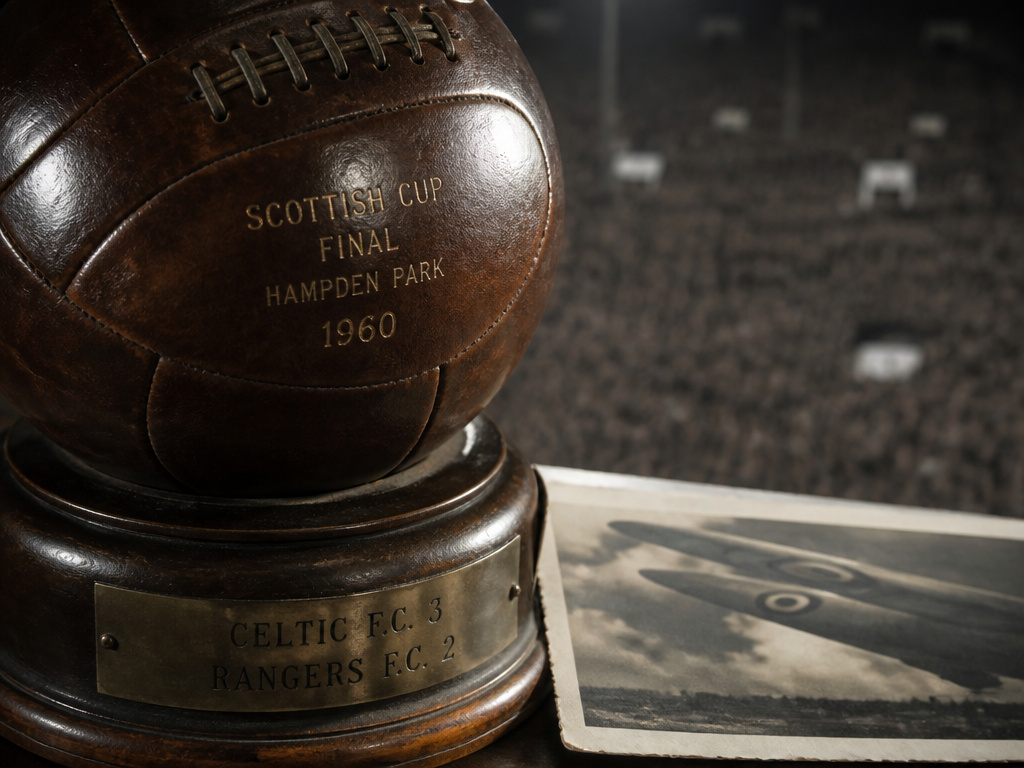
Real Madrid didn’t just win the first final; they defined the competition’s first era. In June 1956, at the Parc des Princes in Paris, they beat Stade de Reims 4-3. They then won the next four finals, a streak of five consecutive titles that has never been matched.
The 1960 final was the pinnacle. Real Madrid faced Eintracht Frankfurt at Hampden Park in Glasgow. Over 127,000 spectators watched Ferenc Puskás and Alfredo Di Stéfano tear the German side apart in a 7-3 victory. The match wasn’t just a win; it was a statement of artistic dominance broadcast across Europe. It cemented the European Cup as the ultimate stage for club football.
Real Madrid won the first five European Cup titles (1956-1960). The 1960 final was played in front of 127,000 spectators at Hampden Park in Glasgow.
But this golden age was also marked by its deepest tragedy. On 6 February 1958, the aircraft carrying the Manchester United team home from a European Cup quarter-final in Belgrade crashed on take-off from Munich. Twenty-three people died, including eight United players, the celebrated “Busby Babes.” The disaster is a permanent part of the competition’s fabric, a reminder that the pursuit of this new trophy carried real and terrible risk. It halted the progress of a young team many believed could have challenged Madrid’s supremacy.
The Trophy’s Tale: From L’Équipe’s Gift to UEFA’s Vault
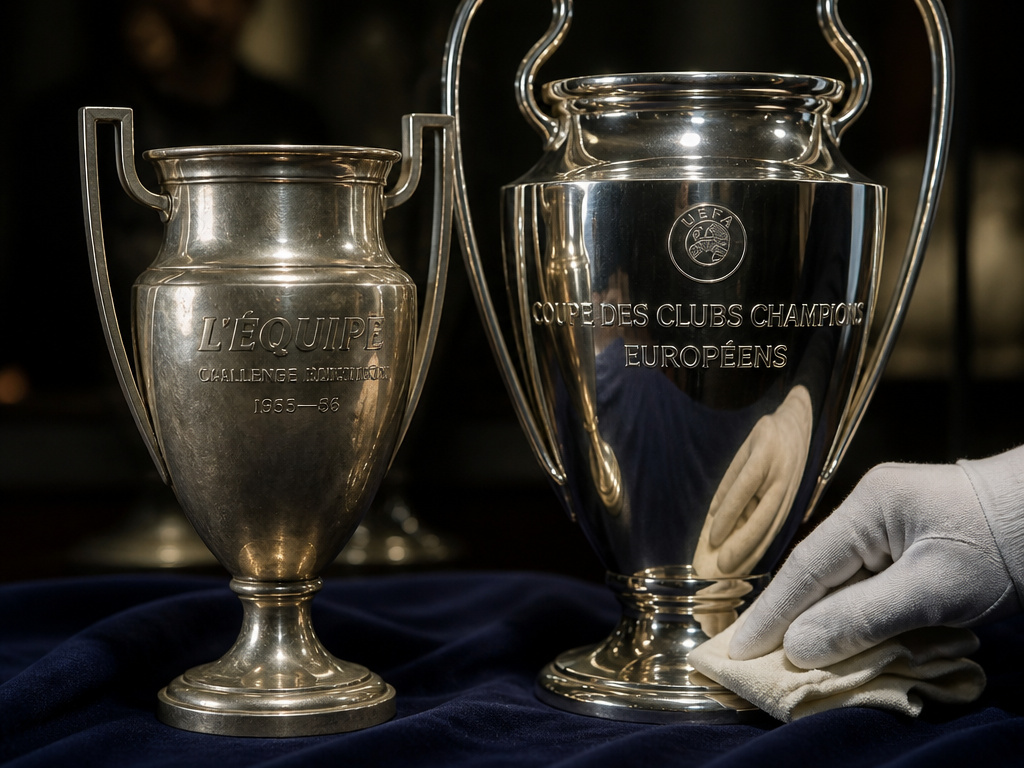
The physical cup has its own history, separate from the matches. The original European Champion Clubs’ Cup was donated by L’Équipe itself. It was a piece of silverware with a distinct design, different from the iconic “big ears” trophy we know today.
The rules stated a club could keep the trophy permanently after winning it five times or three times in a row. In March 1967, having won their sixth title, Real Madrid was awarded the original cup for good. That meant a new trophy had to be made for the next season. Celtic, who beat Internazionale in the 1967 final, became the first club to win the cup in its current design.
The trophy currently awarded is the sixth version, in use since 2006. The rules have tightened. Since 2009, the real trophy remains in UEFA’s custody at all times. The winning club gets a full-size replica with their name engraved. They are allowed to make their own copies, but those must be clearly marked as replicas and can be a maximum of eighty percent the size of the actual trophy. The age of clubs permanently claiming the cup is over.
This evolution from a newspaper’s gift to a tightly controlled corporate asset mirrors the competition’s own journey. It started as an ambitious experiment and became an institution too valuable to let out of sight.
A Continent Transformed: The Ripple Effects
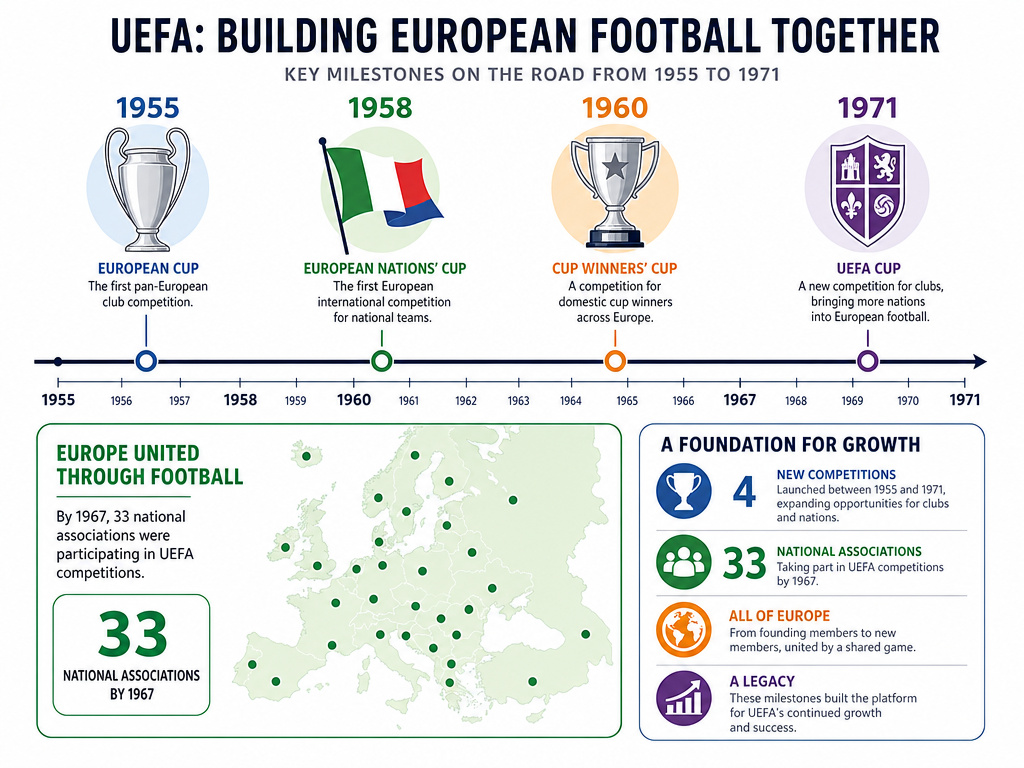
The European Cup didn’t exist in a vacuum. Its creation triggered a wave of new competitions that reshaped the European football calendar. In 1958, UEFA introduced the European Nations’ Cup (now the European Championship), with 17 teams entering its first draw. The first match of that tournament was played on 28 September 1958 in Moscow, in front of 100,572 fans.
The club competition’s success also validated the knockout format for other tournaments, like the European Cup Winners’ Cup (1960) and eventually the UEFA Cup (1971). It created a clear European hierarchy for clubs, where success bred more financial power and attraction for star players. The final itself became a major annual event, a standalone spectacle that drew global attention.
The competition also had a unifying effect across a continent still divided by the Iron Curtain. By the 1966-67 season, 33 different national associations were represented in the European Champion Clubs’ Cup. It was one of the few arenas where teams from Eastern and Western Europe competed regularly, a small but significant thread of cultural connection during the Cold War.
From European Cup to Champions League
The tournament’s structure remained largely unchanged for 37 years. But by the late 1980s, pressure for reform was building. Television revenue was exploding, and bigger clubs wanted more guaranteed games. The pure knockout format was high on drama but risky for business.
In 1992, UEFA restructured the competition, introducing a group stage before the knockout rounds. With this new format came a new name: the UEFA Champions League. The rebrand was slick, modern, and commercially potent. It marked the definitive shift from a sporting contest to a global media product. The essence, crowning the best club in Europe, remained, but the path to get there became longer, more lucrative, and less perilous. The old Cup’s spirit lives on in the knockout phases of its successor, but the days of a straight 16-team knockout are gone, preserved now in competitions like the UEFA Super Cup, which pits the Champions League winner against the Europa League winner.
Who has won the European Cup?
Real Madrid won the first five European Cup titles consecutively from 1956 to 1960. Their first victory came in the inaugural final, held at the Parc des Princes in Paris, where they defeated Stade de Reims 4-3. The 1960 final, where Real Madrid beat Eintracht Frankfurt, was played in front of 127,000 spectators at Hampden Park in Glasgow. The original European Cup trophy was donated by the newspaper L’Équipe. This first trophy was awarded permanently to Real Madrid in March 1967 after their sixth win. Celtic then became the first club to win the cup in its new, current design later that same year.
Which clubs and nations have been most successful?
From its early years, the competition’s roll of honour was dominated by a handful of clubs. Real Madrid’s initial five-title streak set a high bar for success. The clubs that participated in the first tournament provide a snapshot of the nations involved from the start. Among the first 16 entrants, only seven were the actual national champions of their countries. These champions were RSC Anderlecht from Belgium, AGF Århus from Denmark, Djurgårdens IF FF from Sweden, AC Milan from Italy, Real Madrid CF from Spain, Stade de Reims Champagne from France, and SC Rot-Weiss Essen from West Germany.
Frequently Asked Questions
Who actually invented the European Cup?
The competition was the brainchild of journalists at the French sports newspaper L’Équipe. Editor Gabriel Hanot first proposed the idea in print in December 1954, and his colleague Jacques Ferran drafted the first regulations. UEFA officially adopted and organised the competition starting in June 1955.
Why were only 7 champions in the first European Cup?
The first tournament in 1955 was based on invitations from L’Équipe, not automatic qualification. Clubs had to be invited before their domestic seasons ended, so the newspaper selected 16 of Europe’s most prestigious clubs. Only seven happened to be reigning champions at that moment.
What is the difference between the European Cup and the Champions League?
The European Cup (1955-1992) evolved into a straight knockout tournament primarily for domestic champions, though sources disagree on whether the inaugural tournament was exclusively for champions. The UEFA Champions League (1992-present) is its successor, featuring a initial group stage followed by knockout rounds and allowing multiple entrants from top leagues. They are the same continuous competition with a reformed format and name.
Did any club ever get to keep the European Cup trophy?
Yes, under the original rules. A club that won five times or three times consecutively could keep the trophy. Real Madrid was awarded the original cup permanently in 1967 after their sixth win. The current trophy always remains with UEFA; winners now receive a full-size replica.
Before You Go
The history of the European Cup is a story of a newspaper’s gamble that paid off beyond anyone’s dreams. It’s a history written in specific places: a Parisian newspaper office, a Lisbon stadium on a September night, a rain-swept Hampden Park, and a Munich airfield. The competition created templates, the two-legged tie, the one-night final, that feel eternal but were once just ideas on a reporter’s notepad.
If you want to hear the echo of that original tournament, listen to the Champions League anthem before a big match. That music now heralds a global commercial giant, but its prestige was forged in the simpler, riskier knockout battles of the old European Cup. The trophy got bigger, the format changed, but the central question remains the same: who is the best club on the continent? That question, first asked by a French journalist in 1954, still defines European football every season.
