
How the UEFA Conference League Works: From Draw to Final
This post contains affiliate links. As an Amazon Associate, we earn from qualifying purchases.
The UEFA Conference League is Europe’s third-tier club competition, operating under a Swiss Model league phase where 36 teams each play 6 matches (3 home, 3 away). Teams ranked 1-8 advance directly to the round of 16, teams 9-24 enter knockout phase play-offs, and teams 25-36 are eliminated. For the 2026/27 season, all 36 teams must qualify through preliminary rounds; no club enters the league phase directly.
That six-game schedule is the result of a single-league format designed to increase the variety of opponents while keeping the calendar manageable. It replaces the old group stage and is the core of the competition’s modern identity, which is a key part of how the UEFA Conference League works.
What follows is a walkthrough of the competition’s engine: the unique draw that builds the league phase fixture list, the winding qualification routes that feed it, and the high-stakes cutoffs that decide who survives into the knockouts, which is central to understanding how the UEFA Conference League works.
Key Takeaways
- The league phase involves 36 teams in a single ranking, with each club playing just six matches against opponents drawn from different coefficient pots.
- No team qualifies directly for the league phase; for the 2026/27 season, all 36 spots are earned through qualifying rounds, which include paths for teams dropping in from the Champions League or Europa League.
- The final league ranking creates three clear paths: the top eight advance straight to the round of 16, teams placed 9th to 24th enter a two-legged play-off, and the bottom twelve are eliminated.
- The competition ensures at least 34 UEFA national associations are represented in the league phase of UEFA’s three club competitions each season.
- The winner qualifies for the following season’s UEFA Europa League phase, unless they have already secured a Champions League spot.
The League Phase Explained
The old group stage is gone. In its place is a 36-team single league, often called the Swiss Model. Here’s the bit people miss: it’s not a true round-robin where everyone plays everyone. That would mean a much larger number of matches. Instead, the season starts with a complex draw that builds a unique, balanced schedule for every club.
The 36 clubs are divided into six pots of six clubs based on their UEFA coefficient rankings, a fundamental detail in how the UEFA Conference League works. The pots are based on UEFA coefficient rankings, with Pot 1 containing the highest-ranked teams. For the draw, these pots are paired: 1 with 2, 3 with 4, and 5 with 6. Your team is drawn to play one opponent from each of the six pots. Crucially, from each pairing, you’ll play one opponent at home and the other away. This guarantees three home and three away games.
Each club plays six opponents in single-leg ties. Each club plays three home and three away matches. — UEFA Conference League Regulations, Article 17.01
The draw has guardrails. In principle, teams from the same national association can’t be drawn against each other. A club may also face a maximum of two opponents from any other single association. This spreads the games across Europe. The total number of league phase matches is 108.
| Final League Phase Ranking | Destination |
|---|---|
| 1–8 | Advance directly to the Round of 16 |
| 9–24 | Enter the Knockout Phase Play-offs |
| 25–36 | Eliminated from the competition |
Matches kick off at 16:30 CET, 18:45 CET, or 21:00 CET on Thursdays. The fixtures on the final matchday are played simultaneously at 21:00 CET to preserve competitive integrity.
How Teams Qualify: The Road to the League Phase
For the 2026/27 season, the rule is absolute: all 36 teams enter the league phase via qualifying. There are no direct entries.
The qualifying phase and play-offs follow a knockout system, with each tie played over two legs (home and away). Seeding for these draws is determined by club coefficient rankings. Clubs from the same association cannot be drawn against each other in qualifying.
Teams don’t just come from their domestic leagues; they also “drop in” from higher competitions.
- Clubs eliminated in the first qualifying round of the UEFA Champions League enter the Conference League qualifiers.
- Clubs eliminated from the second qualifying round of the UEFA Europa League onwards also enter.
- Crucially, the losers of the Champions League and Europa League play-offs enter directly into the league phase of the Europa League and Conference League, respectively. This provides a late entry into the league phase for these clubs.
Imagine a team from a mid-ranked league. Their most realistic route is through the Conference League’s own qualifying rounds, navigating two-legged ties against similar-level opposition from across Europe. Their journey is just as valid as that of a club falling from the UEFA Europa League.
The Intricate Draw Procedure
The league phase draw is designed to build a fair fixture list under multiple constraints and may be conducted digitally. It may be conducted digitally.
The constraints are what make it fascinating. Beyond preventing clashes between teams from the same association, the draw operates under constraints that the UEFA administration may adapt to avoid deadlock. The UEFA administration may adapt any conditions of the draw to avoid deadlock situations and may even derogate from rules limiting consecutive home or away matches if needed.
Here’s a simplified look at the pot-pairing logic that decides your home and away games:
| Pot Pairing | Your Team Plays… | Example Match-Up |
|---|---|---|
| Pots 1 & 2 | One team from this pairing at HOME, one AWAY | Home vs. Pot 1 team, Away vs. Pot 2 team |
| Pots 3 & 4 | One team from this pairing at HOME, one AWAY | Away vs. Pot 3 team, Home vs. Pot 4 team |
| Pots 5 & 6 | One team from this pairing at HOME, one AWAY | Home vs. Pot 5 team, Away vs. Pot 6 team |
This system ensures you face a balanced mix of strong and weaker opponents, both at home and on the road. It’s a far cry from the old group stage format, where you could be stuck in a predictable four-team mini-league.
From League to Knockouts: The Cut-Offs and Brackets
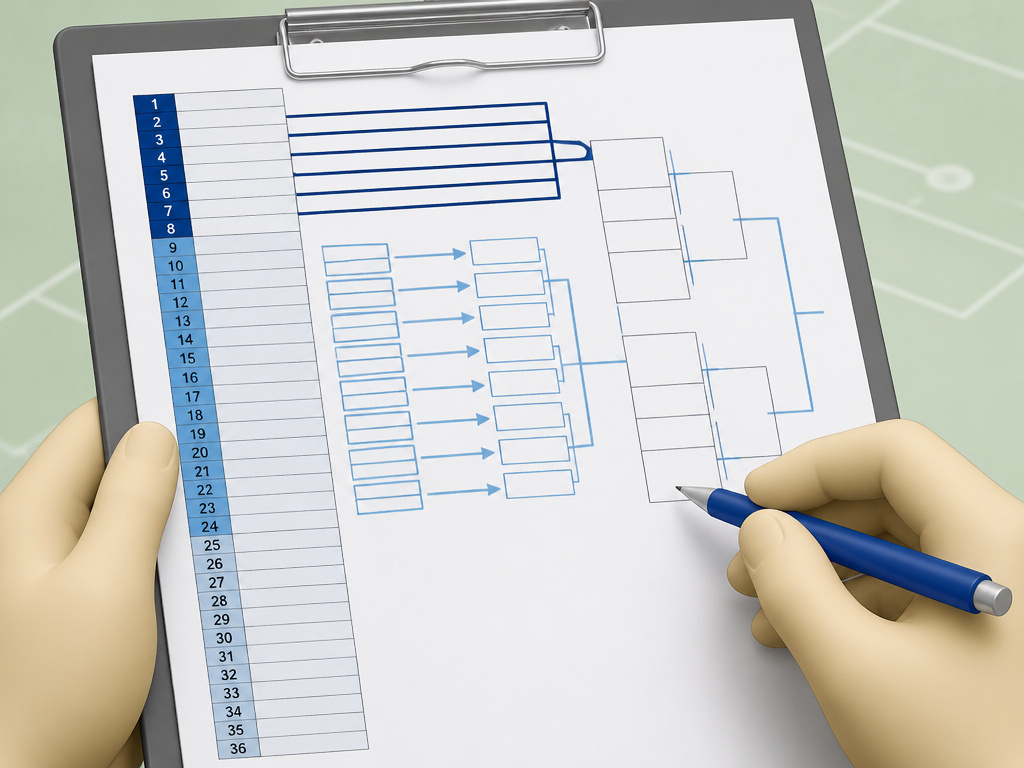
The league phase ends with a single table ranking all 36 teams. This ranking isn’t just for pride; it mechanically slots teams into the knockout bracket.
Teams ranked 1 to 8 skip a round entirely, advancing directly to the round of 16. Teams ranked 9 to 24 enter the knockout phase play-offs. This is a two-legged tie where the 9th-ranked team plays the 24th, 10th plays 23rd, and so on. The eight winners advance to the round of 16 to face the top-eight seeds.
The knockout phase from here is standard: round of 16, quarter-finals, semi-finals, and a one-legged final. Seeding advantages carry through. Teams ranked 1 to 4 after the league phase play the return leg at home in the quarter-finals. Teams ranked 1 and 2 also play the return leg at home in the semi-finals. If a seeded team is eliminated, the team that beats them takes over their seeding position in the bracket.
The final is a one-off match at a pre-determined neutral venue. The team on the silver side of the knockout bracket is considered the nominal home team for administrative purposes, like choosing the dressing room.
Prize, Reward, and Relationship to Other Competitions
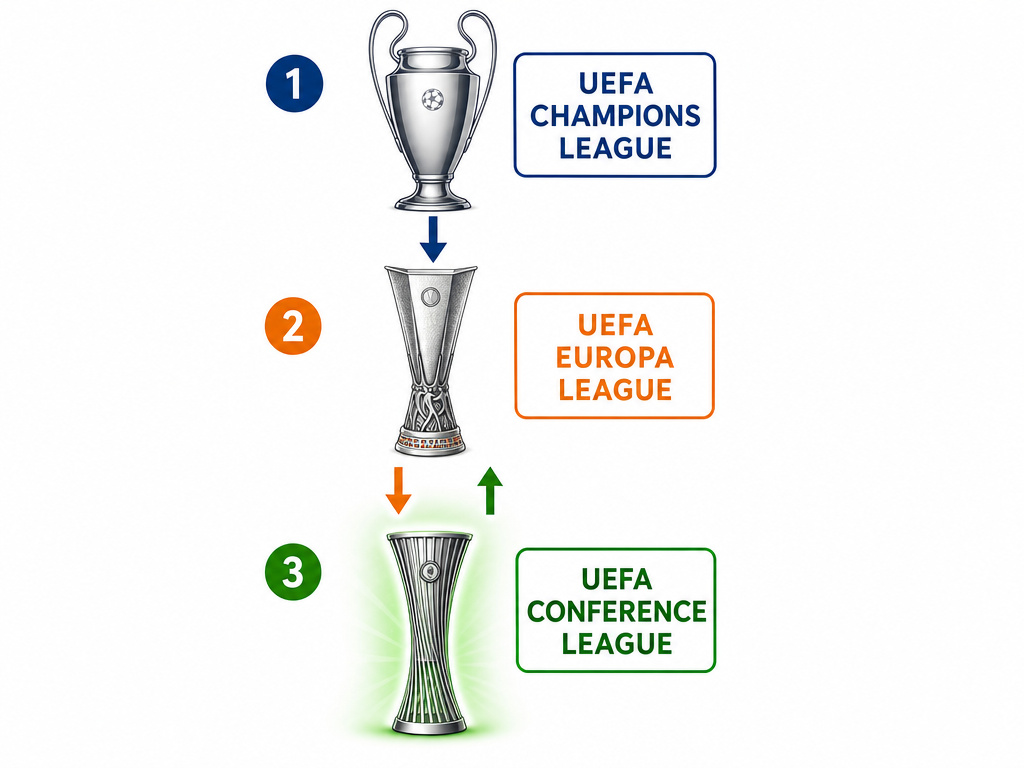
The tangible reward is a place in the following season’s UEFA Europa League phase, unless the winner has already qualified for the UEFA Champions League via their domestic league.
The competition was rebranded from the UEFA Europa Conference League to simply the UEFA Conference League starting from the 2024–25 season. Over 170 teams are involved over the course of a season.
It sits definitively as the third tier, below the Champions League and Europa League. However, the connections are fluid. As we’ve seen, teams drop down from those competitions, and the winner moves up.
Frequently Asked Questions
How is the UEFA Conference League structured?
The competition has two main phases. First, a 36-team league phase where each club plays six matches (three home, three away). Second, a knockout phase involving 24 teams: the top eight from the league phase go straight to the round of 16, while teams ranked 9th to 24th contest a preliminary play-off round.
How are teams selected for the UEFA Conference League?
Teams qualify primarily via their domestic league or cup performance, with slots allocated to each UEFA member association based on UEFA coefficients. Teams eliminated from the qualifying rounds of the Champions League and Europa League also enter the Conference League qualifying path. For the 2026/27 season, all 36 league phase spots are filled through these qualifying rounds.
Why is the Conference League only 6 games?
The six-game league phase is a result of the “Swiss Model” format adopted in 2024/25. With 36 teams in one league, a full round-robin would require 630 matches, which is not feasible. The pot-based draw system creates a balanced, condensed schedule where each team plays a varied set of opponents from different strength tiers, making those six games highly consequential.
What happens if teams are level on points in the league phase?
If two or more teams are tied on points at the end of the league phase, UEFA uses a series of tie-breakers to separate them, as defined in the competition regulations.
The Bottom Line
The true stakes are in the final league table: finish in the top 24 or your European journey is over.
