
History of the FIFA World Cup: From 1930 to the Modern Era
This post contains affiliate links. As an Amazon Associate, we earn from qualifying purchases.
The FIFA World Cup began in 1930 in Uruguay with 13 teams, conceived by FIFA president Jules Rimet to create a standalone global football championship separate from the Olympics. The tournament has been held every four years since, expanding from 16 to 24 teams in 1982, to 32 in 1998, and will feature 48 nations for the first time in 2026, with the format constantly evolving to accommodate growth and maintain competitive balance.
Right, the thing about the game’s biggest stage is that the history of the FIFA World Cup isn’t just a list of winners and hosts. It’s a story of geopolitical tensions, logistical gambles, and constant tinkering with the competition’s very shape. The details are where football lives, and the World Cup’s evolution from a 13-team experiment to a 48-nation mega-event is packed with them.
What follows is a walk through that story. We’ll start with the improbable birth in Uruguay, navigate the cancellations and comebacks shaped by world events, and track how the format has been stretched, squeezed, and redesigned across a century. We’ll also look at the icons that grew around it, the stolen trophy, the anthems, the mascots, that turned a tournament into a true global spectacle.
Key Takeaways
- The first World Cup in 1930 was a gamble with only 13 teams and a unique group-stage format, setting a precedent for constant evolution.
- Major global events directly shaped the tournament, with World War II causing the cancellation of the 1942 and 1946 editions and the 1950 event being postponed.
- The competition’s structure is never static; key changes include the introduction of a round of 16 in 1986 and the upcoming leap to a 48-team, 104-match format in 2026.
- Beyond the football, cultural elements like the Jules Rimet Trophy (stolen in 1983) and official mascots starting in 1966 with World Cup Willie have become integral to the event’s identity.
- Brazil stands alone as the most successful nation, having won five titles and participated in all 23 tournaments to date.
The 1930 Inaugural Tournament: A Leap of Faith
The idea was simple but ambitious. Frustrated by the amateur restrictions of Olympic football, FIFA president Jules Rimet pushed for a standalone world championship. The vote passed in 1929, and Uruguay, recent double Olympic champions and celebrating its centenary of independence, was chosen as host. The plan was bold, the execution chaotic.
Getting teams there was the first crisis. A European economic slump and club objections led to mass withdrawals. In the end, only four European sides. France, Belgium, Romania, and Yugoslavia, made the two-week Atlantic voyage on the Conte Verde liner. They joined nine teams from the Americas. The 13 nations in the 1930 World Cup were: Argentina, Belgium, Bolivia, Brazil, Chile, France, Mexico, Paraguay, Peru, Romania, USA, Uruguay, and Yugoslavia.
According to some historical accounts, the inaugural tournament used a format of three groups of three teams and one group of four, with the four group winners advancing directly to the semi-finals.
The first two matches kicked off simultaneously on July 13, 1930. France beat Mexico 4-1, and the United States defeated Belgium 3-0. In that French victory, Lucien Laurent scored the first goal in World Cup history. Four days later, American Bert Patenaude netted the tournament’s first hat-trick. The host nation, Uruguay, powered through to the final at the Estadio Centenario in Montevideo, defeating Argentina 4-2 in front of a reported 93,000 fans. The world had its first champion, and a new era began.
Format Evolution: Tinkering With the Blueprint
If the World Cup has a constant, it’s change. The tournament’s structure has been reshaped repeatedly to manage expansion, improve competition, and maximize drama. The journey from 13 to 48 teams is a history of the FIFA World Cup marked by trial and error.
Some sources consider the 1934 edition in Italy to be the first with a pure knockout bracket, while others note that the 1930 tournament also featured knockout semi-finals and a final. But the template that felt familiar for decades arrived in 1954. That Swiss tournament introduced a format of 16 teams split into four groups of four, with the top two qualifying for quarter-finals. It was clean, predictable, and lasted.
Expansion forced innovation. When the tournament grew from 16 to 24 teams in 1982, organizers faced a puzzle. The solution was a second group stage (four groups of three) after the initial round. It was convoluted. By 1986, the format introduced a round of 16, with the four best third-placed teams joining the top two from six groups. This cleaner knockout progression became the model for the next expansion, when the field grew from 24 to 32 teams in 1998.
Now, we’re on the cusp of the biggest shift. The 2026 World Cup will be the first to feature 48 competing nations. The plan is for a 48-team format, which will result in a total of 104 matches. The winning team will need to win eight games. You can read more about how this new era works in our explainer on the 48-team World Cup format.
| Era | Teams | Key Format Feature | Why It Changed |
|---|---|---|---|
| 1930–1950 | 13–16 | Varied group + knockout | Finding a stable template |
| 1954–1978 | 16 | 4 groups of 4 → quarter-finals | Standardization for consistency |
| 1982–1994 | 24 | Second group stage | Managing increased team count |
| 1998–2022 | 32 | Round of 16 (from 6-8 groups) | Streamlining for TV and fairness |
| 2026– | 48 | 12 groups of 4 → round of 32 | Accommodating global growth |
War, Boycotts, and the Weight of History
The World Cup doesn’t exist in a vacuum. Its timeline is scarred by global conflict and geopolitical spats. The first major disruption came swiftly. The 1942 and 1946 World Cups were cancelled due to World War II. FIFA’s plans, including a potential host in Germany or Brazil, were utterly derailed.
The aftermath was messy. The 1950 tournament was originally scheduled for 1949 but postponed to 1950 to give Brazil time to prepare, famously building the Maracanã Stadium. The war also reshaped allegiances. England and the other British nations, having withdrawn from FIFA in 1920, rejoined in 1946 and entered the 1950 qualifiers.
Boycotts have been another recurring theme. Angered by the poor European turnout for its 1930 hosting triumph, Uruguay (the 1930 champion) refused to defend its title in 1934. This tit-for-tat spirit has echoed through the decades, reminding us that the tournament is as much about nations as it is about football. Understanding these external pressures is key to understanding the full history of the FIFA World Cup and FIFA as an organization.
Trophies, Tunes, and Mascots: Building the Spectacle
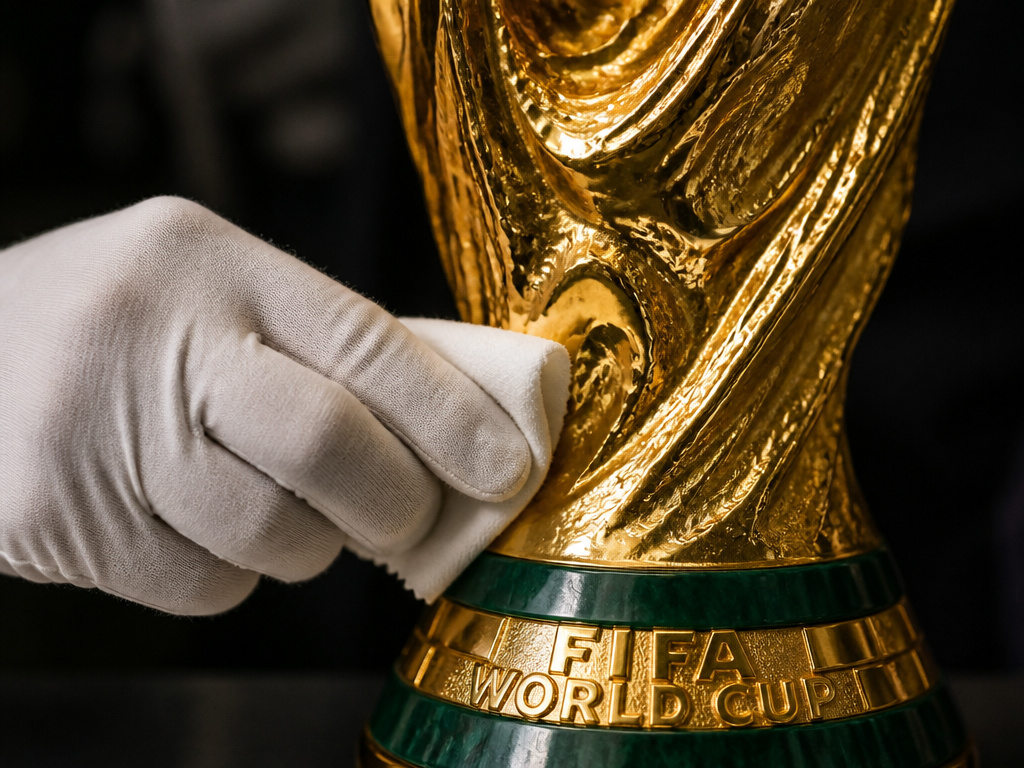
The game is the core, but the pageantry turns a competition into a cultural fixture. The symbols surrounding the World Cup, the trophy, the song, the mascot, have histories as rich as the matches.
For forty years, champions lifted the Jules Rimet Trophy. Named after the tournament’s founder in 1946, it was awarded from 1930 to 1970. The rules stated the first nation to win it three times could keep it. Brazil achieved that in 1970. The trophy’s story didn’t end there, though. That trophy was stolen in 1983 and has never been recovered, likely melted down.
Its replacement, the FIFA World Cup Trophy, is made of 18 carat solid gold. Since 2006, winners receive a gold-plated replica to keep; the original is retained by FIFA in Zurich.
The soundtrack started in 1962. The first official World Cup theme song was ‘El Rock del Mundial’ for the 1962 Chile tournament. The tradition exploded with global hits like Ricky Martin’s “The Cup of Life” (1998) and Shakira’s “Waka” (2010). The visual identity got its own boost in 1966 with the first World Cup mascot: World Cup Willie, a lion, for the 1966 England tournament. Every host since has created a character, embedding local culture into the global event. These elements, like the history of the World Cup match ball, are the tangible artifacts fans remember.
Records, Reigns, and Global Reach
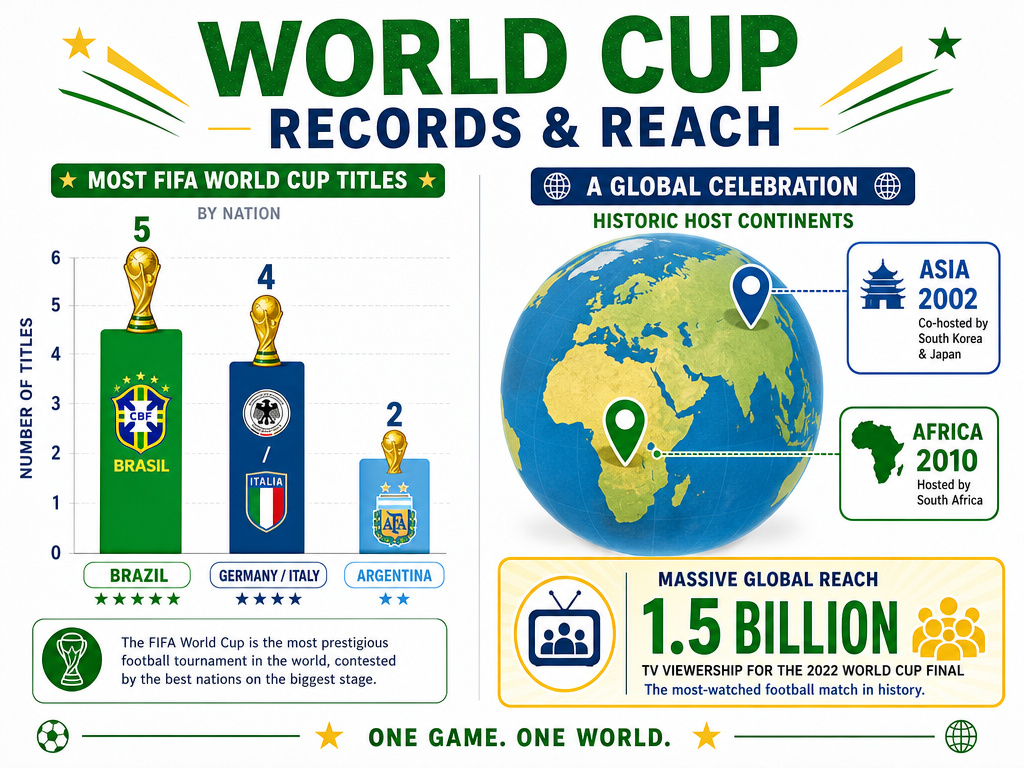
The narrative of the World Cup is written by its champions. A few nations have dominated, creating dynasties that define eras. At the summit stands Brazil, the only team to have participated in all 23 World Cup tournaments and won five titles (1958, 1962, 1970, 1994, 2002).
Germany and Italy have each won four World Cups. Argentina follows with three, its latest in 2022 cementing Lionel Messi’s legacy. This hierarchy of champions is a central pillar of any Wikipedia FIFA World Cup entry.
The tournament’s growth is measured in more than teams. It’s in the stands and on screens. The 1994 U.S. World Cup was the highest attended event in FIFA history. Broadcast numbers are now astronomical. The 2022 men’s World Cup final had 1.5 billion worldwide television viewers, with over 5 billion people tuning in over the course of the tournament. Attendance figures for the 2026 World Cup are not yet available.
Hosting has also globalized. The first time the World Cup was held in Asia was 2002 in South Korea and Japan. The first time in Africa was 2010 in South Africa. The 2026 edition will be co-hosted across 11 U.S. Cities, three cities in Mexico, and two cities in Canada, making Mexico the first country to host the World Cup three times (1970, 1986, 2026). The process behind this, host selection, is a saga in itself. Learn more about how World Cup hosts are chosen.
The Women’s World Cup: A Parallel History
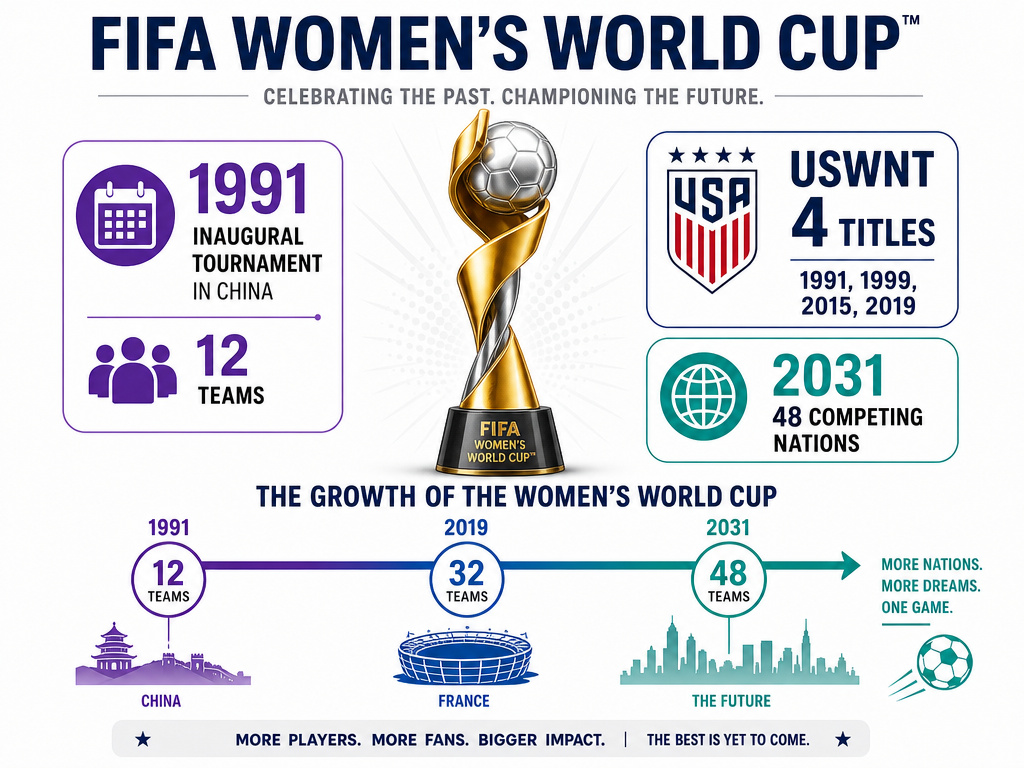
The women’s game carved its own path. After unofficial tournaments in the 1970s, the inaugural FIFA Women’s World Cup was held in China in November 1991 with 12 teams. The United States Women’s National Team (USWNT) won that first title, starting a dynasty. The USWNT has won four FIFA Women’s World Cup titles (1991, 1999, 2015, 2019).
Like the men’s event, it has expanded, reaching 32 teams in 2023. And it will follow the same growth trajectory: the 2031 Women’s World Cup will see 48 nations compete. Its history, though shorter, is marked by similar struggles for recognition and its own iconic moments, like the 1999 final at the Rose Bowl.
Pre-1930 football history and Olympic football
Before the World Cup, the Olympic football tournament was the premier international competition. However, it was restricted to amateur players, which frustrated FIFA and its president Jules Rimet. He pushed for a standalone world championship open to all players, leading to a vote in 1929. Uruguay, the reigning double Olympic champion, was chosen as the host for the inaugural event, which was set for 1930 to coincide with the nation’s centenary of independence. This move established a new, fully professional global tournament.
Comparison to Olympic football
The creation of the FIFA World Cup was a direct response to the limitations of Olympic football. Where the Olympics maintained strict amateur rules, the World Cup was conceived as an open championship for all players, professional and amateur alike. This fundamental difference in philosophy allowed the new tournament to quickly surpass the Olympics in prestige for the sport. The World Cup’s focus solely on football, with nations fielding their strongest possible teams, cemented its status as the ultimate prize in international soccer, distinct from the multi-sport, amateur-focused Olympic model it succeeded.
Frequently Asked Questions
How many teams were in the very first World Cup?
The inaugural 1930 FIFA World Cup in Uruguay featured 13 teams. Only four of those came from Europe due to the travel distance and economic climate of the time.
Why were there no World Cups in 1942 or 1946?
The 1942 and 1946 World Cups were cancelled due to World War II. The global conflict made international travel and organization impossible, halting the tournament for 12 years.
Which country has won the most World Cups?
Brazil holds the record with five World Cup victories (1958, 1962, 1970, 1994, 2002). They are also the only nation to have played in every single tournament final stage.
What was unusual about the 1950 World Cup format?
The 1950 tournament didn’t have a single final match. Instead, the final stage was a round-robin group of four teams (Uruguay, Brazil, Sweden, Spain). The decisive match, Uruguay’s 2-1 win over Brazil at the Maracanã, was the final group game.
How does a team qualify for the World Cup?
Teams must advance through their continental qualification tournaments, a years-long process involving over 200 national teams. The specific qualification process varies by region, with a set number of slots allocated to each confederation. You can read about how World Cup qualifying works.
Before You Go
The beauty of this history is its refusal to sit still. From a 13-team experiment born from one man’s vision, it has been shaped by war, economics, politics, and an insatiable desire to include more of the football world. The upcoming 48-team format will be criticized and celebrated, just as every previous change has been. That’s the cycle.
The next chapter is already being written, with the 2030 tournament slated for Morocco, Portugal, and Spain. But the core appeal remains unchanged from 1930: a simple contest to crown a world champion, now wrapped in a century of stories, stats, and spectacle. For a deeper look at how this contest functions from start to finish, the World Cup format itself is worth your time. The history isn’t just about where it’s been, but where it’s going next.
