
Most Controversial Offside Rule Changes in Football
This post contains affiliate links. As an Amazon Associate, we earn from qualifying purchases.
The most controversial offside rule changes in football are the 1866 three-opponent rule, the move to let level attackers stay onside in the 1990s, the 2005 body-part test, VAR-era millimetre calls, and Arsene Wenger’s ‘daylight’ proposal, which is not yet in the Laws.
Every item in that list answers the same question: how much of a head start does an attacker deserve? Adam Powley, writing for The Conversation, says the 1866 revision tried to settle the pull between fairness and goals. Later revisions pivoted on the same dynamic.
What follows: a six-step timeline, the tactics of a level-is-onside back line, three modern flashpoints (the Diaz flag, the Garcia touch, the 5cm margin), the shaky status of Wenger’s trials, and a ranking by how loud each row got.
Key Takeaways
- IFAB called its 2022 ‘deliberate play’ fix a clarification, not a Law change, even though UEFA’s referees chief wanted better wording.
- A pass, attempt to gain possession or clearance that goes wrong still counts as deliberate play, so the attacker who receives it isn’t penalised.
- The Premier League’s semi-automated system gives attackers 5cm of tolerance, and one outlet says Spain, Germany and France are stricter.
- PGMOL called the Diaz flag a significant human error, and the instant restart meant nobody could fix it in the match.
- Wenger’s daylight law is in trial, not in the Laws, but reports on its status conflict.
Six Steps From 1863 to 2005: The Offside Timeline
The first widely agreed offside law arrived with the Football Association’s published laws in 1863, and it barred any attacker from standing in front of the ball when it was kicked forward.
Offside is judged at the moment a team-mate plays or touches the ball. An attacker is in an offside position when a body part able to legally play the ball is beyond the penultimate defender. Since the 1990s, level with that defender counts as onside, and the 2005 wording narrowed the test to playable body parts.
Early football borrowed from rugby, where players could use their hands in some situations and standing ahead of the ball was an unfair edge. “Offside” literally means unfair. Scotland played a passing game with no offside rule at all, so the argument was live from day one.
| Year | What changed | The argument it fed |
|---|---|---|
| 1863 | No attacker ahead of the ball when kicked | Rugby-style fairness versus passing |
| 1866 | Onside if three opponents are in between | Fairness versus the need for goals |
| 1903 | “Interfering with play” introduced | Subjective test of involvement |
| 1925 | Three opponents became two | Sources report the adoption date differently |
| 1990s | Level with a defender is onside | Ties now go to the attacker |
| 2005 | Only playable body parts count | Fine detail on what “involved” means |
1866 to 1903: Fairness Against Goals
The 1866 revision made a player onside if three opponents stood between him and the goal, or if he was behind the ball. In 1873 offside came to be judged when the ball was played forward, not when it was received. Each step in the evolution of the offside rule swapped one complaint for another.
Then came 1903 and “interfering with play”. Powley calls it a long-standing and often subjective definition of what counts as being active. That subjectivity still shapes the line between interfering with play and merely standing there.
The gap between position and offence trips up plenty of fans. The basic offside rule sorts it out in three points:
- Standing in an offside position is allowed; IFAB’s wording says a player is only penalised on becoming involved in active play.
- No offside from a goal kick, throw-in or corner.
- The punishment is an indirect free kick.
1990 to 2005: Level Is Onside, Then Body Parts
The 1990s brought the change that matters most to attackers: level with a defender means onside. Then 2005 narrowed the test to body parts that can legally play the ball.
None of my sources explains the thinking behind the 1990 move, so I won’t invent a motive. What I can say is that both tweaks gave attackers more room, because level became onside and only playable body parts counted.
What Does Level Is Onside Do to a Run and a Back Line?
Picture a back line holding its shape, a winger on the half-turn and a midfielder lifting his head. The second-last defender sets the line for everyone else. If an attacker can arrive level and stay onside, that defender has to step up a beat earlier to keep him honest. In my reading, that beat is the whole tactical contest.
A back line works like a restaurant brigade. One cook slipping on timing ruins every plate. When the line steps up together, the trap works; when one defender hangs back, he plays everyone onside.
I watch matches from kickoff to final whistle for exactly this reason. The quiet spells show how a back line holds its depth, and highlight reels cut those spells out. Highlights give you the pass and the finish. They hide the run.
I rate the forward who bends a run so he arrives level as the pass leaves a team-mate’s foot over the one who simply outruns the line. Timing is the skill. The sprint is the easy part.
Here’s how to read a run properly, in order:
- Freeze the frame when the pass is played. Judge the moment of arrival instead and you’ll flag onside runs as offside.
- Find the second-last defender. Misread who that is and the whole line sits in the wrong place.
- Check the playable body parts against that line, where level counts as onside. Count an arm and you’ll invent offences.
- Ask whether the attacker got involved. Position alone isn’t punished, so skip this and every flag looks like an offence.
Which one do you skip when you’re watching live? Be honest.
What Went Wrong When Diaz’s Goal Was Flagged at Tottenham?
Luis Diaz thought he’d put Liverpool ahead at Tottenham on 30 September 2023. The assistant raised the flag, VAR did a very quick check, and Gary Neville said he heard “check complete” in his ear with no lines shown on the replay. It was 0-0 in the first half and Liverpool were a man down.
The words that mattered came in the PGMOL statement on Diaz offside decision, published by Sky Sports. PGMOL acknowledged a “significant human error” and called the flag a “clear and obvious factual error” that VAR should have corrected.
The two accounts of the failure differ. Sky Sports News understands the VAR wrongly thought the on-field decision was a goal, which produced “check complete” instead of an intervention. PGMOL’s release to the Premier League says the check was carried out correctly, with an accurate kick-point and a single 2D line on the second rear-most defender’s foot. The match then restarted immediately. The Replay Operator and AVAR queried the outcome a few seconds later, but that was never communicated to the on-field team.
Reactions were loud. Jurgen Klopp called the decision “unfair” and “crazy” and said the line was drawn wrong. Neville and Jamie Redknapp both called it onside and questioned camera angles and line placement. Treat those as reactions, not findings. PGMOL’s own release says the line was placed correctly and puts the failure in the communication.
The part nobody mentions: A correct line doesn’t guarantee a correct outcome. Here the check itself passed, the wrong message ended the review, and the instant restart meant the error could not be corrected after the AVAR spoke up a few seconds later.
The release shows how much the VAR system leans on one clear message reaching the referee. Spurs won 2-1 and Liverpool finished with nine players. VAR Darren England and AVAR Dan Cook were replaced for their next matches.
The Deflection Row: One Touch by Garcia and a 2022 Clarification
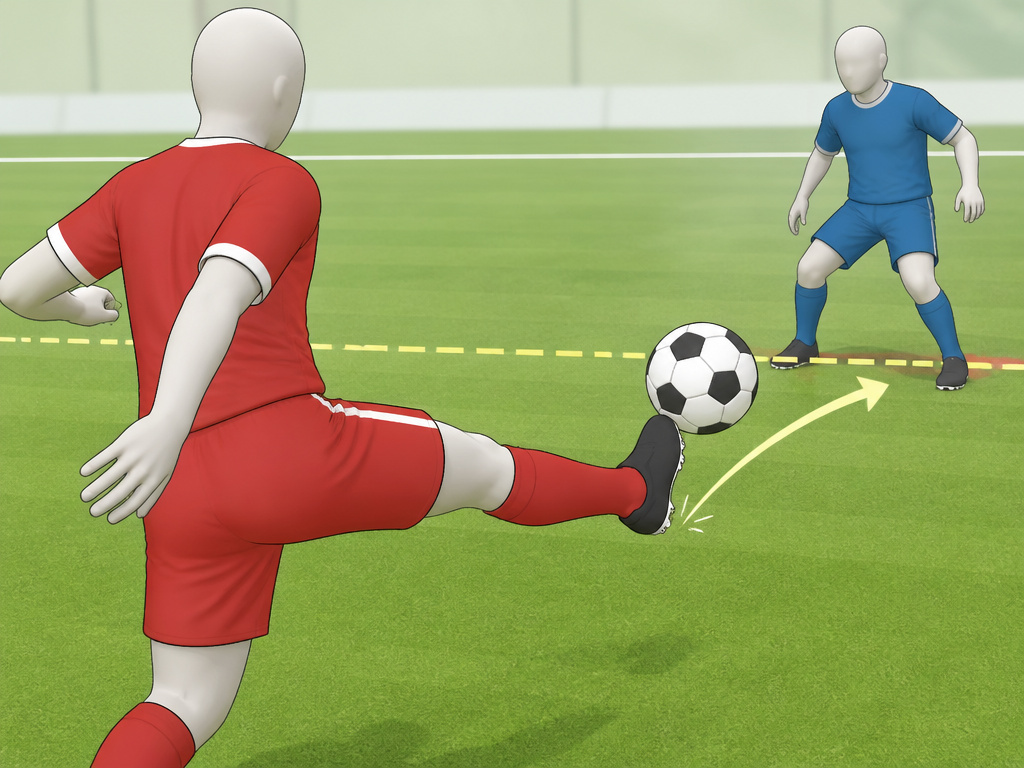
IFAB’s Circular 26 defines “deliberate play” as a player having control of the ball with the possibility of passing it to a team-mate, gaining possession, or clearing it by kicking or heading. That definition decided the Nations League final between France and Spain on 10 October 2021.
Spain defender Eric Garcia stretched to intercept a through-ball from Theo Hernandez and made slight contact. Referee Anthony Taylor ruled that the touch created a new phase of play, so Kylian Mbappe’s goal stood. ESPN’s explainer on why Mbappe’s offside goal stood records the animated protests from Spain after VAR reviewed it.
UEFA’s referees chief, Roberto Rosetti, backed the referee. “Anthony Taylor made a correct decision based on the existing law and its official interpretation,” he said. He also said the interpretation “appears to be in conflict with the spirit of the law” and that UEFA believed the wording could be improved.
IFAB took a different view. In July 2022 it said no change to Law 11 was necessary and clarified only the guidelines. IFAB and FIFA cited “a number of high-profile situations” without naming any. Their stated expectation was that a player clearly in an offside position should not become onside every time an opponent moves and touches the ball.
The practical test is whether the defender was in control with a real option. A failed attempt still counts: if the pass, attempt to gain possession or clearance is inaccurate or unsuccessful, the player has still deliberately played the ball. One exception stands. A player receiving the ball from an opponent’s deliberate play isn’t considered to have gained an advantage, unless it was a deliberate save.
IFAB’s guidelines list five indicators of deliberate play:
- The ball came from a distance and the player saw it clearly.
- It wasn’t moving quickly.
- Its direction wasn’t unexpected.
- The player had time to coordinate their body, rather than stretching or jumping on instinct.
- A ball on the ground is easier to play than one in the air.
I think this is the most underrated corner of Law 11, because one judgment about a defender’s touch can flip a whole attack. That’s an opinion. The text is IFAB’s.
Five Centimetres of Doubt: Thick Lines and VAR-Era Offside
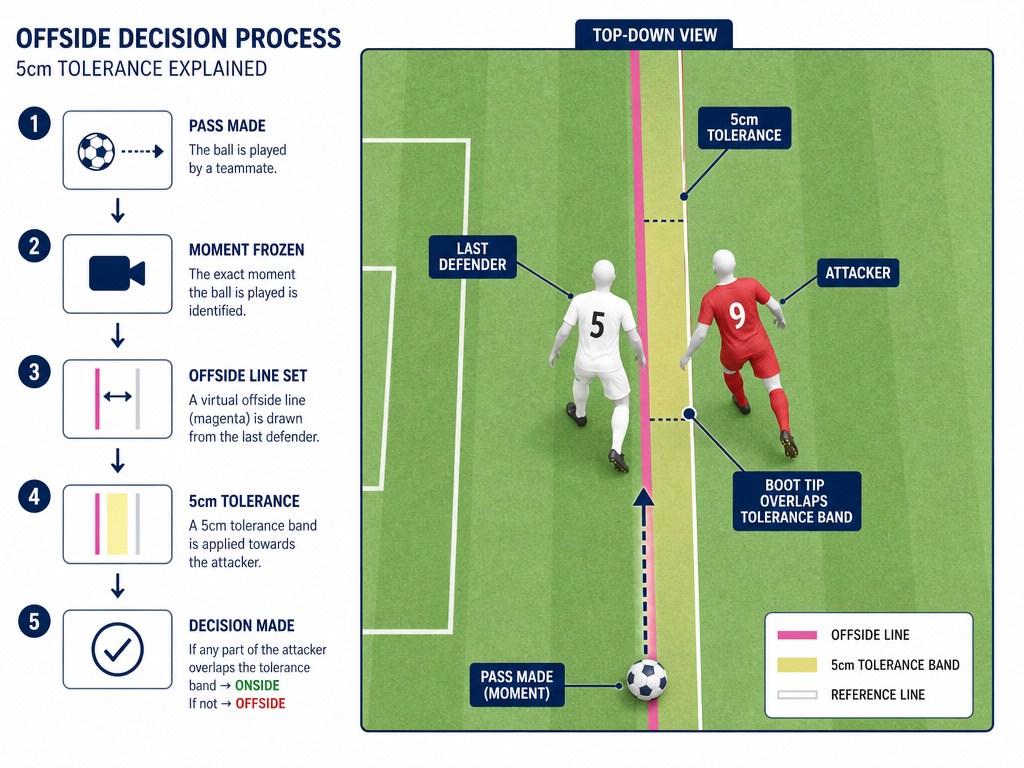
The Premier League’s semi-automated offside system gives an attacker 5cm of tolerance, according to Inside World Football. BBC, cited by Gamereactor, says the margin was added because of technology inaccuracies, and it gives the attacker the benefit of the doubt.
On 4 January, Florian Wirtz scored for Liverpool against Fulham. The assistant’s flag went up right after the goal, then the referee allowed it after a VAR check. The Key Match Incidents Panel confirmed VAR made no mistake: the intervention was “supported as correct, given the tight margin of the offside call and thicker offside lines used for these incredibly tight calls”.
Gamereactor adds that the goal would not have stood in France, Germany or Spain, which it says use stricter semi-automated rules. That’s a secondary source and worth checking against league documents. Same position, different verdict, depending on the country.
Euro 2020 showed the other face of tightness. France beat Germany 1-0 via a Mats Hummels own goal. Goals by Mbappe and Benzema were disallowed for tight but correct decisions, and England’s Jordan Henderson lost a goal against the Czech Republic. Powley argues the strikers may have been technically in breach of the law but not its spirit.
FIFA’s position sits at the other end: it believes VAR and semi-automated offside technology have tilted the attacking balance too far toward defenders. The wider pros and cons of VAR get argued every weekend.
Judge offside at the frame the pass is played, never at the frame the ball arrives. Everything a replay shows after that moment is noise.
Will Wenger’s Daylight Offside Become Law?
Nobody can answer that cleanly yet, and the reports contradict each other. My rule is a second source for every story, because one great tale once fell apart on me. This is where that rule earns its keep.
Wenger’s proposal says an attacker would be in an offside position only if their entire body is completely beyond the second-last defender, creating “daylight”. A separate expected proposal would use the torso: any part of the torso ahead of the defender, with feet, legs and head excluded. Any change needs three-quarters approval, or at least six of eight IFAB votes.
| Source | What it reports | Limit |
|---|---|---|
| Inside World Football (14 Jan) | UEFA and British FAs opposed; FIFA to seek trials | Written before the IFAB meeting |
| WorldSoccerTalk (22 Jan) | IFAB rejected it for next season; testing continues | Aggregator; league unnamed |
| NTN24 | Canadian Premier League is trialling it in 2026 | Spanish-language news report |
Both can be true at once: a rejection for the Laws and a green light for a trial. That reconciliation is mine. No single source states it.
Infantino said in Dubai in December 2025: “Perhaps in the future the attacker would have to be completely ahead to be considered offside.” Wenger told reporters after the London meeting: “We have to try the radical solution first and see if we need to come back from that.”
What the Canadian Premier League Trial Shows So Far
NTN24 reports that under the CPL trial an attacker is offside only when their whole body is ahead of the second-last defender. Any overlap or contact means no offence, and hands and arms don’t count. Alejandro Diaz of Pacific FC (a different Diaz) scored the first professional goal made possible directly by the rule.
On 23 September, Tomasz Skublak of Inter Toronto FC scored an added-time goal that was offside under the traditional rule. It made the score 3-3 against Vancouver FC. I found no published trial results, so anyone quoting goal counts is guessing.
My own lean is to keep the contest between run and line, because that contest is where attackers show craft. That’s taste, not evidence, and FIFA’s concern about defender-friendly technology is a serious counterweight.
Ranking the Most Controversial Offside Rule Changes in Football
Here’s my order, loudest row first. It’s a judgment call, not a poll, and the early rows are hardest to rank because my sources describe the changes rather than the reactions at the time.
- Wenger’s daylight proposal: opposed by UEFA and the British FAs, pushed by FIFA, and currently argued over in two directions at once.
- Thick lines and the 5cm margin: Wirtz’s goal, Euro 2020 tight calls, and a different verdict depending on the league.
- Deliberate play versus deflection: Rosetti said correct but against the spirit; IFAB said no wording change.
- The 2005 body-part test: it defines what counts as ahead, so every millimetre call traces back to it.
- The 1866 three-opponent rule: the first attempt to balance fairness against goals.
The Experiment That Skipped Offside Entirely
Marco van Basten, FIFA’s technical director from 2016 to 2018, campaigned for removing offside. An experimental match without it finished 9-7, but Powley reports that it wasn’t dramatically different tactically.
Frequently Asked Questions
What is the stupidest rule in football?
That’s opinion, and offside gets nominated often. The loudest complaint is millimetre calls like Euro 2020’s, which were correct under the law but arguably against its spirit. My nomination is the gap between letter and spirit, not any one clause.
Did they really change the offside rule?
Yes, repeatedly: 1863, 1866, 1873, 1903, a later move from three opponents to two, the 1990s level-is-onside change and 2005. In 2022 IFAB clarified the ‘deliberate play’ guidelines but said no change to Law 11’s wording was necessary.
Why was the offside rule changed in 1990?
The sources I checked don’t give the motive. Powley frames earlier revisions as a tension between fairness and the need for more goals, but I won’t attach that to 1990 without a source.
Will the offside rule change in 2026?
Reports conflict. WorldSoccerTalk says IFAB rejected Wenger’s proposal for next season’s Laws but agreed testing should continue. NTN24 says the Canadian Premier League is trialling it in 2026. I found no published trial results.
Does a defender’s touch always make an offside attacker onside?
No. Only deliberate play counts, meaning control with a real option to pass, gain possession or clear. A failed attempt still counts, while a deflection doesn’t. A deliberate save is the exception.
The Bottom Line
Before you repeat any claim about the daylight law, check three things: which league, who is quoted, and the date. Reports from January and from the CPL point in different directions, and the label “trial” covers a lot.
Your first step this week is simple. Pause a replay at the frame the pass leaves the passer’s foot, then draw the line in your head. You’ll catch the mistake I mentioned: judging from the arrival frame.
This ranking of the most controversial offside rule changes in football is my judgment. The 5cm margin and the deflection clarification will keep arguments going longer than most people expect. The pure contest between run and line is the part I’d protect.
