
When Is a Player Not Offside in Football? A Checklist
This post contains affiliate links. As an Amazon Associate, we earn from qualifying purchases.
A player is not offside in football when level with the second-last opponent, standing in their own half, or receiving the ball directly from a goal kick, throw-in or corner kick. Being in an offside position is also no offence by itself; the player must play the ball or clearly affect an opponent.
Every one of those exceptions hangs on timing. The referee judges position at the instant a team-mate plays or touches the ball, not when the attacker finally arrives. Freeze the picture at the pass and most arguments end before they start.
What follows: the positions that never count, the restarts that are exempt, the defender touches that reset the line, one 2026 trial that could change the picture, and a five-step test you can run from the stand.
Key Takeaways
- A player on the halfway line cannot be offside, because head, body and feet are all in their own half.
- Goal kick, throw-in and corner kick are exempt, but free kicks are not, and a corner taker can be offside on the return pass.
- Hands and arms are ignored, with the arm’s upper limit at the bottom of the armpit.
- An opponent’s deliberate play resets offside; a deliberate save, a rebound off the woodwork or a reflex touch does not.
- A Canadian Premier League trial from 4 April 2026 uses a more lenient “daylight” test, so the rule can differ by competition.
When Is a Player Not Offside in Football? Three Positions That Are Always Safe
Three positions are always safe: your own half, level with the second-last opponent (or the last two), and any spot where your only forward part is a hand or arm. Everything else in the offside rule is about timing and involvement.
Law 11 defines an offside position as any part of the head, body or feet lying in the opponents’ half and nearer the opponents’ goal line than both the ball and the second-last opponent. Hands and arms are excluded, with the arm’s upper boundary set at the bottom of the armpit. Level with the second-last opponent counts as onside.
I like to think of the line as a kitchen pass. Nothing crosses it until the plate is called, and the call is the team-mate’s touch. That is the whole idea.
| Situation | Offside position? | Reason |
|---|---|---|
| Anywhere in own half | No | No body part in opponents’ half |
| Standing on halfway line | No | Head, body and feet in own half |
| Level with second-last opponent | No | Level counts as onside |
| Only an arm beyond halfway line | No | Arms are ignored |
| Boot nearer goal line than defender | Yes | Feet count |
The arm rule produces the oddest-looking onside calls on when is a player not offside in football. In the IFAB’s own example, a counter-attacker has one extended arm poking past the halfway line while the rest of him stays back, and the referee lets play continue because an offside position requires the head, body or feet to be in the opponents’ half.
Level really does mean level. Not “nearly”.
Three Edge Cases That Trip Up Fans
A defender lying injured beside the goal line still counts when you tot up the two opponents. IFAB’s FAQ says posture (standing, sitting or lying) is irrelevant, so a scorer with two or more opponents nearer the goal line has a valid goal.
Two more cases come straight from the IFAB’s FAQ:
- Defender leaves the field without permission. The Law treats that player as standing on the goal line or touchline until the next stoppage, or until the defending team plays the ball towards the halfway line and it is outside their penalty area. If the exit was meant to play an attacker onside, the defender is cautioned.
- Attacker steps off to avoid active play. Come back on from the goal line and join in before that same reset point, and the attacker is treated as standing on the goal line.
- Attacker on the goal line between the posts. A player who simply stays inside the goal as the ball enters must be given the goal unless an offside or Law 12 offence is committed.
I’d call the first one the sneakiest. It looks like a trick, and the Law shuts it down.
No Offside From a Goal Kick, Throw-In or Corner Kick
The Law names three restarts and stops there. A player cannot be penalised for offside when receiving the ball directly from a throw-in, a goal kick or a corner kick.
The word “directly” does the work. IFAB’s FAQ describes a corner taken short, then returned to the kicker standing in an offside position. The corner exemption covers only the first reception; once the corner has been taken, the kicker can be offside on the pass back, and the referee awards an indirect free kick to the defenders.
What stays exempt, and what doesn’t:
- Goal kick: a long ball to a forward beyond the second-last defender is fine. If a defender then fouls that forward, the foul is punished.
- Throw-in: the forward is safe on receipt. If the ball deflects off a defender and reaches an attacker who was in an offside position, the referee waves play on, because no team-mate touched it after the throw.
- Corner kick: the receiver is safe only when the ball comes directly from the corner; once the corner has been taken, the kicker can be offside, for example when a team-mate passes the ball back.
- Free kick: not exempt. An attacker who receives it directly while offside is penalised.
- Dropped ball: not exempt either. A later long pass to a player in an offside position can still be flagged.
Where this goes sideways: Treating every restart as a free pass. A forward who collects a free kick while offside concedes an indirect free kick, and the goal that follows is chalked off.
A goal can’t be scored directly from a throw-in, either. IFAB’s FAQ says a ball that goes in without touching another player earns a goal kick for the opponents.
Why Isn’t Every Offside Position an Offence?
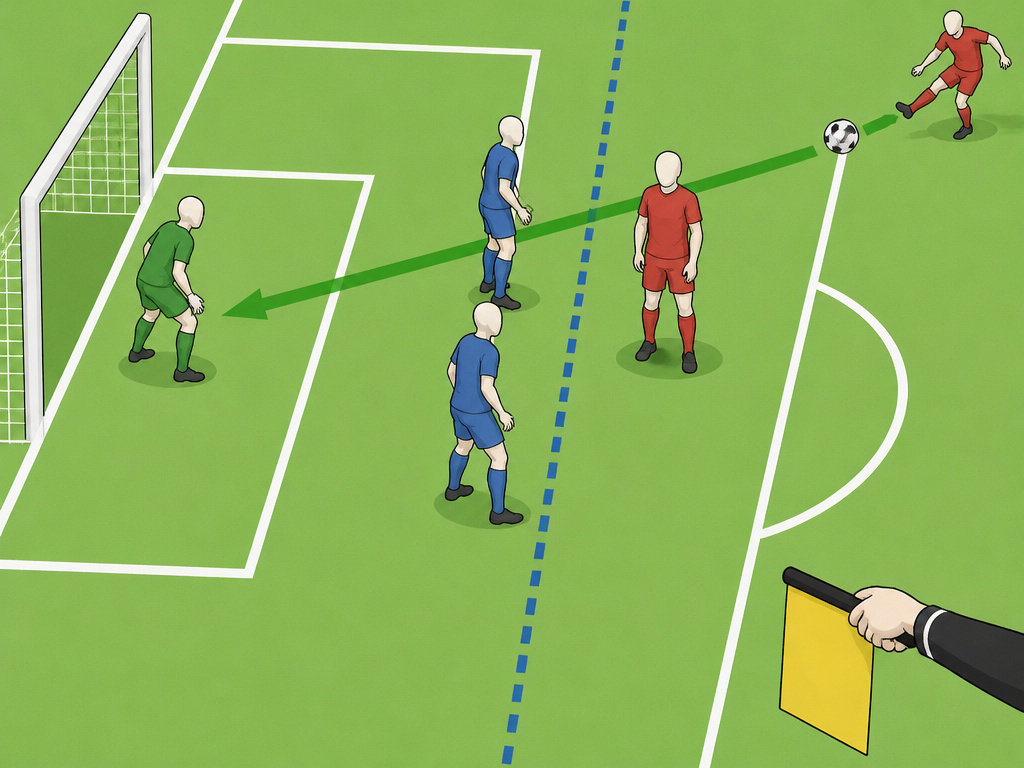
A striker parks behind the last defender while a team-mate shoots from the far wing, and the flag stays down. Is that a mistake? No, it’s the Law working as written: a player in an offside position is penalised only for playing the ball or clearly impacting an opponent’s ability to play or challenge for it.
That is the idea behind interfering with play. Running towards the ball without touching it or hampering anyone is not an offence. IFAB’s example: a midfielder standing on the goal line while a team-mate’s shot goes straight in gets the goal.
The offences, by contrast, include:
- Playing or touching a ball passed or touched by a team-mate.
- Clearly attempting to play a ball that’s close, even without touching it, if the move affects an opponent (a header attempt that confuses the goalkeeper counts).
- Blocking the goalkeeper’s line of vision.
- Moving from an offside position to interfere with a defender’s movement towards the ball.
Offside is punished with an indirect free kick where the offence occurred. If the attacker played the ball in the goal area, the kick can be taken anywhere in that area.
The judgment I trust most is “who did that run affect?” A decoy run that drags a defender out of position and touches nothing is legal. A decoy run that blocks a defender’s path is not.
That is my own view, not a quote from the Law. I’ve spent more evenings arguing about decoy runs than I’d like to admit (my wife can confirm).
When Does a Defender’s Touch Reset Offside?
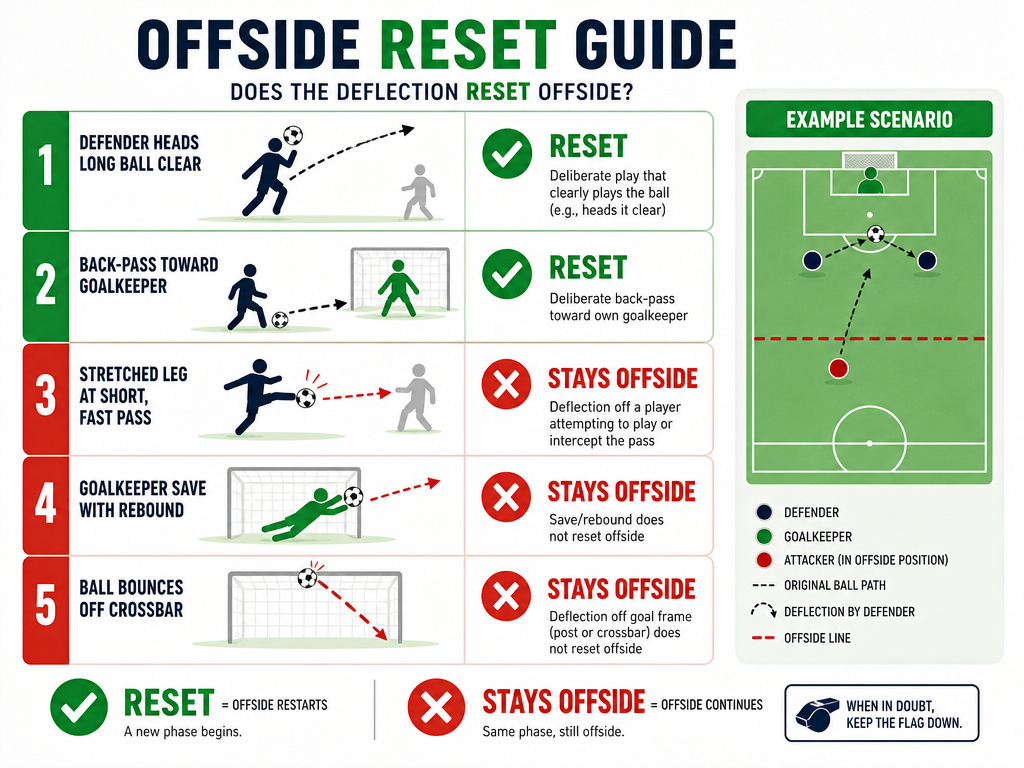
Under Law 11, an opponent who deliberately plays the ball wipes offside clean, and an inaccurate or failed attempt still counts as deliberate. The trouble is separating a real play from a reflex, a save, a rebound or a deflection.
IFAB’s FAQ gives the test. It treats a touch as deliberate when the ball travelled from distance, the defender anticipated its direction and had time to coordinate their body. A defender running or stretching at a short, fast ball with no control is not playing it deliberately, so the attacker stays offside.
| What the defender did | Offside reset? | Why |
|---|---|---|
| Anticipated a long ball, headed it clear | Yes | Time to coordinate |
| Inaccurate pass back towards goalkeeper | Yes | Failed attempt still deliberate |
| Stretched a leg at a short, fast pass | No | Reflex, no control |
| Goalkeeper saved shot, rebound to attacker | No | Deliberate save does not reset |
| Ball rebounded off crossbar to attacker | No | Rebound, not a play |
A “save” has a narrow meaning: stopping, or trying to stop, a ball going into or very close to the goal. A defender who intercepts a pass is playing the ball, not saving it. Skip that distinction and you’ll flag goals that stand.
Deflections between opponents have their own rule. When the ball reaches an attacker after bouncing between defenders, with no touch by a team-mate of that attacker, there is no offence. If it deflects off an opponent from a team-mate’s shot to an attacker who was in an offside position, that attacker is offside.
I think this is the most underrated part of the Law. I’m no numbers man, so I can’t tell you how many calls it decides. I only know it’s the one fans never see on the replay.
The Mbappe Goal That Exposed the Gap in the Wording
On 10 October 2021, in the Nations League final, Mbappe stood in an offside position when Eric Garcia reached out and touched Theo Hernandez’s pass. The goal stood, France v Spain. UEFA’s Roberto Rosetti called the decision correct under the existing Law but against the spirit of the Law.
The ESPN report on IFAB offside clarification records what followed. For 2022/23 the IFAB issued guidance on deliberate play, and under that guidance the Mbappe goal would now be disallowed.
Was it a rule change? It depends on who you ask. IFAB and the FA say the Law text did not change, only the guidance. Some press, including a German Bundesliga fact-check, describes it as a change of interpretation. I’m going with guidance, since that comes from the lawmakers.
A touch like Garcia’s is why the “short distance, fast ball, no control” test exists. Admit it, we’ve all wanted the Law to say that outright.
How Often Do Assistant Referees Get Offside Wrong?
More often than fans assume. Helsen et al., in the Journal of Sports Sciences (2006), found a 26.2% error rate across 337 offside calls in 64 matches at the 2002 World Cup. Of those errors, 86.6% were flags raised wrongly and 13.4% were missed offsides. (I couldn’t open the paper itself, so these figures come from a research summary of it.)
Distance from the line made no significant difference to the error rate. Why the errors happen is still argued:
- Oudejans et al. (Nature, 2000) blamed the viewing angle.
- Baldo et al. (Perception, 2002) argued the flash-lag effect, where the brain sees a moving object ahead of its true position, explains much of the same data.
- Helsen et al. Found distance made no difference and most errors were wrong flags, which supports the flash-lag reading.
Technology now takes some of that weight. The Premier League introduced semi-automated offside technology on Saturday 12 April (Match Round 32), after non-live testing and live operation in the FA Cup. It uses optical player tracking to place the virtual offside line more efficiently and supports the VAR. The system was developed with PGMOL and Genius Sports.
The graphics are the visible part. A thin virtual line appears on the broadcast across the pitch at the moment of the pass. Watch for it, and watch which frame it freezes on.
Is the Daylight Rule Coming?
Not everywhere, and not yet. FIFA announced on 31 March 2026 that the Canadian Premier League would trial a “daylight” interpretation from the start of its season on 4 April, approved by The IFAB after its 140th Annual General Meeting. FIFA’s Arsene Wenger called it an important pilot and said FIFA looks forward to analysing the results.
| Scenario | Current Law 11 | Daylight trial (CPL) |
|---|---|---|
| Level with second-last defender | Onside | Onside |
| Boot ahead, rest of body level | Offside | Onside |
| Whole scoring body beyond defender | Offside | Offside |
| Only an arm ahead | Onside | Onside |
Under the trial, an attacker is onside if at least one scoring body part (not hands or arms) is level with or behind the second-to-last defender. Offside needs a gap, the “daylight”, between them. That is more lenient than the standard Law, which makes any part of the head, body or feet nearer the goal line than the second-last opponent an offside position.
One undated report claimed the IFAB rejected the rule. FIFA’s dated article says the IFAB approved a trial. I trust the dated source. I found no published trial results in the material I checked, so anyone quoting numbers on its effect is guessing.
Easy to miss: In 2026 the same attacker can be onside in Canada and offside under standard Law 11. Check the competition’s rules before you call a decision wrong.
The trial also uses Football Video Support rather than VAR: head coaches get a limited number of review requests, and the fourth official checks every goal for attacking-team offences in the build-up. I’m not convinced by calls to hand attackers more room, because the line is where the tactical contest lives. That’s a view, not evidence, and the trial may prove me wrong.
A Five-Step Test to Decide If a Player Is Onside
Run these in order and most cases resolve by step three. The test beats reading replays, because it forces you to look at the right moment.
- Freeze the pass. Judge position when a team-mate plays or touches the ball. Judge from the finish instead and you’ll overrule a legal goal, like a forward onside at the shot who is offside when the goalkeeper saves it and still scores from the rebound.
- Check the half. If no head, body or foot is in the opponents’ half, stop: onside. Skip this and you’ll flag players standing on the halfway line.
- Count defenders. Level with the second-last opponent, or the last two, is onside. Ignore arms. Miss this and you’ll treat a level player as beyond the line.
- Check the restart and the last touch. A direct goal kick, throw-in or corner kick means no offence. An opponent’s deliberate play resets offside, a save or rebound does not. Skip it and you’ll pull back valid goals.
- Ask about involvement. Did the player play the ball, or clearly stop an opponent playing or challenging for it? If not, play on.
Strikers already live by step one. The craft of timing a run to stay onside means starting the run as the pass leaves the boot, not after it. I’d rather watch a forward manipulate that line than simply outpace it.
How has the offside rule changed over time?
The offside rule has been reworked many times since the early days of the game. The wording in Law 11 today comes from repeated adjustments to how many defenders must be played against and which body parts count. For a fan, the useful point is that the law keeps being tuned, so arguments about how it used to work rarely apply now.
The most recent shifts are easy to trace. In the Nations League final, Mbappé was offside when Eric García touched the pass, and the goal stood. UEFA’s Roberto Rosetti called it correct under the law but against the spirit of the law. The IFAB then issued new guidance on deliberate play without changing the law text, and under that guidance the same goal would now be disallowed.
Technology has followed. The Premier League brought in semi-automated offside, developed with PGMOL and Genius Sports. The Canadian Premier League is trialling a daylight version approved by The IFAB, where any scoring body part level with the second-to-last defender keeps an attacker onside.
Frequently Asked Questions
When can a player not be offside in football?
Player cannot be offside in their own half, when level with the second-last opponent or the last two opponents, or when receiving the ball directly from a goal kick, throw-in or corner kick. Hands and arms never count. A player in an offside position who does not play the ball or impact an opponent also commits no offence.
Is it true you can’t be offside in your own half?
Yes. A player whose head, body and feet are all in their own half is not in an offside position, and that includes the halfway line itself. The offside free kick can still be taken in your own half if the offence happens there, as in IFAB’s example of an attacker who comes back and plays the ball.
How do you know if a player is offside?
Freeze the moment a team-mate plays the ball, then check whether any part of the head, body or feet is nearer the goal line than both the ball and the second-last opponent. If so, the player is in an offside position, and is penalised only if involved in play.
How do you explain offside to a child?
Keep it to a kitchen picture: you can’t hover by the pass waiting for a plate while the last two cooks are still behind you. Standing even with them is fine, and so is staying in your own half. Throw-ins, goal kicks and corners don’t count either.
At what moment is offside judged on a goalkeeper’s throw?
IFAB’s FAQ says the offside position is determined at the moment the goalkeeper releases the ball, because that last touch gives a clear and consistent reference point. Some summaries of Law 11 call it the “last point of contact”; the FAQ’s release moment is the clearer wording.
The Bottom Line
Start with one habit this week: next time a goal is disallowed, pause the replay at the pass, not the finish. If the picture at that frame says the player was level, or the ball came from a corner, goal kick or throw-in, the flag was wrong.
There’s a catch. Everything above is standard Law 11, and the daylight trial shows a competition can run a different test. If you referee or coach in a league that has adopted a trial, read its rules first.
Here’s my line. Don’t memorise the exceptions as a list. Learn the moment of the pass, and every exception becomes obvious.
