
How Long Is a Football Match? Kickoff to Final Whistle
This post contains affiliate links. As an Amazon Associate, we earn from qualifying purchases.
A football match lasts 90 minutes: two equal halves of 45 minutes, with a half-time break of up to 15 minutes and added time on top. Real games run longer. The 2025-26 Premier League average, including stoppages, was 100 minutes 35 seconds across the first 70 matches.
Added time is where that tidy 90 stops being fixed. The referee builds it from a specific list of stoppages, and the 2022 World Cup showed how fast it grows once every injury, substitution and goal celebration gets counted.
What follows: the Law 7 clock piece by piece, how much of it is real football, how World Cup and Premier League games compare, what knockouts and thunderstorms do to the schedule, and a plan for working out when you’ll be free.
Key Takeaways
- The fourth official’s board shows a minimum, and the referee can add but never cut it.
- The ball is in play for 55 minutes on average in the 2025-26 Premier League sample, well short of the 90 on the clock.
- A long stoppage right at the end of normal time doesn’t stretch the board: IFAB’s own example shows 3 minutes announced and 3 played after a 5-minute injury stop.
- FIFA said every 2026 World Cup game would get a 3-minute hydration break at the 22nd minute of each half, whatever the weather.
- Youth and grassroots lengths follow competition rules, and any cut must be agreed before kickoff.
How Long Is a Football Match Under Law 7?
Law 7 of the Laws of the Game sets the clock in one plain sentence: two equal halves of 45 minutes. Everything after that sentence deals with what gets added, what gets cut, and who decides.
Law 7 of the Laws of the Game sets a match at two equal halves of 45 minutes. Shortening is possible only when the referee and both teams agree before kickoff and competition rules allow the change. Added time is then appended to each half, and an abandoned match is replayed unless competition rules or organisers decide otherwise.
The how long is a football match answer depends on a clock that keeps running through stoppages, so lost time has to go somewhere. That’s why added time exists. The referee tallies what was lost and plays it at the end of the half. A rule that solves a real problem sticks in your head better than one you just memorised.
A shorter match needs a yes from the referee and both teams before kickoff, and the competition rules have to allow it. IFAB’s published Law 7 is blunt about the order: agree first, play second.
Here’s the clock piece by piece.
| Piece of the match | Length | Who sets it |
|---|---|---|
| Each half | 45 minutes plus added time | IFAB Law 7 |
| Half-time break | Up to 15 minutes | IFAB Law 7 |
| Drinks break | 1 minute maximum | IFAB Law 7 |
| Cooling break | 90 seconds to 3 minutes | IFAB Law 7 |
| World Cup 2026 hydration break | 3 minutes, 22nd minute of each half | FIFA, via AP |
Half-time is the one piece with a ceiling instead of a fixed length. Law 7 says up to 15 minutes, and the competition rules must state the exact figure. In my view that’s the right design: the Laws set the limit, and each league sets its own routine.
Simple enough.
How Much Added Time Should You Expect?
Qatar 2022 averaged about ten minutes of stoppage time per match, up from six and a half minutes at Russia 2018. FIFA’s own account of the increase came from referees chief Pierluigi Collina. Injuries, substitutions, VAR checks and goal celebrations now counted too.
The England-Iran opener shows how it adds up. Referees played 23 extra minutes across both halves. Collina said 14 of them came from two injuries: about 11 minutes for the Iran goalkeeper and 3 for an England player. Eight goals, a VAR check and an on-field review added to the total.
I keep a notebook at every match and write one line at each substitution. Watching how a manager reacts has taught me more than any app I’ve tried. It also works as a rough stopwatch now. With ten changes possible in a match, the lines pile up fast, and Collina’s estimate was that four extra substitutions add about one extra minute.
What the referee counts, per Law 7:
- Substitutions, each one a small pause that adds up over ten.
- Injuries and treatment, including taking a player off the pitch.
- Time-wasting and disciplinary sanctions.
- Goal celebrations, which IFAB says to allow for because they often burn real time.
- VAR checks and reviews.
- Drinks and cooling breaks, plus outside interference.
The Floor on the Board
The fourth official shows a minimum. The referee can add to it but can’t reduce it. When the board goes up, the crowd splits: groans from the side protecting a lead, a roar from the side chasing.
Easy to miss: A long injury stoppage right at the end of normal time doesn’t stretch the board. In IFAB’s example, 3 minutes were announced, play stopped for 5 minutes, and 3 minutes were shown and played after the restart.
Two more edge cases from IFAB’s Law 7 questions. A player who deliberately kicks the ball out while it’s in play gets a throw-in against his side, not a delay card, but the referee still counts that lost time. And a half runs on until a penalty kick is completed.
Why Collina Wants the Time Back
Collina defended the FIFA push for longer stoppage time in plain terms: “We are not talking of adding something on top.” He wants to compensate for time that wasn’t played. His example of what to avoid was Aston Villa vs Brentford, a game with 43 minutes of playing time.
He told FIFA that matches under 50 minutes of play had been a long-running problem. “People want to watch football, more football,” he said. Fair enough.
The 55-Minute Match Hiding Inside the 90
A corner is awarded. The taker picks up the ball, glances at the box, waits for the shoving to settle, then waits a bit longer. Sunderland averaged almost 50 seconds per corner in Opta’s early 2025-26 sample, and the clock ran the whole time.
Opta Analyst’s Premier League data puts the average ball-in-play time at 55 minutes exactly across the first 70 matches of 2025-26. Think of the clock as the oven timer. Ball-in-play is how long the pan’s actually hot.
Trust ball-in-play time to judge the football and the clock to judge your evening. They answer different questions, and mixing them up is how a “90-minute” match wrecks a dinner booking.
Premier League, Season by Season
Three seasons show the pattern.
| Season | Ball in play | Total game length |
|---|---|---|
| 2023-24 | 58:11 | 101:36 |
| 2024-25 | 56:59 | 99:44 |
| 2025-26 (first 70 games) | 55:00 | 100:35 |
The 2025-26 total is second only to 2023-24 since Opta’s records began in 2006-07. Games are 51 seconds longer than last season, yet the ball is in play for almost two minutes less. Longer matches, less football.
Newcastle’s five-goal game against Liverpool is the extreme case. It lasted 109 minutes 24 seconds and had the season’s lowest ball-in-play time. Referee Simon Hooper gave 31 fouls, and free-kick delays added up to 27 minutes 7 seconds, with Newcastle averaging 67 seconds per free kick. Leeds United sat at the other end, with the longest average ball-in-play time at 56:48, or 57.5% of match minutes.
Restarts are slowing too. The average throw-in rose from 15.6 seconds in 2024-25 to 17.7 seconds in 2025-26. (An earlier Opta piece from December 2023 gave 58:26 for 2023-24, a mid-season figure; I use the later full-season number above.)
Data modelling isn’t my strong suit. I can tell you what 70 matches suggest, but I can’t judge whether that sample holds up. Read the 55:00 as an early-season snapshot, not a verdict.
The Stopped-Clock Idea That Never Arrived
IFAB’s 2017 Play Fair! Strategy noted that a typical 90-minute match has fewer than 60 minutes of effective playing time. It floated two ways to stop the clock for discussion. One was two periods of 30 minutes of effective time. The other was a stopped clock only in the last 5 minutes of the first half and the last 10 of the second (and the same in extra time).
A sports-law analysis at the time pointed out that IFAB’s goal was more playing time, not a shorter match. Law 7 still reads two halves of 45 minutes today.
Ever Wondered How Long a World Cup Match Really Runs?
A peer-reviewed comparison of the 2018 and 2022 tournaments gives hard numbers. Average total match duration was 103.90 +/- 9.22 minutes in 2022 against 99.45 +/- 8.70 in 2018, a rise of 4.45 minutes. Effective playing time went from 55:09 to 58:04.
Collina’s explanation fits that jump. Referees counted injuries, VAR checks and celebrations more tightly, and ten substitutions replaced six in his comparison with Russia. The extra minutes went back into the game, not on top of it.
The sources don’t agree on the exact 2022 playing time:
- 58:04, from the peer-reviewed study.
- Almost 59 minutes, from Collina.
- 59:47, from ESPN, per my research notes (with a 2018 baseline of 55:41 against the study’s 55:09).
The gap between highest and lowest is under two minutes. All three say the same thing: Qatar had far more football than the sub-50-minute matches Collina complained about.
The 2026 Hydration Break
FIFA said in December 2025 that every game at the 2026 World Cup would include a 3-minute hydration break at the 22nd minute of each half. It applied regardless of temperature, host country, or whether the stadium had a roof and air conditioning. AP noted it would make the schedule more predictable for broadcasters.
It replaced an earlier practice of breaks after 30 minutes above a heat threshold, once set at 32 degrees Celsius (89.6 degrees Fahrenheit) wet bulb globe temperature. If an injury stoppage landed just before the 22nd minute, FIFA’s Manolo Zubiria said, “This will be addressed on the spot with the referee.”
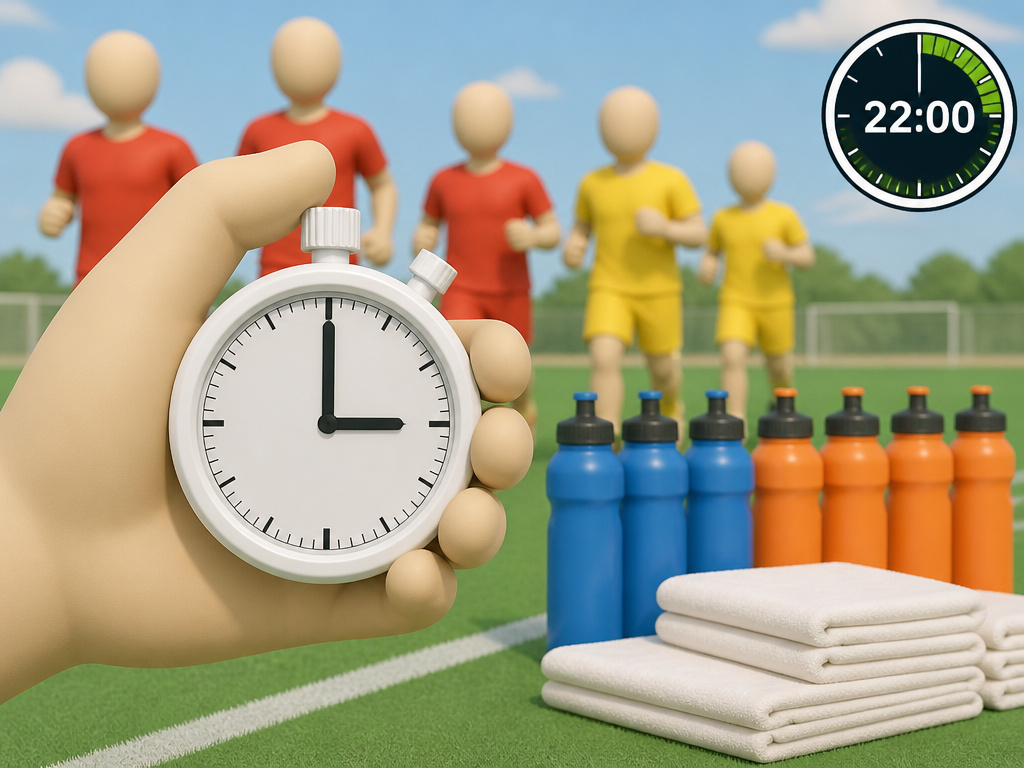
Picture the scene: players jog to the touchline, grab bottles, and towels sit ready around the pitch edge. Three minutes later it’s back to football. Not everyone thinks that’s enough.
| Source | Position on breaks |
|---|---|
| IFAB Law 7 | Drinks 1 minute max; cooling 90 seconds to 3 minutes; half-time up to 15 |
| FIFA, 2026 World Cup (via AP) | Fixed 3 minutes at the 22nd minute of each half |
| FIFPro | Longer half-time; Gouttebarge suggested 20 minutes, plus breaks every 15 |
The part nobody mentions: The fixed 22-minute break was announced for World Cup games. Don’t assume your local league copies it. A Saturday fixture follows its own competition rules, and you’ll sit through the 22nd minute with no pause at all.
A Knockout Tie Has No Fixed Finish Time
When a knockout tie is level after 90 minutes, extra time comes next. The Laws describe it as two equal periods. If that doesn’t settle things, a penalty shootout does.
Penalties can stretch the clock earlier too. Law 7 extends a half until a penalty kick is completed, and a penalty scored directly at the end of the second half ends the match with no kickoff.
The Night Chelsea and Benfica Needed 4 Hours 39 Minutes
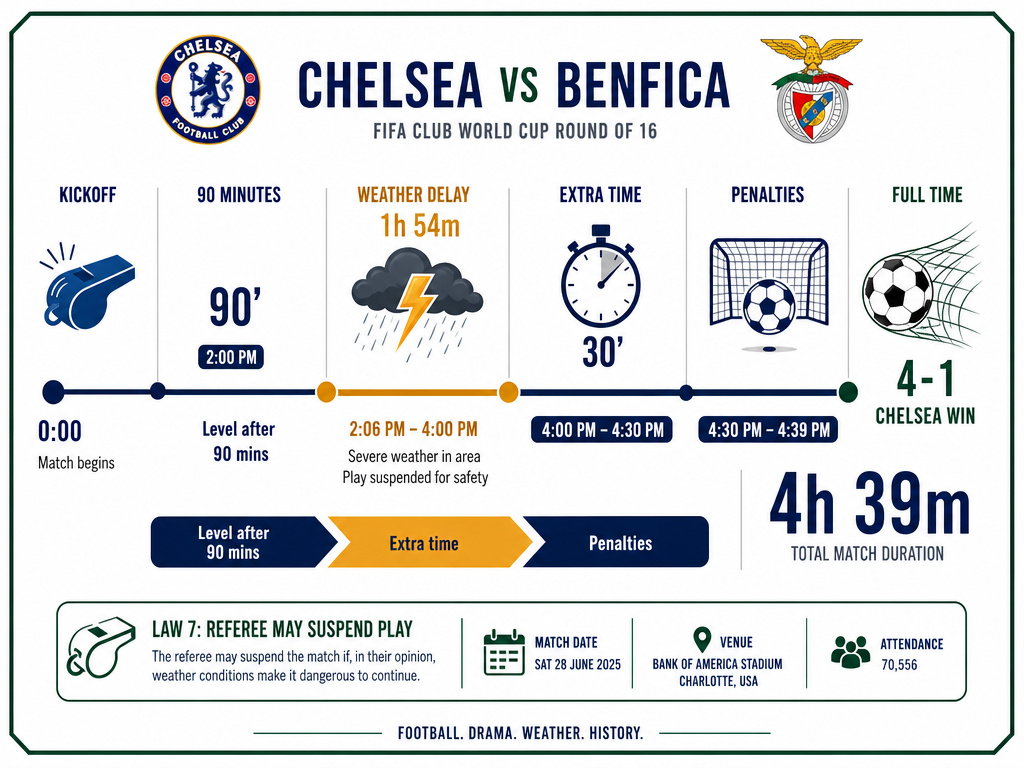
Weather is the real wildcard. In late June 2025, Chelsea led Benfica 1-0 in a Club World Cup last 16 tie in Charlotte, with four minutes of normal time left. A storm triggered local safety protocols and play stopped for a near two-hour delay.
Chelsea scored three times in extra time and won 4-1. The tie took 4 hours 39 minutes to complete. It was the sixth Club World Cup game disrupted by a weather warning. Chelsea boss Enzo Maresca called it “a joke” and said “it’s not football.”
Never plan around the first whistle at a US stadium with thunderstorms in the forecast. Benfica-Chelsea stopped with four minutes left and finished 4 hours 39 minutes after kickoff.
FIFPro said US rules require outdoor events to be halted when thunderstorms are possible, and six matches had lengthy delays. My view: a match with a delay that long is two games stitched together. Under Law 7, the referee can stop, suspend or abandon a match when the field, surrounds or weather won’t allow play.
Why Do Matches Last 90 Minutes? The Dates Don’t Agree
The tidy origin story for 90 minutes has holes. The best-documented dates come from nachspielzeiten.de, a specialist site on the history of the Laws, and even it is a secondary source.
- 1858: Sheffield’s rules used 60-minute matches.
- 1897: the first time 90 minutes appears in IFAB law.
- 1997: extra time with two equal periods enters Law 7, according to the same site.
- Earlier extra-time dates: football-stadiums.co.uk says British competitions used it from 1897 and the world accepted it by 1970.
Other accounts give earlier dates for the 90-minute rule, but I couldn’t trace a citation for any of them. I’d rather admit the gap than repeat a story that sounds neat. If you want to quote a date, use the 1897 IFAB one and say where it comes from.
Does a Youth, Women’s or Grassroots Match Last 90 Minutes?
Three things set the length at lower levels: the Laws, the competition rules, and what both teams agreed before kickoff. Law 7 allows a shorter match only on that agreement, and competition rules must state the half-time length.
Youth lengths vary by country and age band. I won’t guess a table I can’t source, so check your league’s rules. I also found nothing in my sources that sets a separate adult women’s length, so the same advice holds.
Small-sided formats set their own lengths. 5-a-side football and 7-a-side football each run on their own rules, so look up the format before assuming 90.
Picture a Sunday pitch with the light fading behind the goalposts. Under Law 7, a match can be shortened for insufficient light, but only before it starts. If heavy rain wrecks the pitch mid-game, the referee and both teams can agree to shorten the half-time interval.
An abandoned match is replayed unless the competition decides otherwise. In principle, a team that causes abandonment by having fewer than seven players forfeits.
What Changed for 2026/27
The Irish FA says the 2026/27 IFAB changes aim to improve flow, reduce time-wasting and clarify substitutions, injury treatment and restarts. One example: if a match official or outside agent interferes with play, it restarts with a dropped ball at the point of interference. The Irish FA says the changes took effect at the start of July 2026, while the Latvian federation, per my notes, gives 1 August 2026. Check your own national association.
Working Out Your Finish Time From Kickoff
Your finish time is the clock plus whatever the referee adds. Here’s the plan, with what goes wrong at each step.
- Start from the 90 minutes. Skip this and you’ll plan for a match that ends on the dot; the 2025-26 Premier League average is 100 minutes 35 seconds.
- Add half-time. Law 7 allows up to 15 minutes. Opta’s total doesn’t say how it treats the interval, so count the full 15. Skip it and you’ll be at the gate a quarter of an hour early.
- Add a buffer for added time and delays. Qatar averaged about ten minutes of stoppage time. Skip it and a long injury or VAR check leaves you stranded.
- For knockouts, add extra time and penalties with no fixed number. Skip this and a tie like Benfica-Chelsea will outrun any schedule.
Stick with me here: for a league game, 100 minutes 35 seconds plus 15 is 115 minutes 35 seconds. Kick off at 3:00 pm and you finish just before 5 pm at the outside. Broadcast shows before and after the match add more, and I have no figure for those.
So can you watch a match on a lunch break? Not a normal one.
How long is a youth football match for each age group?
The fact sheet gives no age-by-age figures, so treat any number you read elsewhere as local rather than universal. What Law 7 does say is useful. The standard match is two equal halves, and that can only be reduced if the referee and both teams agree before the start and the competition rules allow it. In other words, shorter youth games come from competition rules, not from a separate global timetable.
The practical move is to check with whoever runs your league. Ask for the match length, the half-time interval, and whether any drinks breaks apply. Competition rules must state the length of the half-time interval, so that detail will be written down somewhere. Plan your arrival and pick-up around the published fixture time plus a generous cushion for warm-ups, the break and the walk back to the car.
Frequently Asked Questions
Is a football game 2 hours?
Not on the clock alone. The 2025-26 Premier League average of 100 minutes 35 seconds sits under two hours, and half-time of up to 15 minutes brings the total close to it. Extra time, VAR checks or weather delays push games past two hours.
Is football 90 minutes?
On the clock, yes: two halves of 45 minutes. The ball is in play for far less. Opta’s 2025-26 Premier League sample averaged 55 minutes, and the 2022 World Cup averaged between 58:04 and 59:47 depending on the source.
How long is half-time in football?
Law 7 allows up to 15 minutes. The competition rules must state the exact length, so a league can set a shorter break. FIFPro has asked for longer half-time breaks in extreme heat.
How long is an NFL game?
American football is a different sport with its own clock and rules, and this guide covers association football only. I don’t have official NFL data in my sources, so I won’t quote a figure I can’t back up. Check the NFL’s own numbers.
Can the referee shorten the added time on the board?
No. The fourth official shows a minimum, and the referee can add to it but can’t reduce it. A long stoppage right at the end of normal time doesn’t extend the announced time either.
The Bottom Line
So, how long is a football match? Plan to the 115-minute mark for a league game: the Premier League average plus a half-time of up to 15 minutes. Past that point you’re in knockout, VAR or weather territory, and no average will save you.
This week, take a notebook to one match and write the minute of every substitution and the number on the board. You’ll build a feel for added time that no average gives you.
The plan collapses under a thunderstorm warning at a US venue, or in a tie that goes the distance. In those cases, clear the evening.
