
How to Improve Your Weak Foot in Football: Step-by-Step
This post contains affiliate links. As an Amazon Associate, we earn from qualifying purchases.
To improve your weak foot in football, train it with short, controlled touches and passing first, then add movement and pressure. A six-month study found weak-foot use rose significantly, while a 10-year-old study reported a 33.71% strong-leg juggling gain after weak-side training.
That 33.71% jump is the part worth sitting with. It suggests the weak side can teach the strong side. The plan should start with contact quality, then move into games.
What follows: a measurable baseline, two training models, the drills that transfer, the pressure ladder, and the mistakes that stall progress.
Key Takeaways
- Film the baseline clip. That tells you whether the next six weeks worked.
- Start at 5 meters. Progress to 8 to 10 meters only when contact stays clean.
- Compare the two training models. One study used weekly sessions for about four months; coaching plans push 15 to 20 minutes daily.
- Use weak-foot rules for short blocks. Permanent restrictions can create artificial decisions.
- Watch for sore ankles and hips. The sources don’t give an injury protocol, so add rest when sharp pain appears.
How to Improve Your Weak Foot in Football: The Research That Changes the Plan
A 33.71% strong-leg juggling gain appeared after 10-year-old beginners trained only the weak side. That’s the result from a Scielo study on bilateral transfer, which looks at skill moving from one leg to the other.
The same study also found the strong-side group’s weak-side juggling regressed by -9.20%. Those numbers challenge the assumption that strong-side practice alone fixes the weak side. That changes the plan.
In a controlled study of 10-year-old novices, football basic technical training used size 4 balls on synthetic grass. Drilling sessions lasted about 25 minutes, followed by 3v3 or 4v4 games for about 15 minutes. The intervention ran once weekly between February and May, allowing transfer effects to be measured without daily high-volume load.
A second study gives game-time evidence. A Journal of Sports Sciences study data tracked 71 young players for six months. The trained group increased weak-foot use, while strong-foot use dropped by 3 to 4%. The SAFALL-FOOT tool was used to analyze technical actions during a 20-minute five-a-side game.
Most players in the six-month study preferred the right foot, 84.5% of the sample.
I would treat this as evidence for planned contacts. The weak foot needs short, repeated touches. Vague wishes don’t count.
Do You Need Daily Drills or Weekly Blocks?
The sources disagree on dose. The Scielo study plan used once-weekly training for about four months. LevelUp.soccer plans push 15 to 20 minutes daily for 30 days, and a six-week plan asks for 200 weak-foot wall reps a day.
| Model | Source | What it means |
|---|---|---|
| Weekly academic block | Scielo study | Low volume, long runway, games included |
| Daily short burst | LevelUp.soccer | High repetition, faster feedback, easy to overdo |
| Hybrid choice | My reading | Use daily short blocks. Rest hard striking. |
The six-week plan aims for 80% on target for passing reps by the end of week 4. It also prescribes 40 reps a day for weak-foot shooting.
The foot will feel ugly first. That’s normal.
I would start with 15 to 20 minutes daily, but I would cap weak-foot shooting volume. The sources don’t give an adult injury model, so soreness is a stop signal. If you want a simple home setup, solo wall passing drills give instant feedback without a partner.
What Is the Best Weak Foot Baseline?
A filmed pass-and-receive clip is the baseline. LevelUp.soccer tells players to film a simple pass-and-receive with the weak foot at 10 yards and score it honestly. If you are asking how to improve your weak foot in football, start with a measurable baseline.
A first touch test is just as useful. The weak foot fails when the ball arrives from the left or right. It can look fine when the ball sits still. (I wouldn’t trust a memory test.)
You hear the dull slap of a mis-hit pass when the plant foot is too far from the ball. The plant foot sets balance and direction, so a bad setup changes contact.
The study used size 4 balls on synthetic grass.
Before you start: Weak-foot work can load ankles, hips, and hamstrings that are used to less volume. Warm up with easy dominant-foot touches first. Stop if sharp pain appears, and don’t turn a 15-minute plan into an hour of hard striking.
- Record the 10-yard test. Use the weak foot to pass, control, and pass again. Without a baseline, progress is guesswork.
- Count clean passes. Aim for 30 to 50 consecutive reps before moving back. If you move back too soon, the wall returns bad passes badly.
- Time the cone slalom. Set 5 to 8 cones 2 feet apart. If you watch your feet, you lose scanning time.
- Shoot from close range, such as 8 to 12 yards from a wall or goal. Note how many hit a corner target. If you chase power, the target gets wider.
That’s the whole test.
Which Weak Foot Drills Actually Transfer to Games?
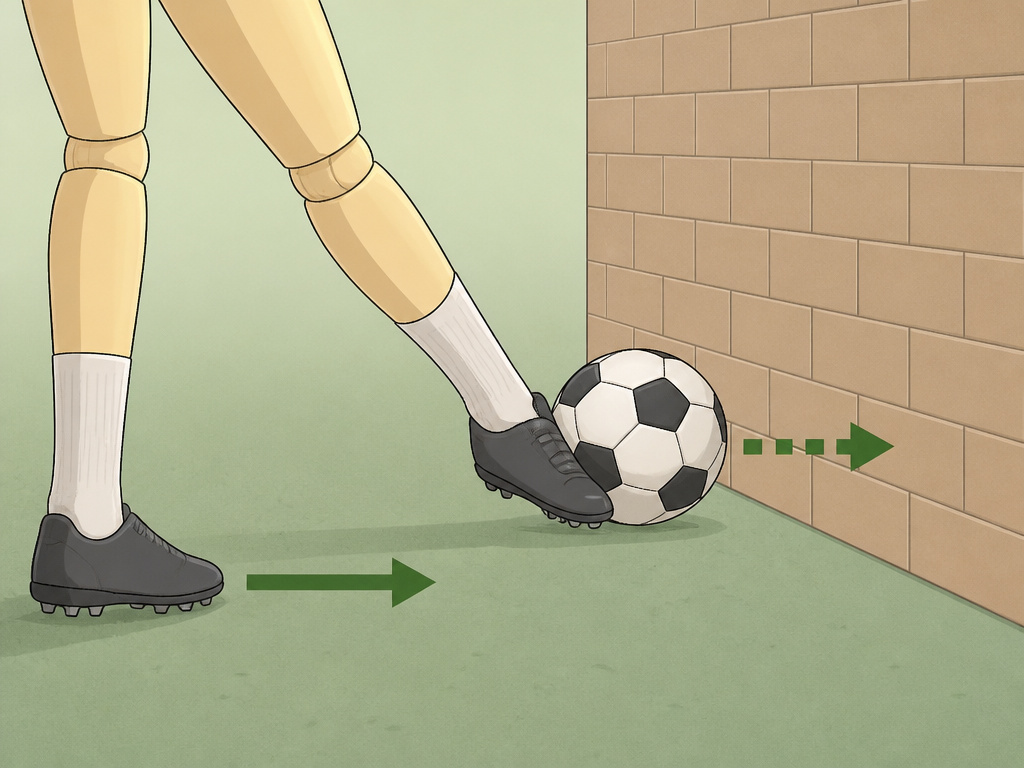
Four surfaces matter first: inside, outside, sole, and laces.
- Toe taps build awareness. Do 30 to 60 seconds per set.
- Inside-outside touches train two dribbling surfaces. Move the ball between cones 18 inches apart.
- Wall work gives honest feedback. Stand 6 to 8 feet from a wall.
- Sole rolls teach soft control. Keep the ball close.
ball mastery gives repeated low-force contacts. The Soccercoachingnotes weak-foot development resource says the first goal is repeatable contact. Simple. Repetition builds confidence.
A clean inside pass feels like a soft push when the plant foot is close.
A 10-minute routine can use 2-minute blocks for touches, passing, receiving, dribbling, and finishing. A 20-minute session can give 4 minutes to ball familiarity. A simple weekly routine can use 20 to 30 controlled passing contacts.
Wall Passing and Receiving
For passing, use short distances first. Start at 5 meters, then move to 8 to 10 meters. Weak-foot work should borrow from principles of accurate passing. The plant foot should point near the target, with the body over the ball.
Practice receiving with the weak foot too. Striking alone leaves the initial touch weak.
Dribbling and Close Control
close control drills teach small touches in tight spaces. Set 5 to 8 cones 2 feet apart. Dribble with the weak foot only, then walk back and repeat. If the ball gets ahead of you, slow down.
Finishing and Laces
For finishing, begin with a stationary ball close to goal. finishing drills can progress to a rolling ball, then receive and shoot. Start 8 to 12 yards from a wall or goal, then move closer if accuracy drops. Add first-time finishes when that feels steady.
If you want laces work, practicing shooting with your laces gives a clear contact point, but keep the weak-foot shot controlled.
Juggling can help familiarity, but it shouldn’t replace passing, receiving, dribbling, and shooting. A player can juggle well and still avoid the foot under pressure.
How Does Pressure Change Weak Foot Training?
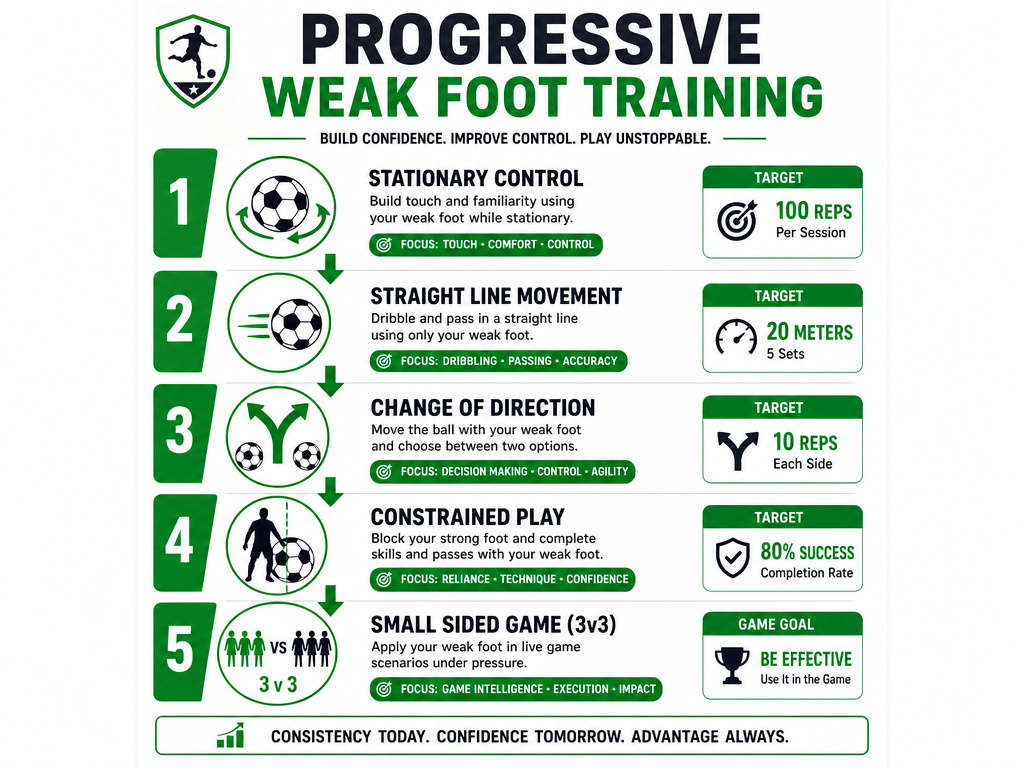
A defender closes. The player switches to the strong foot. Pressure reveals whether the skill is useful.
Start with no pressure, then add movement, decision, a passive defender, and full pressure. Small-sided games should follow. The study plan used 3v3 and 4v4 games after drilling, so the game is part of the training. It isn’t a bonus.
- Stationary touches. Build contact without speed. Skipping this makes later reps sloppy.
- Moving ball. Add a touch into space. Skipping this keeps the skill stuck in a test.
- Decision. Let the player choose weak or strong foot. Skipping this creates rule-following, not play.
- Passive defender. Block the preferred side without full contact. Skipping this hides the fear of mistakes.
- Small-sided game. Use 3v3 or 4v4 pressure. Skipping this leaves the weak foot out of real games.
I wouldn’t chase perfect symmetry. Useful use is the target: one clean weak-foot reception, one controlled 10-meter pass, one close-range finish.
Common mistake: Keeping a weak-foot-only rule for a full game. It can teach artificial decisions, so remove the constraint once the player gets useful reps.
Confidence matters. If every mistake brings criticism, players return to the strong foot. Give specific feedback: ‘That pass needs less force’ or ‘Place your support foot closer.’
What Are the Common Weak Foot Mistakes?
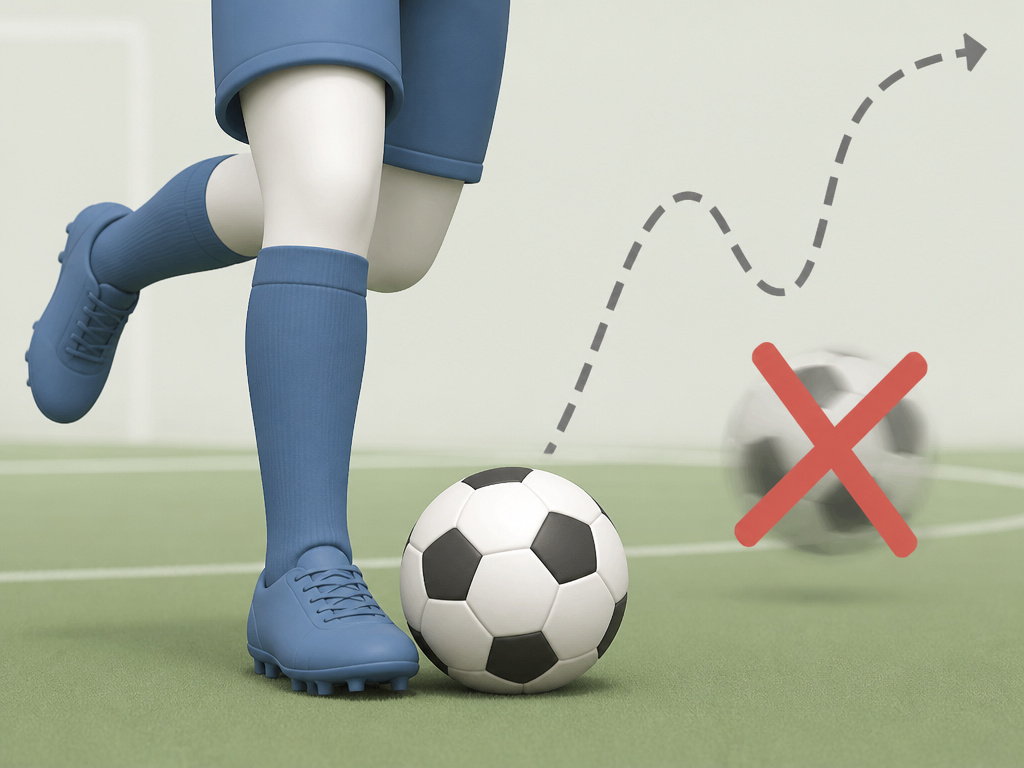
Too much force ruins most weak-foot reps. When you ask how to improve your weak foot in football, the answer is control before force.
| Mistake | Why it fails | Fix |
|---|---|---|
| Kicking too hard | The weak foot has poor control, so force breaks contact | Shorten the distance |
| Poor plant foot | Balance and direction come from the support side | Place the plant foot near the ball |
| Always using the weak foot | The player ignores better strong-foot options | Use short constraint blocks |
| Juggling as the only test | Clean touches don’t prove game use | Add receiving and passing under pressure |
The table covers the big ones. I would add one more: don’t make juggling the whole plan. Juggling is one tool. Game use is the measure.
The sources don’t give a recovery protocol, so I would treat sharp pain as a stop sign. Sore ankles, hips, or hamstrings mean less volume. They don’t mean more grit.
Does Age or Position Change the Weak Foot Work?
The research covers youth players.
The Scielo study used 10-year-old beginners. The six-month study tracked players aged 11 to 16. Those findings don’t test adults, so I would keep expectations modest.
In the six-month study, the Under-13 group increased weak-foot use by +71.8%, the Under-15 group by +56.6%, and the Under-17 group by +54.2%.
For young players, the gap between feet can change with practice and development. Don’t label a 10-year-old permanently.
Easy to miss: A player can avoid one foot at age 10 and still develop it later. Give opportunities before setting a limit.
Central defenders and midfielders need the weak foot during build-up. A pass that arrives on the weak side shouldn’t require an extra touch. crossing technique matters for wide players too. A right-footed left winger should be able to cross with the left or cut inside.
Forwards get the cleanest payoff. If a chance arrives on the weak side, moving the ball back to the strong foot gives a defender time. Close-range weak-foot finishing can stop that delay.
Use the weak foot in warm-ups, small-sided games, and 1v1 situations. LevelUp.soccer suggests a maintenance habit: 10 minutes of weak-foot work in every solo session and no avoiding the weak foot in small-sided play.
Structured multi-week weak foot training plan
Commit to a structured plan over several weeks. One research model involved drilling sessions lasting about 25 minutes, followed by small-sided games. A practical 30-day plan prescribes 15 to 20 minutes of focused weak-foot training daily. Structure your sessions in blocks. Start with ball familiarity activities like inside and outside touches, then move to passing. Begin short passing at a close distance, prioritizing accuracy before power, and aim for a high number of controlled contacts. Progress to shooting from a stationary ball at close range, then to moving balls. Integrate this practice frequently but avoid excessive volume in one session to prevent frustration. The goal is functional ability, not perfect symmetry.
How to use your weaker foot in daily life and casual play
Integrate your weaker foot into all casual ball play. Whenever you are just kicking a ball around, make a conscious rule to use only your weak foot for a set period. Start with simple ball manipulation like sole rolls and short dribbles between objects. Practice receiving the ball with your weaker foot, not just striking it. You can do wall passing from a short distance, aiming for consecutive clean reps. When shooting for fun, start close to a wall or goal with a stationary ball. The key is to make weak-foot use a normal part of your interaction with the ball, moving from isolated practice to incorporating movement and simple decisions, just without the pressure of a formal game.
Frequently Asked Questions
How do I train my weak foot in football?
Start with short, controlled touches and wall passing. Move from stationary work to receiving, passing, and finishing under pressure. Keep sessions short and repeat them often.
Can you strengthen a weak foot?
You can improve control, contact quality, and confidence. The studies show transfer effects and increased game use. The goal is useful control. Raw strength alone isn’t enough.
What is a weak foot in football?
It is the foot a player uses less confidently. The two feet can differ by skill, so a player can receive well but shoot poorly with the weak side.
How long does it take to improve your weak foot in football?
30-day plan can build a usable baseline, while the six-month study showed game-use changes after longer training. Expect short gains first, then pressure transfer.
Should I use only my weak foot in practice?
Use weak-foot-only rules for short blocks. Permanent rules can create artificial decisions, so let players choose the better foot once they get useful reps.
Before You Go
So, how to improve your weak foot in football? Start today by filming the 10-yard pass-and-receive clip.
That one test turns vague effort into a target. I wouldn’t make rainbow flicks and elasticos the main fix.
Which weak-foot moment costs you the most? I would answer with control under pressure.
