
How to Improve First Touch in Football: Simple Drill Steps
This post contains affiliate links. As an Amazon Associate, we earn from qualifying purchases.
*To improve first touch in football, decide your next action before the ball arrives, then move the ball away from pressure and into space.* Coach Notes says the default touch is half a metre to a metre. FIFA Training Centre says move onto the pass. Combine both: receive on the move, then direct the touch into space.
That pairing matters because a touch without movement gives the defender a free step. A touch with movement buys you a half-second. Modern Soccer Coach says intention comes before contact, and the most useful scan happens when the ball starts moving. A key principle of how to improve first touch in football is to scan early.
What follows: a simple checklist, wall and partner work, body-shape cues, and the game-like pressure that turns touch into habit.
Key Takeaways
- Scan at ball movement, because defenders shift too.
- Receive on the move to get a firm touch and more power, per FIFA Training Centre.
- Keep touch volume high: Coach Notes says touches per minute is the only metric that matters at a young age, while the University of Tsukuba study emphasizes a controlled foot approach and limiting rebound.
- Limit rebound and vertical pop; a Tsukuba study links them to slower trap-to-pass time.
- Decide before contact; intention is a prerequisite for a useful touch.
What a good first touch actually means
A first touch is the receiving action that sets up the next move. It changes where defenders have to stand.
A good first touch improves the player’s situation by moving the ball away from pressure and into space. FIFA Training Centre recommends moving onto the pass, while Coach Notes describes a default touch of half a metre to a metre. The University of Tsukuba study links controlled approach, pass-ready posture, and limited rebound to a faster trap-to-pass transition.
The practical question of how to improve first touch in football is simple: where does the ball go? First touch is the most used skill. The difference is a ball killed dead under the feet and a ball moved smoothly into the next action.
I treat control as a directional decision. Every touch should take the ball away from pressure and toward the next action. The first touch matters more than the dribble, because a useful first touch decides where the next defender stands. Flashy moves win views, but a disciplined defender punishes them. A shoulder drop unbalances a defender without the ball moving.
A good first touch receives the ball in a way that improves your situation. You barely notice it when it’s right. The whole action falls apart when it’s missing. Coach Notes says players with average technique and excellent awareness receive better than players with silk feet and no picture of what is around them.
Modern Soccer Coach lists four core references: Ball, Space, Teammates, and Opponents. If you’re off-balance, check the nearest opponent first. If you’re facing forward, prioritize a switch or a vertical pass. Priorities change with the situation.
In a crowded area near your own box, place the ball close to your body. Then return it to the goalkeeper. In open space, move the ball into that space immediately. Which touch would you choose?
That idea links to learning to play with your head up and the broader how to improve first touch in football. Scanning before the pass gives the receiver a target for the touch. The FIFA Training Centre also stresses body orientation. An open body helps the player take a touch and play a quick, accurate pass.
Decide before the ball arrives
Intention matters more than decoration. Modern Soccer Coach says players need to know what they intend to do before the ball arrives.
That changes practice. A drill should ask a question. It should also attach a next action.
I used to watch matches once, for the story. Now I watch them twice. The second viewing’s for shape, and it shows how many good touches start before the ball arrives.
How Do I Improve First Touch in Football Without a Team?
You don’t need a full pitch. You need a wall, a ball, and a plan (a garage door works).
Before you start: Check the surface for wet grass, loose gravel, and holes. A slick patch risks rolling an ankle during a hard touch. Use a ball with a clean stitch line and warm up the ankles and hips first.
Add first touch wall drills and rebounder training to your routine. Practice bringing down a high ball with thigh cushions. Finish with ball mastery exercises in a small square.
- Start with barefoot juggling. Use both feet. If you skip the warm-up, your ankles stay tight and the first touch gets stiff.
- Hit the wall, then take the rebound into space. A stationary stop gives the next pass no runway.
- Change the rebound height between sets. Repeating one height trains only one touch.
- Cushion it with the thigh, then let it drop to the foot. A chest-only touch leaves the ball too high for the next pass.
- Keep the ball close, then push it half a metre away. Close-only control fails when you need space.
A clean touch sounds like a soft thud, not a slap. A slap means the ball’s still too energetic. Slow your step or meet the rebound earlier.
Wall and rebound work
Wall work’s useful because it returns the ball without a partner. The rebound teaches timing. It also exposes a lazy foot.
A partner passes the ball from different angles. This keeps the touch decision live.
Use the inside of the foot for a wide, safe touch. Use the outside to open your body and set up a forward pass. FIFA Training Centre says being on the toes and opening up helps the receiver take a touch and play a quick pass.
If you have a rebound net, aim it at different angles. If you don’t, a brick wall works (avoid windows).
Keep the ball moving. The goal’s to create the next action. Avoid killing the ball dead.
What Does the Research Say About Trap-to-Pass Time?
The movement research gives a useful warning. A touch that looks controlled still slows the next pass. The University of Tsukuba study measured trap-to-pass time, the gap between control and the next pass. It used motion capture to track body movement.
The study measured 17 right-foot-dominant male university players from a high-level Japanese collegiate team. They ran a 5 m sprint-trap-pass task while receiving a live pass.
Four factors were linked to a slower next pass:
- a faster right-foot step onto the ball before contact
- more bend at the left hip at contact
- more rebound after contact
- more ball speed straight up after contact
The study’s practical point’s simple. Use a controlled step onto the ball, a pass-ready body position, and keep the ball low after contact.
What the study measured
The task was dynamic. Players received a live pass after a sprint. That matters. A static trap doesn’t show what happens when the body’s still moving.
A bad touch pops up and leaves a visible bounce before the next step. That bounce creates a delay.
| Question | Coach Notes | FIFA Training Centre or Tsukuba | What to do |
|---|---|---|---|
| Default touch distance | Half a metre to a metre into space | Move onto the pass; keep body open | Take a touch that sets the next action |
| Youth progress metric | Touches per minute | Controlled step and rebound control | Track volume and useful touches together |
| Pressure cue | Decide before ball arrives | Use body orientation and curving runs | Scan, then choose the touch direction |
The Universitas Garut study adds another angle. It used 23 football players in a four-week positional play program. The training had 16 sessions, held four times a week for ninety minutes each. The study reported significant improvements in first-touch performance and decision-making, with p < .001.
That result supports game-like practice. It keeps touch inside the game.
The study used 23 players. Treat it as a useful signal. The study calls for more work across age groups and levels. I lean on match notes more than numbers, but the study gives a clear cue.
Why Does My First Touch Feel Rushed?
A rushed touch comes from late information. The ball arrives. Then the head lifts. By then, the defender’s chosen your option.
Easy to miss: A touch that pops straight up leaves the next pass late. The Tsukuba study links greater ball speed straight up to longer trap-to-pass time.
Use close control drills to make the first stride part of the touch. Coach Notes says the default first touch should move the ball away from the body. That’s the habit that beats a press.
Practice receiving to turn when space allows. FIFA Training Centre says an open body orientation and close control help players adjust quickly to set up a shot. Turning creates that angle.
Add training your weak foot once the dominant foot’s reliable. A predictable player becomes easy to defend. A player who uses both feet gives the team more passing lanes.
| Problem | Likely cause | Quick fix |
|---|---|---|
| Ball pops up | Vertical rebound | Meet the ball lower |
| Touch needs a second action | Dead stop | Move into space |
| Pass feels late | Late scanning | Scan when the ball moves |
Mistakes to avoid:
- You kill the ball dead. Coach Notes says that forces a second touch.
- You scan after the pass. Defenders move while the ball travels.
- You let the touch pop up. That adds delay before the next action.
- You only practice ground passes. Lofted, driven, and bouncing balls need cushioning and foot control.
The drop in touch under pressure’s normal.
Nervous players stop turning in matches.
Expect the mess. Then repeat with the decision attached.
Two-touch pattern
FIFA Training Centre gives a clear match standard. When receiving and where possible, the first touch should take the player toward the opposing goal. The player should try to pass or shoot with the second touch.
Use this sequence in a small game:
- Receive facing the goal.
- Take the first touch into space.
- Play the second touch as a pass or shot.
FIFA Training Centre says a small step after a pass opens an exit route. It simulates drawing in a defender. It creates space for the return pass.
If the first touch goes wrong, recover with a simple option.
That’s a first-touch decision too.
How to Build a Weekly First Touch Session
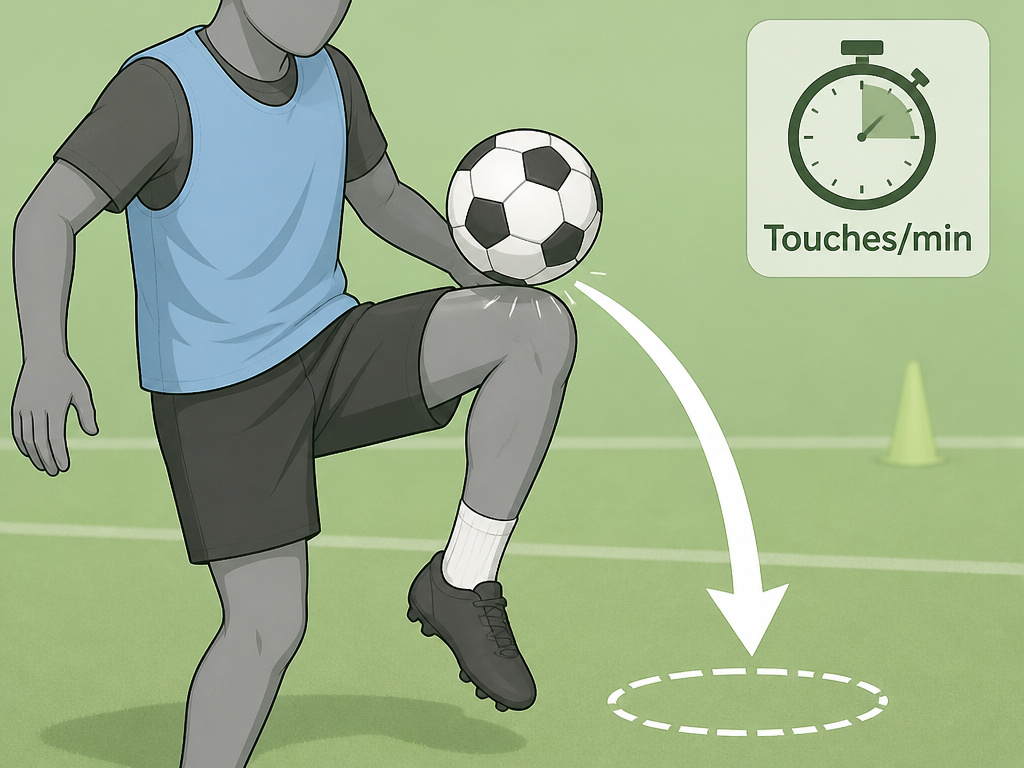
Age changes the focus. For young players, Coach Notes says touches per minute is the only metric that matters. Every arrival at training starts with a ball. Every warm-up includes receiving on the move.
Avoid queues. Touches per minute’s the metric.
For adult teams, Coach Notes says first touch fits inside possession practice. Set constraints in rondos and games. Use a two-touch maximum. Give bonus points for receiving on the half turn.
The technique improves inside the football. It counts in matches.
I used to trust memory for football history. After mixing up two seasons, I started keeping a timeline document. I now use a simpler version for touch: a short note after each game. Did the touch create time?
Did it force a second touch?
Where this goes sideways: Practicing only stationary touches.
A weekly plan stays small. The positional study used four times a week for four weeks. You don’t need to copy that schedule. Use it as a reference for consistency.
These things matter most:
- Volume: get plenty of touches in a short space.
- Direction: send the ball into the space you chose.
- Pressure: add defenders after the touch is reliable.
Do you scan before the ball moves? If not, start there. The most important time to scan is when the ball moves, according to Modern Soccer Coach. A pass changes the situation.
Information from a few seconds earlier becomes stale. Scanning farther away is harder. It reveals good chances.
How to practice one-touch and two-touch play
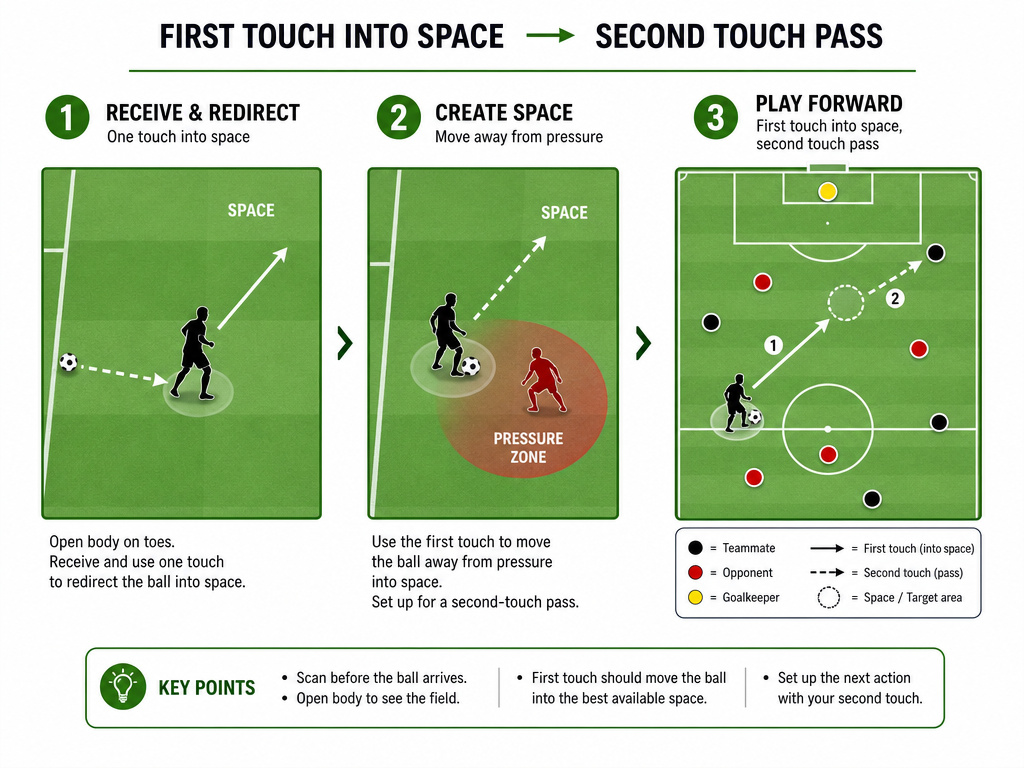
First-touch quality is defined by your intended next action. Before the ball arrives, you must decide. The goal is to receive the ball in a way that improves your situation. For one-touch play, your body orientation is critical. Be on your toes, open your body, and move onto the pass. This helps you play a quick, accurate return. For two-touch play, your default touch should move the ball away from pressure and into space, setting you to face the right direction. The touch should set you to pass or shoot with the second. Every decision revolves around the ball, space, teammates, and opponents.
How to structure progressive first touch drills
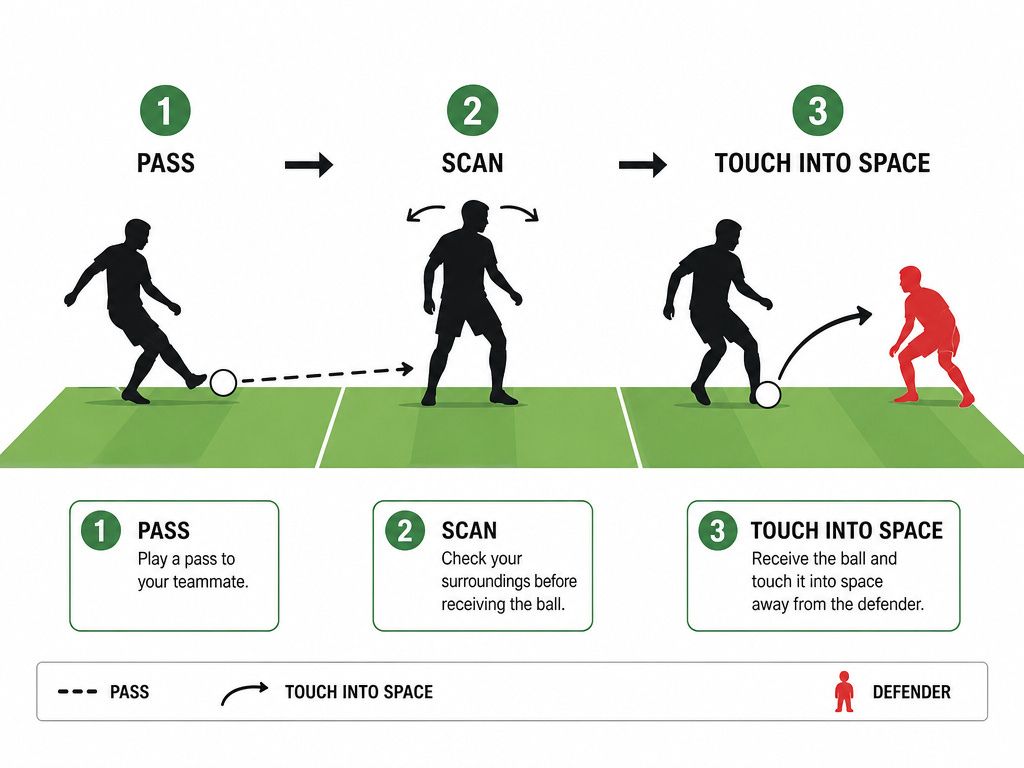
Start with volume. For young players, touches per minute is the primary metric. Use simple, repetitive exercises to build a foundation. Progress by adding constraints that mirror game situations. Introduce movement; players should move onto the pass rather than receiving statically. Add passive then active pressure, forcing the receiver to take a touch away from a defender. Incorporate scanning, especially as the ball travels. Later drills should emphasize a controlled foot approach and contact posture to limit excessive ball rebound. Finally, integrate decision-making by using positional play scenarios, where the touch must account for space and the next action.
Frequently Asked Questions
How to get a better first touch in football?
Move onto the pass, then direct the ball into space. Coach Notes describes a default touch of half a metre to a metre. Make the touch part of the next action.
What drills improve my touch in football?
Use wall work, rebounder work, and partner passes from different angles. Add high balls and bouncing balls. Finish with a game-like receive and turn sequence.
What is the hardest skill in football?
First touch is among the hardest because it combines timing, body shape, and decision-making under pressure. It happens in a split second, and the next action depends on it.
Who has the best first touch in football?
There’s no fixed answer. The Modern Soccer Coach guest article points to Dennis Bergkamp’s touch against Newcastle United as an example of redirecting the ball with intention.
How do I practice first touch at home?
Wall, a ball, and a small space are enough. Use inside and outside touches, thigh cushions, and quick rebounds. Keep the queues short and the touches high.
The Bottom Line
To improve first touch in football, choose the next action before the ball arrives. Then take a touch that creates time. Avoid a touch that merely stops the ball.
Pick a simple drill this week. Use a wall or rebound net, then take the rebound into space. The first touch should improve your situation. If it doesn’t, change the direction.
If you want a question for your next match, ask: did the touch create time? If the answer’s no, the fix is earlier scanning and a clearer intention.
