
How to Do an Elastico: Step-by-Step (Without the Fluff)
This post contains affiliate links. As an Amazon Associate, we earn from qualifying purchases.
To do an Elastico, use the outside of your foot to push the ball one way, then immediately wrap the inside of the same foot around the ball to cut it back the other way. The two touches must be a single, fluid motion, sold with a shoulder drop to unbalance the defender.
That’s the textbook answer. It’s also what makes most first attempts look like a clumsy shuffle. The gap between knowing the sequence and pulling it off in a game is where the real work happens.
What follows is a walkthrough of that gap, answering the core question of how to do an elastico. We’ll cover the four physical steps, the shoulder feint that makes them work, and the one drill progression that actually builds game-speed confidence. We’ll also settle the Elastico vs. Reverse Elastico confusion and when you should even try this move in a match.
Key Takeaways
- The move is two touches in one motion, a push with the outside foot, then an immediate cut-back with the inside. Hesitating between them tells the defender everything.
- Sell the fake with a shoulder drop and head movement in the direction of your first touch. The ball barely moves; the defender’s weight does.
- Start stationary, then add a slow roll. Practicing from a standstill builds muscle memory, but you’ll only need the skill when moving.
- The Reverse Elastico starts with an inside touch. It’s a different move for different scenarios, not just a fancy variation.
- In video games like EA Sports FC, the input is a quarter-circle on the right analog stick. Rush it, and you’ll trigger a roulette or step-over instead.
The 4-Step Breakdown (and the One Step Everyone Skips)
Most tutorials on how to do an elastico list three steps: outside touch, inside cut, explode away. They’re missing the step that happens before your foot even touches the ball.
Step 0 is the sell. Before you push the ball with the outside of your foot, you have to commit your upper body to that fake direction. Drop your shoulder. Shift your weight. Look where you’re pretending to go. A defender reads your hips and eyes, not your feet. If your body stays neutral, the touch is just a touch.
Now for the footwork.
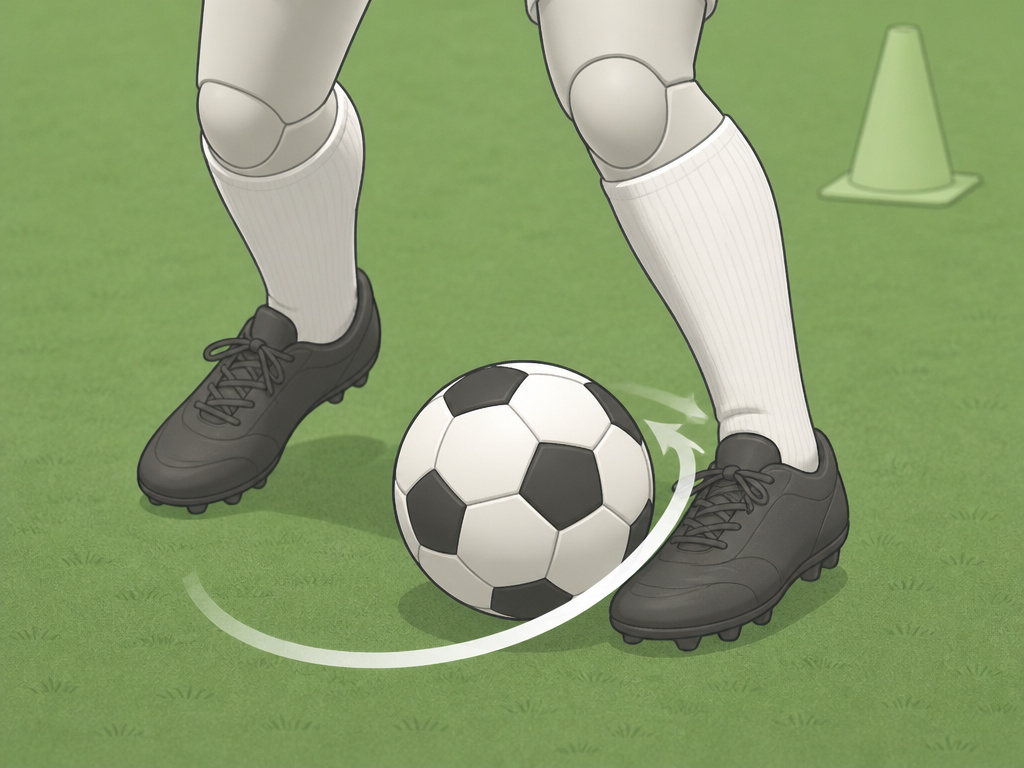
Step 1: The Outside Bait. With the ball slightly ahead of your standing foot, use the area just behind your little toe to push the ball diagonally forward and away from you. We’re talking a small push, enough to tempt a defender to stick a foot in. A bigger touch loses control and gives them time to recover.
Step 2: The Inside Wrap. This is the move. Without pausing, rotate your ankle inward. The inside of your foot, just below the arch, hooks around the front of the ball. Your foot doesn’t stop after the first touch; it flows around the ball’s curve. The ball should cut back sharply, almost touching your standing foot.
Step 3: The Exit. The cut-back should put the ball into the space you just vacated. Your next touch, often with the other foot, needs to be into that space and away from the defender. This is where you change pace. The Elastico isn’t a speed move; it’s a direction change. The explosion comes after.
Common mistake: Treating the two touches as separate actions. The moment you pause between them, the defender sees the ball sitting still and takes it. The entire move should be quick from first touch to exit.
Why the Shoulder Drop Matters More Than Your Feet
You can have perfect footwork and still get tackled. The defender isn’t watching your boots; they’re reading your intention. Your body sells the lie.
When you initiate the outside touch, your shoulder should dip toward that same side. Your head should turn as if you’ve seen a passing lane or a teammate making a run. It’s a full-body commitment to the fake. The defender’s natural reaction is to shift their weight to block that perceived path.
That weight shift is what you’re exploiting. Their planted foot is now on the wrong side. When you cut back with the inside of your foot, they’re stuck. They can’t re-plant and change direction in time. The move works because you beat their brain before you beat their feet.
Without the shoulder drop, you’re just moving the ball from one foot to the other in front of a defender who hasn’t moved. That’s not a skill move; it’s a pass to the opponent.
Drills: From Your Backyard to Game Speed
You won’t learn this by watching highlights. You have to build it layer by layer, and that means starting slow.
Phase 1: Stationary & Slow Roll. Stand over a stationary ball. Practice the outside-inside wrap motion without any power, just feeling the ball roll from the outside to the inside of your foot. Do this fifty times with your strong foot. Then, start with the ball slowly rolling toward you. Time your touch so the move happens as the ball arrives. This builds timing on a moving target.
Phase 2: Cones at a Walk. Set up two cones a short distance apart. Dribble slowly toward them, perform the Elastico between them, and exit past the second cone. The goal isn’t speed; it’s accuracy and maintaining the fluid motion while moving forward. Once it feels smooth, replace the second cone with a passive defender, a friend who stands still but forces you to go around them.
Phase 3: The Weak-Foot Factory. You are not ambipedal. Nobody is. But your weak foot will improve if you force it. Repeat Phase 1 and 2 with your weak foot only. It will feel awful. The touch will be heavy, the wrap clumsy. That’s the point. Do multiple stationary reps every practice session. The neural pathways will build. A serviceable weak-foot Elastico is a terrifying weapon because defenders never expect it.
Phase 4: Pressure & Decision. This is the final test. Have a defender apply light, then medium pressure. Their job isn’t to tackle you, but to force you to decide when to use the move. This bridges the gap between technique and real game situations where you need to beat a defender. It teaches you to read the defender’s stance, the move works best when they are square-on and flat-footed.
Elastico vs. Reverse Elastico: It’s Not the Same Move
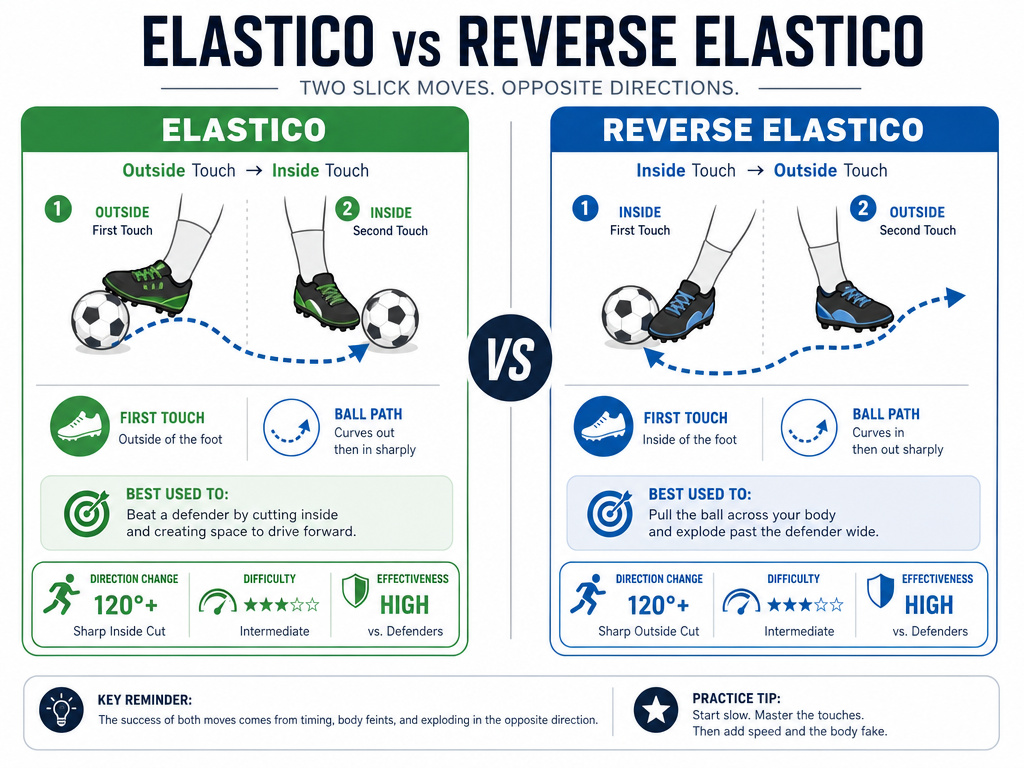
This is where most online guides get fuzzy. They are two distinct skills.
| Aspect | Elastico (Standard) | Reverse Elastico |
|---|---|---|
| First Touch | Outside of the foot | Inside of the foot |
| Second Touch | Inside of the foot wraps around | Outside of the foot wraps around |
| Ball Path | Pushes out, then cuts back in | Pushes in, then cuts back out |
| Best For | Cutting inside from the wing | Going outside a defender on the touchline |
| Famous Practitioner | Ronaldinho | Ronaldo Nazário, Neymar |
The Reverse Elastico is harder for most right-footed players because it requires pushing the ball across your body with the inside of your foot before wrapping the outside foot around it. It’s a different mechanical motion. Don’t try to learn both at once. Master the standard version first, the one that made Ronaldinho famous, before adding the reverse to your toolkit. It’s a complementary move, not an upgrade.
Game Situations: When to Actually Use It
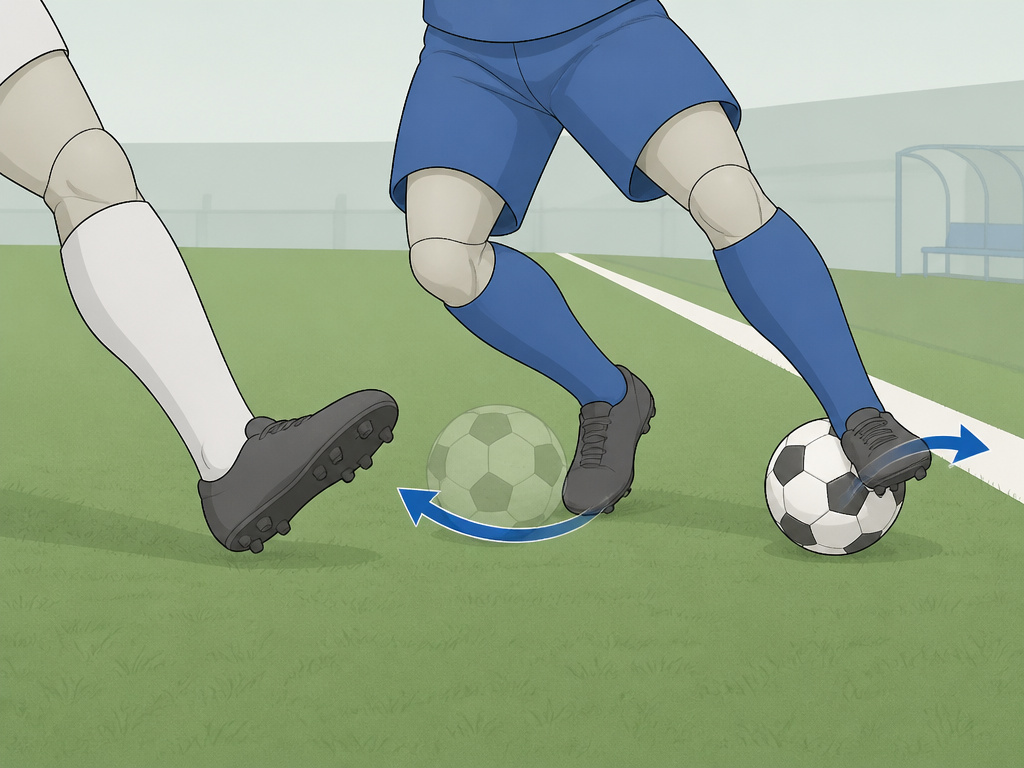
The Elastico is not a playground trick. It’s a tool for a specific job. Use it in the wrong context, and you’ll lose the ball in a dangerous area.
Where this goes sideways: Trying an Elastico in your own defensive third or in a crowded midfield. The move requires a half-yard of space to initiate. In traffic, that space doesn’t exist, and you’ll get swarmed.
The Wing is Your Friend. This is the classic scenario. You’re driving down the right touchline on your right foot. A defender is shepherding you, staying goalside. A quick Elastico cuts the ball inside, past their covering leg, and opens up the field for a shot or a pass. It’s effective because the defender is focused on stopping the cross.
Isolating a Defender. In the final third, when the play has broken down and you’re one-on-one with a defender facing you, the Elastico can create that half-yard of space for a shot. The defender is afraid of a foul in the box and is often flat-footed. The sudden change of direction is enough to get the shot off.
It is not a move for beating a double team. It is not a move for escaping pressure. It’s a precision instrument, not a blunt weapon. Knowing when to use a simple body feint or a Cruyff Turn is often smarter.
Troubleshooting Video Game Execution
For players of EA Sports FC (formerly FIFA), executing the Elastico can be frustrating. The input is a quarter-circle rotation on the right analog stick (e.g., from down to right for a right-footed move to the right). The game registers it as a 5-star skill move.
The most common failure is rushing. If you flick the stick too quickly, the game’s input interpreter reads it as a different sequence, often a roulette or a simple step-over. The trick is a smooth, deliberate, and complete quarter-circle motion. Practice in the skill games arena until the motion feels consistent. Remember, your virtual player also needs the correct attributes, high dribbling and agility stats, for the animation to trigger cleanly. A slow center-back will never perform it like Messi, regardless of your stick work.
The Shadow of Ronaldinho (and Why It’s Overrated)
No discussion of the Elastico is complete without Ronaldinho. He didn’t invent it, but he perfected its use at the highest level, making it a signature part of his joyful, destructive style. He made it look inevitable.
But here’s my take: the move is overrated in the modern game. Defenders are more athletic, more disciplined, and study film. The pure, unadorned Elastico from a standstill that worked in 2005 is easily read today. What made Ronaldinho’s version work was the context, the blinding speed of his feet combined with the total commitment of his feint. He sold the fake with his whole soul.
For most amateur players, spending hours perfecting this one flashy move yields less return than mastering a reliable step-over or a sharp cut with the outside of the foot. It’s a luxury skill. Focus on the fundamentals of close control and ball mastery first. The Elastico is the icing, not the cake. You need a solid game before you decorate it.
That said, the process of learning it, the hours of repetitive ball control drills to make two touches into one motion, will improve your overall touch and coordination. That’s the real value.
Prerequisite Skills for the Elastico
You need a reliable inside-to-outside touch. Practice pushing the ball diagonally away from your body with the outside of your foot while moving at a jogging pace. Control is everything; the ball should stay close enough to instantly pull back. This initial touch sells the fake. Your body must sell it too, with your eyes and shoulders committing to that outside direction. Master this basic feint before adding the cutback. The elastico is just a rapid, deceptive combination of these two touches, so fluidity in the first move sets up the entire trick.
How to Do an Elastico in Video Games
This is a five-star skill move, so only specific high-skilled players can perform it. The input is a quick, fluid quarter-circle motion on the right thumbstick. Start by flicking the stick to the side your player is facing, then immediately roll it around toward the direction of their back foot. The game reads this as one fast, curling motion. Time it as a defender steps in to tackle. A successful elastico will see your player quickly push the ball outward and then snap it back inside with the same foot, leaving the defender lunging at air.
Frequently Asked Questions
How do you do the Elastico?
Use the outside of your foot to push the ball to one side, then immediately use the inside of the same foot to wrap around the ball and cut it back in the opposite direction. The two touches must be a single, fluid motion, sold with a convincing shoulder drop.
What is the hardest skill in football?
Difficulty is subjective, but skills like the Rabona or the Bicycle Kick are often cited due to their technical and athletic demands. The Elastico is challenging because it requires exceptional ankle mobility and coordination in a very short space.
Is Elastico a hard skill?
Yes, for most players, it is an intermediate-to-advanced skill. The mechanical coordination of the quick, opposite touches with the same foot is not natural and requires dedicated, repetitive practice to perform reliably under pressure.
Is Elastico easy?
No. While the concept is simple to understand, executing it with the speed, fluidity, and deception needed to beat a defender is difficult. It looks easy when performed by a master because they’ve hidden the thousands of repetitions it took to get there.
What’s the difference between an Elastico and a Reverse Elastico?
The standard Elastico starts with an outside-foot touch. The Reverse Elastico starts with an inside-foot touch, then wraps with the outside. They send the defender in opposite directions and are used in different tactical situations.
Before You Go
One rule most guides skip: if you can’t do the move three times in a row perfectly on your weak foot at a walking pace, you’re not ready to try it in a game. That’s the threshold. The pressure of a match will degrade your technique, so your baseline has to be rock solid.
Spend your first ten minutes of practice on stationary reps. Then spend five minutes on your weak foot. The consistency this builds matters more than one flashy success. The Elastico is a great party trick, but the real goal is to build the footwork and body control that makes you a harder player to defend. That comes from the boring reps, not the highlight.
