
Progressive Passes and Carries Explained: What to Check
This post contains affiliate links. As an Amazon Associate, we earn from qualifying purchases.
Progressive passes and carries explained means actions that move the ball significantly toward goal. On FBref/Opta, a pass counts at 10 yards or into the penalty area; carries use 10 or 5 yards, depending on zone. Providers differ, so check definitions before trusting a stat.
The 10-yard and 5-yard lines are provider choices, and they explain why sites disagree about the same match. StatsBomb uses a percentage rule, Wyscout uses zone-based meters, and FBref/Opta add an origin exclusion.
What follows: definitions, provider differences, carry-versus-pass comparisons, and the context needed to avoid misreading a possession-heavy team.
Key Takeaways
- Check the provider definition first. FBref/Opta, StatsBomb, and Wyscout don’t use the same pass threshold.
- Carries measure ball movement at feet. A player registers a carry without beating a defender.
- Position changes the read. Centre-backs and deep midfielders have more ground to cover than forwards.
- Raw counts flatter possession teams. Compare per-90 and positional context before making a judgment.
- Progression is a family of stats. Progressive passes, carries, and passes received answer different questions.
What Counts as a Progressive Pass?
A full-back releases a flat pass into midfield. It travels 10 yards closer than the ball had been in the last six passes.
A progressive pass is a completed action that moves the ball toward the opponent goal by a provider-defined distance. FBref and Opta use 10 yards or entry into the penalty area. StatsBomb uses 25 percent of remaining distance. Wyscout uses 30, 15, and 10 meter thresholds by pitch zone. Definitions matter.
Completion matters. I’d rather see a completed 10-yard pass than a risky attempt that fails.
FBref/Opta use 10 yards closer than the furthest point in the last six passes, or any completed pass into the penalty area, and exclude passes originating from the defending 40% of the pitch. STL City SC restates the FBRef definition as 10 yards (30 feet) closer than it has been recently.
A through ball into the penalty area is the clearest example. A driven pass to a midfielder who turns counts if it meets the provider threshold. Both are more useful than a sideways pass that keeps pass completion percentage high.
On a wet pitch, a flat pass skids and finds a midfielder’s feet.
How Are Progressive Passes and Carries Explained by Data Providers?
Provider models explain most disagreements. StatsUltra documents the split, and Sportmonks warns that API choice changes counts. Check the source.
| Provider | Pass rule | Watch-out |
|---|---|---|
| FBref/Opta | 10 yards or penalty area | Excludes defending 40% |
| StatsBomb | 25 percent remaining distance | Uses percentage, not fixed yards |
| Wyscout | 30, 15, or 10 meters by zone | Zone crossing changes counts |
Why the Defending 40% Rule Matters
FBref/Opta exclude passes from the defending 40%, the deep part of a team’s own half. This stops long goal kicks and routine goalkeeper passes from inflating the count. STL City SC’s explainer doesn’t mention that exclusion, so similar definitions hide a different filter.
Percentage Rules and Zone Rules
StatsBomb’s internal method uses 25 percent of the remaining distance toward the center of the goal. Wyscout uses fixed zone thresholds: about 30 meters in the own half, 15 meters across the halfway line, and 10 meters in the opponent’s half. Different rules select different passes.
What Counts as a Progressive Carry?
From the stands, a carry looks like one runner dragging the pitch forward. The ball stays close, and the team gains ground without a pass.
StatsUltra gives a useful edge case. A centre-back pushing 20 yards into midfield without a challenge counts as a progressive carry but not a dribble. A winger beating a defender while moving sideways counts as a dribble. It doesn’t automatically count as a progressive carry.
FBref/StatsBomb describe a carry as 10 yards closer outside the final 40% and 5 yards closer inside that area, while Opta/StatsBomb defines it as advancing the ball at least 10 yards towards the goal line or carrying it into the penalty area. Opta/StatsBomb describe a carry as 10 yards (9.14 meters) toward the goal line, or into the penalty area. Sportmonks reports this rule. The Football Analyst gives a metric version: 10 meters outside the final 40%, 5 meters inside it.
Opta/StatsBomb’s definition includes a carry into the penalty area. The FBref/StatsBomb definition cited by StatsUltra does not list that penalty-area qualification.
StatsBomb open data excludes carries beginning within 5 yards of the opponent goal as short control touches. StatsUltra’s summary doesn’t mention that exclusion.
According to Sportmonks, Opta’s implementation uses the straight-line distance toward the goal between the start and end of the carry. StatsUltra’s summary doesn’t specify path versus straight-line measurement.
In my view, a raw progressive count without possession context is a trap. I’d compare a player with same-position teammates before trusting the number.
How Should You Read Progressive Passes and Carries Together?
A raw count without context is a trap. A centre-back drives 20 yards into midfield. The action changes the team’s position even without a beaten defender or a through ball.
I’ve seen passing patterns break down again and again on muddy youth pitches. Teams that kept the ball simple and direct coped better. That memory keeps me from treating a progressive pass as a clean technical verdict. Conditions, opponent shape, and role all bend the number.
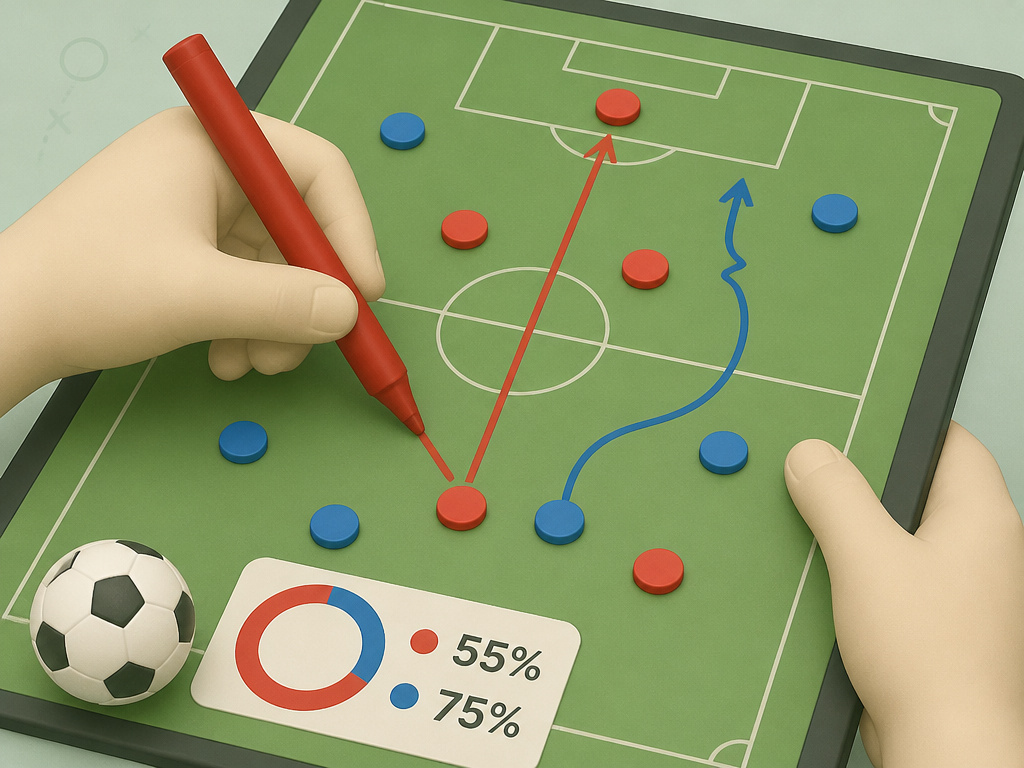
StatsBomb found that teams usually progress the ball more through passing, with ratios from about 55 percent to 75 percent in favor of passes. Teams that lean on carries rely on individual quality, directness, or counter-attacking speed. A focus on accurate passing still misses intent. Off-the-ball movement, such as third-man runs, explains why a receiver appears open.
Progressive Passes Received Adds the Receiving Side
Progressive passes received measures how often a player is on the receiving end of a progressive pass. StatsUltra calls it the most underrated of the three metrics. It flips the perspective from the passer to the target. A target striker’s job is to receive in dangerous areas. These sources do not supply a numeric threshold for it.
Passes, Carries, and Traditional Stats
Traditional stats rewarded safe circulation. Progressive stats separate that from forward movement.
- Pass completion measures safety.
- Progressive passes measure forward movement by passing.
- Progressive carries measure forward movement by running, with or without beating a defender.
- Dribbles measure one-on-one success.
- Key passes measure shots set up, not shot quality, per STL City SC.
STL City SC also lists passes completed into the penalty area (PPA) and expected assists (xA) as related metrics.
How Can You Use Progressive Passes and Carries in Real Football Analysis?
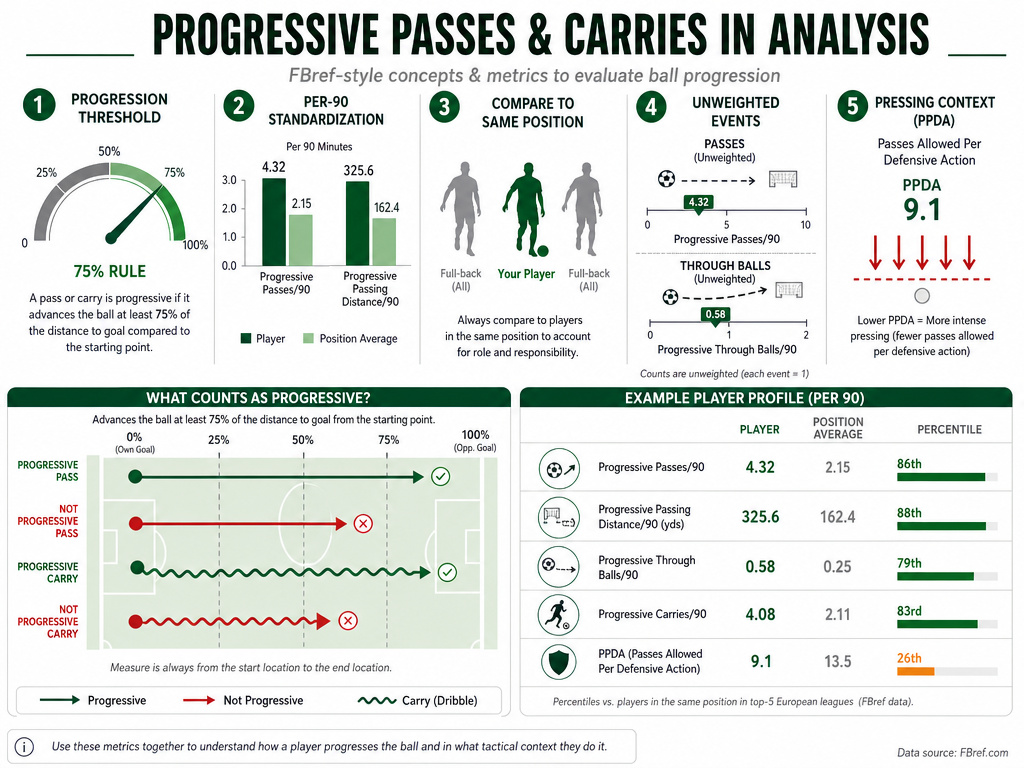
Use cases turn numbers into decisions. For casual fans, FBref is the simplest public place to start, because it tracks progressive passes per 90 and progressive passing distance per 90. STL City SC points to those FBRef metrics. Tactical terms like width and depth shape where carries start. I like pairing progression with passes per defensive action (PPDA) to add pressing context.
- Check the provider definition. Compare the threshold before comparing players.
- Use per-90 numbers. Raw totals rise with possession, per StatsUltra.
- Compare same-position players. Forwards have less ground to cover than defenders, per STL City SC.
- Remember no weighting. A safe pass and a through ball count equally if they meet the threshold, per StatsUltra.
- Add defensive context. Pressing shape affects how much ground a team has to progress into.
What Are the Limits of Progressive Passes and Carries?
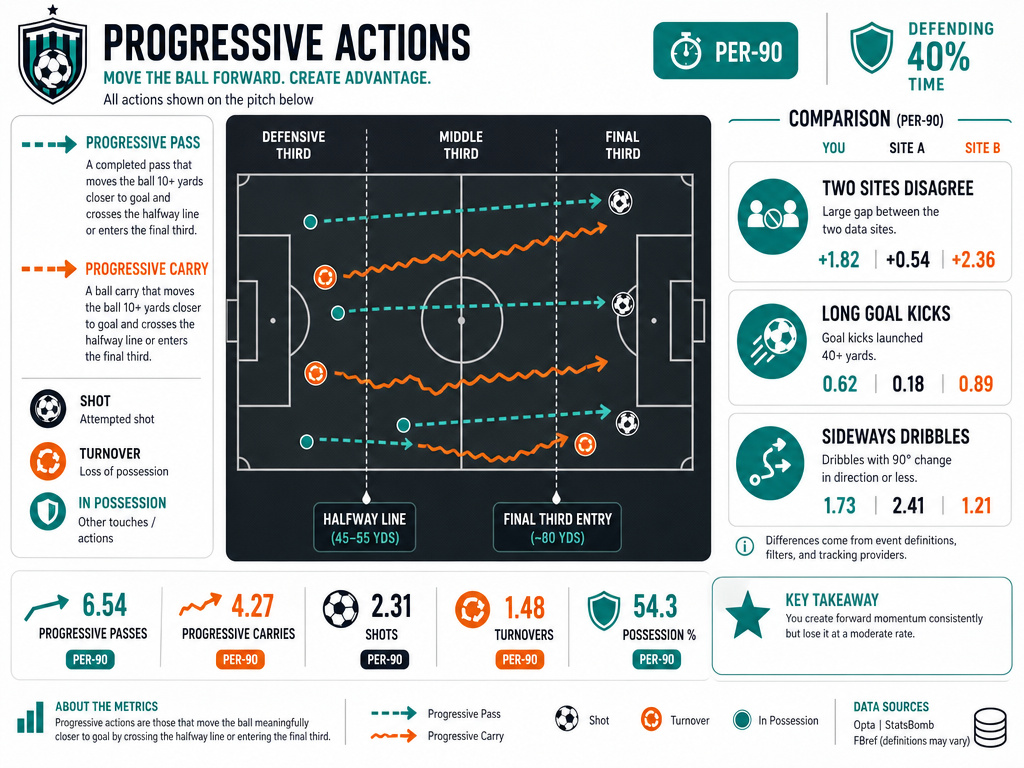
FBref, StatsBomb, and Sportmonks all point to context. Progressive pass and carry outcomes and difficulty are not weighted. A simple pass to an unmarked full-back and a through ball splitting the defense count equally, per StatsUltra. A progressive pass ending in a shot or a turnover also counts equally.
| Problem | Likely cause | Better check |
|---|---|---|
| Two sites disagree | Different threshold models | Compare provider docs |
| Long goal kicks count | Missing origin exclusion | Check defending 40% rule |
| Sideways dribbles look progressive | Metric confusion | Use carries for forward distance |
Raw progressive counts are inflated for teams with more possession against deeper defenses. StatsUltra recommends per-90 and positional comparisons. API/provider choice changes counts. Sportmonks says thresholds include absolute distance, percentage of remaining pitch, or zone crossing.
Easy to miss: raw counts rise when a team has more possession against deeper defenses. That makes a passer look better than a lower-possession rival in the same season.
Sportmonks also notes it doesn’t provide a progressive_carries field in its statistics types reference. If you are building an app, verify the feed before promising a number.
Who are the best progressive passers and carriers?
Looking at specific examples, Andreu Fontas averaged more than six progressive passes and over 550 yards of progressive passing distance per game in a recent MLS season. His ability to break lines from a defensive position consistently added significant attacking value. Similarly, Michael Bradley completed 6.6 progressive passes for every 90 minutes he played, at a progressive passing distance of 410 yards per 90. These players demonstrate how central midfielders and deep-lying playmakers often top these metrics by consistently moving the ball forward through both passing and carrying actions.
Frequently Asked Questions
What counts as a progressive pass?
FBref/Opta use 10 yards or a pass into the penalty area, with passes from the defending 40% excluded, but note that some FBref definitions do not explicitly mention this exclusion.
What counts as a progressive carry?
Progressive carry moves the ball closer to the opponent goal while the player keeps control. FBref/StatsBomb use 10 yards outside the final 40% and 5 yards inside it. Other providers use penalty-area entry or different distance rules.
Are progressive passes the same as forward passes?
No. A forward pass is short and routine. A progressive pass must meet a distance or penalty-area rule set by the provider. Completion also matters for FBref/Opta.
Are progressive carries the same as dribbles?
No. A dribble involves beating a defender. A progressive carry measures forward ball movement, even if no defender is beaten. A sideways dribble doesn’t automatically count.
Where do fans find progressive passing data?
FBref tracks progressive passes per 90 and progressive passing distance per 90. STL City SC highlights those public metrics. For app work, check whether your provider exposes the field, because Sportmonks says it doesn’t list progressive_carries.
Before You Go
For progressive passes and carries explained in practice, check the provider threshold before you compare numbers. A 10-yard FBref count and a 25 percent StatsBomb count describe the same action differently. That difference is the definition doing its job.
My starting point is position and per-90 context. Michael Bradley completed 6.6 progressive passes per 90 at a distance of 410 yards in the 2021 MLS season. A centre-back with those numbers reads differently from a forward with fewer yards available. Andreu Fontas averaged more than six passes and more than 550 yards per game among defenders.
This changes if a team spends long stretches against a low block. Raw totals rise when possession is high against deeper defenses. The muddy pitch still matters.
