
How to Play Football for Beginners: Start With Space
This post contains affiliate links. As an Amazon Associate, we earn from qualifying purchases.
To play football for beginners, learn the simple version first: a small-sided game where everyone touches the ball. U.S. Soccer starts its youngest players at 4v4 with no goalkeeper and a size 3 ball, then adds players, space and rules in stages.
That staged build is the smartest design in the sport. Each step gives you more space to read before it hands you more rules to memorise. We’re talking about association football, the game Americans call soccer, so if you came looking for gridiron, you’re on the wrong pitch.
What follows: the shape of a beginner game, the ball itself, the heading rules that split England from the United States, what a real warm-up trial proved (and didn’t), and a five-step first session.
Key Takeaways
- Start in a small-sided game. U.S. Soccer’s youngest format is 4v4 with no goalkeeper, and offside only arrives at U9.
- Young beginners play with a size 3 or size 4 ball. The adult ball in Law 2 measures 68-70 cm around.
- Heading rules differ by country. England is phasing deliberate heading out of matches from U7 to U11; U.S. Soccer prohibits it at 10 and under.
- A structured warm-up cut overall injuries in a Norwegian trial of young female players (rate ratio 0.68).
- Learn where the empty space is before you memorise formation numbers.
What Does a Beginner Football Game Actually Look Like?
Short, small and busy. A first game has few players, a tiny pitch, and a ball that arrives at your feet every few seconds.
U.S. Soccer’s small-sided standards scale youth football by age. Under-6 to under-8 games run 4v4 with no goalkeeper and a size 3 ball. Under-9 and under-10 games move to 7v7 with a goalkeeper, a size 4 ball, and offside. Under-11 and under-12 games run 9v9 on a pitch 70-80 yards long.
Small-sided games are the heart of how to play football for beginners, being youth games with fewer than 11 players on each team, and U.S. Soccer says the point is simple: fewer players means more touches and more decisions per minute. Adult beginners get the same benefit. If you’re one of the adult beginners turning up to a casual kickabout, a short pitch with a few players does the same teaching job.
The Small-Sided Ladder
The US Soccer Player Development Initiatives document sets out the numbers. The standards began on 1 August 2017 and cover U6 to U12.
| Age group | Pitch (yards) | Max goal (feet) | Game time |
|---|---|---|---|
| U6-U8 | 25-35 x 15-25 | 4 high x 6 wide | 4 x 10 min |
| U9-U10 | 55-65 x 35-45 | 6.5 x 18.5 | 2 x 25 min |
| U11-U12 | 70-80 x 45-55 | 7 x 21 | 2 x 30 min |
Notice what jumps at U9. The pitch roughly doubles in length, a goalkeeper appears, and offside switches on. Before U9 there’s no offside infraction at all, which means a seven-year-old can simply stand near the goal without breaking a rule. That’s deliberate.
Why the Build-Out Line Matters
From U9, a line runs across the pitch 14 yards in front of each goal. While the goalkeeper holds the ball or takes a goal kick, opponents stay behind that line. It also marks where offside can be called, so nobody gets flagged between midfield and the line.
I love this rule because it teaches space with paint. The defending team has time to spread out, and the attackers have to decide where to stand. The goalkeeper can restart sooner, but U.S. Soccer says that comes with accepting the opponents’ positioning and what follows from it.
You can learn the basic rules of the game in an afternoon. Learning why the build-out line exists takes a lot longer, and it’s worth more.
How to Play Football for Beginners: Read the Space First
Before I understood any of this, I thought tactics were a vocabulary test. I’d learned formation numbers off a football video game and felt like a coach. Then I stood on a real pitch and discovered the game never showed me what decides matches: where the other nine players go when the ball isn’t near them. The video game gave me words. It gave me no movement.
Hear me out on what that means for you. The nearest player to the ball matters, but the player with the empty yard of grass beside them matters more.
I’d rather a first-timer spend ten minutes watching one player away from the ball than ten hours memorising formation numbers. A “4-4-2” tells you where players start. It tells you nothing about where they run.
Here is a simple way to practise it from the sideline or the sofa:
- Pick one player who isn’t near the ball and follow only them for two minutes.
- Notice when they move into a gap just before a pass arrives.
- Watch the full-back. Full-backs show the shape stretching and squeezing better than anyone.
- Count how often a team moves together as the ball switches sides.
The same idea sits under every football position. A position is a job in the space, not a spot on a team sheet. And your first touch is really a space decision: you control the ball toward the gap you’ve already spotted.
The Ball: 68 to 70 Centimetres and a Few Surprises

IFAB’s Law 2 gives an adult match ball three measurable limits. Everything else about the ball is judgement.
- Circumference: between 68 cm and 70 cm
- Weight: between 410 g and 450 g at the start of the match
- Pressure: 0.6-1.1 atmosphere at sea level (8.5-15.6 lbs/sq in)
A ball at the right pressure comes back off the foot with a short, crisp thud. A soft one feels like kicking a bag of wet laundry, and it sits dead on the grass when you pass it. Press your thumb in before every session.
Easy to miss: The pressure limit is written for sea level. At altitude the reading changes, so a ball that checks out at the beach will read differently on a mountain pitch.
Young beginners don’t use this ball at all. The U.S. Standards above put the youngest players on size 3 and the U9-U12 formats on size 4. A ball that’s too big for small legs ruins technique before it starts.
Two Law 2 details trip up newcomers. If a ball bursts mid-play, the referee stops the game and restarts with a dropped ball where play stopped, given to the team that would have had possession. And nobody changes the ball during a match without the referee’s permission.
How Do Heading Rules Differ for Young Beginners?
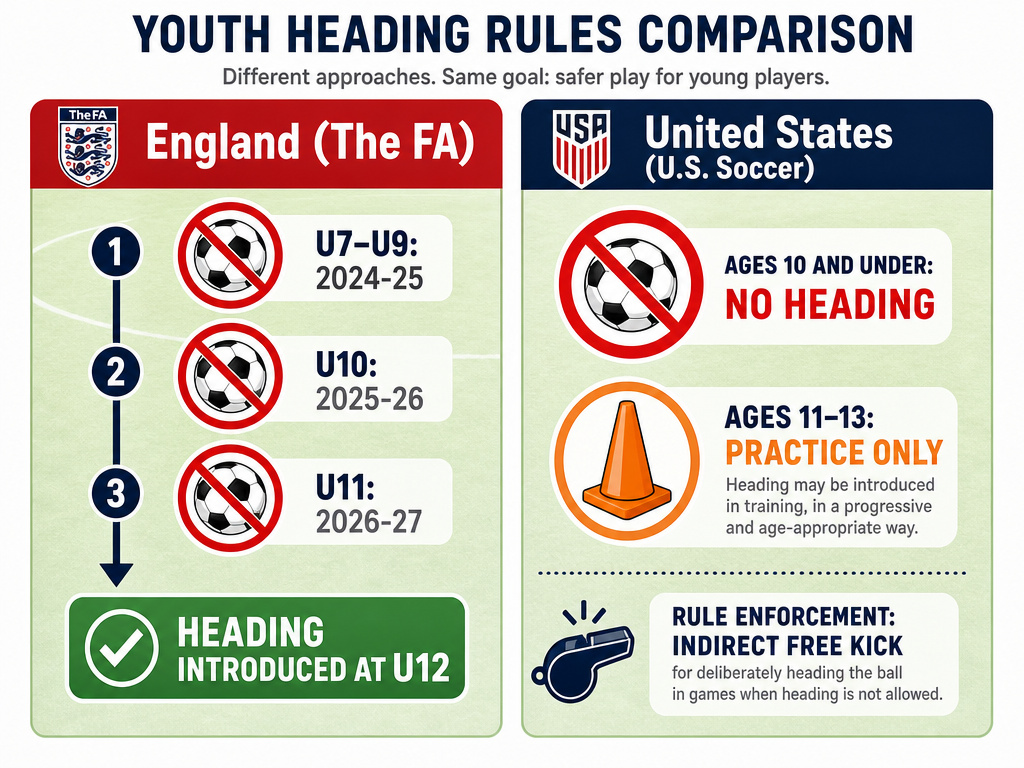
They differ a lot, and the difference depends on which country’s governing body you follow. Parents of new young players hit this question first.
England: A Phased Ban
The FA is removing deliberate heading from affiliated grassroots youth matches, including school football. The phase-in runs U7 to U9 from 2024-25, U10 from 2025-26 and U11 from 2026-27, which is the current season. Heading is then introduced at U12, when players move from primary to secondary school.
This wasn’t the original plan. In July 2022 the FA said that if its two-season trial worked, it would seek a Law change for all U12-and-below matches from 2023-24. The trial ran with around 16,000 teams and 107,000 players. The FA chose a three-season phase-in instead.
The part nobody mentions: A deliberate header in an affected match is an indirect free kick to the opposition, taken where the header happened. Inside your own penalty area, the kick comes from the nearest side line of the penalty area. A first-timer who heads a clearance in the box hands the other team a good chance.
United States: Guidance, Not Law
U.S. Soccer’s 2015 player safety initiative prohibits heading for children 10 and under and limits it to practice only for ages 11 to 13. It came after a concussion lawsuit settlement. But U.S. Soccer implemented the rules as requirements only for its youth national teams and the Development Academy, according to MLSsoccer.com’s report of the announcement.
| Source | What it says | Who must follow |
|---|---|---|
| The FA (England) | No deliberate heading in matches U7-U11; introduced at U12 | All affiliated grassroots youth matches |
| U.S. Soccer 2015 initiative | No heading at 10 and under; practice only at 11-13 | Youth national teams and Development Academy |
| U.S. Soccer small-sided standards | Headers banned in small-sided games | The U6-U12 formats |
So who’s right on the age? Both, in their own countries. Check your own league’s rulebook rather than a general article.
Why does it matter at all? The FA’s training guidance, set in 2020, names head-to-head, elbow-to-head and head-to-ground contact as risks it aims to reduce. Separately, the Mackay NEJM 2019 soccer study looked at former professionals and matched controls. The authors want the result confirmed in prospective studies, and it only covers former professionals. It can’t tell a weekend beginner their own risk.
A Warm-Up Trial That Half-Worked Still Beats Guessing
Most beginners skip the warm-up, because it feels like a delay before the fun. The best evidence I can find says that’s a mistake, with caveats.
A BMJ cluster randomised trial gave a structured warm-up programme to girls’ teams in Norway. It included 1,892 players aged 13 to 17 across 125 clubs over one eight-month season. The warm-up group had significantly lower risk of injuries overall (rate ratio 0.68), overuse injuries (0.47) and severe injuries (0.55).
Here’s the honest part. The results above come from one trial of one group, so they should not be stretched beyond it. The authors concluded a structured warm-up can prevent injuries in young female players, but that’s a conclusion about one group. Applying it to adult beginners or boys goes beyond what the trial measured.
I still do a warm-up every time. A short, structured warm-up routine costs a few minutes, and the trial’s overall and severe-injury results back it. Just don’t let anyone sell you “it cuts injuries by a third” without the caveat above.
Your First Session in Five Steps
Before you start: Football contact can come as head-to-head, elbow-to-head or head-to-ground, which are the three risks The FA names in its training guidance. Keep your first sessions heading-free and play on a pitch you’ve walked for holes. Skip a warm-up and a tight calf shows up the next morning on the stairs.
Follow these in order. The sequence is the point.
- Find a small group. Aim for a 4v4 or similar kickabout. On a full pitch you’ll wait around and touch the ball rarely, so you’ll learn almost nothing.
- Check the ball and pitch. Press the ball with your thumb and look at the grass. A soft ball kills your passes; an unwalked pitch twists ankles.
- Warm up first. Jog, then add dynamic stretches. Jump straight into the game cold and your muscles complain halfway through.
- Practise two things only. Work on passing to a teammate’s feet and a first control with the inside of your foot. Try five skills at once and you’ll improve at none.
- Wear cleats for beginners only when the surface needs them. On dry artificial turf or a hard court, ordinary trainers work fine. Wrong studs on the wrong surface grip too hard and twist the knee.
Add dribbling once the first two feel boring. They will, and that’s the signal.
Your first dozen touches will be bad. That’s normal, and it’s fine.
What is the objective of football and how do you win?
The goal is simple: finish the game with more points than the other team. The team with the ball is on offense and tries to move forward by running with it or throwing it to a teammate. The team without it is on defense and tries to stop that progress by tackling the ball carrier or breaking up passes.
Offenses get a limited number of attempts, called downs, to gain a set amount of ground. If they make it, they keep the ball and earn a fresh set of attempts. If they fail, the ball goes to the other side. That back-and-forth is what drives the whole game. If you’re brand new, watch how each team handles possession first. Everything else makes more sense once you see why the ball keeps changing hands.
How does scoring work in football: touchdown, field goal, extra point and safety?
You get one by carrying the ball across the goal line into the end zone, or by catching a pass while you’re standing inside it. After a touchdown, the scoring team gets a bonus try called the extra point. Usually that is a short kick through the uprights, which earns a small reward. Teams can also go for a more difficult play from close range for a slightly bigger payoff.
A field goal is a kick through the uprights during regular play. Teams often choose it when a touchdown looks out of reach but they are close enough to get the ball through. It is worth less than a touchdown.
A safety is the rarest score and it goes to the defense. It happens when the offense is tackled in its own end zone, or the ball goes out of bounds there. The defense is rewarded with points, and it usually gets the ball back too.
What are the positions on offense and defense in football?
He calls the plays, takes the snap from the center and either hands the ball off, throws it or runs with it. Running backs carry the ball and sometimes catch passes. Wide receivers and tight ends run routes to get open for throws, and tight ends also help block. The offensive line protects the quarterback and opens space for runners. These players rarely touch the ball, but the play falls apart without them.
On defense, the defensive line tries to push through the blockers and tackle the runner or pressure the quarterback. Linebackers stand behind them and handle both run stopping and short pass coverage. Cornerbacks cover receivers near the sidelines, and safeties patrol the back of the field as the last line of defense.
There are also special teams units for kickoffs, punts and field goals. If you’re just starting out, learn the quarterback and the line first, since most plays start there.
Frequently Asked Questions
What are the basic football rules?
Law 2 covers the ball, and the other Laws cover everything from offside to restarts. Beginners meet the small-sided versions first: no offside before U9 in the U.S. Standards, and offside plus build-out lines from U9 onward.
What is the easiest way to learn football?
Play small-sided games. Fewer players on a shorter pitch means more touches and more decisions per minute. U.S. Soccer designed its standards around that.
What size ball does a young beginner need?
Size 3 for the U6-U8 formats and size 4 for U9-U12 in the U.S. Standards. The 68-70 cm adult ball from Law 2 is for full matches.
Can young beginners head the ball?
It depends on the country. England phases out deliberate heading from U7 to U11 in matches, with heading introduced at U12. U.S. Soccer’s 2015 initiative says no heading at 10 and under, and practice only at 11 to 13.
Is there an age that’s too late to start?
The sources behind this guide cover youth formats and set no upper age. Start with a small, friendly group, warm up properly, and build up from there.
The Bottom Line
One threshold to remember: if you’re coaching or parenting a child, check your own league’s heading rule before the first session. England and the United States draw the line at different ages, and the U.S. Rules bind only youth national teams and the Development Academy, so your club may simply follow guidance.
Your first step this week is easy. Find one small-sided game, or sit and watch one, and follow a single player away from the ball for two minutes. That’s how to play football for beginners at its core, and it beats any amount of formation homework.
I’ll concede one thing. Everything above is built around youth standards and a couple of trials, so it won’t tell you how adult recreational leagues run their own rules. Ask the organiser, then go play.
