
How to Choose a Football Team to Support: A Fan’s Guide
This post contains affiliate links. As an Amazon Associate, we earn from qualifying purchases.
Choosing a football team to support means finding a club whose story fits with yours. It’s a connection built on geography, family, shared values, or simply a style of play you love to watch. With 86 professional men’s teams across the US alone, plus hundreds of amateur clubs, your perfect match is out there.
The pressure to pick “the one” is overblown. Your choice isn’t a blood oath. It’s about finding a community and a narrative that enhances your enjoyment of the game. Many guides on how to choose a football team to support exist, but the real work happens after you narrow it down, watching matches, understanding the club’s place in its city, and seeing if the feeling lasts beyond a few wins.
What follows is a breakdown of the real factors that create lasting fandom when you compare a how to choose a football team to support checklist. We’ll cover local roots, family ties, the practicalities of actually watching games, and why the “glory hunter” label exists. By the end, you’ll have a framework to test a club before you fully commit.
Key Takeaways
- Start with your doorstep. Your local club, even if it’s in the amateur NPSL or USL2, offers an unmatched sense of community and the chance to actually attend matches.
- Access dictates everything. Before you commit, verify you can actually watch the team’s games via services like ESPN+, Paramount+, or local broadcasts.
- Club identity outweighs trophies. A club’s values, its supporters’ culture, and its playing style are more durable reasons to support than chasing silverware.
- Multiple allegiances are normal. It’s common and acceptable to follow a local team and a distant one, as conflicts between them are incredibly unlikely.
- You are allowed to change your mind. Fandom is not a prison sentence. If a club no longer aligns with your values, it’s okay to step back or find a new one.
Start With the Ground Game
The most powerful connection you can have is a physical one. There are 86 professional men’s teams playing across MLS, USL, and NISA in the United States. On the women’s side, the NWSL has 12 teams, with numbers 13 and 14 on the way, and the USL Super League will soon bring more professional sides. Beyond that, there are hundreds, if not thousands, of amateur clubs in leagues like the NPSL, UPSL, and USL2.
Attending a match in person is a sensory experience no broadcast can match. You feel the vibrations of a chant through the stands, smell the damp grass and stale beer, and see the manager’s frantic gestures from the touchline that the TV camera never shows. That’s where fandom moves from an idea to a memory.
I’ve lost count of the times a casual conversation in a stadium queue revealed a club’s true character, a story about a charity drive, a gripe about ticket prices, or pride in a youth academy graduate. Those small comments are the unedited truth of a club’s relationship with its community. This habit of listening to the people at the ground has never let me down when trying to understand a team’s soul.
The benefit is straightforward: it’s easier to get to matches and show your support in the stands. You’ll get a real sense of the football fan culture this way. Our guide explains that culture, covering chants and matchday rituals, at football fan culture.
| Club Level | What You Get | The Trade-Off |
|---|---|---|
| Major League (MLS, NWSL) | High-quality play, star players, national TV coverage. | Higher costs, less intimate atmosphere, corporate feel. |
| Lower Pro (USL, NISA) | Affordable tickets, community focus, rising talent. | Variable play quality, less media coverage, league instability. |
| Amateur (NPSL, UPSL) | Pure community passion, volunteer-run, hyper-local. | Very limited schedules, basic facilities, no player salaries. |
If you’re lucky enough to have a local side, start your how to choose a football team to support journey there. Your support, buying a ticket, wearing a shirt, can genuinely help a smaller club survive. If there isn’t a club that speaks to you nearby, that’s fine. The search radius expands. But give the local game a chance first.
The Pull of Family and Friends
For many, the choice was made for them before they could walk. Generational support is the bedrock of most clubs’ long-term fanbase. Growing up with a team creates memories and instant connections. Supporting a team with your friends or family also makes match days more social and fun.
But what if your family’s club doesn’t resonate with you? Or you’re the first fan in your family?
That’s your opportunity to start a new tradition. Use the other factors listed here to choose a team your own posterity might support decades from now. The key is to be honest. Inheriting a passion you don’t feel is a fast track to making football a chore, not a joy.
Where this goes sideways: Feeling obligated to support a family team you dislike. The resentment builds over seasons, and you’ll eventually disconnect from the sport altogether.
This is also where the social side kicks in. Having a crew to share the experience with, whether in person or in a group chat, multiplies the highs and softens the lows. It turns watching into a shared event. If you’re drawn to a club with a local supporters group in your area, that’s a ready-made community waiting for you.
The One Rule Everyone Gets Backwards
Some guides will tell you to pick one team and stick with them through thick and thin, while others note it’s okay to follow more than one club. The reality of how people actually consume football is messier and more forgiving.
It’s okay to follow more than one club. Soccer is one of the only sports where clubs from all over the world can theoretically play each other in competitive matches, but it’s incredibly unlikely that your local USL team and Tottenham will ever face off.
This is the permission slip most new fans need. You can have a local club you attend on weekends and a European side you follow on TV. The local club satisfies the community, tactile itch. A distant club allows you to follow world-class talent and narratives on the global stage. They occupy different spaces in your football life.
The conflict-of-interest fear is largely a myth. The chances of your lower-league American side drawing Bayern Munich in the Club World Cup are infinitesimal. So why force a single choice?
This layered fandom is incredibly common. A fan might have:
- A primary club (local, family-tied, or first-love).
- A secondary club in another league (maybe for a favorite player or style).
- A soft spot for a few other teams (an underdog, a club with a great story).
While some sources emphasize sticking with one club, others note the rigid “one club forever” model is more about tribal identity than modern fan experience. Your attention can be divisible. The Guardian soccer culture feature explores this idea of neutral fandom and choosing sides in depth, challenging the assumption that loyalty must be singular.
Can You Actually Watch Them Play?

This is the most practical, and most often overlooked, step. Whatever choice you make, you should have access to their content. Ensuring you can watch their games is crucial.
I’ve tried supporting teams via news and highlights alone. Without the ability to watch full matches, the interest evaporates within a few weeks. You need to live through the frustrating 0-0 draws and the scrappy midweek wins to build a real bond.
Common mistake: Falling for a club you can’t regularly watch. The initial excitement fades when you realize the only way to follow them is through grainy, illegal streams at 3 AM.
Thankfully, access is better than ever. According to World Soccer Talk, every pro club in the USA has all of its matches available to stream and/or on TV. According to World Soccer Talk, many amateur sides stream matches and provide live social media updates as well. For broader leagues, streaming platforms like ESPN+, Fox Sports, NBC Sports, and Paramount+ provide extensive coverage.
Before you commit, do a quick audit:
- What league do they play in?
- Who holds the domestic broadcast rights for that league?
- Is that service affordable and accessible to you?
If the answer is “I have no way to watch them live,” you need a different club or a different plan. A great guide for new football fans can help you navigate the sometimes confusing world of football broadcasting.
Decoding Club Identity: More Than a Badge
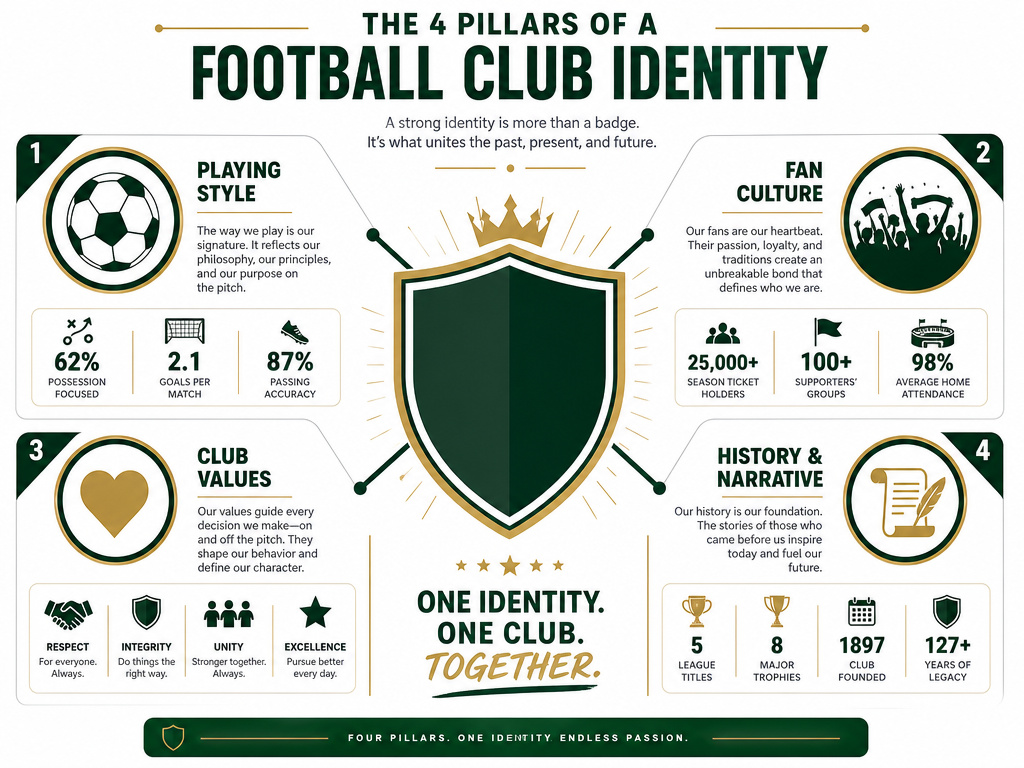
Every club has a unique personality. This identity is woven from its history, its style of play, its values, and its supporters. This is where you move from picking a team to choosing a tribe.
Benedict Anderson’s concept of “imagined communities” fits perfectly here. Above a certain size, it’s impossible for everyone in a social group to know everyone else personally. As a fan, you feel a connection to thousands of strangers because you all imagine yourselves as part of the same whole, supporting the same crest.
Let’s break down the components of identity:
Style of Play:
This can be a determining factor. Do you love possession-heavy, attacking football? Or a disciplined, counter-attacking system? Throughout time, a club’s style does not deviate far from one core philosophy.
- Atletico Madrid is synonymous with gritty, physical, counter-attacking soccer.
- Liverpool under Jurgen Klopp became famous for its organized, high gegenpressing.
Values and Community:
Look at what the club and its supporters stand for. Do they have a strong connection with local charities? Are the supporters politically active? On the flip side, watch for red flags, like a club that overcharges fans or supported schemes like the European Super League. Some clubs are even owned by their fans, a model that deeply embeds community values. You can learn more about this in our article explaining fan-owned clubs.
The Visuals:
It seems trivial, but it matters. You’ll be looking at that badge and wearing those colors for years. A great kit or a classic crest can be a genuine point of pride. A bad one is a constant annoyance. If you’re curious about the best designs, check out our rundown of the best football jerseys to buy.
| Identity Factor | Question to Ask | Example |
|---|---|---|
| Playing Style | What kind of football do I enjoy watching most? | Tiki-taka (Barcelona), Gegenpress (Liverpool), Catenaccio (Historical Inter Milan). |
| Fan Culture | What is the matchday atmosphere like? Are the supporters known for something specific? | Borussia Dortmund’s “Yellow Wall”, Crystal Palace’s loud home support. |
| Club Values | What does the club do off the pitch? How does it treat its community and fans? | FC St. Pauli (activism), AFC Wimbledon (fan ownership after club was stolen). |
| History & Narrative | Is there an underdog story, a phoenix-from-the-ashes tale, or a legacy to uphold? | Leicester City’s 2016 title, Napoli’s recent Scudetto after decades. |
Spend time reading the club’s history, not just its trophy list. Learn about the times fans volunteered to clean the stadium or banded together to save the club from relocation. Those stories are the club’s soul.
What (Mostly) Not to Do
Some selection methods set you up for a shallow or frustrating experience. Here’s what to be wary of.
The Glory Hunter Trap:
It’s tempting to latch onto a perennial winner. Don’t be that person. If you have a legitimate reason to support a giant like Real Madrid, go for it. But doing it just for the trophies is empty. The joy of winning isn’t as sweet if you’ve never endured the struggle. Success is cyclical. The superclub of today can be a mid-table side in a decade. If trophies are your only tether, you’ll be adrift when they dry up.
The Player Carousel:
Players, managers, and owners come and go. A club, its supporters, and its community are everlasting. It’s fine if a superstar like Christian Pulisic draws you to AC Milan. But you should stick around for the club itself after he moves on. Basing your allegiance solely on a transient employee makes your fandom inherently temporary.
The League Snob:
Don’t dismiss a club because it doesn’t play in a “worthy” league. Falling in love with a local NPSL side can be more rewarding than being a passive viewer of the Premier League. The level of play is different, but the emotional stakes, the connection to your community, can be far higher. A great guide for your first stadium visit is about the experience, not just the technical quality on the pitch.
Ignoring the Financials:
While not the most romantic factor, understanding a club’s ownership model can save future heartache. Is it a billionaire’s plaything, a publicly-traded company, or a fan-owned trust? Each model has different priorities (profit vs. Sustainability vs. Community). A club with unstable or predatory ownership can make support feel like an abusive relationship. Our explainer on football club ownership details how these structures work.
The Trial Period and the Exit Ramp
You don’t have to decide today. Think of the next few months as a trial period.
- Watch 5-10 full matches. Don’t just watch highlights. Sit through the boring games, the losses, the frustrating draws.
- Follow the news cycle. See how the club communicates, how it handles a crisis, what the local beat reporters say.
- Engage with other fans. Listen to a supporter podcast, read the fanzine, or lurk in a sensible online forum (not the toxic social media replies).
- Learn the chants and the stories. The history of football chants is a window into a club’s identity and its fanbase’s wit.
What are you looking for? A growing sense of investment. Do you find yourself checking their score first? Do you feel a real pang after a loss? That’s the connection forming.
And if it doesn’t form? That’s okay. Football is meant to be fun. If you change your mind later and find a club that aligns better with your values, you can always switch or follow multiple clubs. Fandom is not a marriage contract. It’s a relationship. Some last a lifetime; others run their course. The key is to be honest with yourself about why you’re there.
Should I use a quiz to pick a team?
Online quizzes can be a fun starting point, but treat them as a spark, not the final answer. A quiz might ask about your preferences in playing style, club values, or the type of fan culture you want. For example, do you prefer a physically disciplined counter-attacking style or a high-pressing organized system? Do you value a club with deep local roots or one with a global following? Use the results as a shortlist for deeper research. Watch those teams play, read about their community role, and see if their story resonates. The best choice comes from your own investigation, not a predetermined set of questions.
Frequently Asked Questions
Is it wrong to support more than one football team?
No, it’s normal and widely accepted. Most fans have a primary club and then other teams they follow with interest in different leagues or countries. Conflicts of interest are rare.
How important is it to support my local team?
It’s the strongest foundation for a deep connection because it’s tangible. You can attend matches, feel the community impact, and build local friendships around it. But it’s not a mandatory rule, especially if no local club resonates with you.
What if I pick a team and then want to change?
You can. While stability is part of traditional fandom, your interests and values can change. It’s better to respectfully move your support to a club you genuinely care about than to force yourself to follow one you don’t.
Should I pick a team based on a favorite player?
Player can be a great gateway to a club. However, your support should ideally outlast that player’s tenure. Try to find other reasons to love the club, its history, its fans, its style, so you have something to hold onto when the player eventually leaves.
How do I start watching a team in another country?
First, identify which broadcaster in your country holds the rights to their league (e.g., Paramount+ for Serie A, ESPN+ for the Bundesliga). Then, immerse yourself in the club’s media: follow local journalists on social media, listen to fan podcasts, and try to watch matches with a local supporters’ group if one exists in your city.
Before You Go
The single biggest mistake is treating this like a permanent, high-stakes decision. It’s not. It’s the start of a conversation with a club and its community.
Give yourself the freedom to explore. Go watch that local USL2 side on a sunny afternoon. Stream a few Atletico Madrid games to see if you appreciate their gritty style. Read about the community work done by a lower-league club. The right fit often reveals itself when you’re not forcing it.
And remember, the most authentic fans aren’t the ones who picked the biggest trophy cabinet. They’re the ones who found a story they wanted to be a part of, and then showed up, in the stands, in the pub, or on the couch, to see how it unfolds. That’s the only commitment that really matters.
