
Football Chants History Explained: From Victorian Roots
This post contains affiliate links. As an Amazon Associate, we earn from qualifying purchases.
Football chants are a modern folk tradition with roots in the 1890s, evolving from Victorian terrace whispers and music-hall ditties into the anthems that define clubs today. The culture exploded in the 1960s with better travel and pop music, and now spreads globally via social media, but its core purpose, forging identity and community through shared song, hasn’t changed.
That timeline seems neat. It is also mostly wrong.
The popular story in the football chants history explained says chanting grew from Victorian community hymn-singing. Academic research, like that cited in the Playing Pasts article, counters that organized, press-promoted hymn-singing at matches didn’t start until the mid-1920s. The real, fan-led noise began decades earlier, was often rowdier, and its history is a mess of competing claims and lost origins. This isn’t a linear evolution from hymns to pop songs. It’s a story of dock workers’ whispers, famous composers writing forgotten anthems, and songs that existed before the clubs that now sing them.
What follows is a walk through that mess. This section examines the Victorian evidence, the 1960s explosion, and how a chant goes from one fan’s idea to a stadium-wide roar. By the end, you’ll hear the noise differently.
Key Takeaways
- The earliest documented chants, like Southampton’s ‘Yi! Yi! Yi!’ whisper, appear in 1890s newspaper reports, debunking the myth that organized singing began with 1920s hymns.
- Norwich City’s ‘On the Ball, City’ was written for the city’s works teams before the club’s 1902 formation, showing how anthems can predate the institutions they represent.
- In the 1960s, better rail connections between towns and cities allowed fans to watch their teams play away from home.
- A modern chant often spreads from creation in a pub or online, to small-group adoption, and then to the wider stadium, with social media accelerating the process.
The Victorian Roots (1880s–1914)
Picture a wet Saturday in 1898. At a Wolverhampton Wanderers match, a small group of fans might be trying out a new tune. It was called “He Banged the Leather for Goal,” a song written for striker Billy Malpass by none other than the composer Edward Elgar. It did not catch on.
That moment captures the early era perfectly. Attempts were made. The earliest documented terrace tunes and chants date back to the 1890s, though some clubs claim earlier origins. Sheffield United had “Rowdy Dowdy Boys.” But the real evidence is in local newspaper archives, which document a vibrant, independent singing culture long before any orchestrated movement.
Newspaper reports of the 1890s describe Southampton F.C.’s ‘Yi! Yi! Yi!’ whisper being sung. This rhythmic whisper, which started quietly and gradually increased in volume, was also chanted by Glasgow’s Third Lanark in the 1890s.
The “Yi! Yi! Yi!” whisper, documented in 1890s newspaper reports, is an example of early football fan culture. It wasn’t a borrowed hymn or a pop song. It was a unique, rhythmic creation born on the terraces. Its appearance in two distant port cities. Southampton and Glasgow, is attributed by historians to the mobility of workers between the docks, not direct imitation. This is cultural exchange at a human level, not a media-driven trend.
Then come the competing claims for the “oldest” chant. Portsmouth supporters claim “The Pompey Chime” (“Play up Pompey, Pompey play up”) was sung from the 1880s, with its words published in the official club handbook for the 1900–1901 season. Norwich City, meanwhile, claims the oldest song with “On the Ball, City,” adopted after the club’s formation in 1902, though The Big Issue notes it was written as a city anthem before the club was officially formed.
| Club | Claimed Chant/Song | Earliest Cited Date | Nature of Evidence |
|---|---|---|---|
| Portsmouth | ‘The Pompey Chime’ | 1880s (alleged) | Words in 1900-1901 club handbook; oral tradition. |
| Southampton | ‘Yi! Yi! Yi!’ whisper | 1890s | Documented in contemporary newspaper reports. |
| Norwich City | ‘On the Ball, City’ | 1902 (club adoption) | Song existed pre-club; adopted upon formation. |
So who wins? Nobody, and that’s the point. These claims show how deeply clubs tie their identity to these early sounds. The history is fragmented, based on handbooks, newspaper snippets, and fan lore. The through-line isn’t musical quality. Elgar’s composition failed, after all, but the basic human urge to create a shared noise for your tribe.
The Myth of the Singing 1920s and the Silent Revolution
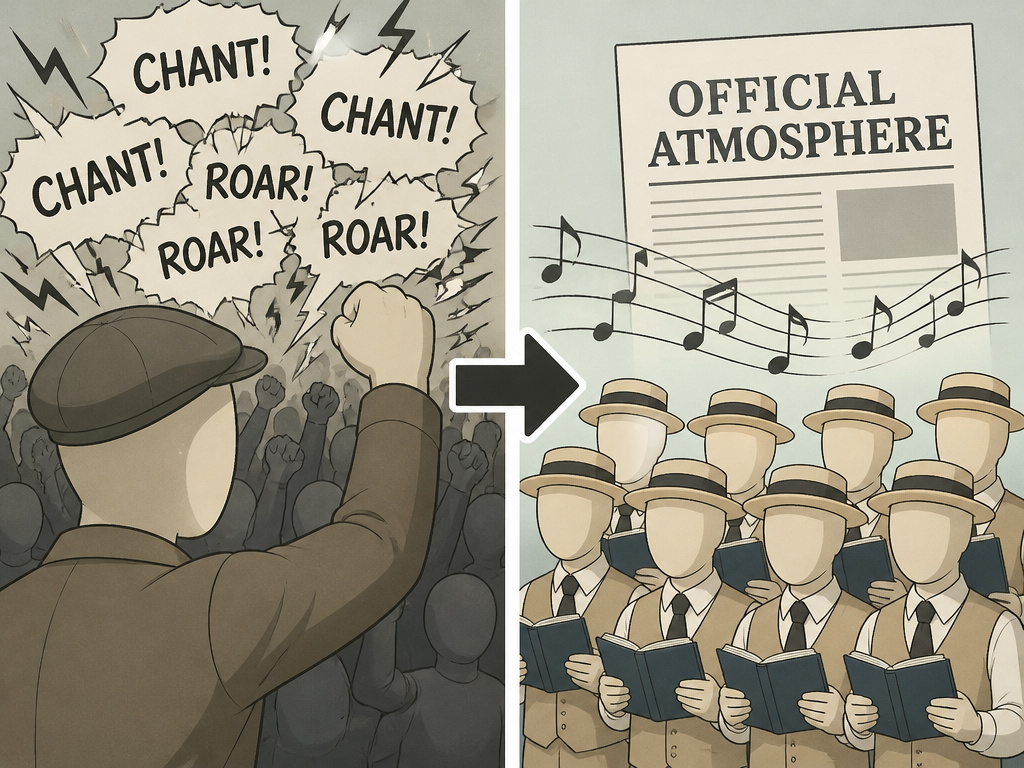
The reality is this. The familiar story, echoed in books like Desmond Morris’s The Soccer Tribe, paints a picture of Victorian communities naturally evolving hymn-singing into terrace chants. It’s a comforting, linear progression.
Academic research, such as that cited by Playing Pasts, counters that the organized, press-promoted hymn-singing movement began in the mid-1920s. Organized, press-promoted hymn-singing at matches began in the mid-1920s. It was a top-down, almost formalized attempt to create “atmosphere,” distinct from the organic, often raucous singing that had existed for decades.
Two singing cultures existed in parallel:
- The vigorous, fan-led chants and whispers of the late Victorian and Edwardian eras.
- The press-promoted, communal hymn-singing of the post-WWI period.
The first was organic. The second was a managed spectacle. The popular narrative has often conflated the two, crediting the later, more “respectable” hymn-singing movement with birthing a tradition that was already alive and well. This correction in the football chants history explained matters because it puts the agency back with the fans, not the newspapers. The noise from the stands was never something that needed to be orchestrated from the outside.
The 1960s: Pop Music, Travel, and the Kop
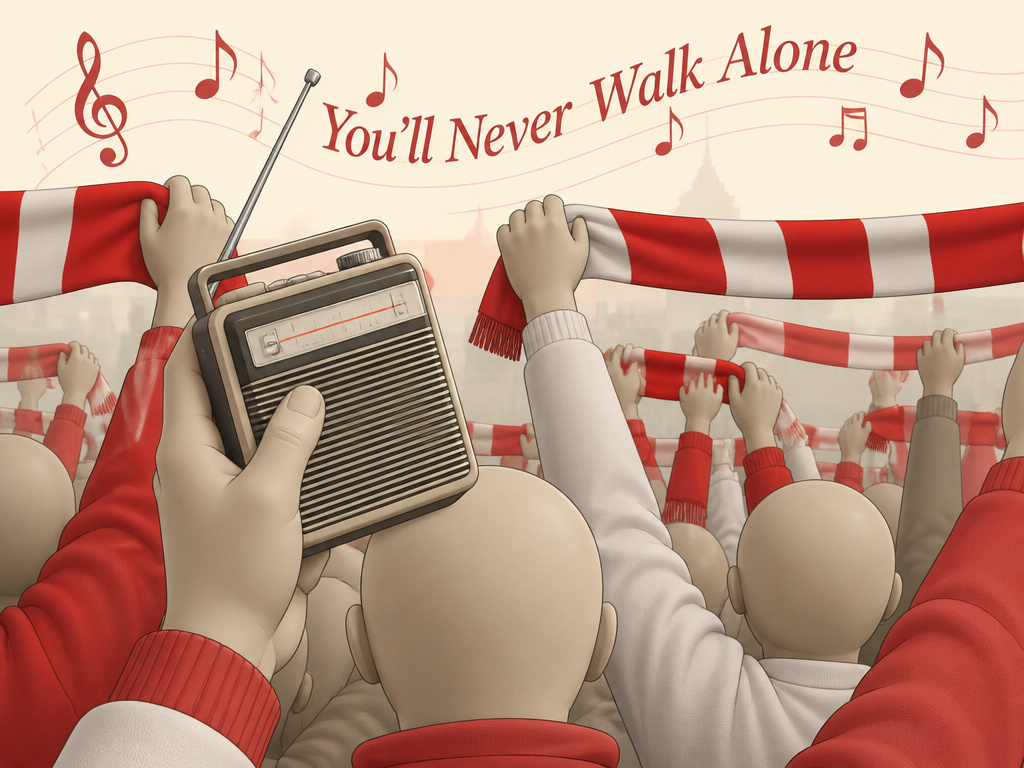
Chant culture changed significantly in the 1960s with better rail travel and the adoption of pop music by supporters. In the 1960s, better rail connections allowed more away travel, and Liverpool supporters adopted Beatles and Cilla Black hits.
Better rail connections meant fans could follow their teams away from home in bigger numbers. When they did, they heard something new. At Anfield, Liverpool’s Spion Kop was adopting Beatles and Cilla Black hits, changing the words to praise their own players. Visiting fans heard these tunes, stole them, and changed the words again. It was a sonic arms race.
A BBC Panorama team was sent to Liverpool in 1964 to investigate the Kop’s chanting. The reporter described the swaying, singing mass as a rich cultural ritual, as mystifying as “any Polynesian culture.”
The anthem “You’ll Never Walk Alone” cemented itself here. After Gerry and The Pacemakers’ version was released in the early 1960s, it became the Kop’s signature. Its power wasn’t just in the melody, but in the sheer, unified volume of a terrace that could hold thousands. This was the birth of the stadium anthem as a pre-match ritual, a wave of sound that could intimidate opponents and elevate the home team.
They were no longer just general club songs like “On the Ball, City.” They were about specific players, managers, and moments. The terrace had its own tabloid wit.
How a Chant Actually Spreads (From Pub to Planet)
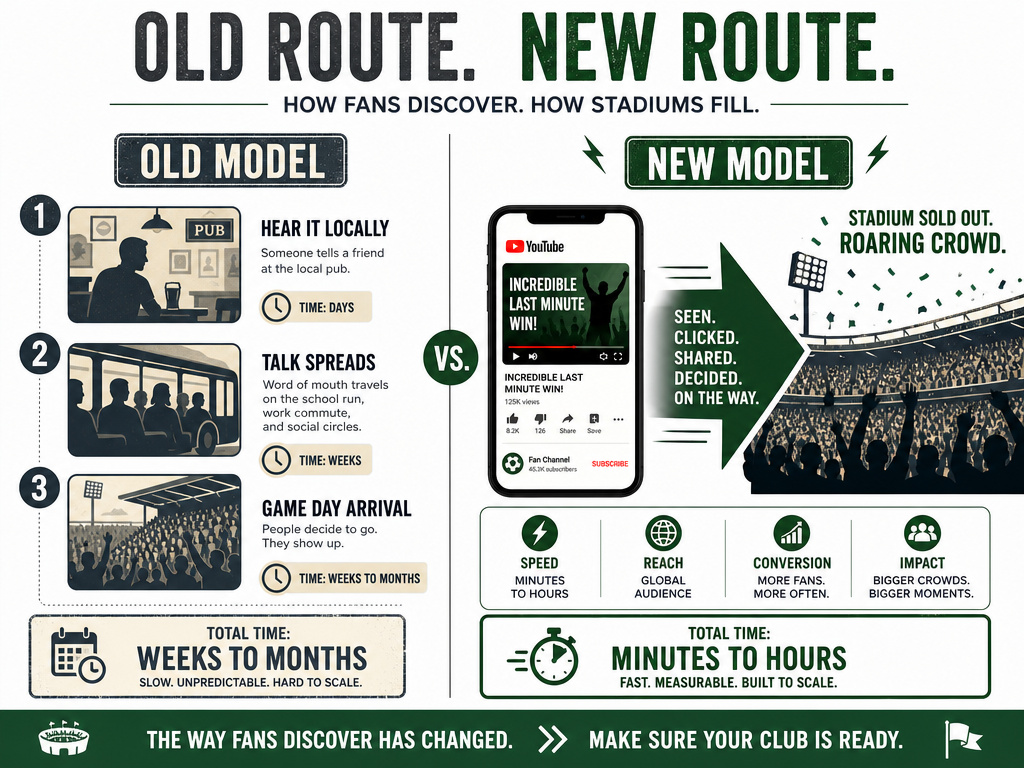
Consider this process. How does a string of words attached to a melody actually conquer a stadium? The process in the football chants history explained has a blueprint, though the timeline has shrunk dramatically.
Take Pete Boyle, the Manchester United fan and prolific chant creator. His most famous song, “Eric the King,” was first sung around 1993.
“Most of my songs came from the pub, mainly the Bishop Blaze, or on the coaches to the games,” Boyle told The Athletic. “If people didn’t join in, I didn’t get embarrassed, I would just go: ‘Come on you bastards’ and carry on.”
That’s the old model:
- Creation: In a pub, on a train, among a small group.
- Small-Scale Testing: Sung repeatedly in that small group, on away trips.
- Terrace Adoption: If it caught on, it would spread slowly through the core support, eventually reaching the main stand on a match day. This could take months or years.
Social media and smartphones collapsed this timeline. Look at Liverpool’s “Allez Allez.” In February 2018, fan Jamie Webster heard a few supporters singing a version in Porto. He looked up the original Italian disco tune, adapted it, and performed it at a fan event. A phone recording hit YouTube and exploded. Within a week, it was echoing around Anfield, becoming the anthem of their Champions League run.
British Wit vs. Global Traditions
It comes down to the details of intent.
It’s a dialogue with the other fans, the players, and the referee. The goal is as much to mock the opponent or comment on the game as it is to support the home team.
Now, compare that to the style of organized supporter groups in places like Italy, Argentina, or Turkey.
| Tradition | Primary Focus | Typical Sound | Role of Leaders | Lyrical Content |
|---|---|---|---|---|
| British | Wit, reaction, insult | Call-and-response, short loops | Organic, often no single leader | Player names, topical jokes, rival taunts |
| Italian/Ultras | Continuous support, visual spectacle | Long, melodic songs, often with drums | Defined capo with microphone leads chants | Club loyalty, historical references, sometimes political |
| Argentine | Passion, identity, 90-minute pressure | Complex, fast-paced songs with drum rhythms | Organized barra brava leaders | Deep club symbolism, neighborhood pride, defiance |
| German | Positive support, anti-commercial protests | Thematic songs, often borrowed from folk tunes | Fan-club organized, sometimes with megaphones | Team praise, criticism of authorities/DFB, solidarity |
The difference is stark. At a Boca Juniors match, the singing is relentless, a wall of sound meant to carry the team for the full 90 minutes. In England, the noise is more episodic, reacting to events on the pitch. A misplaced pass gets a groan, a bad tackle sparks a angry roar, and a goal unleashes a pre-existing anthem. The British style is a reaction; the ultra style is a sustained performance.
This isn’t to say one is better. They serve different purposes. The British model creates those iconic, spontaneous moments of collective wit. The ultra model creates an intimidating, awe-inspiring atmosphere that is a spectacle in itself. Understanding this split helps explain why a chant that works at Millwall might feel out of place at AC Milan, and vice versa.
The Folk Music of the Stands
Sociologist and fan Professor Les Back, in a Radio 4 documentary, championed the idea that football chants are “one of the last vestiges of a living folk tradition,” a phrase he credits to folk musician Martin Carthy. The parallels are strong.
Folk music traditionally:
- Is passed down orally, not through sheet music.
- Is adapted and changed by each community that adopts it.
- Speaks to the experiences and identity of that community.
- Often has anonymous or collective authorship.
Football chants tick every box. A song like “Away In A Manger” was repurposed for Northern Ireland striker David Healy in the 2000s. But The Athletic traced it back further, it first originated at Coleraine FC for player Felix Healy in the 1980s. A song disappears, reappears, and is claimed by a new generation. That’s pure folk process.
These songs are the living history of clubs. Sunderland’s “Keep The Red Flag Flying High” was sung by dockers at the end of public meetings in the 1950s before becoming a terrace staple. Hibernian’s adoption of The Proclaimers’ “Sunshine on Leith” is a direct link to the band’s, and many fans’, roots in the city. These aren’t just songs; they are supporter culture encoded in melody.
This folk tradition is why the biggest rivalries in football often have their own distinct sonic signatures. The songs become weapons and badges of honor. It’s also why the phenomenon of tifo displays, those massive pre-match banners, often works in tandem with chants. The tifo is the visual statement; the chant that follows is the audible, communal ratification of it.
How are football chants created by individuals?
While chants become a collective roar, they often start with a single person. The composer Edward Elgar famously wrote ‘He Banged the Leather for Goal’ for Wolverhampton Wanderers striker Billy Malpass around 1898, a rare early case of a named composer. In the modern era, individuals like Manchester United supporter Pete Boyle, who created ‘Eric the King’ around 1993, and Liverpool’s Jamie Webster, whose recording of ‘Allez Allez’ spread widely in 2018, show how one fan’s idea can define an era. These creators tap into existing melodies, from pop songs to hymns, crafting lyrics that resonate with a club’s identity, but it is the crowd that ultimately decides a chant’s fate.
Frequently Asked Questions
What does “olay olay” mean?
It’s a celebratory chant with Spanish origins (often spelled “olé”), adopted globally. In a football context, it has no specific meaning, it’s a pure expression of triumph and rhythm, usually sung when a team is dominating possession or has just scored. Its simplicity and catchy rhythm made it an easy export.
What is the oldest football chant still in use?
This is contested. Portsmouth’s “Pompey Chime” (“Play up Pompey, Pompey play up”) claims origins in the 1880s and is still sung today. Norwich City’s “On the Ball, City,” adopted in 1902, is also a strong claimant for the oldest continuously sung song. Sources disagree on which club has the oldest chant: Portsmouth claim to have the oldest football chant, ‘The Pompey Chime’, allegedly sung from the 1880s, while Norwich City claim to have the oldest evidence of a song when they started singing ‘On The Ball’ in 1902.
What are some classic football chants?
Classics are defined by longevity and widespread recognition. “You’ll Never Walk Alone” (Liverpool/Celtic), “Blue Moon” (Manchester City), “Marching On Together” (Leeds United), and “I’m Forever Blowing Bubbles” (West Ham) are anthems. Classic chant structures include the “___ is a wonder, wonder, wonder” tune and the call-and-response “When the ___ go marching in.”
What is the most popular football chant?
By global reach, “You’ll Never Walk Alone” is arguably the most famous anthem. For a generic, adaptable chant, the “olay olay” rhythm is probably the most universally used. Popularity is local, though; what’s iconic at a derby at Goodison Park is meaningless at the Maracanã.
The Bottom Line
Football chants aren’t a decorative add-on to the match. They are the match’s audible history, a living archive of fan identity, humor, and pain. The next time you hear a stadium erupt, listen closer. That noise might be a Victorian dock worker’s whisper, a 1960s Beatle’s melody, or a viral video from last week, all folded into one relentless, evolving song.
The tradition’s health hinges on that evolution. When clubs try to manufacture atmosphere with piped-in music or when ultras groups become too rigid in their control, the organic folk process gets stifled. The best chants, the ones that last for decades, still come from the same place they always have: a few voices in a crowd, brave enough to start something, hoping others will follow. That’s the part people miss. It’s not about the quality of the voice. It’s about the willingness to use it.
