
How to Watch Football as a Beginner: Soccer and NFL Paths
This post contains affiliate links. As an Amazon Associate, we earn from qualifying purchases.
To watch football as a beginner, first decide whether you mean soccer or the NFL, then pick one match and follow a single player who is not on the ball for 15 minutes. Skip the rulebook at first; rules make sense once you see how teams use space.
The player on the ball gets the camera, the commentary and the replay. He’s also the least informative thing on screen. Where the next chance appears is decided a few seconds earlier, in space the broadcast barely shows.
What follows: a fork between soccer and the NFL, a first-game checklist, the handful of rules worth learning now, and how to choose a team and somewhere to watch.
Key Takeaways
- Settle the soccer or NFL question first, because the two games have completely different rhythms and different rulebooks.
- Old explainers go stale. The IFAB’s goalkeeper rule changed on 1 July 2025, so a keeper who holds the ball longer than eight seconds concedes a corner, while Premier League guidance describes a warning for a second offence and a yellow card for a third.
- In a Wall Street Journal study of four NFL broadcasts, the ball was live for only about 11 minutes, so a slow-feeling game is normal.
- Hold your tactical opinions until the final whistle. Half a match can mislead you.
- Choose a team by how it plays, then add a player, a rivalry or a fantasy league to make the results matter.
Soccer or NFL? Pick Your Path Before Anything Else
Football means two different games depending on where you grew up. In the US it’s the NFL or the college game. Almost everywhere else it’s soccer, played under the Laws of the Game kept by The IFAB (the International Football Association Board). Your first week of learning how to watch football as a beginner should look different for each.
The clock is the quickest way to feel the difference.
Regulation NFL games run four quarters of 15 minutes each. The game clock keeps running after a routine play is whistled dead. The offense gets a maximum of 40 seconds after one play ends to snap the ball again, and a typical play lasts about four seconds, which makes the ratio of inaction to action approximately 10 to 1.
Here’s the side-by-side I’d hand a friend.
| Aspect | Soccer | NFL |
|---|---|---|
| Structure | Played in halves | Four 15-minute quarters |
| Rhythm | Long passages of continuous play | About four seconds per play |
| Ball in play | No figure in my sources | About 11 minutes (WSJ study) |
| Rulebook | IFAB Laws of the Game | NFL rules; college differs |
So which one wins for a first-timer? If you want to see shape and space, take soccer, because the whole pitch stays in view and players keep moving without the ball. If you learn best in short bursts, take the NFL, because every play starts and stops cleanly and you can study it before the next one.
I’m a soccer man. Everything below about the NFL comes from the sources I’ve linked, not from years of Sunday afternoons, and I’d rather say so than bluff.
How to Watch Football as a Beginner: The First 15 Minutes
A mate of mine had never sat through a full match, so I gave him one job: follow the left-sided centre-back for 15 minutes and ignore the ball. He came back saying he finally saw why the full-back kept pushing up when the ball was on the other wing.
I tried the same trick on a rewatch of a league game. Humbling. I realised I’d spent about 20 years watching the ball and missing nearly every run that created the chance. (Twenty years. I’d like them back.)
Why One Player Off the Ball Teaches More Than the Ball
Defenders move as a unit. When the ball swings to the far wing, the near-side full-back has less to guard, so he steps forward and gives his team width. A centre-back shifts across to cover the gap he leaves. Follow one defender and you see the whole chain react.
You can see it, too. A back line stepping up together tips like a row of dominoes, all in the same direction at the same moment. Once you’ve spotted it, you can’t stop spotting it.
I’d rather you miss a goal than miss the run before it. Look away from the ball at least once per attack, then let the replay tell you whether you caught the movement.
A Five-Step First-Game Checklist
- Pick your player before kickoff, ideally a defender or a holding midfielder. Skip this and your eyes drift back to the ball inside a minute, and you’re watching highlights again.
- Give it 15 minutes without checking your phone. The first stretch feels odd and quiet. The patterns show up later.
- Note where his nearest teammates stand whenever the ball goes to the opposite wing. That distance is the team’s shape.
- Pause at each stoppage and ask what the defence looks like now. Skip the pause and a free kick or substitution passes with no context.
- Write down one confusing moment per half and look up the rule afterwards. Stop the match every time something puzzles you and you’ll never get a rhythm.
The NFL version is simple. Before each snap, check where the defenders line up and what the on-screen graphic says about the situation, then watch whether the play matches.
Eight Seconds Is the Number That Breaks Older Explainers
Under the amended Law 12.2, a goalkeeper who holds the ball for longer than eight seconds concedes a corner kick to the opposing team. The referee uses a visual five-second countdown for goalkeeper ball-holding. The details are in The IFAB’s announcement on goalkeeper time-wasting. The changes took effect on 1 July 2025, and FIFA used them early at the Club World Cup from 14 June 2025.
Easy to miss: A mate or commentator still quoting an older version of the goalkeeper rule is using the rule from before 1 July 2025. The IFAB sanction is now a corner.
Why a corner? It hands the opponents a real scoring chance, which stings far more than an indirect free kick. A keeper now has a much bigger reason to release the ball.
It always comes back to the basics: fouls, offside and set pieces all follow one logic, and the basic rules click faster once you’ve watched passages of play with a defender in your eye line.
| Rule | What it says | Who says so |
|---|---|---|
| Keeper holds ball | More than eight seconds: corner kick | IFAB, Law 12.2 |
| Repeat keeper offence | Second: warning; third: yellow card | Premier League guidance |
| VAR disallowed goal | Clip shown on stadium big screen | Premier League |
| NFL overtime | One possession each, then sudden death | NFL, from 2025 |
| NFL kickoff touchback | Spotted at the 35 | NFL, dynamic kickoff |
Goalkeeper Time-Wasting: Two Sources, Two Sanctions
The IFAB sets a corner for holding the ball past eight seconds. Separately, Premier League guidance describes a second offence bringing a warning and a third a yellow card. I couldn’t confirm from my sources how those two fit together in practice. Check the competition you’re watching before you argue with someone about it.
On the Premier League side, a goal disallowed on the field and confirmed “check complete” by the VAR (the video assistant referee) is shown on the stadium’s giant screen with the clip or screenshot showing why. The league’s 2025/26 rules explainer says every VAR overturn goes on the big screens too. For a newcomer, that’s free teaching.
NFL Overtime and Kickoffs
Since 2025, each NFL team gets one possession in regular-season overtime, then it’s sudden death. The period lasts 10 minutes, and the game can end in a tie. Before 2025, an opening-drive touchdown ended it. Playoff games can’t end in a tie.
The dynamic kickoff became permanent in 2025: the kicker stands at his own 35, with 10 coverage players at the 40, and a touchback is spotted at the 35 rather than the 30. One more warning on kickoffs: summaries of the 2026 out-of-bounds kickoff spot disagree with each other, with the 40, 20 and 35 all mentioned. Check the NFL rulebook before repeating any of them.
How Much of an NFL Game Is Actual Football?
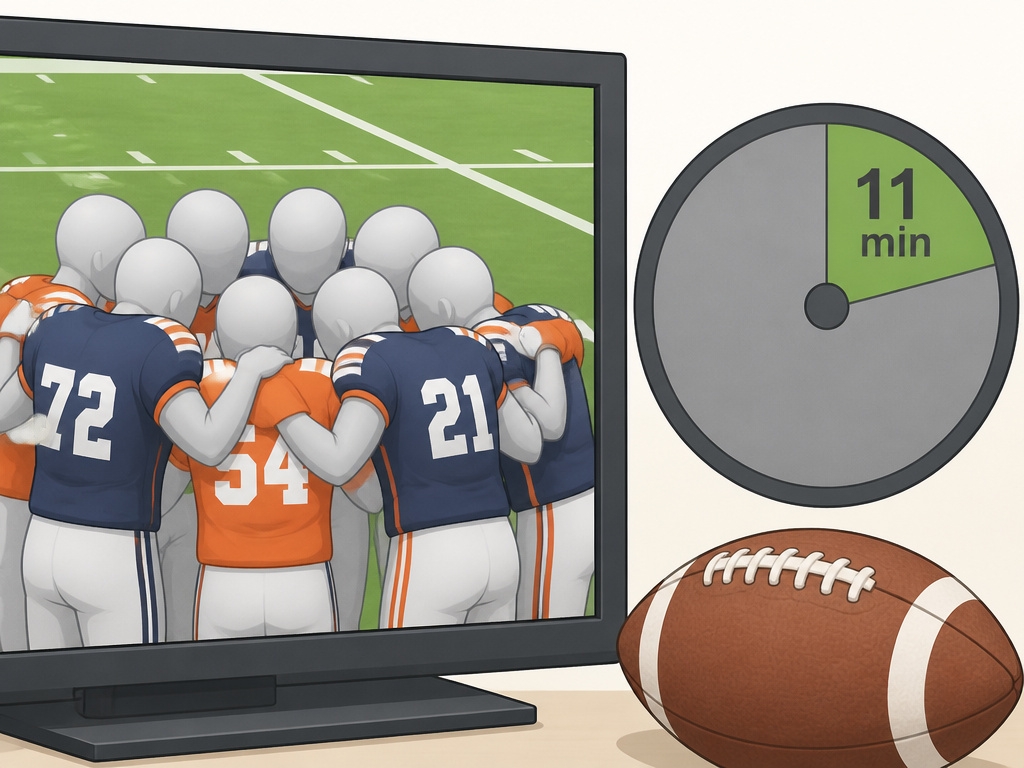
A Wall Street Journal study of four NFL broadcasts found the ball was live for an average of 10 minutes 43 seconds. The average time the ball was live came to 10 minutes 43 seconds, or about 11 minutes. Football games have 11 minutes of action is how Fox Sports republished the findings.
The rest of the broadcast breaks down like this:
- Commercials took about an hour.
- As many as 75 minutes, about 60% of non-commercial air time, showed huddles, players at the line or players milling about.
- The average telecast gave 56% more time to replays than to live play.
Those figures are old, and other counts differ. Researcher Ken Crippen found about 13 minutes 30 seconds of action and C.P. Hutchins counted 13 minutes 16 seconds in 1912. Treat “about 11 to 13 minutes” as the honest range.
The part nobody mentions: Late in a game, the leading team can deliberately let the clock run. A quiet stretch with nothing happening is sometimes the strategy, not a broadcast glitch.
Mechanism time. A typical play lasts about four seconds, yet the clock runs while players peel themselves off the turf and walk back. That’s how a three-hour broadcast holds so little live action. Watch the stretch after a whistle, with the huddle breaking and the replay running, and it makes sense.
Which Team Should You Pick, and Does It Matter?
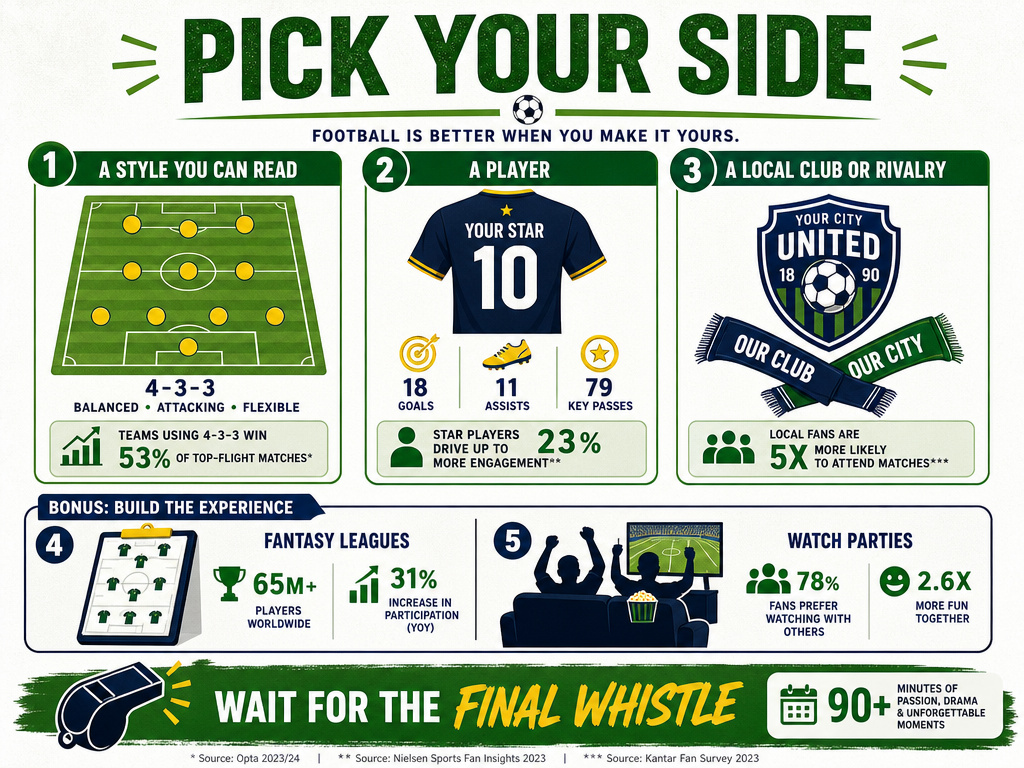
Ever noticed how a match changes once you need one side to win? Passing becomes tension. A throw-in becomes a crisis. That’s the whole point of choosing a side.
You can pick a team by style rather than by last season’s table. Here are three starting points:
- A style you can read. My view: a side that keeps a clear shape is easiest to follow, because you can see where everyone is meant to be.
- A player. Follow one star and you’ve got a built-in reason to watch every minute.
- A local club or rivalry. History gives every result a story before kickoff.
The same ideas apply to women’s football, a fine place to start if the men’s fixture list feels crowded.
Fantasy leagues and watch parties work too. A fantasy squad gives a dull Tuesday fixture a reason to matter, and a watch party puts someone beside you who can explain the offside call without making you feel daft.
I once wrote a confident tactical breakdown after watching only the first half. The halftime switch made it obsolete. Now I wait for the final whistle. And if a tactical take on social media sounds clever, read it, then check it against the match yourself.
Would you trust a verdict on a meal after one bite?
Three Ways to Watch, in the Order I’d Try Them
Start at home on a legal stream, then add company, then go to the ground. Rights differ by country, so check how to watch football online through official broadcasters before you pay anyone.
If you want a watch party, pick a friend who’ll answer questions between stoppages. Skip the person who narrates every pass.
When you’re ready for your first match in person, buy only from official ticket sellers. A cheap listing from a stranger can leave you outside the gate at kickoff.
Pocket Glossary for the Words You’ll Hear in Week One
- Corner kick: a restart for attackers when defenders put the ball over their own goal line.
- Indirect free kick: a restart where the ball must touch another player before a goal counts.
- VAR: the video review team that checks key referee decisions.
- Captains only: a rule where only captains approach the referee. It is optional per competition, not universal.
- Snap: the moment an NFL play starts.
- Touchback: an NFL kickoff ending in the end zone; the ball is spotted at the 35.
- Overtime: extra NFL time after a tie, with a 10-minute cap in the regular season.
How can I learn football by listening to commentators and watching highlights?
Commentators are free teachers, so treat them that way. In your first few matches, keep the volume up and listen for the words they repeat: pressing, offside, the box, third down, blitz. Each term comes with a picture on screen, and after a few games the pairing sticks. Pay attention to the analyst alongside the main voice, because that person usually explains why a play worked or failed.
Away from live games, podcasts are great for commutes. Look for ones aimed at newcomers or built around plain-language tactical breakdowns. Short video highlights work well too, since you see the key moments without a full match of build-up. Watch a highlight once for fun, then again while listening to someone explain what happened. Pause whenever something confuses you and look it up. A little repetition each week builds understanding faster than one long viewing marathon.
Frequently Asked Questions
What is the stupidest rule in football?
That’s opinion, so here’s mine. The NFL running clock frustrates new viewers most: it keeps ticking after a routine play while players walk back, and a leading team can burn it on purpose. In soccer, the rule that changes fastest is the one about goalkeepers holding the ball.
What’s the easiest way to watch NFL games?
Use the official broadcaster in your country and start with one game rather than a full Sunday. With roughly 11 minutes of live action in a typical broadcast, one game gives you plenty to study.
How do I understand the NFL as a beginner?
Watch the lead-up to each snap, then the play. Remember the clock facts: four 15-minute quarters, up to 40 seconds to snap, and a clock that runs after routine plays. Learn rules only when a moment confuses you.
Is soccer or the NFL easier for a first-timer?
Soccer is easier if you want to see shape and space, since the whole pitch stays in view. The NFL is easier if you like short, separate plays that you can study between snaps. I’d pick by temperament, not by prestige.
Do I need to learn every rule before I start?
No. Learn the rules a match throws at you. Rules also change, as the goalkeeper and NFL overtime changes show, so a single stoppage you don’t understand is a better teacher than a rulebook.
The Bottom Line
If you want one answer on how to watch football as a beginner: this week, pick one match, choose a defender, and follow him for 15 minutes without touching your phone. Write down one confusing moment and look it up afterwards.
One concession. Everything here assumes a standard competition. Captains-only rules, goalkeeper sanctions and NFL overtime vary by league and season, so check the rulebook for yours before you argue with anyone.
And hold your verdict until the final whistle.
