
History of Football Boots: The 1863 Rule and Modern Cleats
This post contains affiliate links. As an Amazon Associate, we earn from qualifying purchases.
The history of football boots is a 160-year story of solving three problems: grip, weight, and feel. It began with the 1863 Laws of the Game banning protruding nails, moved through the 1920s Dassler brothers cutting boot weight from one pound to half a pound, and arrived at today’s 200-gram synthetic cleats with interchangeable studs. A major leap was the 1954 introduction of screw-in studs, though exchanging them on early models was a cumbersome process carried out for repair purposes only.
That 1954 moment was a solution to a century-old engineering puzzle. The real history of football boots isn’t just about lighter materials, it’s about how boots kept breaking until someone fixed the studs.
What follows is the chain of problems and solutions in the history of football boots: the banned nails, the wooden strips inside soles, the patent wars over screw threads, and the modern split between disposable high-tech boots and the players who still wear theirs until they rip.
Key Takeaways
- The original 1863 Laws of the Game banned projecting nails and iron plates on boot soles, forcing the first move toward regulated studs.
- Early studded boots had a fatal flaw: studs were driven up into the insole, damaging the shoe within a short time, which led to reinforcements like rigid wooden strips.
- The 1954 World Cup is famous for the Adidas screw-in stud, but patents for removable stud systems date back to at least 1921.
- Modern boot weight has plummeted from one pound in the 1920s to about 200 grams today, driven by synthetic materials and nylon soles.
- Professional use varies wildly: some players use up to 10 pairs a season, while others, like Christian Fuchs, use only four or five and play “until they rip.”
The 1863 Rule That Banned Nails
Football didn’t start with specialised boots. Players wore their rugged work boots, which often had metal-tipped toes and soles hammered with nails or tacks for grip on muddy pitches. The problem was obvious. Rule 13 of the 1863 Laws of the Game put a stop to it, stating: “No player shall be allowed to wear projecting nails, iron plates, or gutta percha on the soles or heels of his boots.”
That single line forced the first evolution. Grip was still needed, but it couldn’t come from dangerous protrusions. The solution emerged from another sport: hockey boots, which used leather studs.
The 1863 law created a design vacuum. Manufacturers could no longer rely on crude metal for traction, which pushed them toward standardised, safer materials like leather for studs, the first step toward a dedicated football boot.
Early dedicated football boots were made of thick leather and featured six leather studs nailed to the sole. They looked more like hiking boots than today’s cleats, with a hardened leather toecap because players primarily kicked with the toe. This was the standard template for decades, but it had a critical, hidden weakness.
The Hidden Engineering War: How to Keep Studs On
The nailed-on leather stud created a predictable failure mode. Every time a player planted their foot, the force drove the stud upwards. After a while, the studs were driven up the insoles, causing discomfort and rendering the shoes useless within a short time.
The German Patent and Trade Mark Office (DPMA) archives show the inventive, sometimes clunky, solutions. To stop the studs from penetrating, manufacturers mounted rigid wooden strips between the insole and outsole. Other fixes were more drastic. A 1921 British patent (GB 186 643 A) proposed hammering in pins that were threaded at one end and had three prongs at the other; the prongs would spread out inside the sole to grip it, allowing a stud with an internal thread to be screwed on.
This was the core problem: how do you attach something to a flexible leather sole that must withstand enormous shear and torsion forces, without destroying the sole in the process? The quest for the removable stud was essentially a search for a reliable thread socket that wouldn’t pull out.
| Patent / Inventor | Year | Proposed Solution | Core Problem It Addressed |
|---|---|---|---|
| George Bell | 1922 | Individual thread sockets between sole layers | Studs pulling out of the sole |
| Ludwig Wackler | 1925 | Leather strips with sockets nailed to sole | Easy stud change without damaging outsole |
| Venustus Eigler | 1930 | Leather discs on a metal base plate | Inexpensive stud exchange |
The narrative that Adidas invented the screw-in stud in 1954 is clean but incomplete. The patents prove the engineering race was already three decades old. What Adidas did was manufacture it reliably and win a World Cup with it.
Weight, Water, and the Player’s Strange Rituals
While engineers fought with studs, players fought with their boots. The early 20th-century boot was a burden. The Dassler brothers. Adolf and Rudolf, founders of Adidas and Puma, made their first major mark in the 1920s by addressing this. They used lighter materials and construction to cut boot weight from approximately one pound to half a pound.
But lighter boots were still stiff, unforgiving leather. So players developed break-in rituals that sound medieval now. The standard advice, from sources like 1937’s Association Football by F.N.S. Creek, was to soak new boots in tepid water for about half an hour, let them dry slowly away from heat, and then grease them with dubbin.
Some pros took it further. England striker Jackie Milburn, who wore a size-six boot on his size-eight feet, would break in new pairs by wearing them without socks and soaking them in cold water. The goal was always the same: mould the rigid leather to the unique shape of the foot, because a comfortable boot was a player’s responsibility, not the manufacturer’s.
This era was defined by uniformity and durability. A single pair of boots was expected to last. Swedish midfielder Anders Svensson recalled that in the early 1990s, his one pair of black Lotto boots would last an entire season.
The 1954 World Cup and the Screw-In Stud
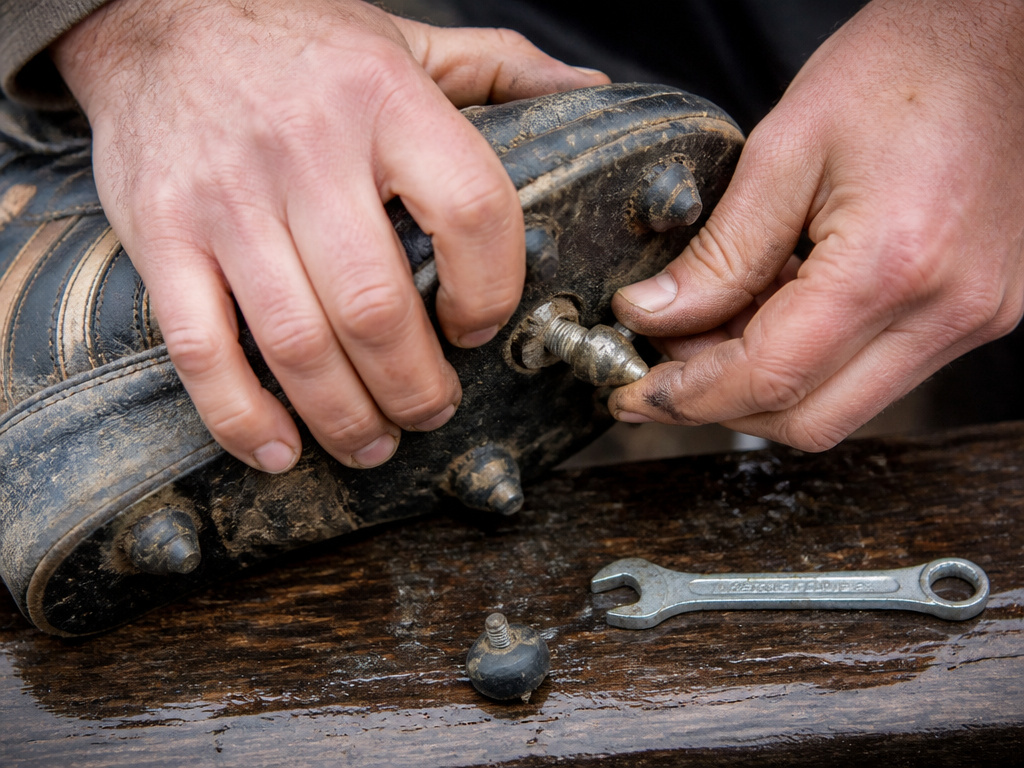
The iconic moment arrived in the 1954 World Cup final, played on a rain-soaked pitch in Switzerland. The West German team wore Adidas boots featuring interchangeable screw-in studs. The longer studs provided crucial traction in the mud, and Germany’s upset victory over Hungary cemented the screw-in stud’s legend.
Adidas produced the first boots with moulded rubber studs in 1949. By 1954, their screw-in system allowed players to change stud length for the first time, turning footwear into adaptive equipment rather than a fixed tool.
But as the DPMA notes, exchanging studs on these early models was “a very cumbersome process carried out for repair purposes only.” The true revolution was nylon. Two years after 1954, boots with nylon soles hit the market. This synthetic material was lighter, didn’t absorb water, and provided a much better base for attaching those screw threads. The age of the heavy, waterlogged leather sole was over.
The 1950 World Cup had already hinted at this future. England’s team, wearing their traditional heavy leather boots with thick toe caps, were unsuited to Brazil’s bone-dry pitches. Stanley Matthews was so impressed he had his own lightweight design made upon returning home, selling 500,000 replica pairs. The template was set: lighter, lower, faster.
From Black Boots to the Predator’s Rise

The post-1954 era saw acceleration. Boots shed their ankle collars and weight kept dropping. Colour arrived, tentatively, with England’s Alan Ball wearing white boots at the start of the 1970s.
The next seismic shift was about control, not grip. In 1994, the adidas Predator first appeared on pitches. It turned the boot’s surface into an active component of play.
Manufacturer focus shifted from durability to hyper-specialised performance. Nike used high-motion cameras at 1,000-frames per second to measure Wayne Rooney’s movements for boot design. Nike placed rings made of hardened plastic on the T90 Laser boot to increase the density of the sweet spot. The boot was now a data-driven precision instrument.
This ethos created the modern paradox of boot life. At the elite level, the evolution toward thin synthetic materials prioritises feel and weight over longevity. Some professional players use up to 10 pairs of boots a season. Yet other pros, like Christian Fuchs, reject this, using only “four or five” pairs and playing “until they rip.” The boot can be a disposable tech product or a trusted, broken-in tool, depending on the player.
The Modern Cleat: Position, Pitch, and Pattern

Today’s football boot is a category of its own. The classic six-stud pattern is now just one option in a vast array designed for specific surfaces and positions.
The evolution of football boot studs has led to specialised outsoles. For soft, muddy natural turf, you’ll find six to eight long, conical studs. For dry turf or artificial grass, the sole might have approximately 10 to 18 shorter, bladed cleats for more contact points and agility.
The smaller the number of studs on a sole, the higher the torsional and shearing forces on each one. This is why reliable stud fastening was such a headache on early six-stud boots, each stud had to handle immense stress.
Positional specialization has advanced, too. Goalkeeper-specific shoes often have more studs or nubs on the outer edge of the sole to provide extra stability for pushing off before a dive. The guide to football boot types now includes categories like “speed,” “control,” and “hybrid,” each with different materials and constructions, from traditional kangaroo leather to modern knit uppers and even laceless designs.
The weight bar has plummeted to about 200 grams per shoe. That’s less than half the weight of the Dasslers’ 1920s innovation. We’ve gone from boots you soaked in a bath to boots you might barely feel.
20th century timeline (1900s-1990s by decade)
In the 1920s, the Dassler brothers created boots using steel studs and nails on the sole, according to Google Arts & Culture, though the 1863 Laws of the Game had banned projecting nails and iron plates. By 1949, Adidas produced the first boots with moulded rubber studs. The 1954 World Cup was a landmark event, with West Germany’s winning team wearing boots featuring screw-in studs. Two years later, boots with nylon soles entered the market. The 1970s saw players like Alan Ball wearing distinctive white boots. The pace of change accelerated in the 1990s, culminating in the first appearance of the adidas Predator on football pitches in 1994, a design that would change the game.
Iconic boot models (e.g., Adidas Predator, Copa Mundial, Puma King)
Iconic boot models are defined by their innovation and the players who wore them. The adidas Predator, which first appeared in 1994, is a prime example. Its design was a significant departure from traditional leather boots, incorporating elements to enhance ball control and swerve. Other legendary models, while not named in the fact sheet, share a history of evolution from the early, heavy leather boots with thick toe caps. Following the 1950 World Cup, where such boots proved unsuitable, players like Stanley Matthews arranged for the design of their own private pairs, leading to commercially successful replicas. These models set the standard for performance and style for generations.
Key brands (Adidas, Puma, Nike, Gola, Valsport)
Key brands have driven the technological evolution of the football boot. Adidas was a pioneer, producing the first boots with moulded rubber studs in 1949 and introducing screw-in studs by the mid-1950s. The brand’s legacy is partly rooted in the earlier work of the Dassler brothers in the 1920s. Nike entered the field with a focus on high-tech design, using advanced motion capture to analyse player movements for boot development. While the fact sheet does not provide specific details on Puma, Gola, or Valsport, these and other brands have all contributed to a competitive market where innovation in materials, stud configuration, and weight reduction continues to shape the modern game.
Frequently Asked Questions
What cleats are illegal in the NFL?
While this article focuses on association football (soccer), the spirit of the 1863 “no projecting nails” rule lives on in all sports. In the NFL, cleats with metal or ceramic tips that are deemed dangerously sharp are illegal. The governing principle is the same: equipment must not pose an undue injury risk to opponents.
What are the three types of football boots?
Modern boots are generally categorized by playing style. Speed boots are the lightest, with thin synthetic uppers and aggressive stud patterns for acceleration. Control boots often feature textured strike zones (like the old Predator) and pliable materials for better passing and shooting feel. Hybrid boots blend elements, offering a balance of touch, support, and weight. This is a marketing and design framework that helps players narrow down choices from hundreds of models.
Why do they call them football boots?
The term “boot” is a direct holdover from the 19th century, when players literally wore their high-ankle work boots to play. Even as the design shrank below the ankle, the name stuck, especially in British English. “Cleat” is more common in American English, referring to the studs on the sole.
What is the oldest recorded football boot?
The earliest known reference is from 1526, when King Henry VIII of England ordered a pair of “football boots” from his royal shoemaker. We have no detailed description, but they were certainly made of robust leather, designed for a rough, medieval form of the game played by nobility.
The Bottom Line
The history of the boot isn’t a smooth arc toward perfection. It’s a story of repeated breakdowns, nails that injured, studs that pulled out, leather that soaked up water and weighed a ton, and the often-awkward inventions that fixed them, from wooden strips to patented screw threads.
One rule still applies from the Jackie Milburn era: the boot must disappear on the foot. The difference is that now, a 200-gram knit boot with a carbon fibre sole does that job from the first wear, no bath required. The quest for that perfect feel, married to unbreakable grip, is what drove every change.
So next time you see a player change their studs at halftime, remember it’s a ritual that connects them directly to the inventors of the 1920s, who were just trying to solve the basic problem of keeping a piece of rubber attached to a shoe. They succeeded. The rest is just marketing, weight savings, and colour.
