
Laceless Football Boots Pros and Cons: How to Choose
This post contains affiliate links. As an Amazon Associate, we earn from qualifying purchases.
Laceless football boots offer a clean striking surface and a sleek, sock-like fit, but they lack adjustable lockdown and are a poor choice for players with wide feet. The main pros are a pure ball feel and a streamlined design; the key cons are a non-adjustable fit, potential for material stretch over time, and a higher price point. For the right foot shape, typically narrow to standard width, they can be excellent, but they are not a universal upgrade.
That’s the technical summary. The real story is in the trade-offs, and they’re sharper than most marketing admits. Lockdown isn’t just about tightness; it’s about how a boot handles the 70th minute when feet swell and materials warm up. A laced boot can adapt in seconds. A laceless boot can’t. The debate over laceless football boots pros and cons hinges on this precise moment.
What follows is a breakdown of the laceless football boots pros and cons, showing where they genuinely excel, where they fall short, and how to know if your feet are even compatible. We’ll look at the conflicting sizing advice, the one model that bucks the trend, and a simple three-step test you can do in any shop.
Key Takeaways
- Laceless boots provide a clean, uninterrupted striking surface, which can improve ball feel for passing and shooting.
- The biggest con is zero adjustability; if the pre-molded fit isn’t perfect, you can’t fix it, making them a poor choice for many players with wide feet, though some sources note a specific model can achieve good lockdown.
- Sizing advice is contradictory: a peer-reviewed study notes players often buy boots 1-2 sizes too small, while a top laceless boot review recommends going at least a half size up.
- Materials can stretch over time, leading to a loose fit that no lace can tighten, compromising lockdown and safety.
- For most amateur players, a properly fitted mid-range laced boot is a more versatile and durable investment than a premium laceless model.
The Lockdown Challenge: Adjustability vs. Snug Fit
The core promise of a laceless boot is a seamless, second-skin fit. The core problem is that skin can’t be tightened. A US patent for a laceless athletic shoe (US11350701) frames the engineering challenge directly: you need lateral and medial portions that are at least two times stiffer than the elastic middle to prevent the foot from rolling during a cut. That’s the blueprint. In practice, it means the boot’s factory shape is your only fit.
Where this goes sideways: Putting on a slightly loose laceless boot. You’ll feel a subtle heel lift during your first hard stop. By the second half, that lift becomes a slide, and you’ll start losing power in every push-off. Blisters follow within a couple of sessions.
This is the trade-off. Laces give you a dynamic fit. You can loosen them at the toe box, crank them down at the ankle, or re-tie them at halftime. A laceless boot is static. The Adidas developers behind the ACE16+ Purecontrol said the hardest part of their 24-month project was making a slip-on that was “stretchable enough to get on, but tight and snug when it’s on your foot during a game.” That tension is locked in at the factory.
If your foot matches that tension perfectly, the feel is incredible. If it doesn’t, you have an expensive, unwearable shoe. There is no middle ground.
The Sizing Conflict: What the Data Actually Says
Here’s where advice gets messy. Sources flatly disagree on how to size football boots, and laceless models amplify the problem.
A peer-reviewed study in the Journal of Sports Sciences (PMC6259463) found that players, in pursuit of a better feel, often buy shoes one or two sizes too small. The study calls this an “inadequate behaviour” linked to injuries like turf toe and recommends custom fitting programs to stop it.
Now, read a review of a top laceless model. The FourFourTwo review of the New Balance Tekela V4+ Pro explicitly says to go at least a half size up from your usual size for the best fit. One source says players go too small; another says a leading laceless boot runs too small. They’re both right, and it creates a minefield for buyers.
| Source | Sizing Guidance | Context & Rationale |
|---|---|---|
| PMC Study (PMC6259463) | Notes players often choose boots 1-2 sizes too small. | Identifies this as a harmful habit that increases injury risk; advocates for education and customization. |
| New Balance Tekela V4+ Pro Review | Recommends buying at least a half size up. | States that even a half-size-up fit is “very snug,” indicating the boot’s last runs exceptionally tight. |
| General Purchasing Advice | Try on multiple sizes and models in person. | The only way to navigate conflicting advice and account for unique foot shape. |
The takeaway? Throw out your usual size. Your mission in the shop is to find the specific laceless model that fits your foot shape, not to force your foot into a size you think you are. This is why our guide on how boots should fit emphasises feel over numbers.
Material and Longevity: The Stretch Factor
On average, football cleats last about 5–10 months with regular use. For laced boots, that timeline is about outsole wear and upper scuffing. For laceless boots, the clock ticks on the elastic materials in the upper.
Laceless cleats can stretch over time and lose lockdown. The elastic yarns that provide that initial snug compression have a memory. After hundreds of flexes, warm-ups, and matches, they relax. In a laced boot, you pull the laces tighter. In a laceless boot, you have no recourse. The fit degrades, and with it goes performance and safety.
The material doesn’t just get looser; it loses its ability to snap back. You’ll feel your foot start to slide inside the boot on sharp cuts, a sensation called ‘internal slippage.’ That’s when a rolled ankle happens.
This aging process is the most underrated con in the laceless football boots pros and cons discussion. That perfect, sock-like fit on day one is a depreciating asset. Reviews of the latest models, like the New Balance Tekela V4+ Pro with its Hypoknit upper, rightly praise immediate comfort. But they can’t tell you how that knit will feel after a full season. For a deeper look at modern materials, our breakdown of knit football boots covers the durability trade-offs in detail.
Performance Pros: Where Laceless Boots Shine
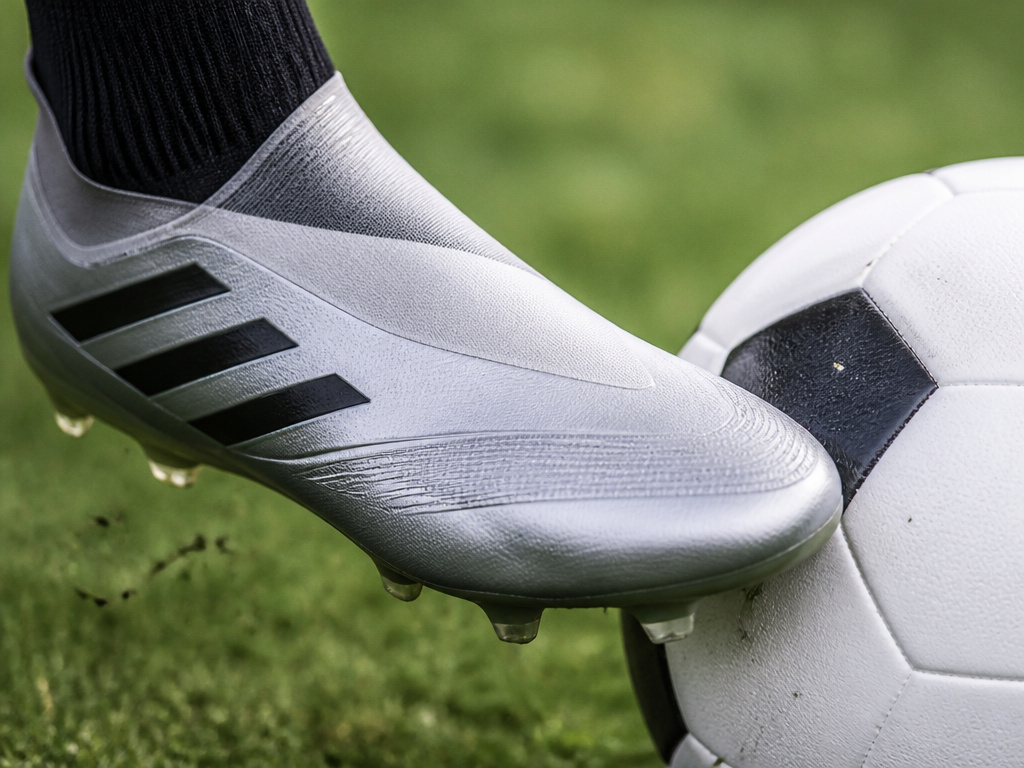
To be fair. When the fit is right, the benefits are tangible and can change how you play.
The primary advantage is the clean striking surface. Removing laces, eyelets, and knots eliminates points where the ball can skid or bounce unpredictably. The primary advantage is the clean striking surface. Removing laces, eyelets, and knots eliminates points where the ball can skid or bounce unpredictably. It’s the “one-to-one” feel brands talk about.
The second pro is weight reduction. By ditching the lacing hardware, brands can shave precious grams. By ditching the lacing hardware, brands can shave grams. This is why understanding boot weight is crucial for position-specific choices.
Finally, there’s convenience and aesthetics. Slip-on, slip-off. No soggy, muddy laces to untie. For the player whose confidence is tied to their gear, that’s not nothing.
Who Should (and Shouldn’t) Wear Laceless Boots
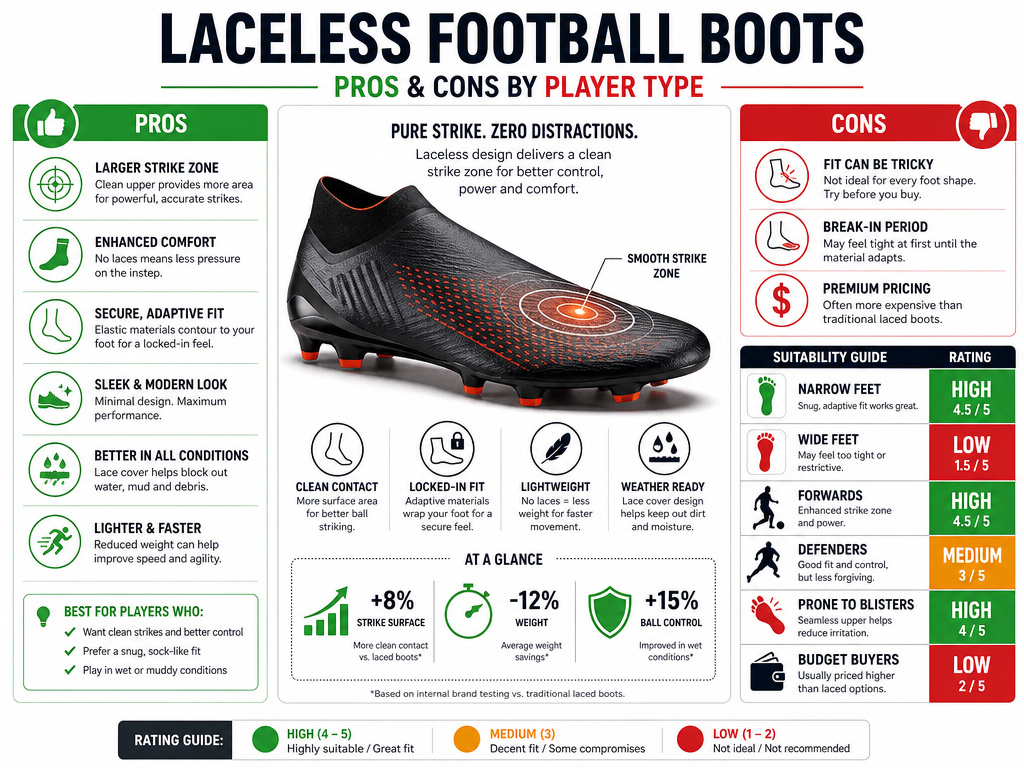
This isn’t about good or bad. It’s about matchmaking. Use this table as a quick-reference guide.
| Player Profile | Suitability for Laceless | Key Reason |
|---|---|---|
| Narrow/Standard Width Feet | High | The pre-molded compression fit is designed for this foot shape. Likely to achieve proper lockdown. |
| Wide Feet or High Insteps | Very Low | The intense, non-adjustable compression creates painful pressure points and numbness. |
| Forwards/Attacking Mids | Medium-High | Benefit most from clean strike zone and lightweight feel for shooting and dribbling. |
| Defenders/Goalkeepers | Low | Require maximum, adjustable lateral stability for tackles, blocks, and dives. |
| Players Prone to Blisters | Risky | Less ability to relieve friction points; a poor fit guarantees hot spots. |
| Budget-Conscious/Buying for Growth | Low | Higher initial cost and non-adjustable fit make them poor long-term value. |
If you’re in the “High” suitability category, your next step is trying on specific models. The Adidas F50 Elite Laceless (UK 3.5-13) is a speed-oriented option, while the New Balance Tekela V4+ Pro is the current benchmark for lockdown in a laceless package. For a wider view of the field, our roundup of the best laceless cleats compares the top contenders.
If your foot shape isn’t ideal, don’t force it. The performance loss and discomfort aren’t worth the sleek look. A well-fitted laced boot will always be the safer, more versatile choice. The debate between leather vs synthetic materials becomes far more important once you’ve settled on a laced design.
The In-Store Fit Test (Don’t Skip This)
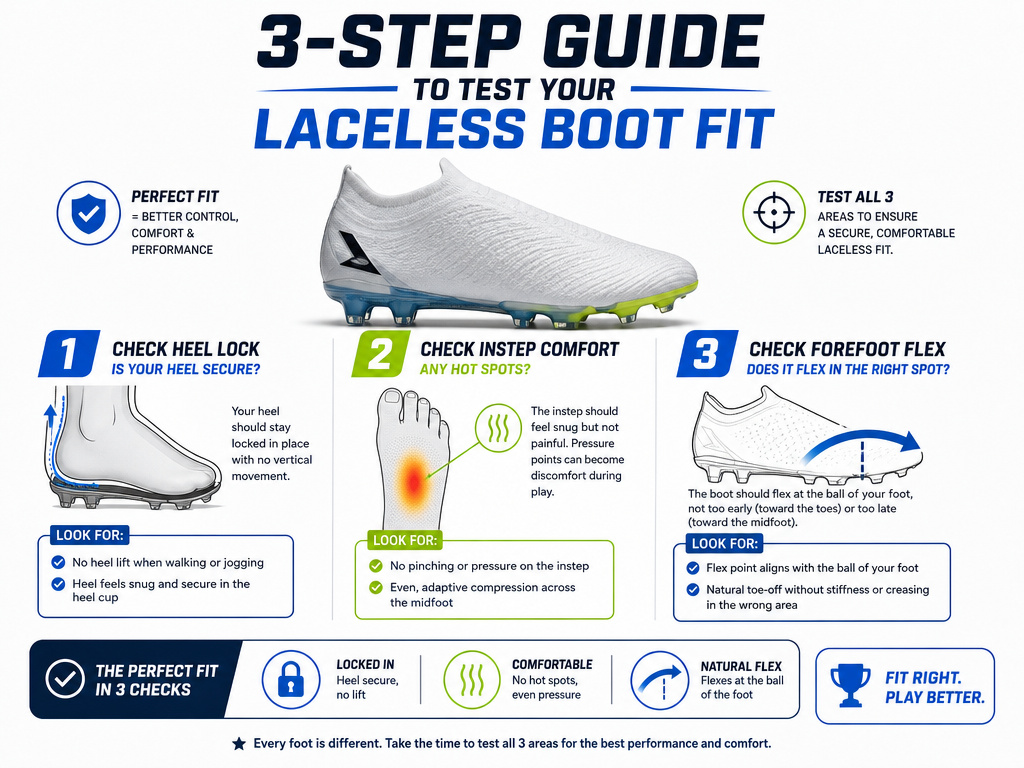
Buying laceless boots online is a gamble. If you’re serious about them, commit to a shop visit. Once you have a pair on, run through this three-step assessment right there in the aisle.
- The Heel Lock Test. Jog in place, then stop abruptly. Focus on your heel. If you feel any lift or slip, the lockdown is insufficient. This is the most common failure point.
- The Five-Minute Stand. Just stand still. After a few minutes, do you feel numbness, tingling, or a sharp “hot spot” on the top of your foot? That’s the sign of a volume mismatch, your instep is too high for the boot’s ceiling.
- The Flex Test. Simulate a kicking motion. Does the upper pinch aggressively across the top of your foot where it bends? A little pressure is normal; pain is a dealbreaker.
Pass all three, and you might have a winner. Fail any one, and you should walk away. The right fit should feel snug but not restrictive, with no distinct pressure points. Remember, they won’t break in like leather; what you feel in the shop is what you get.
How do laceless football boots work?
The construction of a laceless boot is a precise engineering challenge. The goal is to create a stretchy entry that allows the foot to slip in, which then becomes tight and snug during play. A key design principle from a US patent describes an upper built with stiff lateral and medial portions, at least two times stiffer than the elastic intermediate section. This structure aims to cradle the foot securely without laces, preventing unwanted movement. Early models failed because they were too rigid, but modern versions use advanced knitted materials to balance flexibility for entry with lockdown for performance.
Frequently Asked Questions
Are laceless football boots worth it?
They are worth it only if your foot shape matches the boot’s last perfectly and you prioritize ball feel above all else. For most players, the lack of adjustability and higher cost mean a premium laced boot offers better value and versatility.
Do professional footballers wear laceless boots?
Some do, but they are a minority. Most pros prioritize absolute lockdown and custom fit, which laces provide. Notable brands like Nike have never released a laceless football boot, signaling skepticism at the highest performance level. Many players using laceless models from Adidas or New Balance have the option of fully customized fits unavailable to the public.
Can you tighten laceless boots if they are loose?
No. That is the fundamental limitation. Once the elastic materials stretch over time, the fit becomes permanently looser. You cannot adjust them like laces. This is why long-term lockdown is a major concern highlighted in guides like the Metro League laceless cleats guide.
Are laceless boots better for shooting?
They provide a cleaner, more consistent surface for ball contact, which can help with shooting accuracy. However, they won’t improve poor technique. A powerful, accurate shot comes from technique; the boot only ensures the ball doesn’t take a bad bounce off a lace knot.
What are the main alternatives to laceless boots?
The main alternative is a laced version of the same boot model (e.g., Adidas Predator Elite Laced vs. Laceless). This gives you the same soleplate and upper technology with the security of a lacing system. For beginners or those on a budget, exploring the different types of football boots for your playing surface is a better starting point than fixating on laces.
The Bottom Line
Laceless football boots are a specialist tool, not a universal upgrade. They excel for a specific player: narrow to medium feet, attacking mindset, and a preference for pure ball feel. For everyone else, especially players with wide feet, a need for stability, or a budget, they introduce more problems than they solve.
The market tells the story. The failed Lotto Zhero Gravity, an early laceless boot, was too rigid. The modern iterations solved comfort but introduced the stretch problem. That shift speaks volumes.
Before you buy, know your foot. Then match the boot to it, not the other way around. Your choice should be dictated by the shape of your foot and the surface you play on, long before you consider the absence of laces.
