
Kangaroo Leather Football Boots Pros and Cons
This post contains affiliate links. As an Amazon Associate, we earn from qualifying purchases.
Kangaroo leather football boots offer a soft, form-fitting touch prized by many players, but they require more maintenance, absorb water, and face growing ethical and legal challenges. The choice hinges on valuing a custom, glove-like feel against the convenience, consistency, and lower ethical friction of modern synthetic alternatives.
That feel is the whole point. A 2016 study in Applied Ergonomics had twenty players test three otherwise-identical boots with different uppers: calf leather, kangaroo leather, and synthetic leather. The kangaroo leather boot was consistently rated closest to their preferred fit. It wasn’t just softer; it was perceived as tighter and more secure in the metatarsals and instep, molding to the foot in a way synthetics didn’t. That’s the tangible advantage you’re buying, which is a key point in any discussion of kangaroo leather football boots pros and cons.
What follows is a breakdown of the kangaroo leather football boots pros and cons: the upkeep, the wet-weather performance, the durability debates, and the increasingly loud conversation about where the leather comes from. We’ll look at what the brands are doing, what the laws say, and where the game’s top players are putting their feet.
Key Takeaways
- Kangaroo leather provides a perceptibly better, custom-like fit than synthetic uppers, as documented in a peer-reviewed study with twenty testers.
- Major brands like Puma and Diadora have stopped using kangaroo leather, with Puma’s synthetic K-Better material claiming to outperform its previous k-leather.
- At the 2022 World Cup, a Center for a Humane Economy report found over 95% of goals were scored in synthetic boots, with kangaroo leather models accounting for just eight.
- Proper care is essential; a kangaroo leather boot absorbs water and can overstretch if not conditioned and dried correctly after every wet use.
- The ethical and legal landscape is shifting, with sourcing practices under scrutiny and sales banned in California under Penal Code § 653o.
The Core Appeal: Why Players Choose Kangaroo Leather
Minute 63, left channel. A midfielder receives a ball with a defender on their back. The first touch needs to be perfect, cushioned, controlled, and ready for the next move. That’s where the kangaroo leather argument lives. It’s not about raw speed or a colorful design. It’s about tactile connection.
The Applied Ergonomics study is the closest thing to lab-proof we have. When players laced up the kangaroo leather test boots, they didn’t just say they were comfortable. They reported a fit that felt secure and precise in key areas like the instep and across the metatarsals. The synthetic boots in the same test were perceived as the loosest and furthest from their ideal. This matters because a boot that moves with your foot, rather than around it, translates intention into action. A subtle cut, a sharp turn, the feel of the ball rolling under your laces, kangaroo leather communicates that feedback directly.
This structure makes it exceptionally malleable and strong for its weight, allowing it to stretch and conform to the foot’s shape without losing structural integrity.
That conformity creates a personalized fit over time. Like a well-worn glove, a kangaroo leather upper molds to the unique contours of your foot. This can eliminate pressure points and hotspots that synthetic boots, with their more uniform structure, sometimes cause. For players with wider feet or high arches, this adaptive quality can be the difference between a boot they can wear and one they can’t.
Honestly? This is the bit people skip. They see a pro wearing a flashy synthetic speed boot and want the same. But if your game is built on control, passing, and feeling every touch, that molded fit from kangaroo leather is a tangible advantage. It’s the difference between wearing shoes and wearing your shoes.
The Trade-Offs: Drawbacks and Maintenance
For all that sublime touch, kangaroo leather asks for something in return: your attention. A synthetic boot can be tossed in a bag after a rainy match. Do that with a kangaroo leather pair, and you’re asking for trouble.
The biggest practical headache is water management. Kangaroo leather is not waterproof; it’s absorbent. A soaked kangaroo leather boot can gain significant weight and will take a long time to dry properly if you don’t intervene.
Common mistake: Letting wet kangaroo leather boots dry near direct heat like a radiator. The leather dries out, cracks, and loses its suppleness. Always stuff them with newspaper and let them air-dry at room temperature.
This leads directly to the maintenance ritual. After any exposure to moisture, you need to:
- Wipe off surface mud and dirt with a damp cloth.
- Stuff the boots tightly with newspaper to absorb internal moisture and maintain shape.
- Let them dry naturally, away from heat.
- Once dry, apply a thin layer of leather conditioner to replenish oils and prevent cracking.
Skip these steps, and the leather hardens. It becomes brittle, loses its fit, and is prone to cracking at the flex points. Compared to the wipe-and-wear ease of most modern synthetic boots, it’s a commitment.
There’s also a durability quirk. While kangaroo leather is famously strong for its thickness, that very softness can lead to overstretching. If the boot isn’t laced snugly or if it’s consistently exposed to water without proper drying, it can stretch beyond its original fit, becoming baggy and losing that prized locked-down feel. It’s a material that rewards careful ownership and punishes neglect.
Kangaroo vs. Synthetic: A Shifting Performance Debate
So, when weighing the kangaroo leather football boots pros and cons, which is actually better? The answer now depends on who you ask and, more tellingly, what you watch. The data points in opposite directions.
On one side, you have the player perception study showing a clear preference for the kangaroo leather fit. On the other, you have the 2022 World Cup. An analysis by the Center for a Humane Economy tracked World Cup goals. Of those, only eight came from players wearing kangaroo leather cleats. Over 95% were scored in synthetic boots. Their report bluntly states kangaroo leather is “clearly outmatched” by modern, human-made materials.
| Aspect | Kangaroo Leather Argument | Modern Synthetic Argument |
|---|---|---|
| Touch & Feel | Superior, moldable fit proven in player study. | Consistent, game-ready feel from first wear. |
| Performance Data | Subjective preference data. | Dominant usage at elite level (2022 World Cup). |
| Weight | Historically very light. | Can be made equally or more lightweight. |
| Water Resistance | Poor; absorbs water, requires care. | Excellent; often water-repellent or quick-drying. |
| Durability | Long-lasting if maintained, but can overstretch. | Highly durable with minimal maintenance. |
The brands are voting with their R&D budgets. Puma will stop producing kangaroo leather boots this year, replacing it with K-Better, a synthetic made from recycled nylon that they claim outperforms their previous k-leather in testing. Diadora ceased development of kangaroo leather shoes back in 2019. Nike and Adidas still use it. Nike in a “small portion” of boots, Adidas in a share “significantly below one percent”, but their flagship speed boots (Mercurial, X) are all synthetic.
From a pure boot weight perspective, the gap has closed. Where kangaroo leather once had an unbeatable strength-to-weight ratio, engineered knits and meshes now match or beat it. The question is no longer which material is objectively better, but which property you value more: the broken-in, custom feel of leather or the relentless, care-free consistency of synthetic.
The Ethical and Legal Landscape

Here’s where the conversation leaves the pitch and enters more complicated territory. The soft leather comes from a wild animal, and the industry around it is a point of intense conflict.
Proponents argue it’s a sustainable byproduct of necessary population control, but sources disagree on population trends. The Australian government estimates a population of around 34 million, while a Sokito blog citing population data claims a drop from 60 million to 31 million between 2001 and 2021.
The humane aspect is equally contested. Industry codes require a single shot to the head for a quick death.
Legally, this has consequences. California Penal Code § 653o prohibits the commercial import and sale of kangaroo parts. A 2020 investigation found widespread non-enforcement, with kangaroo leather cleats still readily available in the state, but the law remains on the books. At the federal level, the proposed Kangaroo Protection Act seeks a national ban, highlighting the growing political pressure.
For you, the buyer, this means two things. First, purchasing genuine kangaroo leather boots may become more difficult or legally ambiguous depending on where you live. Second, it adds an ethical dimension to your choice. You’re not just choosing a material for its feel, but indirectly supporting a specific supply chain. For many players, this alone is reason enough to opt for the many high-performing synthetic alternatives now available.
Caring for Your Kangaroo Leather Boots
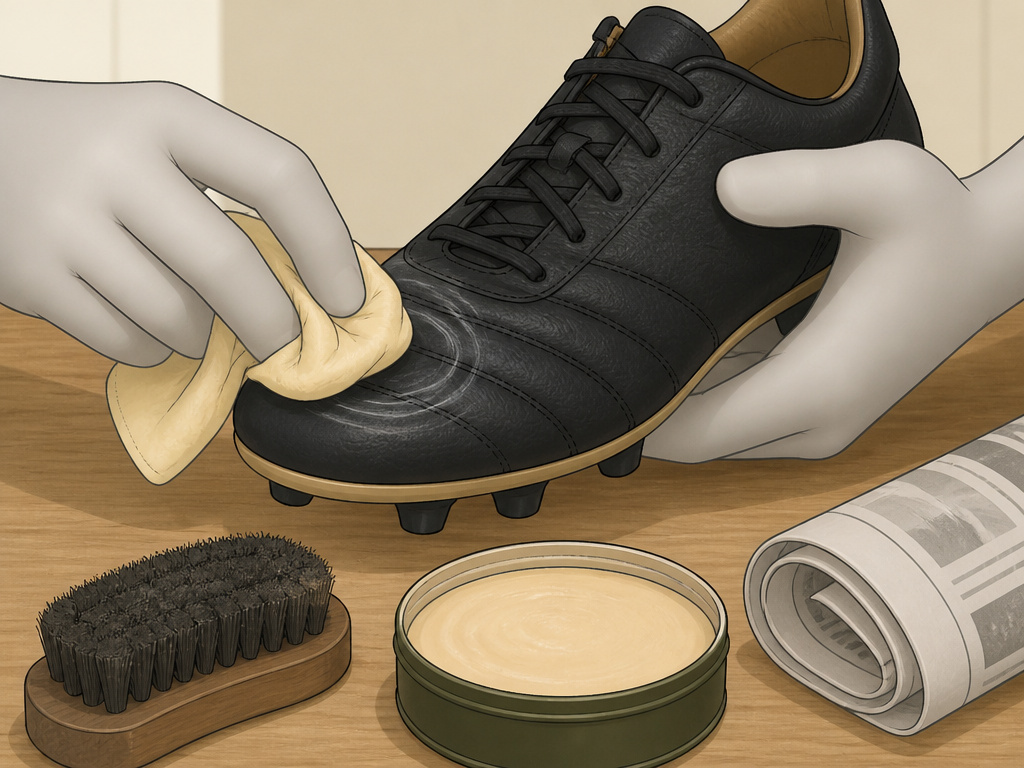
If you decide kangaroo leather is for you, its lifespan is in your hands. Think of it like maintaining a defensive shape, it’s about consistent, disciplined habits.
Immediate Post-Match (The Clean):
Never let mud or grass stains dry. Use a soft brush or damp cloth to wipe the upper clean. For the soleplate and studs, a stiff brush removes debris that can wear down traction. This isn’t just about looks; embedded grit grinds away at the leather and stitching over time.
The Dry (The Most Important Step):
This step is critical. Remove the laces and insoles. Remove the laces and insoles. Pack the boot firmly with newspaper, replacing it when it becomes damp. This draws moisture from the inside out. Let them dry at room temperature, never by a heater or in direct sun. Heat bakes the leather, making it brittle.
The Condition (The Replenish):
Once fully dry, apply a dedicated leather conditioner. A tiny amount on a soft cloth, rubbed in circular motions, is all you need. It replaces the natural oils lost to water and play. Let it absorb for an hour before wiping off any excess. This step keeps the leather supple and prevents the cracks that end a boot’s life.
Storage:
Store them in a cool, dry place out of direct sunlight. Use a boot bag that breathes, not a sealed plastic bag. Those silica gel packets you get in electronics boxes? Toss one in each boot to fight humidity.
Follow this cycle, and a pair can last multiple seasons. Neglect it, and you might not get through one. It’s the fundamental trade-off: time for touch.
Frequently Asked Questions
Are kangaroo leather football boots being phased out?
Yes, by several major brands. Puma will stop production in 2024, Diadora ended development in 2019, and Asics and Mizuno announced in 2025 they would stop using it. Nike and Adidas still use it in a small percentage of models but are heavily invested in synthetic technologies.
What is the best alternative to kangaroo leather?
Modern synthetic uppers from major brands are the direct alternative. Puma’s K-Better, Nike’s Flyknit, and Adidas’s Primeknit are examples of engineered materials designed to offer a precise fit, lightweight performance, and water resistance without using animal leather.
Is kangaroo leather good for wet conditions?
No, it is one of its main weaknesses. Kangaroo leather readily absorbs water, which adds weight, stretches the material, and requires a thorough drying and conditioning process after use. Synthetic boots are far superior for consistent play in wet weather.
How can you tell if boots are real kangaroo leather?
Genuine kangaroo leather is typically labeled as “K-Leather” or “Kangaroo Leather” on the boot’s tongue or product description. It has a uniquely soft, almost suede-like feel compared to stiffer calf leather or the uniform texture of synthetic. If the price seems too low for a premium leather boot, it likely isn’t the real thing.
Why are kangaroo leather boots so expensive?
The Bottom Line
Kangaroo leather football boots offer a specific, proven sensation, a molded, glove-like fit that many players swear by. But that advantage is now ringed by caveats: diligent care, poor wet-weather performance, and a significant ethical debate.
The evidence from the highest level of the game is telling. When virtually every goal at the 2022 World Cup was scored in synthetic boots, it signals where performance innovation is focused. Brands are following, with Puma and others actively moving on.
So here’s the takeaway. Choose kangaroo leather if you prioritize that traditional, broken-in feel above all else and are committed to its upkeep. But for most players, especially those playing in variable conditions or who prefer a grab-and-go routine, the latest synthetic materials offer a compelling, high-performance, and less complicated path. The beautiful game has evolved, and its boots have, too.
