
Football vs Soccer Name Difference Explained
This post contains affiliate links. As an Amazon Associate, we earn from qualifying purchases.
The football vs soccer name difference explained in one line: soccer is British schoolboy slang for Association football, first found in print in 1885, and the US and Canada kept it because football already names their gridiron game. Of FIFA affiliates where English is official or primary, 43 use football in their names.
The word to watch in that answer is “Association.” Schoolboys clipped it to “Assoc.” and added “-er,” the same habit that gave English “footer” for football (1863) and “brekker” for breakfast (1889). Rugby football got the matching nickname “rugger.” Say them out loud and the pattern is obvious.
What follows covers the 1863 split that created two kinds of football, the school magazines that printed “soccer” first, and a popular origin story that falls apart on the dates. It also covers why Britain, America, Australia and New Zealand ended up in different places. A country table and a short FAQ close it out.
Key Takeaways
- Schoolboys made the word, not Americans: the earliest known print use is a letter signed “Soccer” in The Marlburian, dated 25 November 1885.
- The Charles Wreford Brown coinage story first appeared in 1952, a year after his death, and he was still at school when “soccer” reached print.
- The US governing body was renamed from the U.S. Football Association to the U.S. Soccer Football Association in 1945, then became the U.S. Soccer Federation in 1974.
- Australia’s governing body switched to “football” in 2005, and New Zealand followed in 2006.
- Sources split on when Britain cooled on “soccer”: the 1970s or the 1980s, depending on who you read.
Why One Sport Got Two Names in 1863
The Football Association drew up its rules in 1863, and the sport has had two named versions ever since. Before that, “football” covered a loose family of kicking games. After it, English sport had “association football” and “rugby football.”
Association football is the code of football defined by the rules the Football Association drew up in 1863. The name separates it from rugby football, the variety played at Rugby, which earned the nickname rugger. Soccer and rugger began as schoolboy slang for these two codes, formed by clipping the first word and adding -er.
Football Is Older Than the Rules
“Football” has been in English since the early 1400s, for various games where people kicked balls around a field. The word beat the modern game by a very long way. You can read the etymology of the word football on Wikipedia, and nobody argues about that old word. The fight is over the new one.
The Walkout That Made Rugby Separate
Part of how the Football Association codified the rules was deciding what to cut. Blackheath’s F. M. Campbell, the first FA treasurer, withdrew his club after two draft rules were removed. One of them allowed running with the ball.
That cut is the fork in the road. Carry the ball and you’re heading toward rugby football. Leave it out and you’ve got association football. I’d call 1863 the real birthday of the naming problem.
The founding of the FA in England left one more oddity. As the first football association, it never put “English” in its title. It also holds a permanent seat on IFAB, the body responsible for the Laws of the Game. Of the original eleven clubs, only Civil Service FC survives with an unbroken association football history.
Where Did the Word Soccer Come From, and Who Printed It First?
On 25 November 1885, a pupil at Marlborough College wrote to the school magazine and signed his letter “Soccer.” He complained there’d been no “Association” on the Common that term. Picture the page: a short letter in a school magazine, ending in one odd pseudonym he expected readers to understand.
Marlborough played rugby, which makes the letter stranger. Other letters in that magazine praised association football, but only this one used the word. Within days, two other school magazines printed it as “socker.” Scottish Sport History finds no obvious link between the three.
The -er Habit
The Oxford English Dictionary traces “soccer” to “Assoc.,” short for Association, plus “-er.” Say “Assoc” aloud and you get a clipped, hard stop before the suffix lands. Slang like this was common:
- footer, for football (1863)
- brekker, for breakfast (1889)
- ekker, for exercise (1891)
- bonner, for a bonfire (1898)
- cupper, for an intercollegiate cup match (1900)
There’s a practical reason “footer” wasn’t enough. It could mean either code, so schoolboys needed a separate word for Association. “Association” runs to five syllables; “soccer” gets it down to two.
Who Printed It, and When
The printed record is thin. Scottish Sport History found only about a dozen instances of “soccer” by 1890, mainly in school magazines. The OED’s earliest example was once 1891, and digitised Victorian publications pushed it back to 1885.
| Publication | Date | Spelling and note |
|---|---|---|
| The Marlburian | 25 Nov 1885 | “Soccer,” signed letter |
| The Oldhallian | 1885 | “socker” |
| The Carthusian | Oct 1886 | “soccer,” school internationalists |
| Oxford Magazine | Feb 1887 or 1888 | “Socker”; sources differ |
| Boy’s Own Paper | Apr 1889 | “Socker,” national pickup |
The Oxford Magazine row shows a real disagreement. Scottish Sport History dates its first “Socker” to February 1887. Fred Shapiro, quoted on Grammarphobia, found “soccer” in an 1888 issue. Both agree it came after the 1885 school-magazine uses.
By 1899 the Daily Telegraph wrote that “On whose lips Association first changed into Soccer, history is silent.” That’s still true. In the 1890s the spelling settled on “soccer” over “socker.”
Did Charles Wreford Brown Really Invent the Word?
The tidy story credits one Oxford man, and it gets repeated everywhere. Charles Wreford Brown was an Old Carthusian, captain of the University football eleven and an England international. Right, so, the story says he coined “soccer.” The dates say otherwise.
The part nobody mentions: Geoffrey Green of The Times first told the Wreford Brown story in 1952, a year after Wreford Brown died. Green added the caveat “Or so the story goes.” Anyone repeating it as fact is quoting a 1952 anecdote about events from the 1880s that its subject couldn’t confirm.
Here’s what weakens it:
- He was still at school when “soccer” first appeared in print.
- The Oxford Magazine’s first “Socker” is February 1887, three months after its first “Rugger.” Nothing earlier has turned up at the University.
- No contemporary use of “assoccer” exists. Scottish Sport History thinks that explanation surfaced only this century.
Wikipedia’s football-word entry still credits him, with a caveat. Scottish Sport History rules him out. I side with the historian who worked from the digitised magazines.
Say “rugger” and “soccer” aloud. They sound like twins because the evidence suggests they were born in the same few years. A school kitchen shouting the short version of an order and moving on is a fair picture of how they spread.
Who said it first, then? Probably a schoolboy nobody remembers.
Why Americans and Canadians Kept the Word Soccer
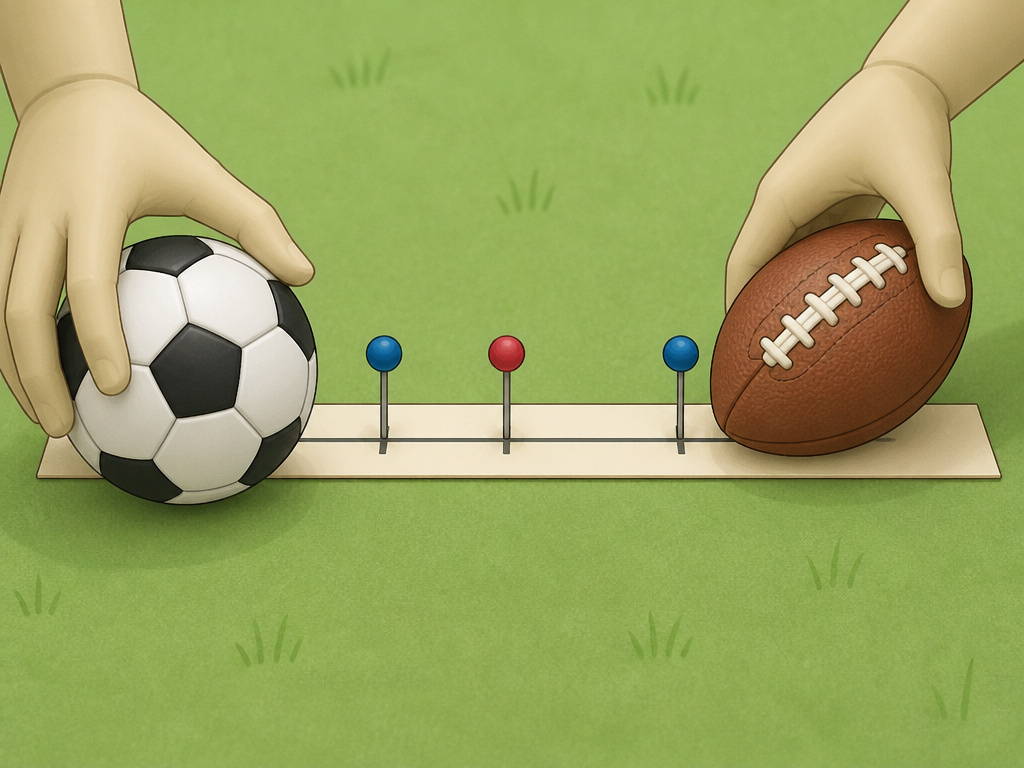
In 1876, most football-playing US colleges abandoned soccer for rugby. That turn explains why “football” ended up meaning something else on the other side of the Atlantic. U.S. Soccer’s own timeline shows how it went:
- 1862: The Oneida Football Club played a game closer to rugby than soccer. American football started drifting toward rugby early.
- 13 November 1869: Princeton and Rutgers played the first intercollegiate soccer game in America, under association rules.
- 1876: Most colleges dropped soccer for rugby.
- 1883: The Western Football Association, the first soccer league in America, formed in St. Louis.
- 1945: The U.S. Football Association became the U.S. Soccer Football Association.
- 1974: It became the U.S. Soccer Federation.
So “football” stayed in the US governing body’s name until 1974, when it became the U.S. Soccer Federation. The history of football in America is really two stories: the kicking game that went to immigrant communities, and the rugby-descended game that took the college fields.
Wikipedia says “soccer” caught on in the US to distinguish the game from the locally better known American football. In the US and Canada other codes of football are dominant, so “soccer” became the prevailing term. If you want the Michigan angle, the university’s Record has an article on the British origins of the word soccer. The researcher behind much of this, Stefan Szymanski, is a University of Michigan sports economist.
American habits are shifting. By the early 2000s, American clubs from youth leagues to professional franchises began adding “F.C.” to names in homage to British practice. “S.C.” is also used, but less often. One Language Hat commenter reports that young Americans in the Northeast are the most insistent on saying “football.”
Football vs Soccer Name Difference Explained by Country
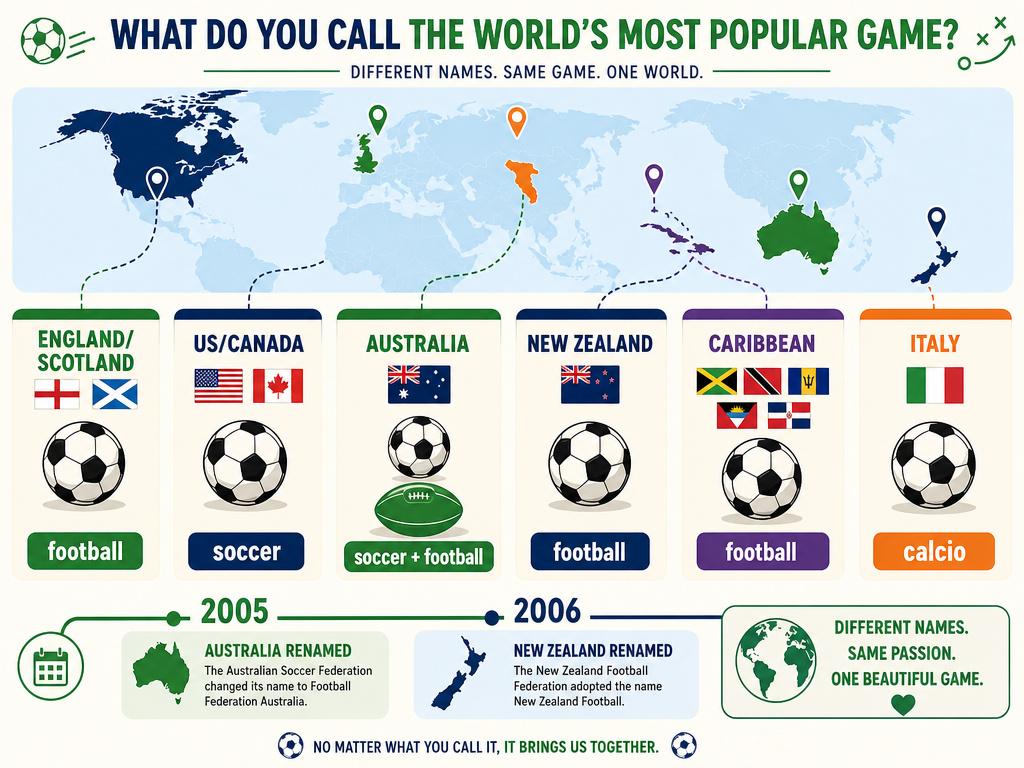
Three patterns cover most of the English-speaking map: places where another football code dominates, places that renamed their federation, and places where both words live side by side. Wikipedia counts 43 FIFA affiliates with English as an official or primary language that use “football” in their official names. Canada and the United States use “soccer.”
| Place | Everyday word | What changed |
|---|---|---|
| England, Scotland | football | “Soccer” understood by most |
| US, Canada | soccer | Other football codes dominate |
| Australia | soccer, football | Governing body renamed, 2005 |
| New Zealand | football | Federation renamed, 2006 |
| Caribbean | football, mostly | Bahamas uses football only |
| Italy | calcio | Different word entirely |
Australia is the messy case. “Football” there can mean up to four codes: soccer, Australian rules, rugby league and rugby union. “Soccer” is used in Australia to tell the sport apart from Australian Rules Football (“Footy”). The men’s team is still the Socceroos.
The renaming dates need care. The Australian Soccer Federation became Soccer Australia in 1995. On 1 January 2005, the Australian Soccer Association renamed itself Football Federation Australia with the slogan “old soccer, new football,” partly to distance itself from the failings of Soccer Australia. The company page lists the name starting 24 December 2004, so the exact day depends on which record you use. The body became Football Australia by a vote on 25 November 2020. New Zealand followed in 2006, and the women’s team nickname changed from SWANZ to Football Ferns.
In the Caribbean, “football” is far more common. Trinidad and Tobago’s “Soca Warriors” refers to a style of music, not the word soccer.
What about the rest of the world? Wikipedia notes that many languages use a term phonetically close to “football,” and Language Hat’s author points out that Italians say “calcio.” I’m weakest outside Europe, and the sources I leaned on don’t give a clean reading for Spanish or Russian, so I won’t pretend they do.
Gridiron works from the other direction. Many English speakers outside North America say “gridiron” or “grid” for the American game. Many English speakers outside North America use “gridiron” for the American game.
Is Soccer a Rude Word in Britain?
Short answer: no, but you may get a look. Britain used “soccer” more recently than most Brits would guess. Szymanski found it quite popular in the UK up to the 1980s, though it never rivaled “football.” Matt Busby’s autobiography is called Soccer at the Top. Jimmy Hill’s 1961 book is Striking for Soccer, and John Charles’s is King of Soccer.
Sources disagree on the turn. Wikipedia says “soccer” was a recognised UK term until around the 1970s, when it began to be wrongly perceived as an Americanism, and by the 1980s British fans had started avoiding it. Szymanski dates the popularity to the 1980s and gives a social-class explanation: in Britain the word carried an elitist, informal air, too colloquial for The Times in the first half of the 20th century. Nobody has settled it.
I’d go with the room. Say “football” in a London pub and “soccer” at a Chicago barbecue, and you’ll never start an argument you didn’t want. If a Brit teases you about it, remind them the word is theirs.
A reader once told me one of my pressing explainers was lost in jargon. I rewrote it around a single image and now ask whether a casual fan could follow every paragraph. Same test applies here. The image for this whole debate is one word: “Assoc.” with a suffix on the end.
Quick Cheat Sheet and Four Myths to Retire
A few lines sort most of the confusion. The word “soccer” is British in origin, schoolboy in style and from the 1880s in print. “Gridiron” is the outside-North-America name for American football. Plenty of other football terms shift meaning by country, so check which code someone means first.
In Australia “football” can mean four different games, so ask which code before you assume the sport.
- “Americans invented soccer.” The word is British schoolboy slang, found in print in 1885.
- “Britain never says soccer.” Busby, Hill and Charles put it in book titles.
- “Wreford Brown coined it.” The story is from 1952, and he was still at school in 1885.
- “Football means feet everywhere.” Australia uses it for four codes.
Is soccer the same game as American football?
No. Soccer and American football share a word and a family tree, but on the field they are different games. The split goes back to the 1863 rules drawn up by the Football Association. When those rules were being written, Blackheath’s F. M. Campbell withdrew his club after two draft rules were removed, one of which allowed running with the ball. That disagreement is the root of the whole divide. Association football became a game built around the feet, while rugby football kept carrying the ball.
American football grew out of the rugby side. The fact sheet notes that in 1876 most football-playing US colleges abandoned soccer in favor of rugby, and the American game developed from there. In practice, that means soccer is mainly played with the feet and a round ball, with hands barred for most players. In American football, players can carry and throw an oval ball. Outside North America, many English speakers call the American game gridiron to keep the two apart.
Frequently Asked Questions
Why do the USA say soccer instead of football?
“Football” in the US already meant the college game that grew out of rugby. By 1876 most football-playing colleges had left soccer for rugby, so the British slang “soccer” became the clear label for the other game.
Does Ronaldo call it soccer or football?
The sources behind this article don’t say what any individual player calls it, so I can’t give you a verified answer. Most of the world’s players speak languages with their own word, and many of those words sound close to “football.”
Do Mexicans or Russians call it soccer or football?
I can’t source Spanish or Russian usage here. What the sources do say is that many languages use a term phonetically similar to “football,” while Italians use “calcio.”
What is American football called outside North America?
Many English speakers outside North America call it “gridiron.”
Is “soccer” an American word?
No. The OED derives it from “Assoc.,” short for Association, plus “-er.” Its earliest known print use is a British school magazine from 1885.
The Bottom Line
Here’s the football vs soccer name difference explained as a rule you can use this week: say “football” in Britain and most of the world, “soccer” in the US and Canada, and ask which code in Australia. If you only remember one fact, remember that the word started as a schoolboy’s clipped “Assoc.” with an “-er” on the end.
One concession: the sources disagree on when Britain turned against “soccer,” on the first Oxford Magazine date and on Australia’s exact rename day. Treat any article that states those as settled with suspicion. My contrarian view is that the Wreford Brown story should retire. Next time someone tells it to you, ask who first printed it and when.
