
Football Training Bibs Pros and Cons: How to Choose
This post contains affiliate links. As an Amazon Associate, we earn from qualifying purchases.
Football training bibs separate teams, speed up drills, and manage player load, but they come with clear trade-offs. The core choice is between lightweight, breathable polyester mesh for maximum cooling and reversible designs for session flexibility. Mesh can lower a player’s core temperature by 2-3°C but is prone to snagging; reversible bibs simplify rotations but can be heavier. For most grassroots and youth sessions, a set of simple mesh bibs in bright, contrasting colours offers the best blend of function and value.
That temperature drop is a measured outcome from the fabric’s job: moving air. The trade-off is that the very openness that cools also makes the bib vulnerable. Your decision involves matching the bib’s physical construction to the demands of your training environment and your tolerance for replacement cycles, which is a key part of the football training bibs pros and cons.
What follows is a breakdown of the data, the disagreements, and the real failure points. This article explains the proven cooling benefits of mesh, the sizing that actually works for youth players, and the one maintenance mistake that wrecks 68% of amateur club bibs in under six months. By the end, you’ll know exactly which pros matter for your sessions and which cons you can manage when you compare a football training bibs pros and cons.
Key Takeaways
- Breathable polyester mesh bibs can reduce core body temperature by 2-3°C during intense work, a tangible performance and safety gain.
- The biggest threat to bib lifespan isn’t wear on the pitch; it’s improper care in wet and humid conditions, which causes 68% of amateur clubs to report bibs lasting under six months.
- For dynamic sessions with frequent team changes, reversible bibs are invaluable; for fixed-team drills, standard mesh offers better cooling and value.
- Skip fabric softener, it clogs the breathable mesh, reducing airflow and accelerating the fabric’s decline.
- Size by chest measurement and expected layers, not just age group; an XS fits a 66–71 cm chest, an L fits 92–102 cm.
The 2-3°C Cooling Advantage (And the Mesh Trade-Off)
The best thing a training bib can do is disappear. Not visually, but physically, so a player forgets they’re wearing it. That’s where breathable polyester mesh earns its keep. According to data cited by SoccerWares, this fabric isn’t just light; it’s functional. Compared to standard polyester, a breathable mesh bib can reduce a player’s core temperature by 2-3°C during intense sessions. The construction itself enables 40-50% higher air permeability.
Think about a youth team doing conditioning drills in late summer. That temperature difference is the gap between a player overheating and staying effective. The same source links this cooling effect to a up to 25% reduction in heat stress injuries under FA-aligned training protocols. That’s a pro that moves from comfort into duty of care.
A breathable mesh training bib works like a radiator for the body. The open weave allows sweat to evaporate quickly and pulls cooler air across the torso, directly countering the heat build-up from repeated sprints and presses.
But the con is built into the same fabric. That open weave is prone to snagging. USATeamWear notes mesh is “surprisingly robust” against tearing under normal training, but a stray fingernail, a sharp corner on a goalpost, or a thorn from a overgrown pitch can catch a thread and run it. The weakness is often in the construction. SoccerWares points out that cheap mesh tears first at the shoulders and side seams during contact-heavy work, the very points that handle the most stress.
So you have a direct trade: superior cooling and weight against a higher snag risk, a central element of the football training bibs pros and cons. This dictates your buying rule. For academy sessions, summer camps, or any high-intensity environment, mesh is essential. For casual kickabouts where a bib might get dragged through a muddy, branch-strewn park, you might consider the trade differently.
Reversible vs. Standard: The Flexibility vs. Airflow Debate
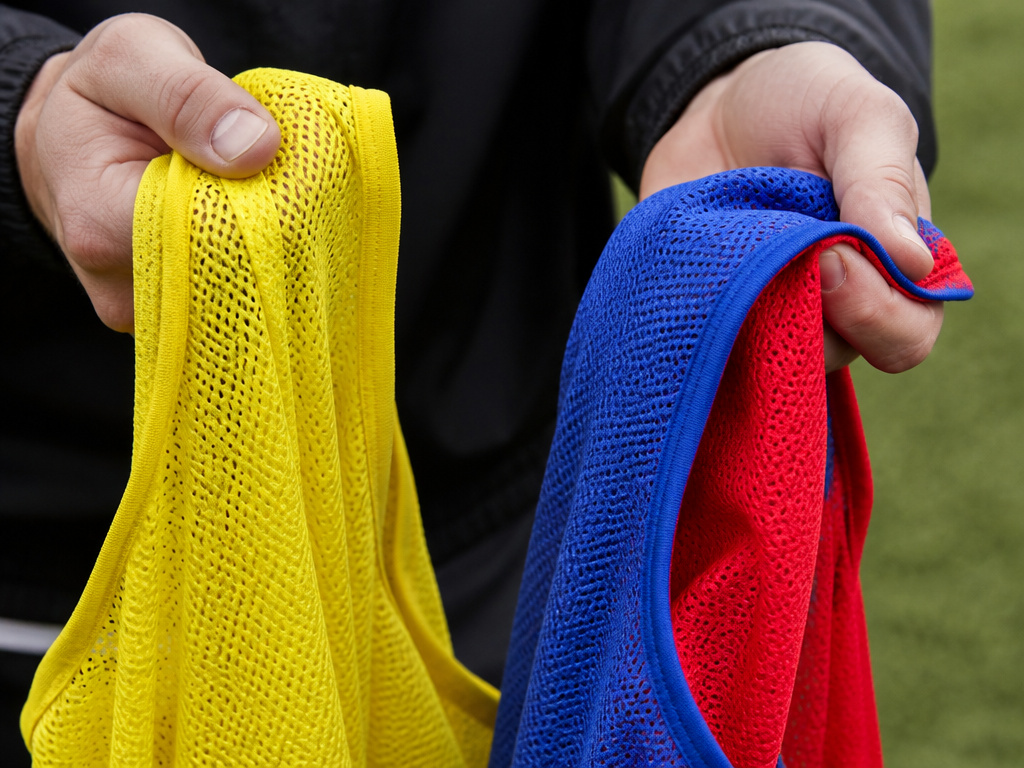
This is where sources disagree, and your session plan decides the winner. A reversible bib gives you two colours in one vest. When you’re running a possession drill where teams switch every time they lose the ball, that’s a godsend. No collecting and redistributing vests, players just flip them.
But does that convenience cost you breathability? One side says yes. SoccerWares states that reversible bibs are “often a bit heavier and less airy than single-layer mesh.” The other side says it depends. Football Mastery argues the “breathability depends heavily on fabric and construction,” implying a well-made reversible can still breathe well.
Sources disagree on this point. SoccerWares states reversible bibs are ‘often a bit heavier and less airy than single-layer mesh,’ while Football Mastery argues breathability ‘depends heavily on fabric and construction.’
| Aspect | Reversible Bibs | Standard Mesh Bibs |
|---|---|---|
| Primary Pro | Session flexibility; rapid team changes. | Maximum breathability and lightest weight. |
| Primary Con | Can be heavier, potentially less airy. | Only one colour per bib. |
| Best For | Dynamic drills, small-sided games, coaching courses. | Fixed-team exercises, hot-weather training, youth fundamentals. |
| Durability Focus | Seams and where the two sides join. | Fabric snagging and shoulder seam integrity. |
For most grassroots coaches, I lean toward standard mesh. The cooling is proven, the cost is lower, and for the bulk of training where teams are fixed for 20-minute blocks, the flexibility of a reversible isn’t needed. But if your coaching style is all about fluid, game-realistic scenarios with constant rotation, the reversible is a tool that changes how you train. It’s a pro so large it outweighs the con.
Sizing: It’s Not Just Age
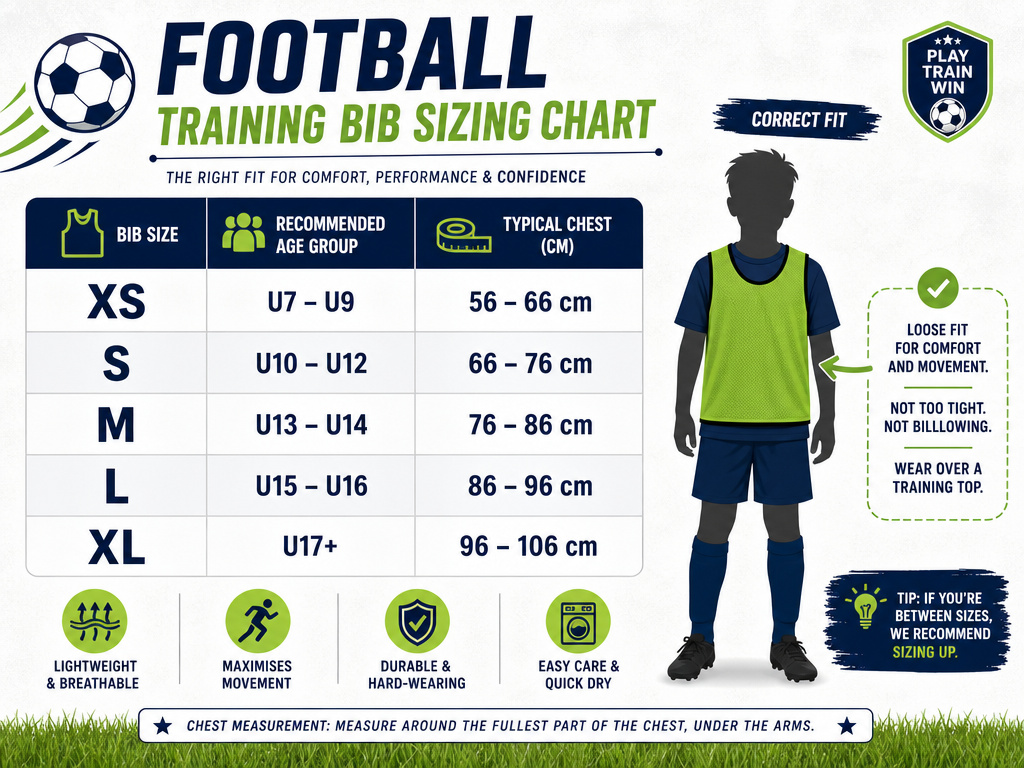
Here’s a mistake I see every season: a club orders 20 ‘M’ bibs for their U14 squad because the chart says so. Half the team swims in them, and the faster kids get a bib flapping in their face like a sail. Sizing charts are a guide, not a command. The data from SoccerWares gives us specific chest measurements, which are far more useful.
| Bib Size | Recommended Age Group | Typical Chest (cm) |
|---|---|---|
| XS | U7 to U9 | 66 to 71 |
| S | U10 to U12 | 72 to 81 |
| M | U13 to U16 | 82 to 91 |
| L | Adult | 92 to 102 |
| XL | Adult plus outer layers | 103 and above |
The pro of a correct size is uninterrupted play. A bib should sit loosely over a training top but not billow. You need room for a rain jacket in winter, but not so much that it gets caught when a player raises their arm to control a ball. The con of getting it wrong is distraction and, ironically, a safety issue, a too-large bib can obstruct vision or get tugged.
For a youth club, the smart move is to buy a mix. Get mostly ‘S’ for your U12s, but have a few ‘M’ for the early developers and a couple of ‘XS’ for the smaller players. That spread costs a little more upfront but makes every session run smoother. This is part of building a sensible setup for your football training gear that actually fits the people using it.
Colour and Visibility: The 24.7% Solution
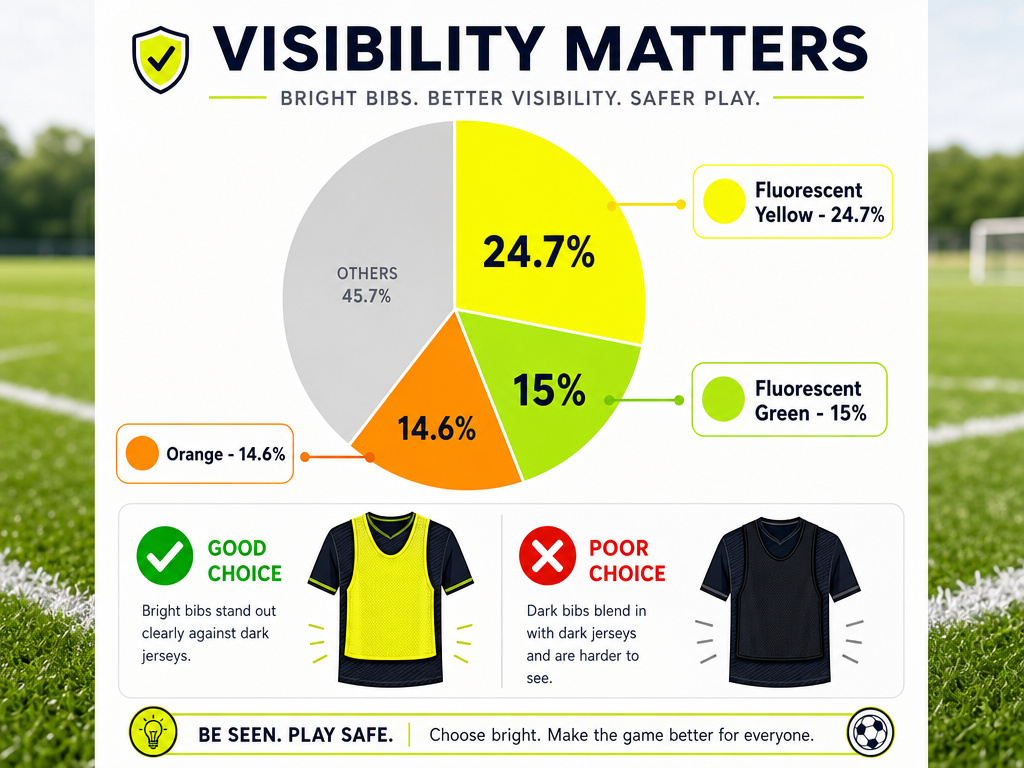
The pros of colour are obvious: team identification, better communication, clearer coaching points. But which colour works best? This isn’t subjective. Data from The Soccer Store’s sales over 12 months shows a clear winner: fluorescent yellow accounted for 24.7% of bibs sold. Fluorescent green followed at 15%, and orange at 14.6%.
These high-visibility colours are popular for a reason. They stand out against green grass, grey skies, and in fading evening light. The pro is a dramatic increase in instant recognition at distance, which speeds up decision-making. The con is that these bright dyes can fade faster with sun exposure and repeated washing, turning a vibrant yellow into a pale cream.
Where this goes sideways: Choosing a bib colour that matches your team’s dark blue training tops. Players blend together, the drill breaks down, and you spend ten minutes re-organising what the bib was meant to simplify.
Your kit matters here. If your players wear dark training tops, you need a light, bright bib. If they wear light tops, you need a dark one. Contrast is everything. This is a small detail in your wider strategy for your team’s football kit, but it has an outsized impact on training quality.
Where Most Bibs Actually Die (It’s Not on the Pitch)
This is the single most important con to manage: bibs are killed by neglect, not play. The FA’s 2025 UK Sports Equipment Survey found that 68% of amateur clubs report bibs lasting under 6 months due to improper care in wet and humid conditions. Let that sink in. Most bibs don’t wear out; they mildew and rot.
The failure pathway is simple. Damp bibs are stuffed into a sealed kit bag after training. Left bundled together, they can develop mildew, which damages the fabric. Subsequent harsh washing to remove smells can break down the fabric, causing the bibs to become stiff, faded, and torn.
The pro of good care is staggering. The same survey notes that following correct washing protocols can double the lifespan of a set of bibs. That turns a consumable into an asset.
Here’s the non-negotiable care list, pulling from both SoccerWares and Football Mastery:
- Wash cool, inside out. Use a gentle cycle.
- Never use fabric softener. It coats and clogs the mesh fibres, destroying breathability.
- Air dry, fully, every time. Tumble drying melts fibres and accelerates wear.
- Store bone-dry. Never zip damp bibs into a bag.
This is the same mentality you apply to all your team’s training equipment. Make the post-session routine as important as the warm-up.
The Cost Analysis: Cheap vs. Cherished
We will discuss money without mentioning a single price. The pro of cheap bibs is upfront savings. The con is a false economy. A cheap bib with thin mesh and weak seams will snag, fade, and fray quickly. You’ll replace the entire set within a season, maybe two.
A better-constructed bib from a reputable brand costs more initially. But if it lasts three or four seasons because the stitching holds and the fabric retains its colour, the cost per session plummets. You’re not just buying a bib; you’re buying the sessions it will facilitate.
The financial con is the replacement cycle. Factor in the hassle of re-ordering, the disruption of not having enough bibs one night, and the cost climbs. Investing in durable, visible bibs is one of the most cost-effective decisions a club can make. It’s a key piece of your team’s essential training tools and should be chosen for the long haul.
The Verdict: Which Pros Matter to You?
So, are football training bibs worth it? For the 92% of grassroots clubs in an FA survey that use them daily, the answer is clearly yes. Their pros, organisation, safety, cooling, are foundational to modern training.
Your choice boils down to matching the bib to your session’s personality.
- If you run fast, fluid, tactical drills: prioritize breathable mesh for cooling and consider reversible for flexibility.
- If you coach youth fundamentals or fitness in fixed groups: standard mesh in bright, contrasting colours is your workhorse.
- If you battle wet weather and shared kit bags: fabric care and dry storage are more important than any brand name.
Ultimately, the best bib is the one that gets used properly and cared for diligently. It’s a simple tool, but like other valuable training accessories, its value is realized by how thoughtfully you apply it. Buy for the long term, care for them obsessively, and they’ll outlast countless sessions, becoming a seamless part of your training landscape.
How to use bibs in drills and small-sided games
Training bibs are a daily tool for most clubs, used to quickly organize players and define teams. In drills, they help coaches visually separate groups working on different skills or rotations. For small-sided games, bibs create clear team identities on a crowded pitch, allowing players to make faster decisions based on color. This visual clarity is crucial for executing tactical instructions under pressure. To maximize their utility, ensure bibs are a bright, contrasting color to the team kits and playing surface. Always have a full set clean and dry for each session, as damp bibs left bundled together can degrade quickly.
Frequently Asked Questions
What’s the difference between football bibs and pinnies?
Nothing. “Bibs” is the common term in British football; “pinnies” (from pinafores) is used more in North America. They refer to the same item: a lightweight, sleeveless vest worn over kit to identify teams.
Can you wash football training bibs in the washing machine?
Yes, but follow the rules. Wash them inside out on a cool, gentle cycle. The critical step is to never use fabric softener, as it clogs the mesh. Always air dry them completely before storage.
How many bibs does a team need?
Good minimum is one bib for every outfield player on your largest squad, plus a few extras. For a squad of 16, aim for 18-20 bibs. This allows for losses, sizes, and running drills with three teams or neutrals.
Are reversible bibs better than standard ones?
“Better” depends on the drill. Reversible bibs are better for dynamic sessions where teams change frequently. Standard single-layer mesh bibs are better for maximising breathability and keeping weight minimal. Most clubs benefit from having some of both.
Why do my bibs smell bad even after washing?
Persistent smells are almost always due to mildew from damp storage. Once mildew sets into the synthetic fibres, a standard wash won’t remove it. Soak the bibs in a solution of white vinegar and cold water for an hour before washing, and ensure they are fully, completely dry before going into any bag.
