
High Press vs Low Block in Football: Key Differences
This post contains affiliate links. As an Amazon Associate, we earn from qualifying purchases.
High press vs low block in football comes down to where you win the ball back and what you sacrifice to do it. A high press pressures the opponent in their own defensive third, aiming to win possession high up the pitch to launch short, high-xG counters. A low block stations 9 players within 25–30 meters of its own goal, conceding territory to deny penetration and springing long counters. For most elite sides seeking to dominate, a structured high press is the default, but tournament football and specific matchups often reward the disciplined low block.
That 30–40 meter versus 25–30 meter gap in the high press vs low block in football is the tactical map. One pushes the battle into the opponent’s half; the other pulls it into your own penalty box. Tracking data from companies like SkillCorner allows us to measure the tactical choice, along with its fitness cost, the shift in recovery positions, and which opponents each system targets or avoids.
What follows is a breakdown of the metrics that define each approach. PPDA, defensive line height, sprint distance, and the match situations where one flips from brilliant to broken. We’ll walk through the stats, the manager examples, and the one training drill that shows players the difference in a single session.
Key Takeaways
- The defensive line height is the single clearest differentiator: a high press operates with a line 35–45 meters from its own goal, while a low block sets up at 18–25 meters.
- High pressing strategies generate 7.6 offensive transitions per match but concede an average of 1.8 goals; low blocks create only 3.4 transitions but concede just 1.2 goals on average (JPHR Study).
- PPDA (Passes Per Defensive Action) quantifies press intensity: Manchester City (5.2) and Liverpool (5.8) show low PPDA for high presses; Atlético Madrid (12.8) shows the high PPDA of a deep block.
- Contrary to common belief, a high press can lower physical demands when a team has a numerical advantage, reducing distance covered by 19.8% and player velocity by 20.0% (Otto-von-Guericke-Universität Magdeburg study).
- The choice isn’t permanent. The most effective modern teams, like Carlo Ancelotti’s Real Madrid, master switching between a high press against weaker opponents and a low block against elite attacks based on the match state.
Defining the Battle Lines: High Press vs Low Block
Forget formations for a second. The first question any defensive system answers is: how much of our own half are we willing to give up? A high press says none. A low block says almost all of it.
According to a Premier League analysis using SkillCorner data, a ‘high block’ is defined as a team engaging the opposition when they have the ball in their own defensive third. Manchester City spent 23% of their time in this mode last season, the largest share in the league. The aim is to win the ball back within 30–40 meters of the opponent’s penalty area. The moment you recover it there, the game’s math changes. Research cited by FootnoteFC shows short counters within 5 seconds of a recovery have a 60% retention rate and 35% box penetration rate, producing the highest expected goals (xG).
A ‘low block’ is defined by the average position of the deepest three defensive players being within their own defensive third. Sunderland spent 30% of their time here, the highest share in the Premier League. The system stations 9 players within 25–30 meters of its own goal, erasing space in the most dangerous zones.
The low block concedes possession and often more shots, but the shots it allows are from worse positions. It’s a trade of territory for security. The high press trades security for territory and the chance to strike immediately. One isn’t better than the other. One is a better fit for your players, your opponent, and the minute on the clock.
The One Metric That Tells You Which Is Which
If you only track one thing, track defensive line height. It’s the independent variable that dictates everything else. Data from FootnoteFC breaks it down cleanly:
- High Press: Defensive line 35–45 meters from own goal.
- Mid Block: Defensive line 25–35 meters from own goal.
- Low Block: Defensive line 18–25 meters from own goal.
A shift in defensive line height significantly changes the space available to the opposition. This is why managing your defensive line is the first skill a young coach should drill. Get that line wrong, and your press has no cover, or your block has no outlet.
| Tactic | Defensive Line Height | Ball Recovery Zone | Primary Aim |
|---|---|---|---|
| High Press | 35–45m from own goal | 50+ meters from own goal | Win ball in opponent’s half for immediate chance |
| Low Block | 18–25m from own goal | 25 meters or less from own goal | Deny penetration, counter from deep |
The Physical Cost & Surprising Energy-Saver
Everyone knows a high press is exhausting. The image of Jurgen Klopp’s Liverpool harrying opponents for 90 minutes is the archetype. The data mostly agrees, but with a fascinating twist that changes the calculation for coaches.
High-press teams cover a total sprint distance of 110–130 km per match (team total). Low-block teams cover 90–110 km. That’s a tangible extra 20 km of high-intensity running spread across the side. You hear it on the pitch: the constant shriek of boots on turf as forwards chase down a center-back, the collective groan when a midfielder has to sprint back because the press was bypassed. It’s a system built on repeated, coordinated bursts.
Where this goes sideways: Pressing as individuals rather than as a unit. One player chases, the rest stay flat-footed. The press is broken with one pass, and now your team is scrambling back over a large distance.
But what if the high press could actually save energy? A pilot study from Otto-von-Guericke-Universität Magdeburg tested this in an 11-versus-10 scenario. When the team with the extra player employed a high press, distance covered decreased by 19.8% and player velocity dropped by 20.0% compared to deep defending. The heart rates were lower too.
The researchers from Otto-von-Guericke-Universität Magdeburg concluded that coaches could consider a high-press strategy when in numerical superiority to decrease players’ physical and physiological demands, while a study from the German Sport University Cologne recommends using high-press defending sparingly due to trade-offs. It makes sense. Pressing with an extra man means you can cover passing lanes more easily, forcing more predictable, shorter passes that you can intercept without a full-speed chase. You control the game without the graft.
This highlights a point of disagreement in the data. A common perception is that a high block is brutally taxing, while the experimental evidence shows that in a specific, man-advantage context, it can be the less demanding option. The experimental evidence shows that in a specific, man-advantage context, it can be the less demanding option. The truth likely lives in the middle: a well-coordinated high press against an unbalanced opponent is sustainable; a chaotic, individual-based press against a slick passing team is a path to exhaustion.
Statistical Showdown: What the Numbers Say Wins
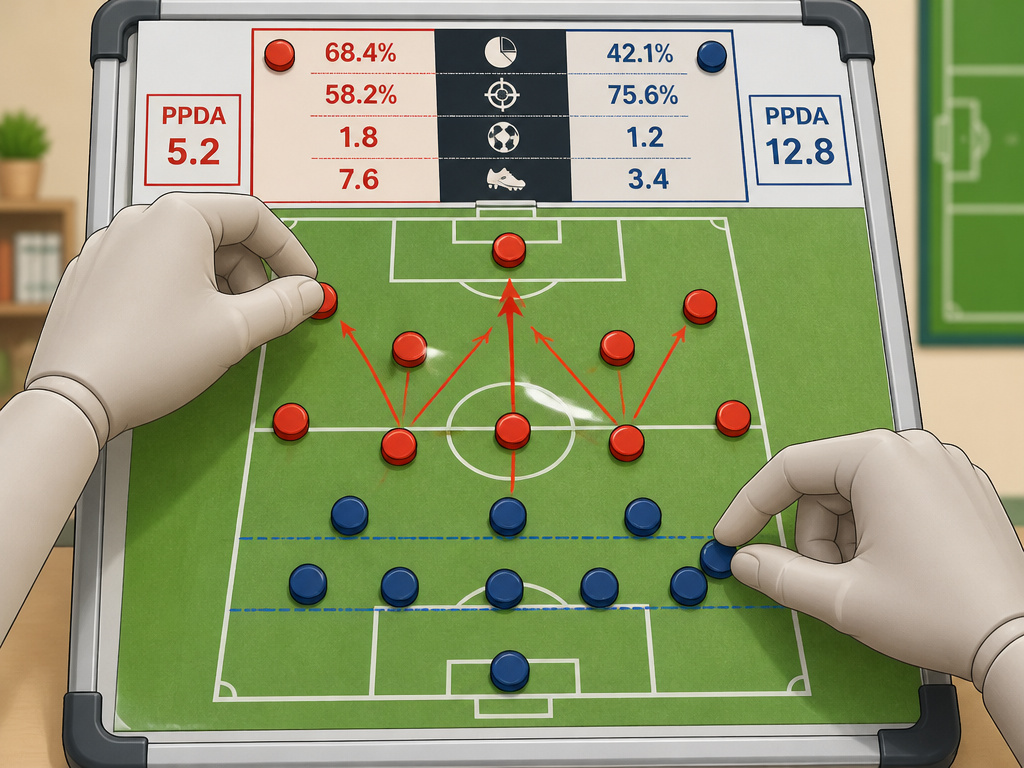
Tactics feel abstract until you see the scoreboard. A 2025 study in the Journal Physical Health Recreation (JPHR) analyzed 120 professional matches to compare the effectiveness of high pressing and defensive (low block) strategies. The numbers paint a clear picture of risk and reward.
High Pressing Strategies (per match):
- Ball Recovery in Opponent’s Half: 68.4%
- Defensive Success Rate: 58.2%
- Goals Conceded: 1.8
- Offensive Transitions Generated: 7.6
Defensive/Low Block Strategies (per match):
- Ball Recovery in Opponent’s Half: 42.1%
- Defensive Success Rate: 75.6%
- Goals Conceded: 1.2
- Offensive Transitions Generated: 3.4
The trade-off in the high press vs low block in football screams from the page. The high press creates more than double the offensive transitions and dominates the ball in the opponent’s half. But it pays for that with a higher defensive failure rate and nearly an extra half-goal conceded per game. The low block is the opposite: remarkably stable defensively, but it struggles to create its own attacking momentum.
This is why the low block shines in tournament formats, as noted by Breaking The Lines. In a single-elimination match where avoiding defeat is paramount, that defensive solidity is worth more than the attacking volume. Conversely, over a 38-game league season, the team that generates 7.6 transitions a game will usually outscore the one that generates 3.4, provided it doesn’t leak too many goals at the back.
The PPDA Litmus Test
The single best metric to diagnose a team’s defensive posture is PPDA (Passes Per Defensive Action). It counts how many passes the opposition completes before your team makes a tackle, interception, or foul. A low number means you’re disrupting play quickly.
The FootnoteFC data provides perfect examples:
- High-Press Teams: Manchester City (5.2 PPDA), Liverpool (5.8), Marcelo Bielsa’s Leeds (5.5).
- Low-Block Team: Diego Simeone’s Atlético Madrid (12.8 PPDA).
The difference is stark. City and Liverpool allow about 5 passes before acting; Atlético allows over 12. This isn’t a lack of effort, it’s a deliberate tactic to stay compact, let the opponent have the ball in deep areas, and only press once they enter the final third. Monitoring your team’s PPDA metric is the fastest way to know if they’re executing a high press or sitting in a deeper block.
When to Use a High Press, When to Use a Low Block
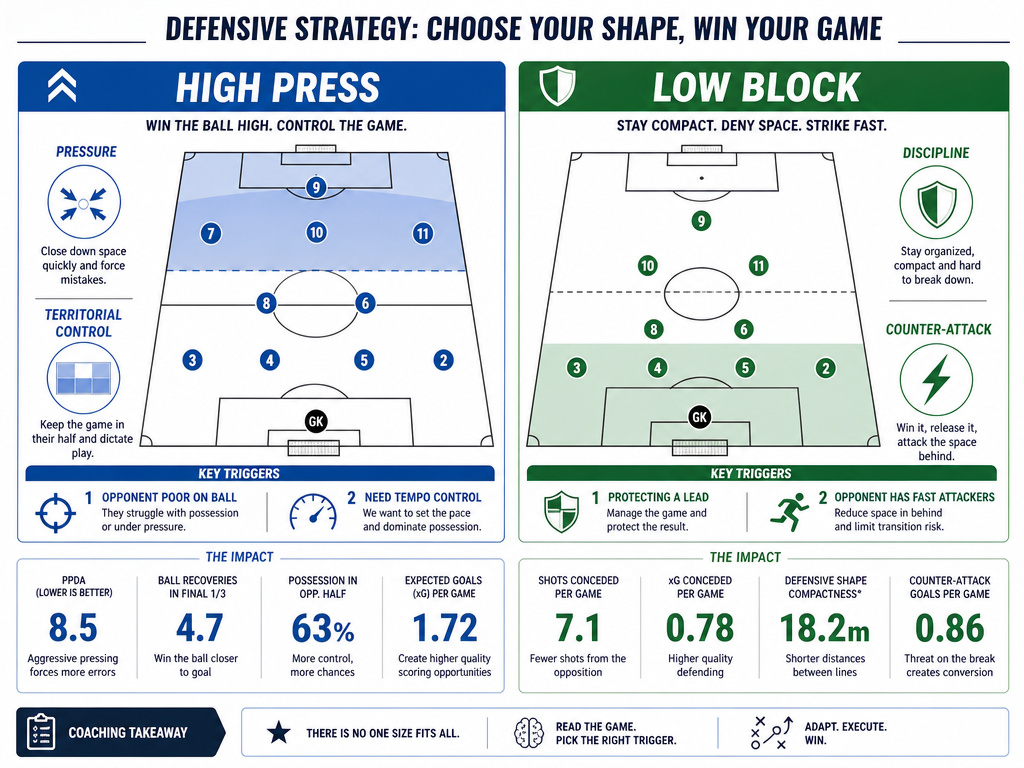
This isn’t about philosophy. It’s about the specific opponent in front of you and the specific players you have available. The data from sources like EcoTrails and Total Football Analysis points to clear rules of thumb.
Deploy a High Press when:
- The opponent is uncomfortable building under pressure. If their center-backs are shaky on the ball or their goalkeeper hates playing short passes, a high block “tends to pay off,” as EcoTrails notes.
- You have a numerical advantage. As the Magdeburg study showed, pressing up the pitch can conserve energy and control the game more easily with the extra man.
- You need to dictate territory and tempo. Teams like Manchester City use it to suffocate opponents and starve them of time on the ball near their own goal.
Common mistake: Using a high block against a team whose defenders can hit accurate long balls. Total Football Analysis warns against this, while EcoTrails notes a high block tends to pay off against opponents who are uncomfortable building under pressure.
Deploy a Low Block when:
- You are protecting a lead in a knockout match. The historical record is filled with underdogs who have used organized defensive systems to beat superior, possession-based sides.
- The opponent has faster attackers or a superior passing game in the final third. A high line against such a team, EcoTrails argues, is often not the better tactical read.
- Your squad lacks the collective fitness or coordination for a sustained press. A well-drilled low block relies more on discipline and shape than on athleticism, making it accessible for less physically dominant teams.
The modern solution, exemplified by Carlo Ancelotti’s Real Madrid, is to master both and switch based on the match state. Lean towards a low block against elite attacks, shift to a high press against weaker opponents, and be ready to flip within the 90 minutes as the scoreline changes. This adaptability is the real hallmark of a top coach.
The Managerial Blueprints: Klopp vs. Simeone
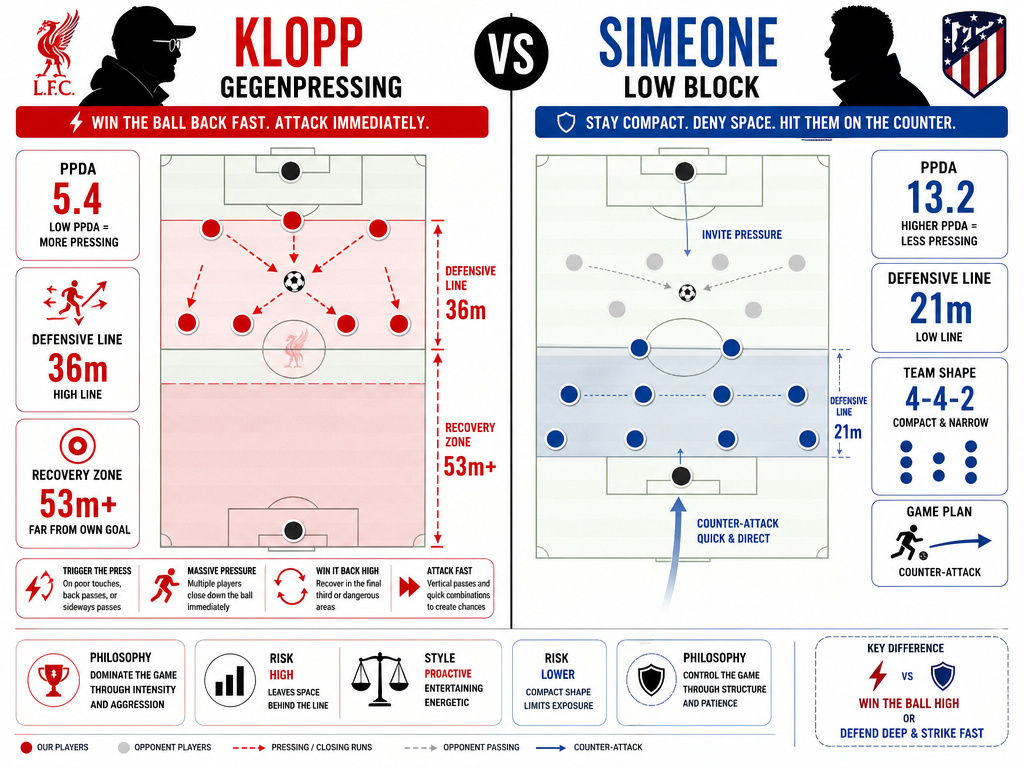
The theories come to life in the dugout. Two managers have defined the extremes of this tactical spectrum: Jürgen Klopp with his gegenpressing at Liverpool and Diego Simeone with his low-block mastery at Atlético Madrid.
Klopp’s Liverpool (2018-19 UEFA Champions League Winners)
This was the peak of the high-press machine. The data from FootnoteFC sketches the portrait:
- PPDA: 5.4
- Defensive Line Height: 36 meters
- Sprint Distance: 128 km per match (team total)
- Ball Recovery Zone: 53+ meters from own goal
The system was built on the famous front three of Salah, Mané, and Firmino triggering the press, with an energetic midfield behind them. The risk was visible, they were often vulnerable on the counter, but the reward was an avalanche of high-xG chances created within 5 seconds of winning the ball back.
Simeone’s Atlético Madrid (2015-16 UEFA Champions League Finalists)
The textbook low block. The same source provides the contrasting numbers:
- PPDA: 13.2
- Defensive Line Height: 21 meters
- xG Against: 0.78 per match
- Ball Recovery Zone: 28 meters from own goal
Simeone’s 4-4-2 was a compact, zonal fortress. The defensive success rate of 75.6% from the JPHR study is the kind of number his teams would reliably hit. They conceded few offensive transitions (3.4 per match). Their attack was almost entirely based on launching counter-attacks through Griezmann and Costa after winning the ball deep.
| Aspect | Klopp’s High Press (Liverpool) | Simeone’s Low Block (Atlético) |
|---|---|---|
| PPDA | 5.4 (Low) | 13.2 (High) |
| Defensive Line | 36m from goal | 21m from goal |
| Primary Risk | Beaten by long balls over the top | Sustained pressure leading to fatigue errors |
| Primary Reward | High-xG chances from immediate recoveries | Extreme defensive stability and low xG against |
Training the Transition: A Practical Drill
Most guides stop at the theory. For a coach, the real question is: how do you teach this? How do you get players to feel the difference between a high press and a low block, and to switch between them?
Here’s a simple drill I’ve used to make it concrete. You need a full pitch, two teams, and a rule change at the whistle.
- Set-Up: Play a normal 11v11 possession game.
- Phase 1 (High Press): For 5 minutes, the defending team must trigger their press whenever the ball reaches the opponent’s center-backs. Their defensive line must be at the halfway line. The only way they can score is by winning the ball back in the opponent’s half.
- Whistle & Transition: Coach blows the whistle. The score is now frozen. The team in possession must immediately pass the ball back to their own goalkeeper.
- Phase 2 (Low Block): For the next 5 minutes, the same defending team must now drop their defensive line to the edge of their own penalty area. They cannot press until the attacking team crosses the midway line. The only way they can score is from a recovery made deep in their own half.
- Debrief: Discuss the feelings. In Phase 1, players feel the aerobic burn and the coordination needed for pressing triggers. In Phase 2, they feel the mental discipline of holding shape and the different timing required for launching a counter.
The drill forces the switch. It shows that a high press isn’t just running harder, and a low block isn’t just sitting deep. They are different skills, and the best teams, as Ancelotti proves, are those that can use both tools in their box.
What triggers a high press
Teams initiate a high press to force turnovers in dangerous areas. A common trigger is an opponent receiving the ball in their own defensive third, especially if they are uncomfortable building under pressure. The press is often coordinated to exploit a specific player, like a defender under pressure or a midfielder receiving a pass with their back to goal. Gegenpressing typically targets a 5-8 second window immediately after losing possession, aiming to win the ball back before the opposition can organize. Counter-pressing recoveries in the final third are known to create some of the highest-quality chances in football.
How to break down a low block
Breaking down a low block requires patience and precision. Since the defending team stations most players deep, quick ball circulation and player movement are essential to create gaps. Avoid forcing play through the middle where numbers are dense; instead, use width to stretch the compact unit horizontally. Look for opportunities to switch the play rapidly, as this can shift the defensive block and create momentary imbalances. It’s also advised to be wary of the counter-attack, as low-block teams often generate offensive transitions from deep recoveries, so maintaining defensive balance is crucial during sustained attacks.
Frequently Asked Questions
What is considered a low block in football?
Low block is a defensive shape where the team’s deepest players position themselves within their own defensive third, typically with 9 outfield players stationed within 25–30 meters of their own penalty area. The aim is to deny space and penetration, forcing opponents into low-quality shots from distance.
What does “high press” mean in football?
High press, or high block, is a defensive tactic where a team pressures the opponent high up the pitch, aiming to engage and win the ball back while the opponent is in their own defensive third (within 30–40 meters of their goal). It’s a high-risk, high-reward strategy designed to create immediate scoring chances.
Where do you put your weakest players in a low block?
The central defenders and central midfielders are the core of the block, requiring the most positional discipline and decision-making. Wide players have less complex defensive responsibilities and are primarily tasked with staying compact and delaying crosses.
Why is 4-4-2 not used anymore for a high press?
The 4-4-2 is still used, but it’s less common for an aggressive high press because it can leave a gap between the two midfield lines. Modern high presses often use a 4-3-3 or 4-2-3-1, which provides a more staggered press with three forwards to cover the opponent’s back line and a denser midfield to support and cut off passing lanes immediately.
Can a team use both a high press and a low block in one match?
Absolutely. The most effective modern teams are those that can switch systems based on the game state. A team may start with a high press to score early, then switch to a mid-block or low block to protect a lead. Carlo Ancelotti’s Real Madrid and Pep Guardiola’s Manchester City are masters of this tactical flexibility.
The Bottom Line
The high press versus low block debate isn’t about finding a winner. It’s about matching a tool to a job. The data gives us clear triggers: press high against build-up vulnerability and with a man advantage; drop deep against superior athleticism or to protect a crucial result.
For coaches, the takeaway is to train both. Spend a preseason week on the coordinated angles of a high press, then a week on the zonal discipline of a low block. Your team needs to feel the difference in their legs and see the difference on the video analysis. Because the best tactic is the one you can execute, and the one your opponent least wants to face.
The next time you watch a match, don’t just watch the ball. Watch the space between the defensive line and the midfield. Is it 40 meters or 20? That gap tells you everything about the battle being waged, the risks being taken, and the story the scoreline won’t.
