
Gegenpressing Explained: Principles and Common Pitfalls
This post contains affiliate links. As an Amazon Associate, we earn from qualifying purchases.
Gegenpressing, or counter-pressing, is a team’s immediate, coordinated attempt to win back the ball within seconds of losing possession, a tactic planned while still in attack to exploit the opponent’s brief moment of disorganization.
The game’s most chaotic moments are often the most rehearsed. A team doesn’t just decide to press when the ball is lost; they position themselves for that moment while they still have it. The German tactics site Spielverlagerung calls this out with engineer’s precision, it’s a plan baked into the attack. This guide pulls apart the layers: the history, the famous proponents, the numbers used to measure it, and the very real debate about what those numbers actually tell us. Gegenpressing explained is the core of this tactical trap. By the end, you’ll see the difference between a frantic chase and a tactical trap.
Key Takeaways
- The core idea is winning the ball back within seconds of losing it, a window where the opposition is most vulnerable; sources cite various timeframes like Ralf Rangnick’s 8-10 seconds, a common ‘Five-Second Rule’, Pep Guardiola’s six seconds, and a general definition of five-to-eight seconds.
- It is not the same as a high press; gegenpressing is triggered by a loss of possession, while a high press is a proactive strategy started from an organized defensive shape.
- The primary metric for measuring press intensity is PPDA (Passes per Defensive Action), but a low number can be misleading without context on a team’s territorial dominance, a point Stats Perform (Opta) itself acknowledges.
- Contrary to common belief, a 2025 peer-reviewed study in BMJ Open Sport & Exercise Medicine found no consistent link between high-intensity running loads and hamstring injuries in professional players.
- Successful execution hinges on pre-planned positioning and compactness, not just individual effort or fitness.
The Clock Starts at Zero: Defining Gegenpressing
Gegenpressing is pressing immediately after losing the ball, with one’s own defence normally already organised because players positioned themselves in anticipation while in possession. This planned withdrawal is what separates a coordinated press from a desperate scramble.
Forget the idea of a team frantically chasing the ball. Gegenpressing starts earlier. It begins with how a team attacks, keeping players close enough to the ball that when possession turns over, two or three of them can swarm the new ball-carrier instantly. The aim is to win it back before the opponent can lift their head and pick a pass.
The moment of loss is critical in any gegenpressing explained model. Ralf Rangnick, often called the godfather of this approach, has said the 8 to 10 seconds after winning or losing the ball decide games. Other coaches drill a tighter window. A commonly used training theory is the “Five-Second Rule,” where maximum intensity is applied for exactly five seconds post-loss. Pep Guardiola pinpointed the first six seconds of opponent possession as the prime time to strike. The slight disagreement on the exact number matters less than the universal principle: act now, or don’t act at all.
This is where it diverges from a general high press. A high press is a proactive, territorial strategy to disrupt an opponent’s build-up from the back. Gegenpressing is a reactive, timed response to your own mistake. You can employ a high press without a true gegenpress, and you can gegenpress deep in your own half if that’s where you lose the ball. The two often work together, but they are different tools.
A Tactic With Many Fathers: The Historical Roots
The word is German, but the idea of aggressive pressing after losing the ball has older lineage. Pressing itself gained prominence from the 1960s onwards with innovators like Viktor Maslov, Ernst Happel, and the legendary Arrigo Sacchi. Sacchi’s AC Milan didn’t just run; they controlled space and, in his words, aimed to “hurt the confidence” of the opposition.
The German lineage that gave us the term is clearer. It runs through Wolfgang Frank, who influenced a young Jürgen Klopp at Mainz, and the systematic Ralf Rangnick. Thomas Tuchel and Julian Nagelsmann are later branches of the same coaching tree. Klopp, with his “heavy metal football” at Borussia Dortmund and Liverpool, became the global face of gegenpressing. But popularizing isn’t inventing. He refined and broadcast an idea that had been germinating in German coaching circles for decades.
Rangnick’s epiphany came playing against Valeriy Lobanovskyi’s Dynamo Kyiv, a team that pressed with a systematic ferocity he’d never seen. That experience, fused with studying Sacchi’s Milan, shaped his entire philosophy. He wasn’t just teaching a tactic; he was instilling a “swarming behaviour,” a synchronized movement he believed decided matches in those pivotal seconds after a turnover.
Measuring the Madness: PPDA and Beyond
If gegenpressing is about intensity, how do you measure it? The go-to metric is PPDA (Passes per Defensive Action), introduced by analyst Colin Trainor in 2014. The calculation is simple: divide the number of passes an opponent makes in their own final 60% of the pitch by the defensive actions (tackles, interceptions, duels won) the pressing team makes in that same zone. A lower PPDA means a more intense press.
| Team (2018/19 Season) | PPDA | What It Tells Us |
|---|---|---|
| Eibar (Lowest) | 6.72 | Most intense press in Europe’s top five leagues that season. |
| Average Across Top 5 Leagues | 11.01 | The baseline press intensity. |
| Nürnberg (Highest) | 18.21 | Least intense press in the sample, allowing many more passes per action. |
The scale is useful. In a specific match example, when Liverpool played Manchester United in October 2019, Liverpool’s PPDA was a fierce 5.2. In the 2015/16 season, Barcelona recorded the lowest season-long PPDA at 7.5 according to Stats Perform (Opta). However, Stats Perform (Opta) acknowledges that a low PPDA can be confounded by territorial dominance. A team like Paris Saint-Germain, which perpetually camps in the opponent’s half, will naturally log a low PPDA because all actions happen there. It doesn’t automatically mean they are executing a coordinated gegenpress.
Newer metrics are attempting to get closer to the truth. Data provider Wyscout has a defined event subtype called “Counterpressing Recovery.” And a 2024/25 arXiv preprint by Joris Bekkers proposed a “Pressing Intensity” metric based on calculating the time it would take for the nearest defender to intercept a pass, converted into a probability. This moves beyond just counting events to estimating the pressure’s effectiveness. The public data is catching up, but the best evidence is still often your eyes.
Where this goes sideways: Chasing a low PPDA number without the coordinated structure. A team can have a great PPDA by simply winning the ball a lot in the opponent’s half, even if those wins come from long balls and second balls, not a triggered press. The metric sees the what, not the how.
The Physical Toll: Myth vs. Measured Reality
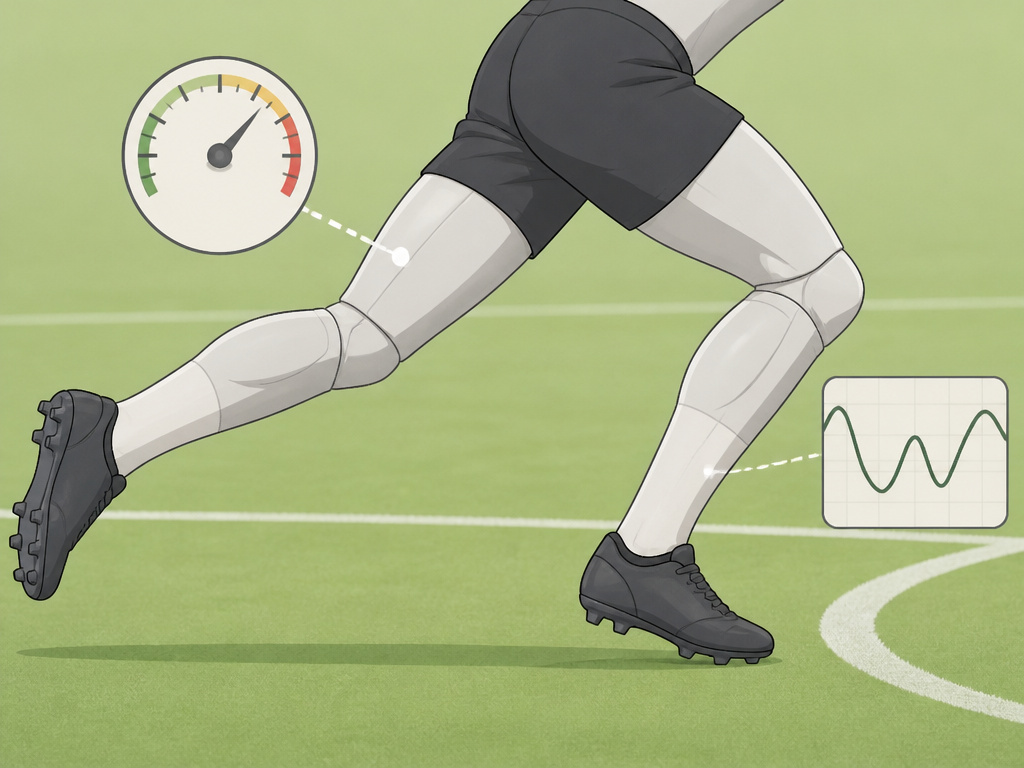
The standard narrative in a typical gegenpressing explained is brutal: the tactic is unsustainable. The high physical demands lead to fatigue, squad rotation, and inevitably, more injuries over a gruelling season. It’s a logical argument, but it is disputed by peer-reviewed research. But what does the measured data say?
A study published in September 2025 in BMJ Open Sport & Exercise Medicine followed 25 players from three Swedish top-division clubs over four seasons. It examined external training load, accelerations, decelerations, high-speed running, against 25 hamstring injuries. The conclusion? The authors found “large individual variation and no consistent group-level trend.” The study, led by Tania Nilsson, noted that short-term load alone was of limited use in predicting injury risk.
To be clear. This doesn’t mean gegenpressing is risk-free. The study is exploratory and doesn’t isolate pressing as a single variable. But it does present a direct, peer-reviewed counterpoint to the widespread assumption. It neither acquits nor condemns the tactic. It simply shows that the blanket statement, “more pressing equals more injuries”, is not supported by this evidence. The physical cost is individual, not guaranteed.
Executing the Trap: Principles Over Passion
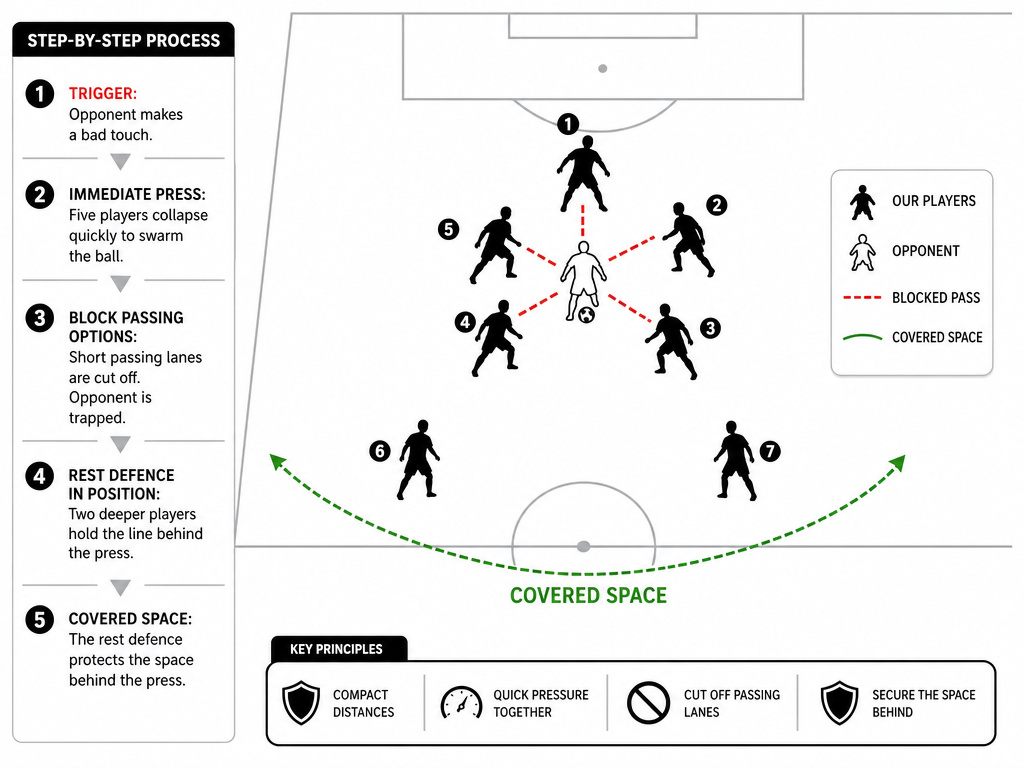
Gegenpressing isn’t about who wants it more. It’s a mechanical exercise built on three principles: triggers, compactness, and rest-defence.
Triggers are the specific cues that launch the press. This could be a bad touch by an opponent, a pass to a player under pressure, or a pass back to the goalkeeper. Teams drill these so the reaction is instantaneous, not instinctual.
Compactness is the essential geometry. Players must be close enough to each other to support the press, cutting off short passing options. If the gaps are too big, the press is easily played through. It’s about controlling space, not just the man.
Rest-defence is the safety net. It’s the positioning of players not directly involved in the press who are ready to snuff out any attempted long ball over the top. They maintain the team’s defensive shape even during the aggressive transition, preventing a catastrophic counter-attack if the press is bypassed.
These principles turn chaos into a calculated risk. Without them, you just have a lot of running.
Common Pitfalls and How to Beat a Gegenpress

Easy to miss: Pressing as individuals. The most common mistake is one player zealously charging at the ball-carrier while his teammates hold their positions. This creates a passing lane around the presser and exhausts him for no gain. The press must be a collective step forward.
Knowing the common failures shows you how to beat the system. A well-drilled gegenpressing team fears two things: the pre-emptive long ball and the player who can turn under pressure.
How to beat it: The first is psychological, don’t play into their hands. If you lose the ball in your own half, the immediate urge is to play short to feet. That’s what the press is designed to punish. Instead, play an early, directed long pass to a target forward or into the space behind the pressing line. The second is technical: you need a midfielder with a quick first touch and the ability to spin away from pressure, someone who can receive a pass with a defender on their back and still find an outlet. Teams that lack these qualities will spend the entire game trapped in their own third.
How to Coach Gegenpressing Drills
Implementing gegenpressing starts with training the immediate reaction to losing the ball. Drills should focus on the critical seconds after a turnover. A common framework uses the theory of the ‘Five-Second Rule,’ where players are conditioned to press with maximum intensity for five seconds to try and win the ball back. If recovery isn’t achieved in that window, they must transition into their organised defensive shape. Training should replicate game scenarios where players attack in compact units, ensuring they are already positioned to counter-press the moment possession is lost. The emphasis is on collective, coordinated movement rather than individual chasing, drilling the instinct to swarm the ball-carrier before they can settle.
Frequently Asked Questions
Is gegenpressing the same as counter-pressing?
Yes, they are the same tactical idea. “Gegenpressing” is the German term; “counter-pressing” is the direct English translation. Both describe the immediate, collective effort to win the ball back within seconds of losing possession.
What’s the difference between gegenpressing and a high press?
High press is a proactive strategy applied when the opponent is building play from the back, regardless of who last had the ball. Gegenpressing is a reactive strategy triggered specifically the moment your team loses possession. A high press is about location; gegenpressing is about timing.
Which teams are famous for using gegenpressing?
Jürgen Klopp’s Borussia Dortmund and Liverpool teams are the most famous modern examples. Ralf Rangnick’s RB Leipzig, Thomas Tuchel’s Chelsea, and Julian Nagelsmann’s Bayern Munich have also employed it extensively. Historically, elements were seen in Arrigo Sacchi’s AC Milan and Marcelo Bielsa’s teams.
What is a good PPDA number?
Lower PPDA indicates a more intense press. In the 2018/19 season, the average PPDA across Europe’s top five leagues was 11.01. Context is key, dominant teams often have artificially low PPDAs.
Is gegenpressing bad for player fitness?
The narrative that it inevitably leads to injury is challenged by data. A 2025 study in BMJ Open Sport & Exercise Medicine found no consistent link between high running loads and hamstring injuries at the group level. While physically demanding, the risk appears highly individual and manageable with proper training and rotation.
The Bottom Line
Gegenpressing is less about endless running and more about planned geometry. It turns a moment of vulnerability, losing the ball, into a planned moment of opportunity. The numbers from PPDA give us a sketch, but the full picture requires watching how a team’s shape morphs from attack to defence in the blink of an eye.
The research on injuries should change the conversation. It moves the debate from “it’s too dangerous” to “how do we manage it smartly?” The real constraint isn’t the fitness room; it’s the training pitch. Can you coach the triggers, the compactness, and the rest-defence well enough that the five-second surge is a synchronized trap, not a desperate gamble?
Most guides will tell you it’s all about passion and intensity. They’re not wrong, but they’re missing the point. It’s about the quiet, pre-planned positioning that happens long before the ball is ever lost. That’s where the game is really decided.
