
Juego De Posicion Explained: A Tactical Guide
This post contains affiliate links. As an Amazon Associate, we earn from qualifying purchases.
Positional play, or Juego de Posición, is a tactical philosophy that seeks to control a match through structured possession and intelligent space management, using a zonal division of the pitch to create and exploit specific types of superiority over the opponent.
The best attacks are built through a sequence of passes that manipulate the opponent’s shape, making the assist just one part of a larger tactical process. Rewind every goal to its originating sequence and trace how the defensive shape was pulled apart. Positional play provides that map; it’s the systematic process of getting the ball into scoring positions by controlling the space, not just the ball. A key tactical model for this is the juego de posicion explained in many coaching manuals.
What follows: a look inside the four kinds of superiority the system chases, a walkthrough of how a team actually progresses from back to front, the real-world examples from Pep Guardiola’s Manchester City and Spain’s national team, and the drills you can use to train it at any level.
Key Takeaways
- Positional play uses a mental division of the pitch into zones; players occupy specific lanes and heights to create passing triangles and open “free” teammates.
- The system aims to create one of four specific superiorities: numerical (more attackers than defenders), qualitative (isolating your best player against their weakest defender), positional (receiving the ball between defensive lines), or socio-affective (team cohesion).
- A loss near your own goal can directly become a conceded goal; a loss in the attacking third gives you time to press and reorganize, making risk management zone-dependent.
- Youth coaches should start with simple zone-occupation games (like “Stay in Your Zone” for U8s) before introducing complex rotations; the classic Rondo remains a fundamental drill for maintaining possession under pressure.
- Some sources describe positional play as a system-agnostic philosophy and team identity, while others define it as being structured in relation to a specific game system.
What Exactly Is Positional Play?
It’s more than just keeping the ball. If possession football is about having it, positional play is about using it as a tool to manipulate the opponent. The aim is to move the defensive block, stretch it, and eventually break it by creating a superior situation, a two-versus-one overload, a striker isolated against a slower defender, a midfielder receiving between the lines with time to turn.
The field itself is treated as a cognitive grid. Lanes and sectors are defined not just by tradition, but by their tactical function in that moment of play. A player’s job isn’t just to be a right-back; it’s to occupy and control a specific zone, which might shift depending on whether the ball is on the left flank or in the centre circle.
Positional play can be traced in any zone of the pitch: own-goal restarts, intermediate progression zones, and offensive zones near the opponent’s area. Players are placed in different planes, lanes, and heights to progress in an orderly fashion.
You build from the back not because it’s pretty, but because it draws the first line of the opponent’s press forward. When their striker jumps to press your centre-backs, a space opens behind them. That’s the space your number six is waiting to receive in. That’s the first domino.
What Are the Four Types of Superiority in Positional Play?
The whole system orbits around creating one of four distinct advantages. Most teams aim for one or two; elite positional sides hunt for all of them simultaneously.
| Type of Superiority | The Goal | How It’s Created | Real-Game Example |
|---|---|---|---|
| Numerical | Outnumber the opponent in a specific zone. | Overloading one flank with an overlapping full-back and a winger to create a 2v1. | A team’s left-back and left-winger pinning a single opposing right-back. |
| Qualitative | Isolate your most skilled player against their weakest defender. | Rapidly switching play from a congested flank to an isolated winger on the opposite side. | A right-footed left winger (an “inverted winger”) cutting inside onto his stronger foot against a full-back uncomfortable defending centrally. |
| Positional | Give a teammate more time and space than the marking defender. | A midfielder making a run “between the lines” to receive a pass in a pocket of space. | A number 10 dropping into the gap between the opponent’s midfield and defensive lines to receive a pass, turn, and face the goal. |
| Socio-Affective | Achieve a higher level of team cohesion and understanding than the opponent. | Years of drilled patterns, shared tactical language, and intuitive player movement. | The almost telepathic link between a midfield trio who know instinctively when to rotate positions without verbal communication. |
The first three are tactical objectives. The fourth is what makes them possible. Without the socio-affective layer, the trust, the drilled patterns, the shared brain, the other superiorities fall apart. A player won’t make the run into the half-space if he doesn’t trust the passer to see him.
Which Superiority Matters Most?
It depends on the players you have. If you’ve got a generational dribbler on the wing, you’ll chase qualitative superiority every chance you get. If your squad is full of intelligent, technically solid midfielders, you’ll build through numerical and positional advantages. The system is a framework, not a prison sentence.
Where this goes sideways: Chasing numerical overloads on one flank while completely neglecting the weak side. You win the 2v1, but then have no good passing options because everyone is bunched on the same side of the pitch. The switch of play is a fundamental safety valve in positional play.
How Does a Team Progress? A Phase-by-Phase Walkthrough
Follow the ball. The abstract principles are one thing, but how do they translate to eleven players moving across real grass?
Phase 1: Build-Up from the Back. The centre-backs split wide, the full-backs push high, and the defensive midfielder drops between the centre-backs to form a back three. This isn’t for show. It forces the opponent’s forward line to decide: do they press high with two strikers against three defenders (a losing numbers game), or do they hold their mid-block? Either choice creates a space to exploit. The pass is almost never to feet; it’s into the space a teammate is about to occupy.
Phase 2: Progression Through the Midfield. Width and depth are essential here. The wingers stay wide, stretching the defensive block horizontally. The central midfielders and full-backs occupy different vertical “heights” to offer layered passing options. The key is to never have two players on the same horizontal line. This staggering creates the diagonal passing lanes that are the lifeblood of the system. A pass isn’t just a transfer of the ball; it’s a tool to “fix” a defender. Pass to the winger to pin the opposing full-back, then quickly play inside to the now-free central midfielder.
Phase 3: Creation in the Final Third. Here, the principles of overloads and underloads come sharply into focus. You might overload the left flank to draw the defence over, then suddenly switch play to a single runner exploiting the underload on the right. Or, you use third-man runs. Player A passes to Player B. Player B lays it off first-time to Player C, who has made a forward run from deep. Player C is the “third man,” and he’s often the one breaking the last line.
The entire process relies on a concept called rest defence, the positioning of players not directly involved in the attack to immediately counter-press if the ball is lost. It turns what looks like a purely offensive system into a defensive safeguard.
Pitch Division: The Invisible Grid
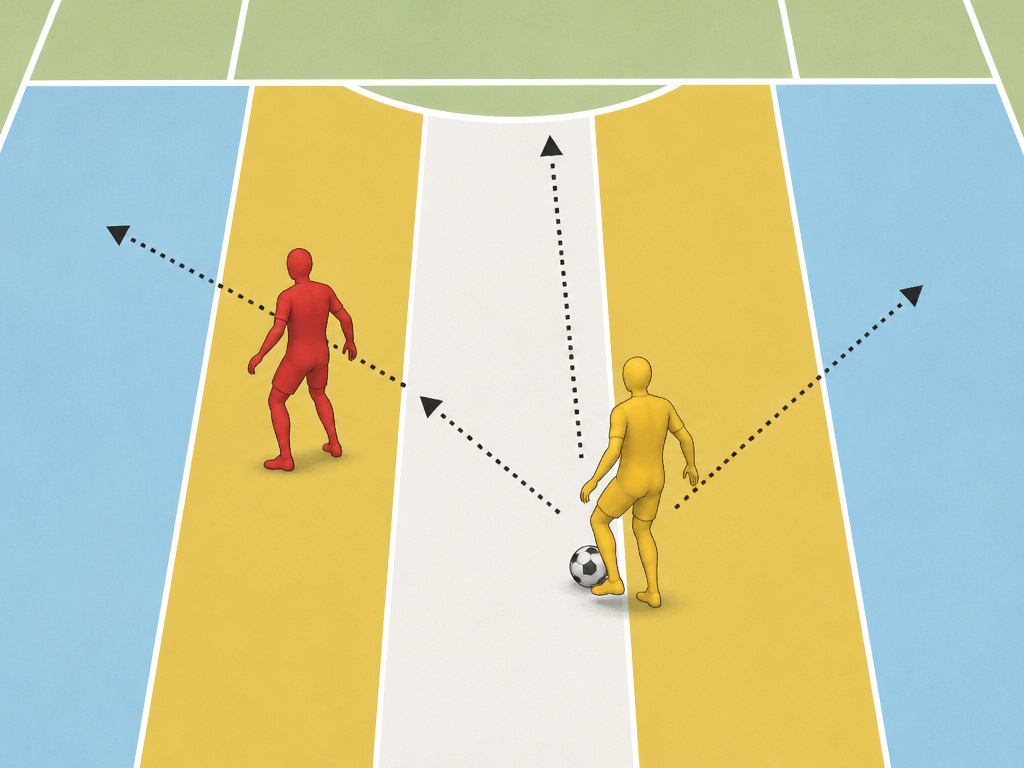
Forget the traditional lines on the TV screen. In positional play, the pitch is divided into a series of vertical lanes and horizontal sectors. Pep Guardiola’s famous grid is the clearest example: he sees the field in fifths, two wide channels, two half-spaces, and one central lane.
The most valuable real estate is often the half-spaces, the channels between the central lane and the wide areas. They are goldmines for creating positional superiority. A player receiving the ball in the half-space is often facing the goal with multiple options: pass wide, pass inside, shoot, or drive forward. A defender marking him is in an uncomfortable, exposed position.
This rigid zoning dictates everything. A player’s first thought isn’t “get forward”; it’s “occupy my zone.” This maintains the team’s structure, ensures passing options are always available, and prevents players from “bunching”, the single biggest killer of attacking flow at amateur levels.
The Historical Roots: From Cruyff to Guardiola
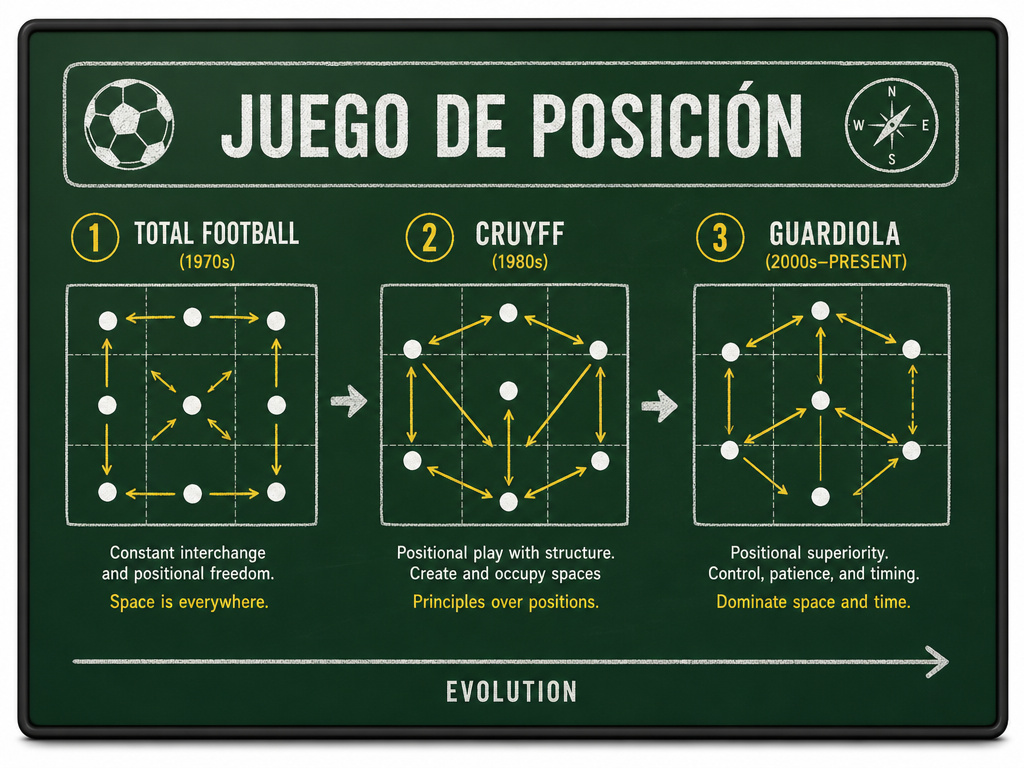
The philosophy’s DNA, which culminates in the modern juego de posicion explained, can be traced to Rinus Michels’ “Total Football” at Ajax in the 1970s, where players fluidly exchanged positions. But it was Johan Cruyff, first as a player under Michels and later as Barcelona manager, who refined it into a structured, possession-centric doctrine. He saw possession as a means to an end: control the game, fatigue the opponent, and create clear chances.
Pep Guardiola, a product of Cruyff’s Barcelona “Dream Team,” is the system’s most famous and systematic modern exponent. At Barcelona, Bayern Munich, and Manchester City, he has implemented an even more rigid and spatially-aware version. He didn’t invent it, but he perfected its application at the elite level, proving it could dominate across different leagues and eras.
Common misconception: That Jürgen Klopp is a major proponent of positional play. While his Liverpool team employs structured possession, Klopp’s foundational philosophy is Gegenpressing, intense counter-pressing to win the ball back high up the pitch, which is a different, though sometimes complementary, tactical beast.
Real-World Examples: Manchester City & Spain
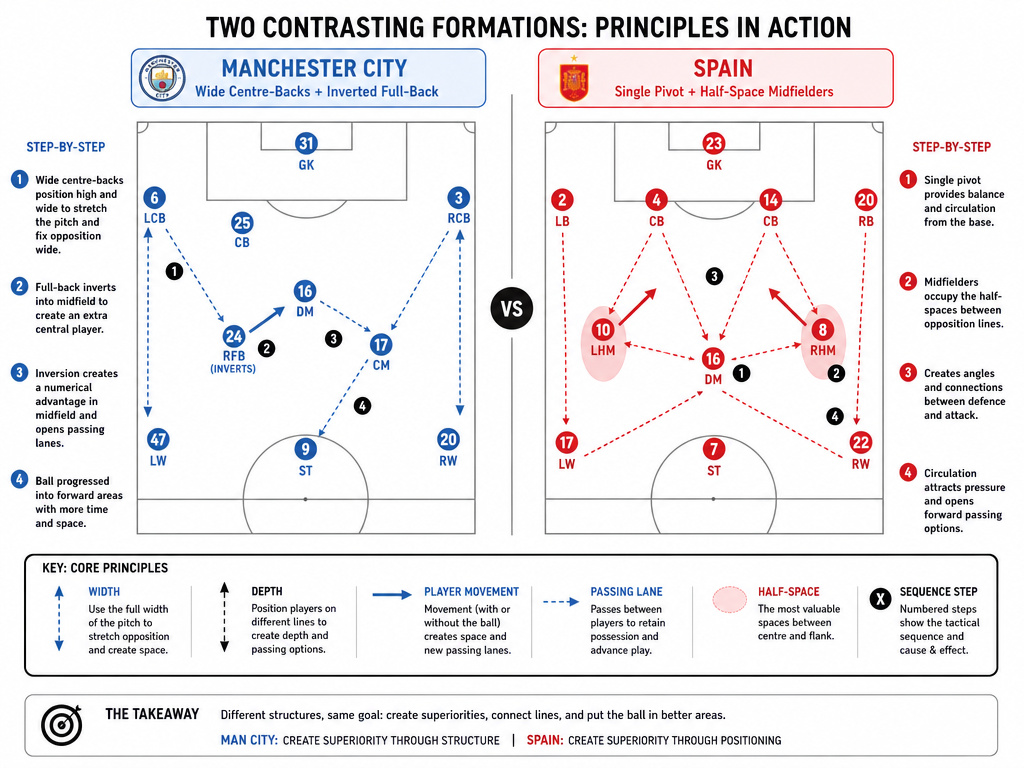
Theory is one thing. Seeing it on the pitch is another.
Manchester City under Guardiola is the textbook. Watch how they build from the back. The centre-backs go to the touchlines, the full-backs (often one playing as an inverted full-back) move into midfield, and the holding midfielder drops deep. This creates numerical superiority against the first line of the press every single time. Their midfielders, like Kevin De Bruyne or İlkay Gündoğan, are masters at receiving “half-turned”, body angled to see both the passer and the forward options, so they can play the next progressive pass instantly.
Spain’s national team during their tiki-taka golden era (2008-2012) is the other prime example. They mixed positional play’s controlled circulation with sudden vertical bursts. Sergio Busquets acting as the single pivot, Xavi and Andrés Iniesta occupying the half-spaces, and constant movement from the forwards created a dizzying, relentless style. It was possession football with a ruthless purpose: to score.
Both examples show the system’s flexibility. City use it with extreme width and precise vertical passes. Spain used it with shorter passes and more central focus. The core principles, width, depth, staggered players, creating the free man, remain unchanged.
Training Positional Play: From Kids to Pros
How do you coach this? You don’t start with a whiteboard lecture. You start with constrained games.
For Youth Players (U8-U9): The goal is to break the “beehive” mentality where all kids chase the ball. An exercise like “Stay in Your Zone” is perfect. Divide a small pitch into four zones. Assign each child a zone. They must stay primarily in their zone and try to pass to teammates in other zones. It teaches the first lesson: you have a responsibility to your space on the pitch. Another simple drill is a 4v4 game on a wide, short pitch, which naturally encourages using width.
For Advanced/Professional Players: The Rondo (e.g., 4v2, 5v2 keep-away) is the cornerstone. It trains quick passing, receiving under pressure, and constant support. But to specifically train patterns of positional play, coaches use Positional Games (JPO). These are small-sided games with strict rules to force the desired behaviours.
For example, a “6x6x6 +2” game involves three teams of six in two large grid spaces. One team defends while the other two try to keep possession. The rule: they must complete 6-7 passes before switching the play to the other grid, as in a 6x6x6 +2CI positional game. There’s also a technical limitation of 2 touches per player, as used in specific JPO formats like 6x6x6 +2CI. This forces quick decision-making, scanning for the free man, and using the width of the entire area.
Another common JPO is an “8×8 + 4CI” game, played across grids with specific rules to train zonal occupation and the use of neutral players. Players cannot leave their grid. This explicitly trains players to find solutions within their zone and to use the neutral player to create superiority, mirroring the search for the “third man” in a real match.
The part nobody mentions: These drills look messy and frustrating for the first 15 minutes of a training session. Players will lose the ball constantly because the constraints are unnatural. That’s the point. The frustration is them learning to see the game differently.
Common Criticisms and Counter-Strategies
No system is perfect. Positional play can be accused of being sterile or predictable. A well-drilled low block that refuses to be drawn out of shape can stifle it. If the pressing team cuts off the passing lanes into the central midfielders, the whole build-up can stall.
The most effective counter is a high, aggressive press that targets the passing options from the goalkeeper and centre-backs. If you can force a long, aimless ball from the back, you bypass their carefully constructed structure and create a 50-50 duel.
But that’s the risk-reward trade-off the system accepts. The coaches who teach it believe the benefits, sustained control, opponent fatigue, high-quality chance creation, far outweigh the risks. And they build rest defence principles precisely to mitigate those risks when possession is lost.
Common Misconceptions About Positional Play
Positional play is often misunderstood as a rigid system, but it is a flexible style of play and a team identity. It is not bound to a specific formation or system; its principles of occupying spaces in different planes and lanes can be applied from any starting structure. Another misconception is that it is purely offensive. While focused on controlling possession and space, a core pillar is pressure after loss, making it a defensive tool as well. The philosophy seeks to create superior situations, but this is achieved through adaptable principles, not a fixed tactical dogma.
Frequently Asked Questions
Is positional play just “tiki-taka”?
Not quite. Tiki-taka is a style of short-passing, high-possession football. Positional play is the underlying tactical framework that can produce a tiki-taka style. All tiki-taka teams use positional play principles, but a team using positional play might not play tiki-taka, they might use longer switches of play or more direct vertical passes.
Can a team use positional play in a 4-4-2 formation?
Yes, but it’s more challenging. The classic 4-4-2 has two flat banks of four, which makes creating the necessary staggered layers and central overloads harder. The system is more naturally suited to formations with a three-man midfield (like 4-3-3 or 4-2-3-1) or a back three (3-4-3), which provide more central numbers and inherent triangular relationships.
Why is the “third man” concept so important?
Because it breaks the direct marking relationship. If Player A is marked, and he passes to Player B who is also marked, a direct return pass to A is predictable. But if Player C makes a forward run from a deeper, unmarked position, the pass from B to C breaks two lines of defence at once. It’s the essence of playing through a team, not around it.
How long does it take for a team to learn positional play?
For a professional team with daily training, ingraining the basic patterns and principles of positional play requires consistent coaching over a significant period. But to reach the fluid, intuitive level of a Guardiola team or peak-era Barcelona, it requires years of consistent coaching, player buy-in, and a squad recruited specifically for the technical and cognitive demands of the system.
Can amateur or youth teams effectively use positional play?
Absolutely, but the focus must shift. At amateur levels, don’t obsess over complex rotations or playing out from the back under heavy press. Start with the core ideas: creating width, staggering in midfield, looking for the free player, and passing with a purpose. Simplified positional games are excellent teaching tools. The philosophy makes players smarter, regardless of the level.
The Bottom Line
Positional play isn’t a magic formula. It’s a demanding, intellectually rigorous way to approach the game that requires total commitment from the coaching staff and the players. When it works, it looks like effortless domination. When it fails, it looks like pointless sideways passing.
The key for any coach or fan trying to understand the juego de posicion explained is to watch the space, not the ball. Watch how the team’s shape creates passing lanes. Watch how one pass makes a defender turn his head, and how the next pass exploits the second he’s off-balance. It turns football from a game of moments into a game of chess, where the goal is often set up three moves in advance.
It’s the quiet orchestration before the roar.
