
Possession Football Tactics Explained: How to Train It
This post contains affiliate links. As an Amazon Associate, we earn from qualifying purchases.
Possession football tactics are defined by moving the ball with the specific intent to progress it into dangerous areas and disorganise the opponent, not by how long you can keep it. The Football Association’s England DNA breaks this into four pillars: counter-attacking, retaining to build, progressing and penetrating, and creating and scoring. For the US Youth Soccer ODP, ten codified principles, like “Spread Out” and “Speed of Play,” give players the decision-making rules. Modern research adds a crucial caveat: ball possession percentage doesn’t predict match outcomes, and short, progressive possessions are more effective than long, sterile ones.
That’s the core distinction: keeping the ball versus doing something with it. The two coaching documents above don’t talk about pass counts. They talk about moments, intent, and consequences. The research papers back them up by showing that holding the ball for its own sake wins you nothing. This isn’t an opinion; it’s a measurable outcome from thousands of analyzed possessions, a fundamental truth in possession football tactics explained.
So we’re not here to praise endless sideways passing. We’re here to pull apart the actual mechanics of possession with purpose. What follows is a walk-through of the official frameworks, what the data says about when possession actually works, and how you can spot (or coach) the difference between sterile control and a team pulling a defence apart.
Key Takeaways
- Judge possession by lines broken, not passes completed, a principle echoed in the US Youth Soccer ODP manual and recent academic studies.
- The FA’s philosophy rests on four defined aspects: counter-attacking, retaining to build, progressing and penetrating, and creating and scoring.
- Academic research is clear: possession percentage does not correlate with match success, and short, progressive possessions in advanced areas are strongly linked to positive outcomes.
- After a back pass, the next move is usually a switch of play to find space, a key rule of thumb from the US Youth ODP principles.
- Every player, including the goalkeeper, is integrated into the in-possession philosophy, acting as the 11th outfield player in build-up.
The FA’s Four-Pillar Philosophy: Possession as a Means, Not an End
The England DNA document from The Football Association is a coaching curriculum, not a feel-good mission statement. Its in-possession section is built on four defined, interlinked aspects: Counter-attacking, Retaining the ball to build the play, Progress and penetration, and Creating and scoring.
The future England goalkeeper will play an important role in all aspects of the in-possession playing philosophy. Possession may be lost at any stage, prompting a transition to the defensive philosophy.
That blockquote does two things. First, it explicitly includes the goalkeeper in the build-up, a fundamental requirement for modern possession teams. Second, it states the obvious that coaches often forget: possession is temporary. The moment you lose it, a different set of rules applies. This isn’t a slow, patient style versus a fast one. It’s a philosophy with multiple gears.
The four aspects are a cycle, not a ranking. Counter-attacking is listed first, which is telling. It acknowledges that the most efficient path to goal – winning the ball and attacking before the defence is set – is a core part of intelligent possession. Retaining the ball to build is what most people picture: short passes, triangles, drawing the press. Progress and penetration is defined as “forward passes or forward running and dribbling that moves the ball between and beyond opponents.” Creating and scoring is the end point.
The document states the number of goal-scoring opportunities created reflects the effectiveness of play in the other three elements. In other words, if you’re not creating chances, your possession in the first three phases is failing. It’s a system that judges itself by its output.
What The Research Says: Debunking the Possession Percentage Myth
If you’ve ever watched a team pass the ball sideways for 70% of a match and lose 1-0, you’ve seen the research in action. A 2022 systematic review in PLOS One analyzed 75 studies and concluded that “the match outcome is not related to ball possession percentage” and that it “is not dominant to predict match success.”
That’s a seismic shift from the common coaching assumption that more ball equals more control equals more wins. The review digs deeper, citing a finding that the offensive efficiency of counterattacks is 40% higher than positional attacks. This directly challenges the idea that patient build-up is inherently superior. It suggests that the FA’s first pillar – Counter-attacking – is not just a nice addition, but a statistically more potent weapon.
A more recent study in Frontiers in Psychology looked at 2,324 possessions from UEFA Euro 2020. It found that “short possessions, with the intent to progress and developed in advanced zones of the field, are strongly associated with successful outcomes.” Conversely, “long possessions in offensive zones did not consistently correlate with success.”
This is the “possession with purpose” idea quantified in any good possession football tactics explained. A 20-pass move that stays in the midfield third is less valuable than a 5-pass move that slices from the right-back, through the lines, and into the opponent’s penalty area. The duration is less important than the intent and the territory gained.
| Possession Type | Key Research Finding | Practical Implication |
|---|---|---|
| High Possession % | No correlation with match outcome (PLOS One 2022) | Stop focusing on the stat; focus on what you do with the ball. |
| Long Possessions (>12 seconds) | No consistent link to success (Frontiers 2025) | Patient build-up has diminishing returns if it doesn’t progress. |
| Short, Progressive Possessions | Strongly associated with successful outcomes (Frontiers 2025) | Coach quick combinations and forward intent in the final third. |
| Counter-attacks | 40% higher offensive efficiency than positional attacks (PLOS One citing Sarmento) | Transition moments are golden opportunities; rehearse them. |
The data supports playing vertically. It tells coaches that encouraging risk in the final third – those line-breaking passes – is supported by evidence from the Frontiers in Psychology study, while The FA’s philosophy also values retaining the ball to build play.
The US Youth Soccer 10 Principles: A Player’s Decision-Making Guide
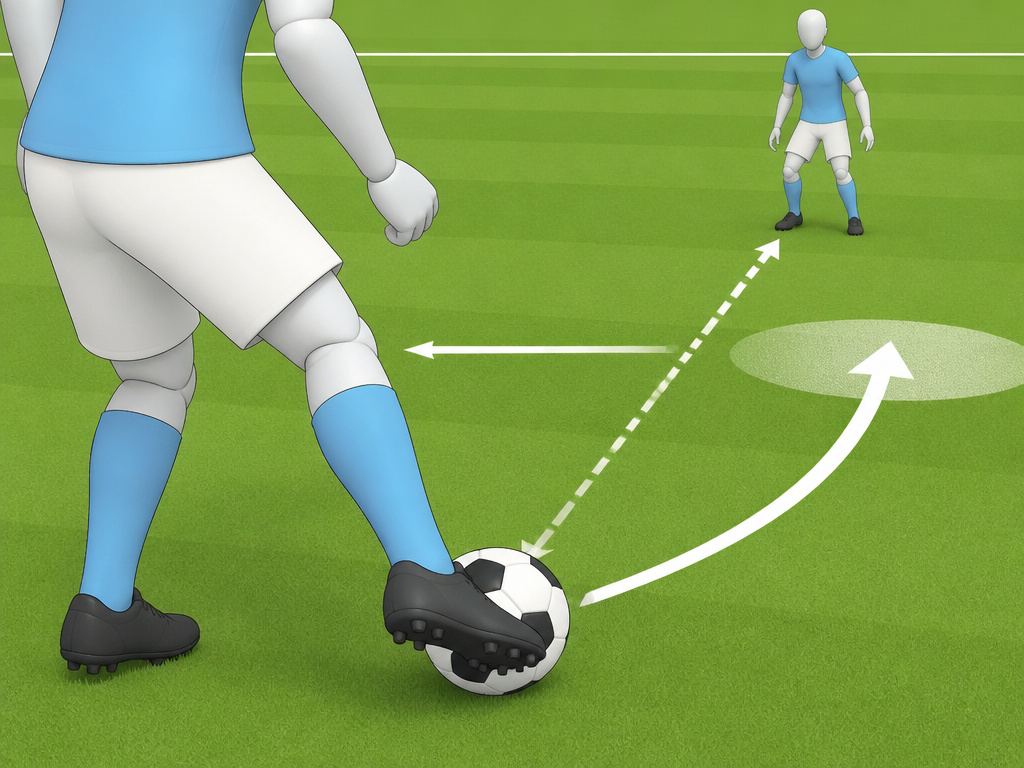
While the FA outlines a philosophy, the US Youth Soccer Olympic Development Program (ODP) gives players a practical handbook. Its 2023 manual mandates teaching possession within the 4-3-3 system, aligning with U.S. Soccer national teams. More importantly, it provides players with ten codified principles to guide their decisions. These aren’t vague ideas; they’re specific rules of thumb.
Principle 1: Spread Out. This is the foundation. Width and depth create passing lanes and stretch the opposition block. Without it, even the most technical team passes into traffic.
Principle 5: Bend Forward Runs. Running in a curved, disguised path is harder for defenders to track than a straight, obvious run. It’s about creating uncertainty.
Common mistake: Throwing the ball down the line into a crowd from a throw-in. The US Youth ODP manual explicitly warns this “usually results in a loss of possession.” Principle 9 says to use throw-ins to switch the point of attack instead, exploiting the space on the far side.
Principle 6: Back Passes Are Usually Followed By A Switch. This is a critical coaching point. The manual explains a back pass usually means the area ahead is congested. Therefore, the next pass should switch the play to a less crowded area. It’s not a sign of failure; it’s a trigger for a specific, positive action.
Principle 7: The Ball Doesn’t Stay In An Area For Long. The manual’s rule of thumb: after a couple of short passes in one zone, the next pass should be played out of it. This constant circulation prevents the opposition from settling into a compact press.
Principle 10: Speed of Play. The document advocates for “quick one touch or two touch passing” as the best way for the majority of the time. This isn’t frantic hurrying; it’s a crisp, connected rhythm that denies defenders time to recover their shape.
These principles turn abstract concepts into executable actions, which is the goal of a clear possession football tactics explained. A player who knows that a back pass triggers a switch is already playing with more purpose than one who is just trying to keep the ball.
From Philosophy to Formation: The 4-3-3 and Player Roles
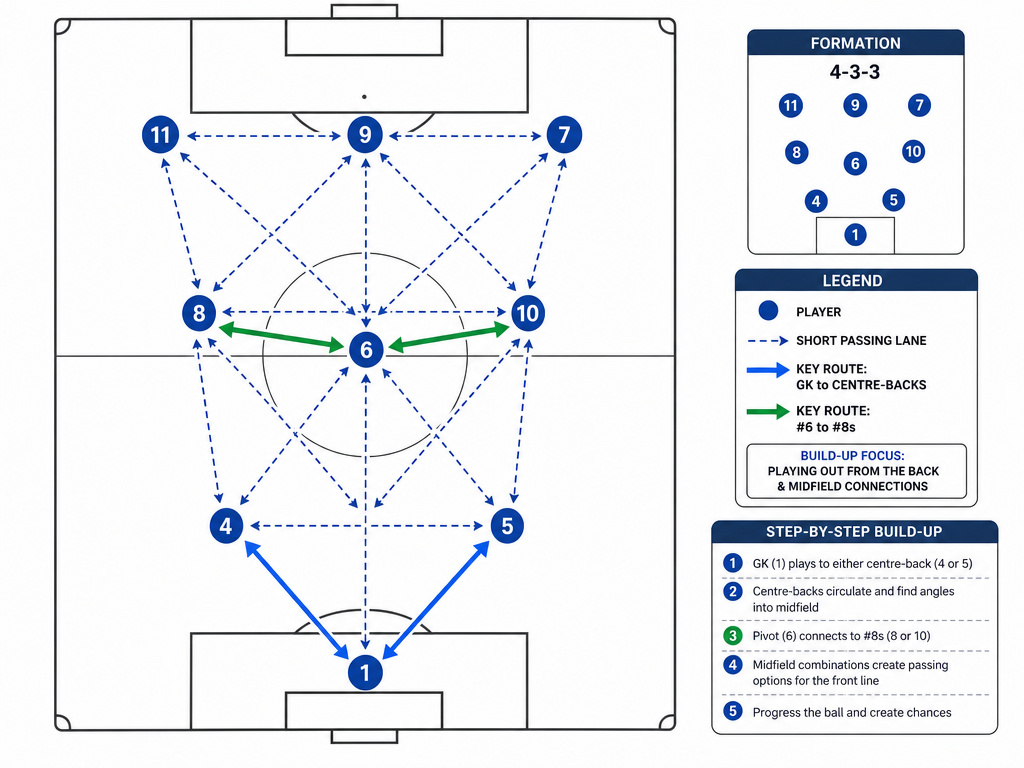
The 4-3-3 formation is a common vessel for possession football, prescribed by the US Youth Soccer ODP and described as the “classic possession formation” by tactical guides, though some coaches, like Tim Lees, reject a focus on numbered systems. Its strength is the midfield triangle, which naturally creates passing options and control. However, as coach Tim Lees notes in his philosophy document, an over-obsession with “numbered systems” can create “robots.” The shape is a starting point, not a prison.
The real magic happens in the roles within the shape. For a possession team, every player must be a willing and capable passer.
| Position | Key Possession Role | Critical Attributes |
|---|---|---|
| Goalkeeper | First line of build-up; distributes to centre-backs or takes short kicks. | Composure, passing accuracy, decision-making under pressure. |
| Centre-Backs (Ball-Playing Defenders) | Start attacks, break the first line of press with vertical passes. | High passing ability and composure are critical. |
| Deep-Lying Midfielder (e.g., #6) | Metronome; receives from defenders, dictates tempo, finds progressive passes. | High passing ability, composure, anticipation, and positioning are critical. |
| Advanced Midfielders (#8/#10) | Receive between lines, combine with forwards, provide penetration. | First touch, passing in tight spaces, movement off the ball. |
| Wide Forwards / Wingers | Provide width, attack half-spaces, make diagonal runs to support the striker. | Dribbling, timing of runs, ability to play intricate passes. |
The goalkeeper’s integration is essential. The FA states the goalkeeper is included in all aspects of the philosophy, and Football Manager guides for possession tactics instruct to use “Distribute to Centre-Backs” or “Take Short Kicks.” This turns a back-pass into a constructive restart, not a relief valve.
Breaking the Low Block: Possession’s Ultimate Test
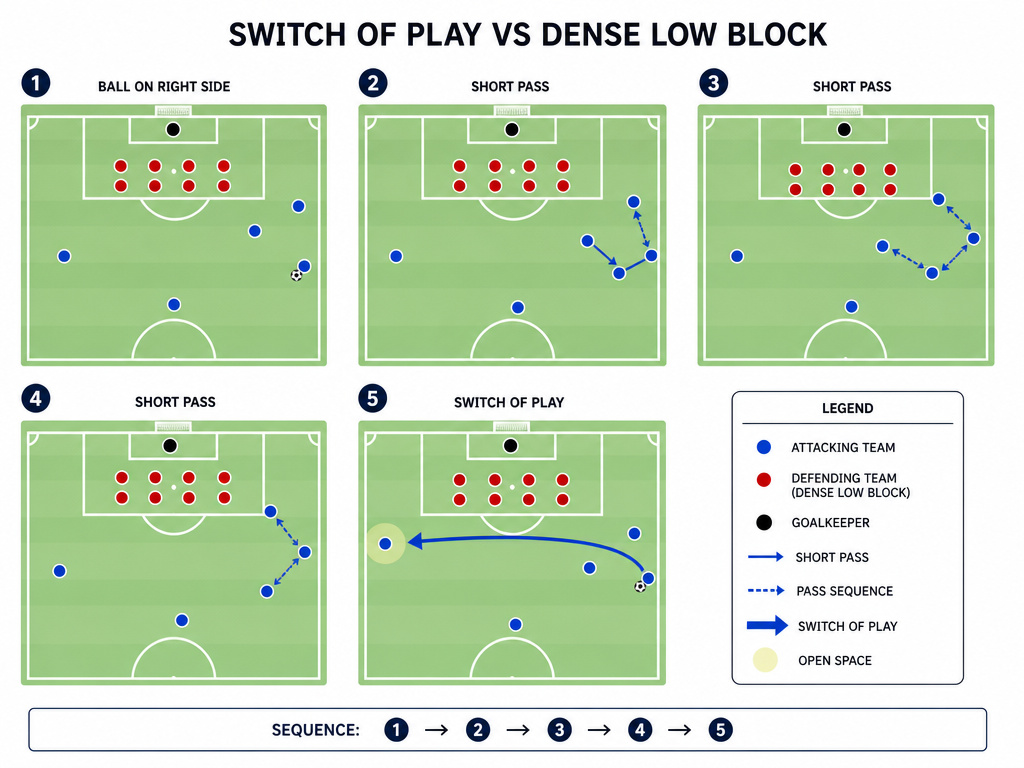
The true test of a possession philosophy isn’t playing a similarly open team; it’s breaking down a deep, compact low block. This is where “possession with purpose” separates from “possession as vanity.”
The research already gave us the clue: long possessions in offensive zones don’t correlate with success. So, what does work? You need to move the defensive block. This is achieved through the principles we’ve outlined: using width (Spread Out) to stretch the block sideways, quick circulation (The Ball Doesn’t Stay In An Area For Long) to shift it side-to-side, and sudden vertical passes (Progress and penetration) when a gap appears.
I tracked passes in a game once where we completed a high number of passes but created very few real chances. All that sideways passing felt secure and achieved nothing. I now ask players where they moved before the pass, not how many they completed. Possession-at-all-costs coaching rewards the safe pass, and the safe pass rarely breaks a low block.
A key tactic is the switch of play, which is the recommended action after a back pass according to US Youth Soccer ODP Principle 6. After a series of passes on the right, drawing the defence over, a rapid switch to the left winger in space can create a 1v1 opportunity before the block can slide across. This is why the US Youth ODP emphasises it.
Another is using rotations and third-man runs. Static players are easy to mark. When a forward drops deep to link play (a False Nine movement), and a midfielder runs into the space they vacated, it forces defenders to make decisions – and decisions under movement lead to mistakes. This is a core part of rotations in football tactics.
Ultimately, breaking a low block requires patience with a sharp, decisive intent. You must be willing to recycle the ball (retain to build) to probe, but always with the trigger-ready intent to play a penetrative pass or make a run behind when the defender blinks.
Common Pitfalls and How to Avoid Them
Where this goes sideways: Celebrating the pass count instead of the line broken. If coaches praise a 30-pass move that ends with a backwards pass, players learn that circulation is the goal, not progression.
- Static Possession: Players pass the ball around without any off-ball movement to create new options. The fix isn’t shouting “move!” It’s designing practices where passing options disappear after two seconds, forcing players to relocate. Remember, spacing gives passes their power.
- Vulnerability on Transition: A team committing players forward in possession can be exposed if the ball is lost. This is why pressing and possession are linked. Without it, you’re playing a high-wire act.
- Overcomplication in the Final Third: Sometimes, after a beautiful build-up, a simple cross or shot is the right answer. Possession teams can fall in love with the extra pass, ignoring a clear shooting opportunity. The principle of “creating and scoring” is the final phase of the in-possession philosophy.
- Dogmatic Formation Adherence: Sticking rigidly to a 4-3-3 when the players don’t fit the roles is a recipe for sterile play. The philosophy is more important than the numbers on a whiteboard. Other formations can execute possession principles effectively if coached with the same intent.
It’s worth remembering a contrarian view from coach Tim Lees: “I do not believe in rondos.” He argues that in a ten-minute rondo, players get an average of nine touches, many of which are short, unpressured passes. His point is that time could be better spent in more game-realistic, opposed possession exercises. It’s a reminder that even the most revered training tools should be scrutinized for their actual transfer to the match.
How to train possession football
Effective training moves beyond repetitive rondos. Sessions should integrate the core aspects of possession as defined by sources like The FA: counter-attacking, retaining the ball to build, progressing and penetrating, and creating and scoring. Drills must include the goalkeeper as a key part of build-up play. Principles like spreading out to create space and using quick one- or two-touch passing are emphasized in sources like the US Youth Soccer ODP manual. The aim is to design sessions where possession has clear consequences, moving beyond just pass counts.
Frequently Asked Questions
What is the main difference between possession football and tiki-taka?
Tiki-taka is a specific, highly regimented subset of possession football characterized by extremely short passes, constant player movement, and a focus on playing through tight central spaces. All tiki-taka is possession football, but not all possession football is tiki-taka. A possession team might use longer switches of play and be more vertical in its progression.
Is 4-3-3 the only formation for possession football?
While the 4-3-3 is the classic and most common formation due to its natural triangles and balance, it is not the only option. Formations like 3-4-3 or 4-2-3-1 can also facilitate possession play if coached with the right principles. The US Youth Soccer ODP mandates it for national team alignment, but the core ideas of spacing, support, and progression are transferable.
Why do some possession teams struggle to score?
They often fall into the trap of “sterile possession.” This happens when a team focuses on keeping the ball (circulation) without the intent or mechanism to progress it into dangerous areas (penetration). They may lack players who make runs in behind, struggle with the final pass, or take too long on the ball, allowing the defence to regroup. The research on short, progressive possessions directly addresses this failure mode.
How important is pressing to possession football?
Extremely important. Most modern possession teams employ immediate counter-pressing after losing the ball. The logic is twofold: winning the ball back quickly returns you to your preferred style of play, and it prevents the opponent from launching a counter-attack while your team is out of its defensive shape. Possession and pressing are two sides of the same controlling coin.
Can a less technical team play possession football?
Yes, but in a simplified form. The core principles of spreading out, providing support, and looking to switch play can be adopted at any level. The key is adjusting expectations: you may not dominate 70% of possession, but you can out-pass a direct opponent by making smarter, safer choices and using the space effectively. The technical threshold is lower if the tactical understanding is high.
Before You Go
The biggest shift in thinking is this: possession percentage is a vanity metric. The real measure is in the lines you break and the dilemmas you force. Whether you’re coaching a youth team using the US Youth ODP’s ten principles or analyzing a pro match through the FA’s four pillars, judge the possession by its consequence.
The next time you watch a game, rewind the goal 20 seconds. Look for the switch of play that stretched the block, or the quick one-touch combination that played through the lines. That’s possession with purpose. The assist was just the final step of a process built on intent. Start counting those moments instead of the pass count, and you’ll see the game differently.
