
7 a Side Football Rules Explained
This post contains affiliate links. As an Amazon Associate, we earn from qualifying purchases.
The official 7-a-side football rules, as defined by The Football Association (The FA), call for a pitch length of 50-60 metres, a width of 30-40 metres, two halves of up to 25 minutes each, and teams of seven players with three substitutes. Unlike 11-a-side, there is no offside rule, and the ball is returned to play with a kick-in instead of a throw-in. However, these are recommended laws, organizations like the Special Olympics and youth programmes often use different dimensions and modified rules.
That “recommended” part is where most confusion starts. The FA publishes their laws for small-sided football, but they explicitly state they are not mandatory. This means your local league, a youth tournament, or an international competition for athletes with cerebral palsy can and do set their own parameters.
What follows is a guide to the standard FA rules, the common variations you’ll actually encounter, and the tactical logic that makes 7-a-side a unique game, effectively a 7 a side football rules explained resource.
Key Takeaways
- The official FA pitch dimensions are 50-60m long and 30-40m wide, but the Special Olympics allows pitches up to 70m x 50m, and youth football often uses different ranges.
- Matches are played in two halves of up to 25 minutes each, with a maximum 5-minute half-time, though youth formats sometimes use three periods of 15 minutes.
- You play with a maximum of 7 players and 3 substitutes, using rolling substitutions, and there is no offside rule in standard small-sided football.
- The ball is returned to play with a kick-in, not a throw-in, and a goal cannot be scored directly from it.
- All free kicks are indirect in youth 7s formats, and a common rule is a 13-metre retreating line for goal kicks and when the goalkeeper has the ball.
What Are the Official 7-a-Side Pitch Dimensions?
The FA’s recommended dimensions for adult 7-a-side are a length of 50-60 metres and a width of 30-40 metres. That’s the box you’re aiming for.
But step outside that box, and the field literally expands. The Special Olympics rules for 7/8-a-side allow a maximum pitch of 70m x 50m, with a minimum of 50m x 35m. Their field is often larger. Meanwhile, The FA’s own youth development guidelines for 7s recommend a width of 36-45m and a length of 55-65m, a slightly different rectangle altogether.
Where this goes sideways: Assuming one set of lines fits all. Turning up to a Special Olympics tournament with a pitch marked to the narrower FA minimum will cause a last-minute re-measure. Always check the competition rules first.
Here’s a quick look at how the three main standards compare:
| Governing Body / Format | Pitch Length | Pitch Width | Notes |
|---|---|---|---|
| The FA (Adult 7s) | 50m – 60m | 30m – 40m | The standard recommended dimensions. |
| Special Olympics (7/8-a-side) | 50m – 70m | 35m – 50m | Allows for a significantly wider pitch. |
| The FA Youth 7s | 55m – 65m | 36m – 45m | Designed for player development, often slightly larger. |
The goal size and penalty area are proportionally smaller than in 11-a-side. The ball size also changes with age. According to the Special Olympics rules, players aged 8-12 use a Size 4 ball (circumference 63.5-66cm), while all other ages use a standard Size 5 (68-70cm). This isn’t just a detail, a Size 5 is harder for younger players to control and strikes differently, which changes the game.
The 7-a-Side Match: Duration, Players & Substitutions
A 7-a-side match is built for pace. The FA states the game is divided into two equal periods of “over 5 and up to 25 minutes each period.” The half-time interval cannot exceed five minutes unless the referee agrees otherwise. That means a typical adult game might be 2 x 20 minutes, 2 x 25 minutes, or anything in between, decided by the competition.
Youth football shakes up the timing to focus on development and involvement. The FA’s youth 7s format has a maximum duration of two periods of 25 minutes (20 minutes in the first year). Crucially, they offer an alternative: three periods of 15 minutes with 5-minute intervals. This three-period model is brilliant. It creates two natural breaks for coaching points, allows for more squad rotation, and keeps energy levels high.
On the pitch, you have seven players: one goalkeeper and six outfielders. Each team can name three substitutes, making a matchday squad of ten. The substitution rule is one of 7-a-side’s best features: rolling substitutions. A player can come off and go back on multiple times. This demands a different kind of squad management from a coach.
The player taking the kick-in may not play the ball a second time until it has touched another player. The ball is in play immediately after it is kicked or touched.
The short version: It’s faster, the breaks are more flexible, and everyone gets more time on the ball thanks to rolling subs.
Key Rule Differences from 11-a-Side
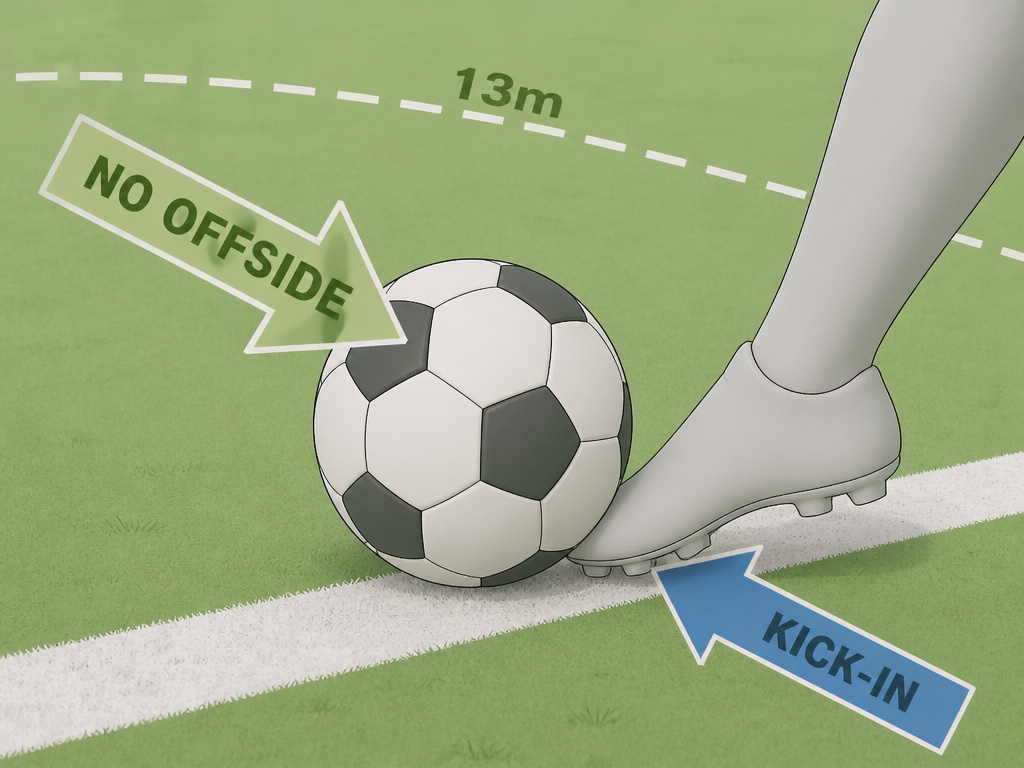
This is where 7-a-side becomes its own game, not just a shrunken version of the full-sized sport, a key point in any 7 a side football rules explained article. The changes are designed for more flow, more touches, and simpler refereeing.
First, the most celebrated difference: there is no offside rule in standard small-sided football. The FA’s laws are clear on this. It opens up the pitch, encourages attacking movement, and removes a complex law that can be tricky for young players and casual referees. However, note the exception: in CP Football (Football 7-a-side for athletes with cerebral palsy), the offside law does apply, but it’s restricted to the area between the goal line and the 13-metre line. This shows how modifications serve specific needs.
Second, forget throw-ins. When the ball goes out over the touchline, you take a kick-in. A kick-in is awarded when the whole of the ball passes over a touch line, and it is kicked back into play. You can’t score directly from a kick-in. For a kick-in, The FA states defenders must be at least 3 metres away. In The FA’s youth 7s format, this distance is 6 metres, and the player must use a short pass. It’s a quicker, more skillful restart that keeps the game moving.
Third, the rules around the goalkeeper and restarts are often modified to encourage building from the back. In many youth formats:
- The pass-back rule does not apply.
- Goalkeepers must throw or pass the ball from the ground; long kicks from the hand are not allowed.
- A 13-metre retreating line is used. When the goalkeeper has the ball in hand or for a goal kick, all opposing players must retreat behind this line until the ball is played to a teammate. This creates space and encourages playing out.
Finally, discipline has a practical twist. The FA advises referees to report any red-card offences to their County FA within 48 hours of the game. And in a very specific edge case, if the ball bursts during play, the game is restarted with a dropped ball at the exact spot where the original ball failed.
Fouls, Free Kicks, and Restarts

The principles of fouls are the same as 11-a-side: reckless challenges, dangerous play, and handling the ball. But the restart distances and types can differ.
For standard FA 7-a-side, free kicks operate similarly to the full laws. However, in The FA’s youth 7s format, a major simplification occurs: all free kicks are indirect. You cannot score directly from any free kick. This reduces the incentive for cynical fouls around the penalty area and reinforces the focus on team play.
The distance opponents must be from the ball on restarts is another point of variation. In standard adult 7s, defenders must be 3 metres from a kick-in. In youth 7s, the required distance is 6 metres for kick-ins, kick-offs, free kicks, and corner kicks. This larger buffer gives the attacking team more time and space to execute a planned play.
| Restart Type | Standard FA 7s Distance | Youth FA 7s Distance | Key Difference |
|---|---|---|---|
| Kick-in | Defenders at least 3m away. | All opponents 6m from the ball. | Youth rules double the space. |
| Free Kick | Standard IFAB laws apply. | Opponents 6m away; all kicks are indirect. | Direct free kicks are removed. |
| Corner Kick | Standard IFAB laws apply. | Opponents 6m from the ball. | Encourages short corners. |
| Kick-off | Opponents in own half. | Opponents 6m away from the ball. | A defined, shorter distance. |
Another unique restart rule in youth 7s happens after a goal. The scoring team must retreat to the halfway line, and the team that conceded restarts with a kick-off. This immediately flips the momentum and encourages quick restarts.
Formations and Basic Tactics for 7-a-Side

With only six outfield players, your formation is about covering space efficiently. You can’t have specialists in every position. Every player needs to be comfortable defending and attacking.
The most common and balanced formation is the 2-3-1. It provides a solid base of two defenders, a midfield three that can control the centre, and a lone striker. The three midfielders are key, one can hold, while the other two support the attack. It’s versatile and a great starting point for any team.
A great resource for exploring these ideas is our guide to common 7-a-side formations and tactics.
Equipment and Safety
The equipment rules are straightforward but mandatory. Player safety is the priority.
- Shinguards: These are mandatory. They must be covered entirely by the socks and made of suitable material (rubber, plastic, or similar) providing reasonable protection.
- Jewellery: The FA laws are absolute: All jewellery must be removed.
- Goalkeepers: They must wear colours that easily distinguish them from other players and referees. They are also permitted to wear long trousers.
It’s also worth checking the specific goalkeeper rules and modifications, as their ability to handle back-passes and distribute the ball is often modified in small-sided games.
Forfeit and minimum player rules
For practical guidance, you should consult the specific competition rules you are playing under, as these can vary. In some modified formats, such as CP Football, the referee must not abandon the match if a team is reduced to fewer than three players, and for Women’s CP Football, the match continues with fewer than four players. Always check with your league or organizer for their exact forfeit policy.
Slide tackle rules
The fact sheet does not contain any specific rules regarding slide tackles in 7-a-side football. Where rules are not stated, the normal Laws of Association Football apply, with certain exceptions like the offside rule. This means that, unless your specific competition has modified the laws, standard tackle rules from the full-sized game are in effect. A slide tackle is generally permitted if it is performed legally, without endangering an opponent or making contact with the player before the ball.
Frequently Asked Questions
How many players are on a 7-a-side team?
You have seven players on the pitch at one time: one goalkeeper and six outfield players. Teams are usually allowed a matchday squad of ten players, which includes three substitutes. Rolling substitutions mean these subs can be used repeatedly throughout the match.
Is there offside in 7-a-side football?
In the standard small-sided football laws published by The FA, there is no offside rule. This is a key difference designed to simplify the game and encourage attacking play. However, specific variants, such as CP Football (7-a-side for athletes with cerebral palsy), do have a modified offside rule.
How long is a 7-a-side football match?
Match is typically divided into two equal halves. The FA states each half should be “over 5 and up to 25 minutes,” so common lengths are 2 x 20 minutes or 2 x 25 minutes. In youth football, an alternative format of three 15-minute periods is also used to maximise playing time and coaching opportunities.
What is a kick-in?
Kick-in replaces the throw-in. When the ball goes out over the touchline, it is placed stationary on the line and kicked back into play by a member of the opposing team. Defenders must be 3 metres away (6 metres in youth football), and you cannot score directly from a kick-in.
Can the goalkeeper pick up a back-pass?
This depends on the competition rules. In standard FA 7-a-side, the normal back-pass rule applies. However, in many youth development formats, the pass-back rule is specifically waived to encourage playing out from the back and to keep the game flowing.
Before You Go
The beauty of 7-a-side is in its adaptability. The FA provides a framework, a pitch between 50-60m long, two short halves, no offside, kick-ins, but it’s a starting point, not a rigid doctrine. Your local league might use a bigger pitch like the Special Olympics standard. Your child’s youth game will definitely use the retreating line and indirect free kicks.
So the single most important rule is this: always get a copy of the specific competition regulations before you play or coach. Knowing whether you’re playing under standard FA laws, youth development rules, or another organization’s framework like the official 7-a-side football regulations is what separates a prepared team from a confused one. Everything else, the formations, the tactics, the frantic substitutions, flows from knowing the canvas you’re playing on.
