
Futsal vs Football Differences: A Side-by-Side Comparison
This post contains affiliate links. As an Amazon Associate, we earn from qualifying purchases.
Futsal is a 5-a-side game played on a hard court with a smaller, low-bounce ball and a stopped clock, while football is an 11-a-side game on grass with a larger, bouncier ball and continuous time. The futsal pitch is between 25m and 42m long, the ball is size 4 with a 50-65cm bounce from 2m, and its rules, like kick-ins and no offside, create a faster, more technical game focused on close control.
That tight court is the root of almost every other difference. It forces faster decisions, demands closer control, and creates a game of constant, high-intensity movement. While they share a ball and a goal, the space they’re played in reshapes everything from the equipment to the player’s mindset. A clear summary of these distinctions is found in the key futsal vs football differences.
What follows is a side-by-side breakdown of the futsal vs football differences: the pitch, the ball, the teams, the rules, and the style of play. We’ll also tackle the practical questions, like which sport is harder, and what skills actually transfer between the two.
Key Takeaways
- The futsal pitch is a hard court between 25m and 42m long, less than a third the size of a football pitch, which turns every touch into a high-pressure decision.
- A size 4 futsal ball has 30% less bounce than a football, weighing 400–440g; this keeps play on the floor and rewards sole-of-the-foot control.
- Rolling substitutions and no offside rule in futsal create a non-stop, flowing game where tactical structure looks completely different from 11-a-side football.
- Futsal develops unbeatable close control and quick decision-making, but it doesn’t teach the long passing, heading, or aerial game that football requires.
- The transition between sports is a genuine physical shock; football fitness doesn’t automatically prepare you for futsal’s relentless intensity, and vice versa.
The Pitch: From Grass to Hard Court
The space defines the game. Look at the numbers from the rulebooks. A FIFA-regulation futsal court measures 25m to 42m in length and 16m to 25m in width. For international matches, that range tightens to 38–42m long and 20–25m wide.
Now compare that to the football pitch. The IFAB Laws of the Game specify a length of 90m to 120m and a width of 45m to 90m. Even at its smallest, a football pitch is more than twice the size of a futsal court.
A standard international futsal court (within the 38–42m long and 20–25m wide range) could fit inside the penalty area of a full-size football pitch. This isn’t just a smaller field; it’s a different ecosystem where players are never more than a few steps from an opponent or a touchline.
The surface changes everything, too. Futsal is played on a smooth, flat hardcourt, think basketball or handball. The ball skims and stays low. Football is played on grass or artificial turf, where the ball can bobble and bounce unpredictably. This makes the footwear essential. Football boots have studs for traction on grass; futsal shoes have non-marking gum rubber soles for grip on polished hardwood.
That confined space is the engine of futsal. There’s no hiding, no leisurely jog back into position. Every pass is under pressure, every first touch has to be perfect. It’s a game of inches, played at a breakneck pace.
The Ball: Size, Weight, and Bounce
If the pitch is the stage, the ball is the lead actor. And here, the two sports use completely different performers.
We’ll look at the official specifications. Per the FIFA Futsal Laws of the Game, the match ball must be:
- Size 4 (not size 5)
- 62–64 cm in circumference
- 400–440 grams in weight
- Have a pressure of 0.4–0.6 atmospheres
The most telling spec is the bounce test. A futsal ball, when dropped from a height of 2 meters, must rebound between 50 cm and 65 cm on its first bounce. That’s about 30% less bounce than a traditional football.
| Specification | Futsal Ball | Football Ball |
|---|---|---|
| Size | Size 4 | Size 5 |
| Circumference | 62–64 cm | 68–70 cm |
| Weight | 400–440g | (Not specified in fact sheet) |
| Bounce (from 2m) | 50–65 cm | Higher, less regulated |
| Primary Effect | Stays low, encourages ground play | Bounces freely, enables aerial play |
That low bounce is deliberate. A ball that stays on the floor rewards technical skill, the sole-of-the-foot roll, the quick turn, the disguised pass. You can’t just hoof it forward and hope. In football, the larger size 5 ball is a tool for a different game. It’s made for driven passes over distance, for crosses into the box, for winning headers. The equipment dictates the style.
This is the most common mistake I see in casual play: using a regular football for futsal. The game instantly becomes a pinball match, bouncing wildly and frustrating everyone. The right choice of ball isn’t a minor detail; it’s the difference between playing the game and fighting it.
Team Size, Subs, and the Flow of the Game
Headcount changes everything. Football is a game of 11, with defined positions and specialized roles. Futsal is a game of 5, where everyone is a midfielder, a defender, and an attacker all at once.
The FIFA futsal rules are clear: a match is played by two teams, each with no more than five players, one of whom is the goalkeeper. You can have up to nine substitutes on the bench. Here’s the revolutionary part: substitutions are rolling and can be made at any time. A player comes off, another comes on, and the game doesn’t stop. There’s no limit on how many times a player can be swapped.
Contrast that with football’s IFAB Law 3: 11 players per team, with a maximum of five substitution opportunities in most official competitions. Each stoppage for a sub breaks the rhythm.
This fundamental difference in the futsal vs football differences reshapes the game’s physics. Futsal is a high-intensity sprint. Players can go all-out for a 90-second shift, then recover on the bench. The pace is relentless because fatigue is managed strategically. Football, with its limited subs, is a marathon with intermittent sprints. It requires a different kind of endurance, the ability to sustain effort over 45-minute halves.
Where this goes sideways: Coaches trying to run a futsal session with football substitution rules. The players in the middle are gassed within three minutes, the game slows to a crawl, and the technical quality plummets. You have to use the bench, or you’re not playing futsal.
The goalkeeper’s role morphs too. In futsal, the keeper often acts as a sweeper, participating in outfield play. You’ll rarely see them wear gloves, the smaller, less-slick ball is easier to grip with bare hands. In football, the keeper is a specialist, usually gloved and confined to their area.
Rulebook Clash: No Offside, Kick-Ins, and the 4-Second Rule

This is where the games truly divorce. Football’s rules are built for a large, outdoor pitch. Futsal’s rules are engineered for a fast, indoor cage match.
The most well-known difference is that futsal has no offside rule. On a court that small, with players already packed together, the rule isn’t needed to prevent goal-hanging. Removing it keeps the game flowing and forces defenders to stay alert through sheer proximity, not an arbitrary line.
Restarts are completely different. Forget throw-ins. In futsal, you have kick-ins. The ball is placed on the touchline and kicked back into play. You have four seconds to take it. This rule alone prevents time-wasting and keeps the tempo furious. Similarly, goalkeepers have four seconds to release the ball from their hands.
Then there’s the accumulated fouls rule, a unique futsal quirk. Once a team commits five direct free-kick fouls in a half, every subsequent foul is punished with a 10-meter direct free kick (from the second penalty mark), taken with no defensive wall. It’s a huge deterrent against cynical, tactical fouling.
| Rule | Futsal | Football |
|---|---|---|
| Restart from touchline | Kick-in (4-second limit) | Throw-in |
| Offside | No offside rule | Offside rule applies |
| Goalkeeper release | 4-second limit | 6-second guideline (rarely enforced) |
| Foul accumulation | 5+ fouls per half → 10m direct kick (no wall) | No equivalent team-foul penalty |
| Match Officials | 2 referees | 1 referee + 2 assistant referees |
These official rules aren’t just minor tweaks. They create a distinct sport. A player who’s mastered the rules of indoor football in a walled arena will still be lost in futsal’s open-play structure. The cognitive load is different. In futsal, you’re constantly scanning for the immediate threat and the quick restart. In football, you’re managing space over a much larger area, thinking several passes ahead.
Which Sport Is Harder? It’s the Wrong Question
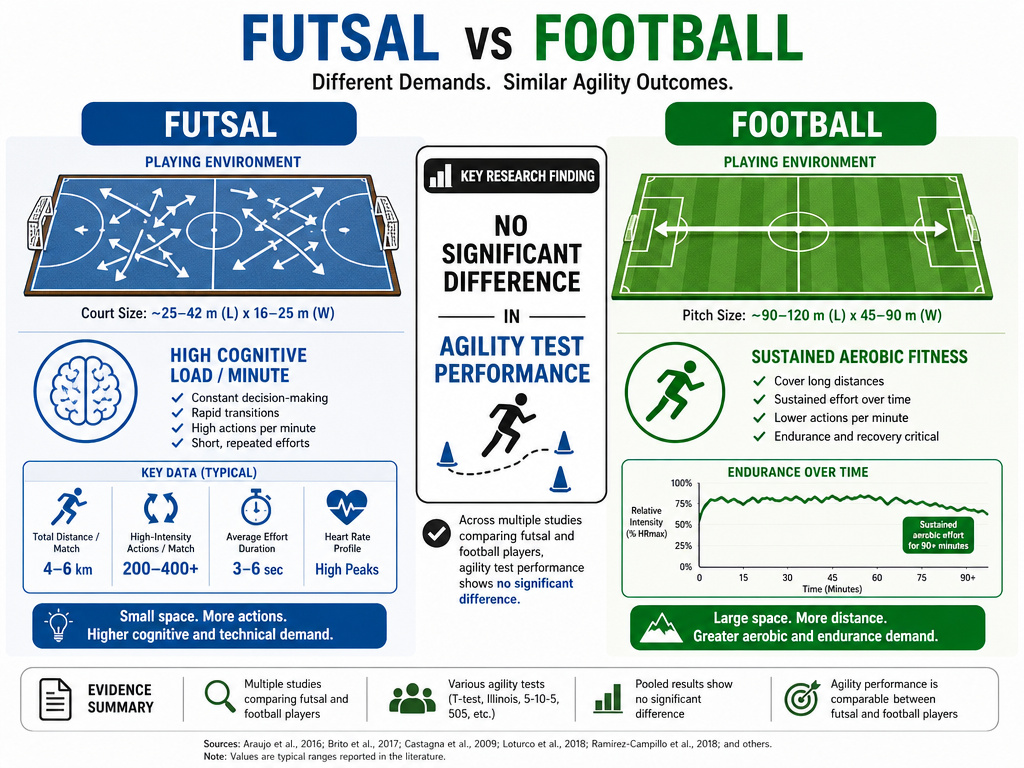
People love to ask which is tougher. The answer isn’t simple, because they demand different kinds of hard.
A study in Kinesiology noted that the smaller futsal court leads to a higher frequency of short, high-intensity actions and a greater cognitive load per minute, while another study found no statistically significant difference in agility test performance between futsal and football players. You’re constantly making decisions under pressure, with no time to rest on the ball. It’s mentally draining in a way football often isn’t.
Football asks for a different type of endurance. Covering a pitch over 100 meters long requires sustained aerobic fitness, repeated long sprints, and the strength for aerial duels. A 90-minute match with added time is a physical marathon.
A player who’s fit for a full 90 minutes of football can still find a futsal match surprisingly demanding in the first few sessions, simply because the intensity rarely drops. This isn’t a sign either sport is ‘harder’ overall, just that they load the body differently.
The research on physical attributes like agility is telling. A specific study highlighted on Futsal Focus found no statistically significant difference in agility test performance between futsal and football players. The raw athleticism might be similar, but the application is sport-specific.
So, which transition is easier? Football players moving to futsal often struggle with the technical demand, their first touch isn’t tight enough for the confined space. Futsal players moving to football can be tactically naive, unused to the offside trap and the spatial awareness needed for a big pitch. Neither switch is automatic.
What Skills Actually Transfer (And What Doesn’t)

Futsal is rightly championed as a brilliant developer for football. A study in the Journal of Human Kinetics confirmed it’s an excellent tool for improving ball control, reducing touches, and enhancing passing accuracy under pressure. The technical transfer is powerful and direct.
What you learn in futsal sticks:
- First touch: You have to control the ball instantly, or you lose it.
- Close control: Dribbling in phone-booth spaces.
- Quick passing: One- and two-touch combinations become second nature.
- Two-footedness: You don’t have time to shift the ball onto your “good” foot.
These skills translate perfectly to tight midfield situations in football. Watch players like Philippe Coutinho or Neymar, their futsal background is evident in their ability to wriggle out of pressure.
But the transfer isn’t complete. Here’s the part most youth coaches miss.
Futsal does not develop:
- Long passing and switching play: The court isn’t big enough to practice a 40-yard diagonal.
- Heading and the aerial game: The low-bounce ball rarely goes above head height.
- Football-specific tactical shape: The rotations of a futsal “pivot” don’t map onto the movements of a football striker. Some football coaches argue that the complete absence of an offside rule in futsal means young players don’t learn how to hold a defensive line or make timed runs behind, a tactical gap not addressed in futsal’s focus on technical development.
The part nobody mentions: A teenager who only plays futsal might have wizard-like feet but will look lost on a full-size pitch. They won’t know how to conserve energy over 90 minutes, how to position themselves for a cross, or how to play a simple channel ball. The games complement each other; one doesn’t replace the other.
This is why the best development pathways use both. Futsal builds the technical foundation in the winter months or in training. Football provides the arena to apply those skills in the full, complex game. It’s not futsal or football. For a well-rounded player, it should be futsal and football.
Gear Up: Shoes, Gloves, and the Right Ball
You can’t play the game properly with the wrong tools. The equipment differences are logical extensions of the rules and surfaces.
We’ve covered the ball. For footwear, it’s a hard rule: futsal shoes have flat, gum-rubber soles. They’re designed not to mark the court and to provide grip on a smooth surface. They’re also generally more flexible and lightweight than football boots, offering better feel for the ball. Football boots, with their studs or blades, are dangerous on a hard court and will slip on the polished wood.
Goalkeeping gear is different, too. Most futsal keepers don’t wear gloves. The smaller, slightly tackier size 4 ball is easier to catch bare-handed, and gloves can reduce the precise feeling needed for quick, under-arm throws to start attacks. In football, goalkeepers typically wear gloves.
If you’re starting out, don’t overcomplicate it. Get a proper size 4 futsal ball, brands like Select, Mitre, or Adidas make good ones. Wear court shoes or dedicated futsal trainers. For football, a standard size 5 ball and molded cleats will do. Trying to force football gear into a futsal setting is the fastest way to have a bad, frustrating time. Proper equipment allows you to concentrate on playing futsal as intended.
Goal Size and Equipment
This smaller target demands greater precision and composure from shooters, rewarding placed shots over sheer power. The ball itself is also a key piece of equipment. A futsal ball is a size 4, smaller than a standard football. It is designed with a low bounce, which encourages ball control and passing along the hard court surface. This specific equipment setup fundamentally changes how the game is played in and around the penalty area.
Frequently Asked Questions
Is futsal harder than football?
It’s not that one is harder, but they are hard in different ways. Futsal is more mentally and technically demanding per minute due to constant pressure and quick decisions in tight spaces. Football requires greater aerobic endurance and physical strength over a longer duration. A fit football player will still be gassed after a futsal game because the type of intensity is unfamiliar.
Why do people play futsal instead of football?
Accessibility is a huge factor. You can play futsal year-round, indoors, without needing a full-sized pitch or 22 players. It’s also an unparalleled skill-developer, offering more touches and decision-making reps per minute than football. For many, it’s simply a faster, more intense, and more socially engaging version of the game.
Does futsal skill transfer to football?
Yes, powerfully, but selectively. The close control, first touch, quick passing, and comfort under pressure developed in futsal transfer directly to football, especially in midfield. However, skills like long passing, heading, and understanding the offside rule are not developed in futsal and must be learned separately on the football pitch.
Is futsal the same as 5-a-side football?
No. While both are 5-a-side, futsal is a codified sport with FIFA rules: a size 4 low-bounce ball, kick-ins, a 4-second restart rule, no offside, and no walls. Casual 5-a-side often uses a regular football, throw-ins, and allows play off surrounding walls, making it a different, often more chaotic, game.
Before You Go
The biggest takeaway isn’t which set of rules is better. It’s that futsal and football are distinct sports that share a common language of passing and scoring, but speak it with different accents.
If you’re a coach or a parent, the value is in the combination. Use futsal as the ultimate technical training ground, the place where touch and decision-making are forged under fire. Then, let football be the expansive canvas where those skills are applied, along with the aerial, long-range, and tactical elements futsal leaves out.
For players, the cross-over is a challenge. Don’t assume fitness in one grants fitness in the other. The first time you step onto a futsal court after a season of football, your lungs will burn in a new way. Embrace that shock. It means you’re learning a new game, and it will make you a more complete footballer in the end. The goal isn’t to choose a side, but to understand how each sport makes the other one better.
