
How to Play Futsal: Step-by-Step
This post contains affiliate links. As an Amazon Associate, we earn from qualifying purchases.
To play futsal, you need five players per side, a size 4 ball with low bounce, and a hard court. Official matches are two equal periods of 20 minutes each. No offside rule applies.
That framework is the international standard, but getting a casual game going is simpler. The real challenge for new players isn’t memorizing every law, it’s adjusting to the speed and tight spaces. Soccer instincts often backfire here, which is why learning how to play futsal is key.
By the end, you’ll know how to set up a court, what calls a referee will make, and where to stand so you’re not just chasing shadows when you compare a how to play futsal guide.
Key Takeaways
- Use a size 4 futsal ball (circumference 62-64cm), a standard soccer ball bounces too high and ruins ball control.
- Unlimited “flying” substitutions are allowed at any time, but a player must leave the court before their replacement enters, or it’s a yellow card.
- The goalkeeper’s 4-second possession rule applies only in their own half; they can hold the ball in the opposition half with no time limitations.
- On a free kick, opponents must be 5 meters away; if two defenders form a wall, attackers must stay 1 meter back.
- After a team’s fifth accumulated foul in a half, every subsequent foul results in a direct free kick from the second penalty spot with no defensive wall.
The Official Ball, Court, and Match Length
The game feels different because the tools and the stage are designed for close control. The first time my local youth side tried to use a regular size 5 match ball on a gym floor, this is what happened. It was like trying to play pinball, every first touch sent the ball skidding toward the walls. We switched to a proper futsal ball the next week, and the difference was immediate. The game slowed down just enough for players to think about how to play futsal properly.
The official specs matter because they create the right conditions. Per the FIFA Futsal Laws of the Game, the ball must have a circumference of 62-64 cm and weigh 400-440g at the start of a match. The critical number is the bounce: when dropped from 2 meters, its first rebound must be between 50 and 65 cm. That low bounce is what kills hopeful long balls and rewards players who keep it on the deck.
A FIFA-approved futsal ball has a pressure range of 0.6–0.9 atm (600–900 g/cm²) at sea level and a strictly controlled rebound height of 50–65 cm from a 2-meter drop. This specification ensures consistent, predictable low bounce essential for indoor control.
The FIFA laws set the boundaries: length (touchline) between 25m and 42m, width (goal line) between 16m and 25m. For a casual game, anything close to a basketball court works. The goals are smaller than soccer goals, measuring 3 meters wide by 2 meters high.
Match timing is precise. An official match consists of two equal periods of 20 minutes each. Here’s the part most people miss: the clock stops every time the ball goes out of play or play is halted. Those 20-minute halves represent 20 minutes of actual action, not running time. For youth or recreational play, The FA explicitly advises using less time, while FIFA states match periods may only be reduced if permitted by competition rules.
| Element | Official Spec (FIFA) | Recreational Adaptation |
|---|---|---|
| Match Time | 2 x 20-min stopped-clock halves | Shorter halves (e.g., 2 x 15-min) for youth/beginner play |
| Pitch Size | 25m x 16m (min) to 42m x 25m (max) | A standard basketball court (~28m x 15m) is perfectly acceptable |
| Ball Size | Size 4 (62-64cm circumference) | Must be a low-bounce futsal ball; a standard soccer ball won’t work |
Core Rules That Change Everything from Soccer
If you know soccer, you’re halfway there. But several key swaps change the rhythm completely. The most jarring is the restart. The ball goes out over the sideline? That’s a kick-in, not a throw-in. The goalkeeper makes a save? That’s a goal clearance, thrown or rolled from inside the penalty area, and they have four seconds to release it.
Substitutions are unlimited and rolling, often called “flying subs.” Players must enter and leave through a designated zone on the sideline. The strict part is the sequence: the substitute cannot enter until the outgoing player is completely off the court. Get this wrong, and the referee will show a yellow card. Futsal NSW and FIFA are clear on that caution.
The 4-second rule applies to all restarts: kick-ins, goal clearances, corner kicks, and free kicks. The player taking the restart has four seconds to put the ball back into play. It’s a pace-setter. Hesitate, and the referee blows the whistle and turns possession over to the other team.
Then there’s the foul count. This isn’t just about free kicks; it’s a strategic timer. Each team’s fouls are counted per half.
Where this goes sideways: Committing a sixth foul in a half. From that point on, every foul (unless it’s a penalty) results in a direct free kick from the 10-meter second penalty spot. The defending team cannot form a wall, only the goalkeeper is allowed to defend it. This “no wall” rule turns minor infractions into high-percentage scoring chances.
Here’s a quick guide to what’s different from the outdoor game:
- No Offside Rule. Players can position themselves anywhere on the court.
- Slide Tackles are forbidden. Any attempt is penalized with a direct free kick (or a penalty if inside the area) and likely a yellow card.
- The “Back-Pass” Rule: A goalkeeper cannot handle the ball with their hands if it has been deliberately kicked to them by a teammate. They can use their feet.
- Goal Scoring: A goal cannot be scored directly from a kick-in. It must touch another player first. Goals can be scored directly from a corner kick, kick-off, or free kick.
Basic Tactics and Positioning for Beginners
Watching a futsal team can look like organized chaos. The ball moves faster than any player can run. I assumed formations were static numbers on a sheet. Watching a clever side shift between three different shapes in a single half taught me to describe a formation by the phase of play, are we attacking, defending, or transitioning?
For beginners, keep it simple. Start with a basic 2-2 setup: two defenders and two attackers. This diamond shape provides balance. The goalkeeper often acts as a sweeper, ready to receive a back-pass.
Space is your best teammate. If you have the ball, your first look should be for a pass, not a dribble. If you don’t have it, move into a passing lane to support the player who does. Simple, continuous movement off the ball is the single biggest skill you can develop.
Defending is about patience and positioning, not wild tackles. In a one-on-one situation, your goal isn’t to win the ball immediately; it’s to show the attacker away from the center of the court and toward the sideline, where their options narrow. Jockey, stay on your feet, and wait for a mistake or for a teammate to provide cover.
| Position | Primary Role | Key Trait for Beginners |
|---|---|---|
| Goalkeeper | Shot-stopper, first attacker | Quick, accurate distribution with hands and feet |
| Defender (Fixo) | Last line of defense, build-up starter | Composure on the ball, ability to play a penetrating pass |
| Winger (Ala) | Create width, link defense to attack | Endurance, 1v1 dribbling skill, willingness to track back |
| Pivot | Target player, hold-up play, finish moves | Strength to shield the ball, quick turns, finishing in tight spaces |
Set plays are a huge part of the game. With only 5 meters of space to defend a free kick, well-rehearsed moves can be devastating. Even a simple idea, like two players standing over the ball, one dummying a shot while the other passes to a third runner, can break down a disorganized defense.
Essential Gear and Setting Up a Game
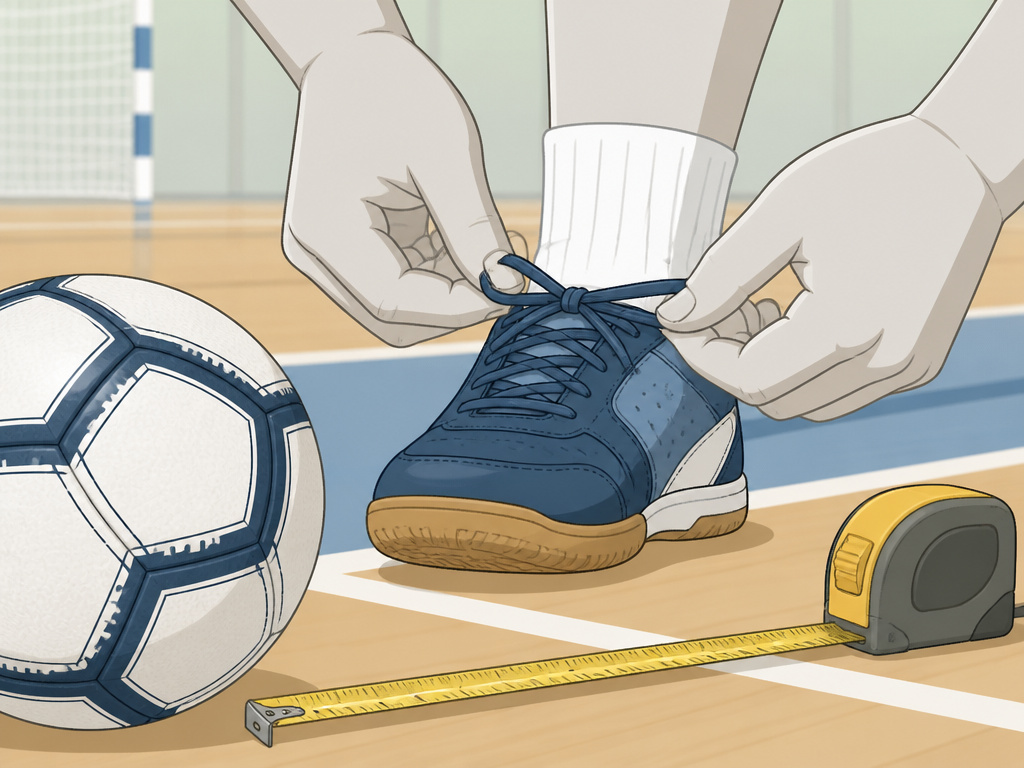
You don’t need much. You must have a futsal ball that meets the FIFA rebound spec. Brands like Select, Mitre, and Adidas make reliable, affordable models that meet the bounce spec. Wear flat-soled indoor court shoes, football boots with studs or cleats will damage the floor and are often banned. Shin guards are a smart precaution under long socks.
Finding a court is the main hurdle. A local school gym, community center, or indoor soccer facility are your best bets. Many have hourly rentals. If you’re playing recreationally, the FA suggests a minimum area of 25m x 15m, while FIFA sets an absolute minimum of 25m x 16m for any official match.
For a casual game, you can manage with one referee and a timekeeper who also counts fouls. The official law calls for two referees, a third referee, and a timekeeper, but that’s for formal competition. The key is having someone who knows the basic restart rules and can enforce the 4-second count.
Before you start, agree on the basics: half length, whether you’ll use the accumulated foul rule, and substitution procedure. A quick coin toss decides who kicks off.
Before you start: Proper indoor shoes with gum rubber soles prevent slips.
Common Beginner Mistakes and How to Avoid Them
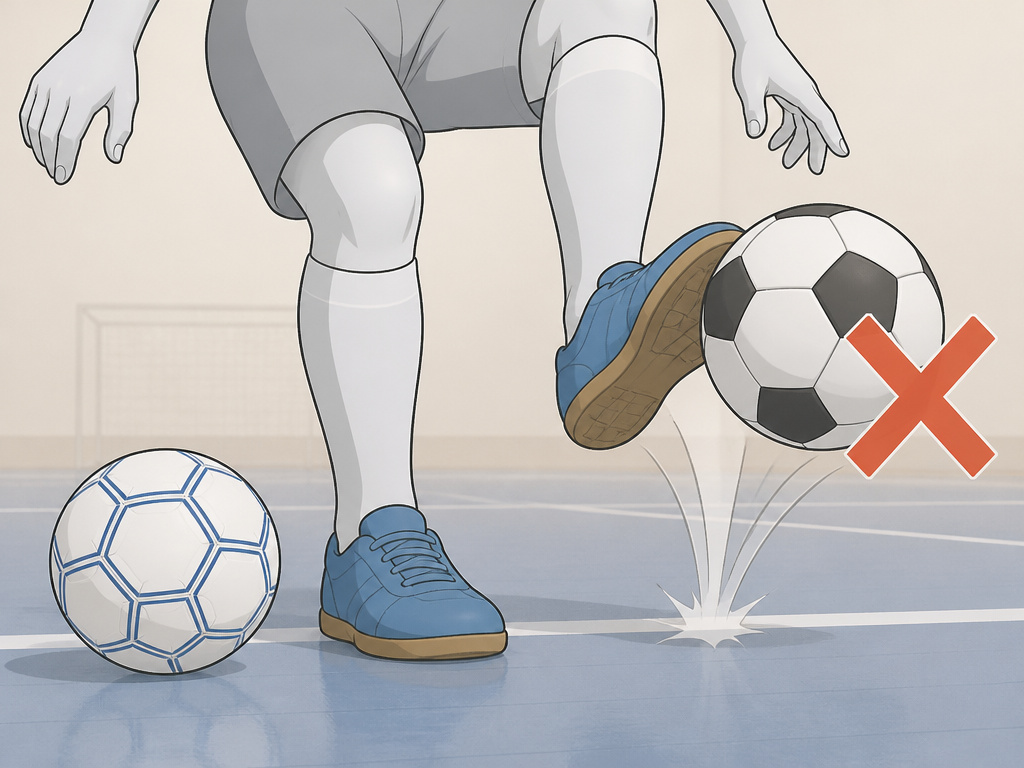
The learning curve is steep. The most frequent errors come from carrying over outdoor soccer habits. The first is using the wrong ball. A standard soccer ball’s high bounce makes controlled passing in a confined space nearly impossible. Invest in a dedicated futsal ball.
The second is static positioning. In soccer, you might have time to receive a pass, look up, and then decide. In futsal, you must know your next move before the ball arrives. If you stop moving, you kill an attacking option and become easy to mark.
Holding the ball too long is a turnover machine. Futsal defending is about quick, collective pressure. Dribble past one player, and another is already closing you down. Dribble only to beat a player and create a numerical advantage, not for its own sake.
For goalkeepers, the big adjustment is the 4-second rule and playing with their feet. You cannot just pick up a back-pass. You must be a competent fifth field player, comfortable receiving under pressure and making a pass to start an attack.
Finally, there’s the foul count. Beginners often don’t track it. A reckless challenge for a 50/50 ball in the midfield might seem harmless, but if it’s your team’s sixth foul, you’re handing the opposition a direct shot from 10 meters with no wall. Defend with your feet and your shape, not with desperate tackles.
Frequently Asked Questions
What are the five positions in futsal?
The traditional positions are the goalkeeper, the fixed defender (Fixo), the two wingers (Alas), and the pivot (the most advanced attacker). In practice, all outfield players must attack and defend. The wingers provide width, the pivot acts as a target, and the fixo is the defensive anchor and playmaker from the back.
Is futsal harder than soccer?
It’s different. Futsal is often considered more technically demanding because you have less time and space on the ball, requiring quicker decisions and better close control. The stopped clock also means it’s physically intense for the full duration. However, it lacks the endurance test of covering a full-sized pitch for 90 minutes. Many players find the differences from football make it a superb training tool.
Can a goalkeeper score in futsal?
Yes. A goalkeeper can score a goal with any part of their body except their hands or arms, provided they are not in their own penalty area when they play the ball. If they throw or kick the ball from their own area and it travels the length of the court into the opponent’s goal, it counts.
How do substitutions work?
Substitutions are unlimited and can happen at any time, without stopping play, hence “flying subs.” The player coming off must leave the court completely, usually via a designated substitution zone near the halfway line, before the replacement enters. Failure to follow this procedure results in a yellow card.
What is a “Power Play” in futsal?
Power Play is a tactical decision to replace the goalkeeper with an additional outfield player, usually when a team is losing and needs a goal. One of the outfield players is designated to have goalkeeper privileges (they can use their hands inside the penalty area). It’s a high-risk, high-reward strategy.
Before You Go
The best way to learn is to play. Grab a few friends, a low-bounce futsal ball, and find a local court. Don’t worry about mastering every futsal rule on day one. Focus on the big three: keep the ball on the floor, move to support your teammate, and release it quickly.
Start with a simple dynamic warm up to get used to the surface and wake up your touch. The game’s beauty is in its simplicity and its demand for intelligent play. It’s the purest test of technical skill and spatial awareness you’ll find. Now get out there and play.
