
Sell on Clauses in Football Explained
This post contains affiliate links. As an Amazon Associate, we earn from qualifying purchases.
A sell-on clause is a private contract term between two football clubs that entitles the original selling club to a percentage of a future transfer fee when the player is sold to a third club. The percentage can apply to the total fee (gross) or, more commonly, the profit (net) made by the middle club. This article explains sell-on clauses in football.
That two-component structure – a lower fixed fee now for a slice of an uncertain future – is the core of every deal, as in the sell on clauses in football explained. It’s a bet on a player’s potential, priced with incomplete information. The clause is the selling club’s honest admission that it can’t name tomorrow’s price today, so it settles for a share if that price arrives.
What follows is the mechanics, the real-world math, and the legal fine print that decides whether a multi-million pound promise pays out or evaporates. We’ll cover the difference a single word in the contract makes, the CAS cases that defined the rules, and what happens when a club everyone thinks got a windfall actually got nothing.
Key Takeaways
- A sell-on clause splits the transfer fee into a fixed amount paid upfront and a variable, future promise, protecting the seller if the player’s value skyrockets.
- The clause can be based on the total future fee (gross) or the profit made (net).
- The wording is critical: according to a CAS ruling (Sevilla FC v. RC Lens), a clause triggered by “resale” applies only to subsequent transfers “based on a contract,” while another CAS ruling (FC Zurich v. MFM FC) states a clause triggered by “transfer” is wide enough to cover every kind of transfer, both contractual and non-contractual.
- To be valid under FIFA rules, a variable sell-on clause (where the percentage changes based on the buying club) must pass the three-part “FC Zurich test”.
- The FIFA solidarity mechanism is separate, paying 5% of any international fee to a player’s training clubs – it’s automatic, not negotiated.
The 2-Component Structure: Fixed Fee + Variable Promise
The purpose isn’t to get rich later. It’s insurance.
The purpose of a sell-on clause is to “protect” a club transferring a player against an unexpected increase, after the transfer, in the market value of the player’s services. In transfer contracts, the parties divide the consideration into two components: a fixed amount, payable upon the transfer, and a variable, notional amount, payable to the old club in the event of a subsequent “sale”. — CAS Award, Sevilla FC v. RC Lens
A smaller club sells a promising teenager. It believes he could be worth £50 million in five years, but the big club buying him today will only pay £5 million for that risk. The sell-on clause bridges the gap. The seller accepts the lower £5 million now (the fixed component) in exchange for, say, 20% of any future profit (the variable component).
The buyer gets the player for a manageable fee. The seller gets a lottery ticket where the buyer controls the draw. If the player flops, the clause costs the buyer nothing. If he becomes a star, the seller shares in the success it helped create. It’s a compromise built on shared uncertainty.
Gross vs. Net: The Math That Decides the Payout
This is the single biggest point of confusion in reported transfers, which a proper explanation must clarify. When a news article says “Club X has a 20% sell-on clause”, the next question should always be: 20% of what?
- Gross Clause: The percentage applies to the entire future transfer fee. Simple, and rare.
- Net Clause (Profit Share): The percentage applies to the profit the middle club makes. This is the standard. The calculation is: (Sell Price – Original Purchase Price) x Percentage.
The difference is enormous. We will use a real example from the CAS files.
In the Sevilla v. Lens case, the clause stipulated 12% of the capital gain, defined as the difference between the fee received and the €5,000,000 Sevilla originally paid. That’s a net clause.
| Clause Type | Original Fee | Future Sale Price | Percentage | Payout to Seller |
|---|---|---|---|---|
| Gross | £5 million | £50 million | 20% | £10 million |
| Net (Profit) | £5 million | £50 million | 20% | £9 million (20% of £45m profit) |
A net clause only pays if the selling price exceeds the buying price. If the player is sold for the same amount or less, the original club gets nothing.
What Triggers the Clause? The One-Word Legal Battle

This isn’t academic. It’s a multi-million euro question that has gone to the Court of Arbitration for Sport, and the answer hinges on the specific word used in the contract.
Sources disagree, and CAS has ruled differently based on wording.
- If the clause is triggered by “resale”: The CAS panel in the Sevilla FC v. RC Lens case ruled this applies only to subsequent transfers “based on a contract”. It explicitly excludes statutory contract terminations, like a player buying out his contract under FIFA Article 17.
- If the clause is triggered by “transfer”: The CAS panel in the FC Zurich v. MFM FC case ruled this is “wide enough to cover every kind of transfer, both in a contractual and non-contractual framework, for which the new club is to receive a payment.” This could include a contract buyout.
The lesson for clubs and agents is brutal in its simplicity: read the exact wording. A “resale” clause might not pay if the player engineers a move via a buyout. A “transfer” clause likely will. That one word is the line between a windfall and a costly legal dispute.
Real-World Examples: From Windfalls to Whispered Figures
The theory is clean. The practice is messy, confidential, and often reported wrong.
Jude Bellingham’s Journey
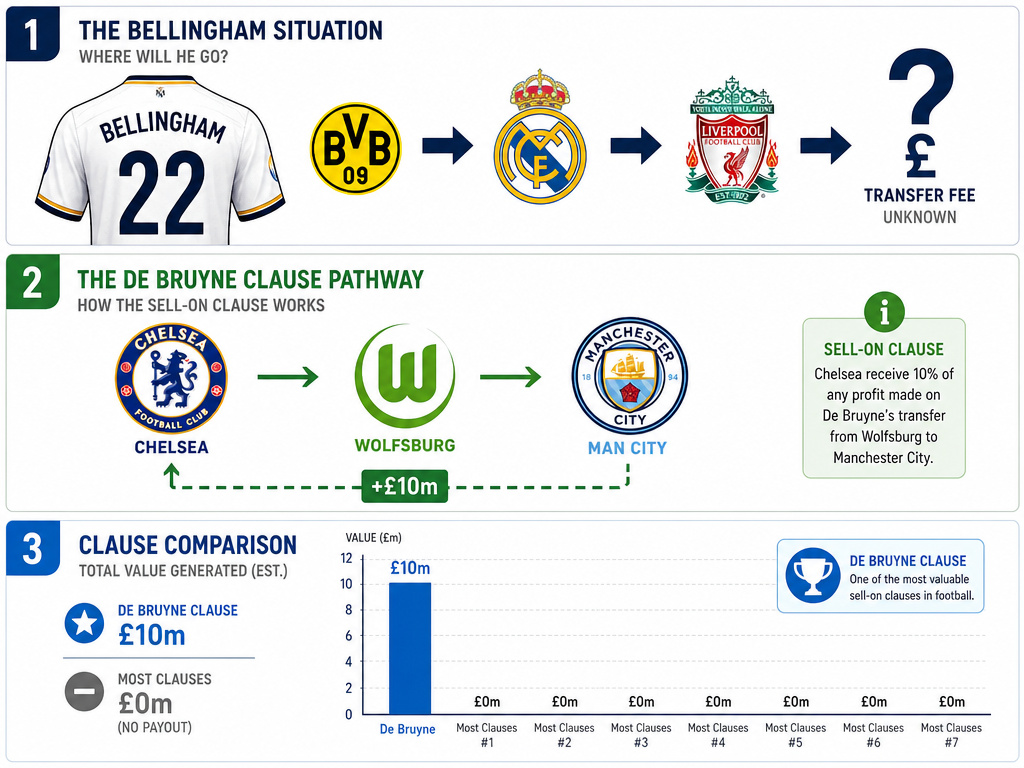
Birmingham City sold Jude Bellingham to Borussia Dortmund in 2020 for a fee reported around £25 million, with a sell-on clause attached. When Dortmund sold him to Real Madrid in 2023 for an initial €103 million, the clause triggered. Reported payments to Birmingham varied wildly in the media from £4 million to over £10 million. That spread tells you everything about the privacy of these terms and the guesswork in journalism.
Kevin De Bruyne’s Chelsea Bonus
A clearer anecdote: Chelsea sold Kevin De Bruyne to Wolfsburg for £18 million with a sell-on clause of about 25%. When Manchester City bought him for £55 million, Chelsea received an additional £10 million windfall. That’s a classic net clause in action – 25% of the £37 million profit.
The Quiet Reality for Most Clauses
For every De Bruyne, there are a hundred players whose clauses never pay. The middle club can run down the player’s contract, sell him on a free, or use him in a swap deal. In each case, the sell-on percentage evaporates. The clause is only as good as the middle club’s willingness to sell for a fee.
Variable Sell-On Clauses and the “FC Zurich Test”
What if the percentage changes based on who buys the player next? For instance, 15% if he goes to any club, but 25% if he’s sold to a domestic rival.
This is a variable sell-on clause, and it sits in a legal grey area. It’s not inherently illegal, but it draws scrutiny under EU competition law and FIFA’s rules against third-party influence.
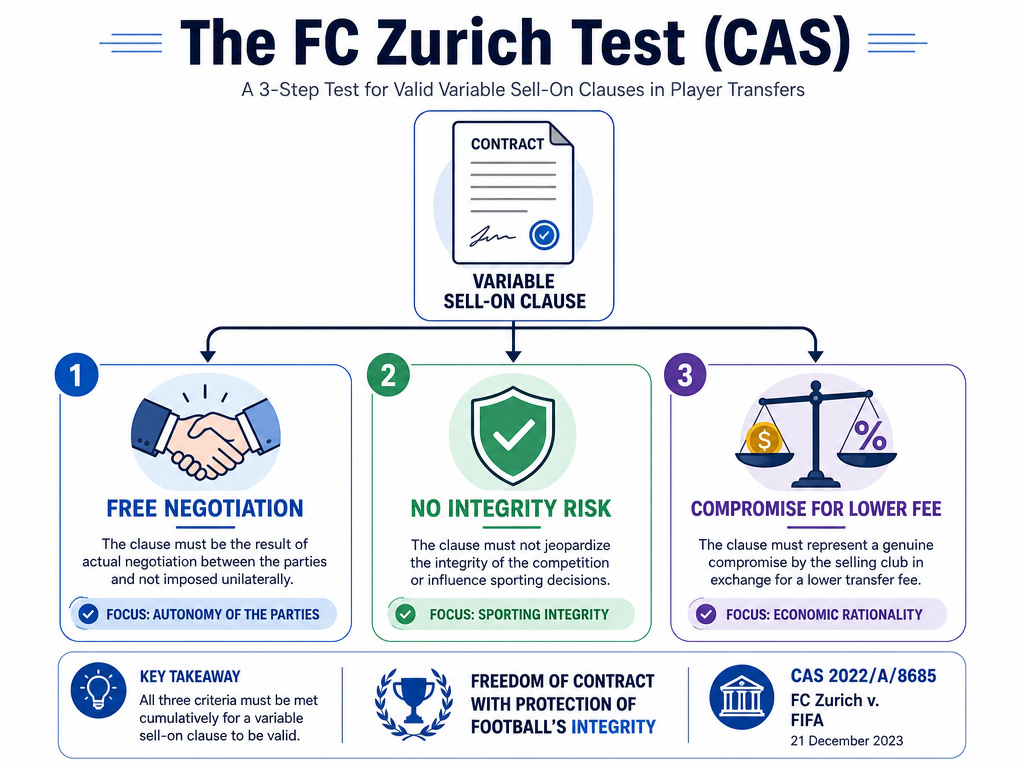
FIFA’s Regulations on the Status and Transfer of Players (RSTP), specifically Article 18bis, governs these agreements. In the FC Zurich v. MFM FC case, CAS established a three-part test for a variable clause’s validity:
- Free Negotiation: The clause must be the result of genuine, unforced bargaining.
- No Integrity Risk: It must not create a risk to the integrity of competition (e.g., discouraging a sale to a rival for sporting reasons).
- Compromise for Lower Fee: It must function as a compromise for the selling club accepting a lower initial transfer fee.
A clause that fails this test could be deemed unenforceable. This is elite-level contract law, but it matters because it shapes what clubs can legally ask for.
Drafting to Avoid Disputes: What’s In and What’s Out
A contract doesn’t just say what will happen; it says what won’t.
To avoid disputes, parties need to stipulate transactions excluded from the application of sell-on fees, such as loan, player exchange, free transfer, or contract termination.
Most disputes arise from ambiguity. If the contract is silent, does a loan-with-obligation-to-buy trigger the sell-on? What about a free transfer when the player’s contract expires?
Smart clubs and their lawyers now explicitly list the excluded transactions. A well-drafted clause might read: “This sell-on obligation shall not apply in the event of a temporary loan move, a permanent transfer for a nominal fee under €1 million, or a termination of the player’s contract pursuant to FIFA Article 17.”
It removes the argument before it starts. This is the unglamorous, essential work that turns a handshake deal on a percentage into a legally enforceable asset.
How Sell-On Clauses Fit Into the Bigger Picture
A sell-on clause doesn’t exist in a vacuum. It’s one tool in a box that includes buy-back clauses, release clauses, and complex loan deals. It’s fundamentally different from the FIFA solidarity mechanism, which automatically distributes 5% of any international transfer fee to the clubs that trained the player between ages 12 and 23. Solidarity is a tax; a sell-on is a negotiated bet.
When you’re evaluating a club’s player valuation model, the presence or absence of a sell-on clause tells a story. A deal packed with sell-ons and add-ons suggests the buyer refused to meet the seller’s full valuation upfront. A clean, massive fee with no strings attached – like a release clause being triggered – means the seller’s price was met in full, no deferred arguments needed.
The clause also interacts with a player’s own power. A star with six months left on his contract has immense power; he can wait, sign a pre-contract agreement elsewhere, and move for free, vaporizing any sell-on. This is why contract length is a key part of how football transfers work.
How do sell-on clauses affect a buying club’s transfer strategy?
Frequently Asked Questions
What does a 10% sell-on clause mean?
It means the original selling club is entitled to 10% of a defined amount from the player’s next transfer. The critical detail is whether that 10% applies to the total fee (gross) or just the profit (net) the middle club makes. Always ask “10% of what?”.
Can a sell-on clause last forever?
No, they almost always have a time limit or expire when the player’s contract with the buying club ends. A common structure is for the clause to be active for the duration of the player’s contract with the middle club, plus sometimes one additional transfer window. The specific term is a negotiated point.
Who pays the sell-on fee – the buying club or the selling club?
The buying club (the third club in the chain) pays the full transfer fee to the middle club. The middle club is then contractually obligated to forward the agreed percentage to the original selling club. The agent’s fee is a separate cost usually borne by the club hiring the agent.
Do players benefit from sell-on clauses?
Not directly. The clause is a private contract between two clubs. The player is not a party to it and does not receive a share. However, a strong sell-on clause can make a selling club more willing to accept a lower initial fee, which might allow the buying club to offer the player higher wages.
What’s the difference between a sell-on clause and a buy-back clause?
Sell-on clause gives the original club money if the player is sold to anyone. A buy-back clause gives the original club the right to repurchase the player at a pre-set price from the buying club. They are different tools for different strategies.
Before You Go
The next time you see a transfer headline, look past the fee. Look for the clause. Its presence is the story of a negotiation where two clubs saw different futures and decided to share the risk. Its absence is the story of a price so unanimously agreed upon that no insurance was needed.
For a smaller club, a well-negotiated sell-on clause isn’t just a bonus; it’s a vital part of a sustainable player valuation model. It turns a single sale into a potential revenue stream, funding the next generation. For a big club, it’s the cost of doing business on potential, a discount today for a potential bill tomorrow.
They are football’s most honest contracts. In a business built on hype and speculation, they are the written admission that nobody really knows what tomorrow’s price will be.
