
How to Get Scouted in Football: Step-by-Step Guide
This post contains affiliate links. As an Amazon Associate, we earn from qualifying purchases.
To get scouted in football, you need to be visible where scouts actually look: consistently performing in competitive matches, maintaining a verifiable online profile, and understanding that modern recruitment blends live observation with data analysis from platforms tracking over 400,000 young players. The process is talent-led but imperfect, and success often hinges on readiness when opportunity arises, not on paid shortcuts.
The gap between that simple answer and what actually happens on a muddy Saturday morning is where most hopeful players and parents get lost, often unsure of how to get scouted in football. They chase a single perfect game or a magical connection, while the system is built to evaluate consistency, attitude, and fit over time.
What follows is a breakdown of that system, the traditional grassroots routes, the new data platforms clubs rely on, the specific attributes that cut through the noise, and the honest steps that work when you don’t have a direct line to an academy.
Key Takeaways
- The majority of academy players are first spotted in competitive grassroots matches or at club-affiliated development centres, not at paid showcase events.
- Modern scouting is increasingly data-led; platforms like Eyeball are used by a majority of Premier League clubs to analyze over 2,000 data points per match and provide access to more than 400,000 young players globally.
- Scouts consistently rank attitude and coachability as critical factors, often valuing them as highly as pure technical skill.
- Getting scouted does not require an agent for initial discovery; an agent’s role becomes relevant later for contract negotiation once interest is established.
- For players outside traditional pathways, a current digital profile with genuine match footage is essential for visibility in the modern scouting process.
The Modern Scouting Landscape: It’s Not Just a Man in a Coat
The image of a solitary scout with a notepad is nostalgic, but incomplete. The race to find talent has transformed, and understanding this shift is the first step to being found.
Where this goes sideways: Relying solely on live scouting in your local area. Clubs now have digital nets cast across continents, and if you’re not in the water, you can’t be caught.
The change is visibility. A decade ago, a talented player in a remote region might only be seen if a scout physically travelled there. Now, as covered in a recent BBC Sport scouting feature, platforms like Eyeball film amateur and academy fixtures across 42 global markets, processing north of 2,000 data points every match. This data creates a searchable database of over 400,000 young players that more than 60% of top European clubs use.
This doesn’t replace the scout. It arms them. A recruitment team can now ask a system to “find players like X,” watch every progressive pass a prospect has made in the last season, and then send a live scout to a specific tournament to watch a shortlist of targets. As one technical director noted, the hidden gem kind of thing almost does not exist any more because clubs are aware of far more players, far earlier. However, other sources note that plenty of professional players were not identified until their mid-teens and that seventeen feels late but is not.
For you, this means two things. First, playing in leagues or tournaments that are filmed and fed into these systems matters. Second, your digital footprint, a highlight video, basic stats, isn’t just for college coaches anymore. It’s the first layer of a global screening process.
| Scouting Method | How It Works | Player Action Needed |
|---|---|---|
| Traditional Live Scouting | Scouts attend local grassroots, school, or representative matches. | Play consistently at the highest competitive level available in your region. |
| Development Centre Observation | Academy staff watch players attending club-linked development programmes over weeks. | Join a reputable development centre attached to a professional club. |
| Data-Led Recruitment | Platforms like Eyeball analyze filmed match data; clubs identify and track players remotely. | Ensure your team’s matches are filmed; maintain a basic online profile with accurate info. |
| Direct Applications / Open Trials | Some clubs or specific international programmes recruit via open applications or trials. | Research legitimate opportunities and apply with a complete player profile. |
The takeaway? You must be findable. This is the essential first step in the modern game.
What Do Football Scouts Actually Look For?
It’s easy to think scouts just want the kid who scores a hat-trick. They don’t. They’re looking for players who solve problems and fit a specific profile, often over the course of several weeks of observation.
A player who is large at Under-10 may be overtaken by peers who develop later. The focus shifts to technical foundation and football intelligence.
The evaluation is a matrix, not a checklist. Here’s how it breaks down.
Technical Quality: This is the baseline. Can you control the ball under pressure? Is your passing range and weight appropriate? But technical skill alone is just entry tax. Everyone at a certain level has it.
Tactical Intelligence (Football IQ): This is the separator. Do you understand your role within and between the lines? Scouts watch for players who make others better through their positioning and decision-making. A player who doesn’t score but wins headers, presses intelligently, and leads by example will have scouts asking questions at the final whistle.
Physical Attributes (with a caveat): Pace and strength catch the eye, but smart scouts are wary of the “early developer” who dominates through size alone. They look for athleticism that translates to the game: agility, balance, and sustainable endurance.
Attitude & Coachability: This is the silent deal-breaker. Scouts watch how you react to conceding a goal, a mistake, or a bad referee decision. A player who sulks or blames teammates is a red flag, regardless of talent. They want players who listen, apply feedback, and work relentlessly.
| Attribute | What Scouts See | The Red Flag |
|---|---|---|
| Technical Skill | First touch, passing accuracy, ball striking. | “Training ground” skill that disappears in competitive matches. |
| Football IQ | Spatial awareness, decision speed, understanding of triggers. | Being a passenger when your team is out of possession. |
| Physicality | Functional strength, pace over short bursts, recovery speed. | Relying solely on size or speed to compensate for poor technique. |
| Mentality | Response to adversity, leadership, consistency of effort. | Poor body language, arguing with officials/teammates, giving up. |
The players who get the second and third look are the ones whose attributes work together when a scout is evaluating the how to get scouted in football question. The technically clean midfielder who also covers ground and organizes. The quick winger who tracks back. The scout’s job is to project how these traits will develop, not just to record what they see today.
Practical Steps: How to Actually Get Seen
Knowing what scouts want is one thing. Putting yourself in their line of sight is another. This is where action replaces hope in the how to get scouted in football process.
1. Play at the Highest Visible Level
This is the most repeated advice because it’s the most important. Scouts go where the good players are. If you’re serious, you need to be in the most competitive league or team you can manage, even if it means less playing time initially. Dominating a weak Sunday league is invisible. Competing in a strong regional development league is where scouts actually show up.
2. Build and Maintain a Digital Profile
Social media alone won’t get you signed, but an absent or unprofessional profile will raise questions. A scout who hears your name will look you up.
- Highlight Video: If you don’t have one, make it this week. It doesn’t need Hollywood editing. It needs 3-4 minutes of clear footage showing your technical actions in real games. For guidance on creating a football highlights tape, focus on clarity over effects.
- Basic Stats: Keep a simple record of appearances, goals, assists. Update it.
- Professionalism: Your public social media should show you training, playing, and taking the game seriously. It’s a verification tool.
3. Understand the Pathways
There is no single dominant route into a football academy. Clubs use a combination, and your strategy should too.
- Grassroots Football: The most common initial discovery ground. Be consistently excellent here.
- Development Centres: Programmes attached to professional clubs are extended auditions. Academy staff observe sessions over time.
- Representative Football: Playing for county or school national teams dramatically increases visibility.
- Open Trials: The success rate can be low, but for players outside other pathways, they are a direct shot. Research them thoroughly to avoid scams.
4. The Role of an Agent (And When You Need One)
The point is clear: You do not need an agent to get scouted. This is a crucial distinction many miss. An agent can be invaluable later, negotiating a contract, managing offers, providing career advice, but the initial discovery is almost always down to your performances and visibility.
At younger age groups (below 16), formal agents play almost no role in academy recruitment. Clubs scout independently. Worry about finding a football agent after the interest is real, not before.
For Players Outside the Traditional System
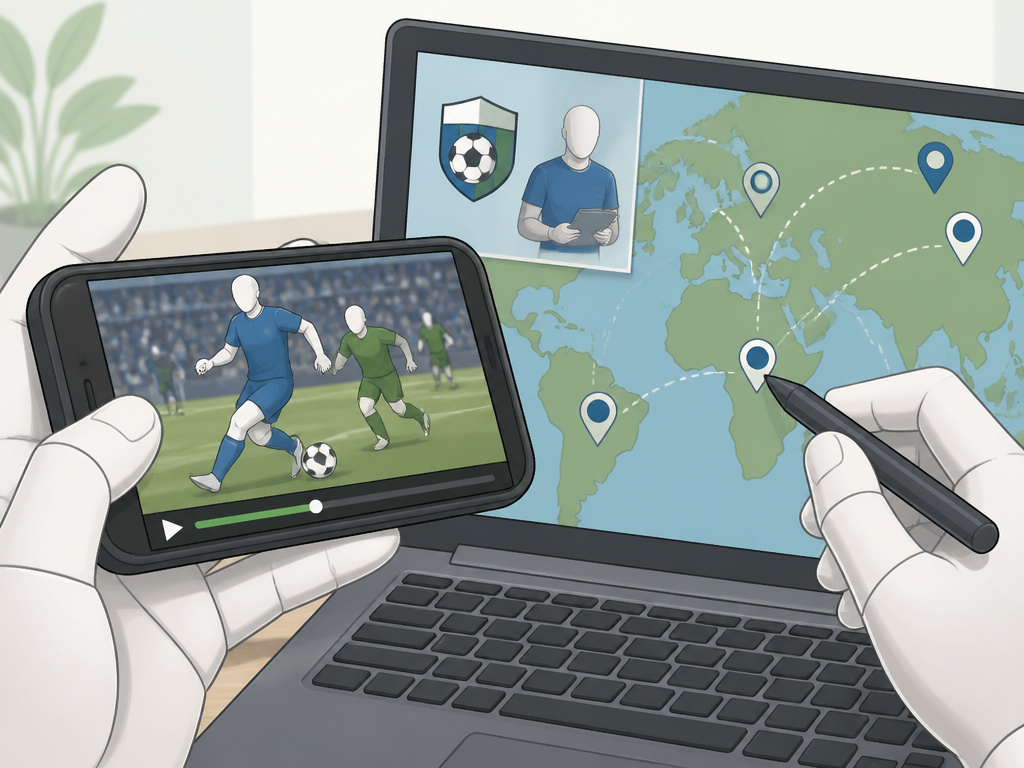
What if you’re not in an academy catchment area? What if you’re older? The door isn’t closed; you just need a different key.
The “Late Bloomer” Reality
Seventeen feels late, but it isn’t. Plenty of professional players were not identified until their mid-teens. Many more are discovered between 18 and 23 through semi-professional leagues, university football, or strong senior-level performances. The pool is different, but scouts are still looking.
Leveraging Technology and Direct Applications
This is where the modern landscape helps. If you can’t be seen live regularly, your digital profile must be impeccable. Also, some clubs and specific international programmes operate on direct applications.
Anecdotal example: For one club’s European tryout tour, 50 players applied directly through an app and two were selected for a fully covered trial. No agent, no prior connection.
The Geographic Hurdle
If you’re in a remote or under-scouted region, research which platforms or tournaments feed into the scouting networks mentioned earlier. Sometimes, the play is to get footage to a platform like Delphlyx (which focuses on African talent) or to a specific club known for sourcing from your region.
The mindset shift is critical: You must become your own advocate. The process is not passive.
What Happens After a Scout Notices You?
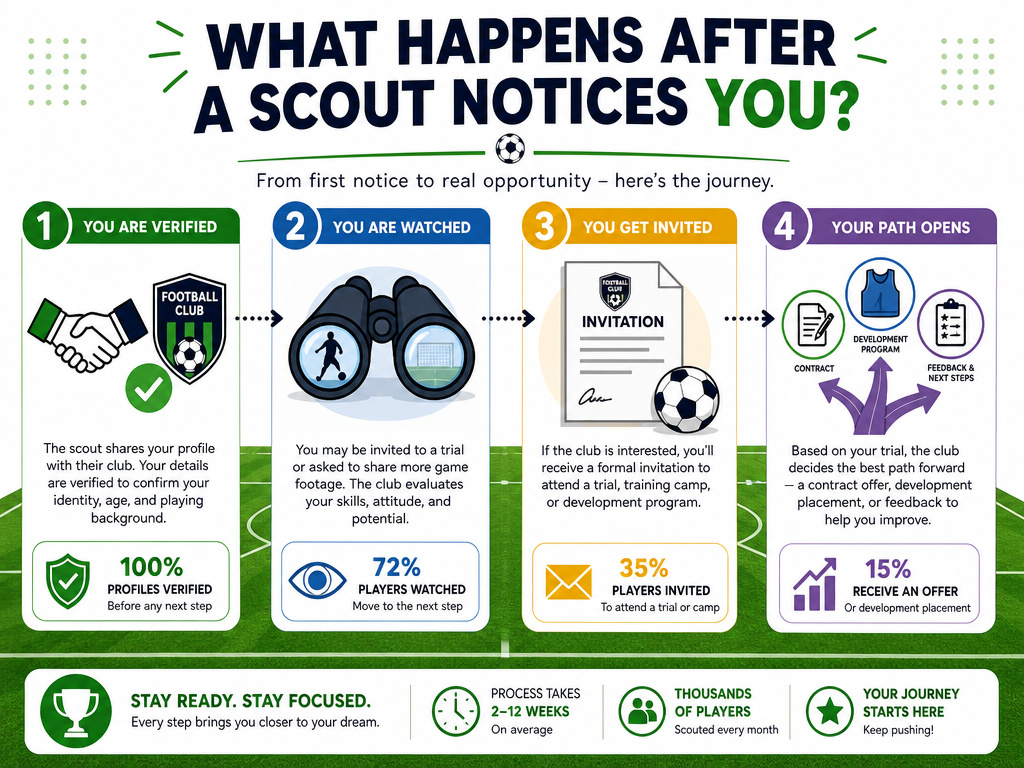
The scout speaks to you or your parents after a game. What next? This is where excitement meets process.
1. Initial Contact & Verification
A legitimate scout will identify themselves and their club. Always verify. You can check with the club directly or refer to The FA’s safeguarding guidance. They should not be asking for money.
2. The Assessment Phase
Scouting is a process, not an event. The initial notice usually leads to further observation. The scout will likely watch you again, perhaps in different conditions, against stronger opposition, when your team is losing. They’re testing for consistency.
3. The Invitation: Trial or Development Centre
If interest solidifies, the next step is typically an invitation. This could be:
- A short observation training session with an academy age group.
- A longer trial period, often lasting 6 weeks.
- An offer to join the club’s development centre for extended assessment.
This is where understanding how football trials work is vital. Go in prepared to work hard, be coachable, and fit in socially with the group.
4. The Outcome
After the trial, the club will decide. The options are: an academy registration offer, an invitation to continue in the development centre, or a release with feedback. The odds are stark, remember, a club such as Cruzeiro was cited as rejecting 4,000 players under 15 for every one they took in, but a clear process means you can plan your next move regardless.
How to Get Scouted at Different Ages

At younger ages, scouts are generally cautious about making too much of physical attributes. The focus is on technical ability and, frequently, attitude as a major factor.
What Scouts Look For in Each Position
Your job is to be impossible to ignore in the specific tasks of your role, demonstrating the technical and mental attributes that define excellence in your position during competitive matches.
Networking and Building Relationships with Coaches
Getting scouted is not a passive process, but professional clubs recruit through a combination of scouting, development centres, trials, referrals, and representative football. No single channel is dominant. The majority of players who enter academy football are first identified through grassroots matches, where a strong relationship with your coach can lead to a referral or recommendation for higher-level games. At the younger age groups, formal agents play almost no role in academy recruitment. Focus on performing consistently for your coach and team, as this creates the most credible pathway for your name to be passed along within the football community.
Frequently Asked Questions
What is the best age to get scouted for football?
There is no single “best” age. Initial academy recruitment can start as young as 6-8 for development centres, but most formal identification happens between 9 and 14. Crucially, many professional players are discovered in their mid-to-late teens. The pathway remains open much longer than many believe.
Do you need to pay for scouting services to get noticed?
No. Paid scouting exposure services rarely offer a meaningful advantage over simply playing well in the right, visible environments. Clubs scout talent, not paid showcases. Focus your resources on quality coaching and competitive football.
How can I tell if a scout is watching my game?
You often can’t, and that’s the point. Scouts aim to be discreet to see authentic performances. Don’t waste energy trying to spot them; assume someone could be watching every time you play. Consistency is your only strategy.
Is it harder to get scouted as a goalkeeper?
The process is the same, but the evaluation criteria are position-specific. Scouts will look for handling, distribution, command of the area, and communication. Your highlight video and stats should reflect these goalkeeping metrics, not outfield play.
What if I get released from an academy?
Release is a common part of the professional pathway, not the end of it. Use the feedback, return to a strong grassroots or semi-pro club, and continue developing. Many current professionals were academy releases who persevered.
Before You Go
The most important thing to understand is that getting scouted is not a lottery ticket. It’s the outcome of a long series of controllable actions: choosing the right competitive environment, performing with consistency, presenting a professional profile, and demonstrating a coachable attitude.
The system is designed to find players who are already doing the work, not to create them. It rewards those who treat every session, every game, and every interaction as part of the audition. The romantic idea of the undiscovered talent is fading not because opportunities are gone, but because the net is now so wide that true obscurity is a choice.
So start with what you can control. Get into the best team you can. Put together that highlight reel. Play like someone is always watching. Because in the modern game, they might be, whether it’s a person on the sideline or a algorithm scanning a database from another continent. Your job is to be ready, and findable, when they look.
