
How the PFA Player of the Year Is Chosen?
This post contains affiliate links. As an Amazon Associate, we earn from qualifying purchases.
*The PFA Player of the Year is chosen by a direct, secret ballot of the members of the Professional Footballers’ Association.* Voting is conducted each spring at all 92 English Football League and 10 Women’s Super League clubs. Players cannot vote for a teammate, and an independent company counts the votes to determine the winner from a shortlist of six nominees.
The award’s prestige hinges on that single rule: your peers decide. It’s not a panel of journalists or a fan vote. The result comes from the dressing rooms and training grounds, which means the winner has earned respect from the very people who understand the game’s hardest challenges. This is how the PFA Player of the Year is chosen.
What follows is a walk through the ballot box, explaining how the PFA Player of the Year is chosen. We’ll look at who gets a vote, how the form is structured, the quirky human realities of player voting, and what the award’s history tells us about what players truly value in a teammate and a rival.
Key Takeaways
- The electorate is every PFA member, thousands of active professional footballers across England’s men’s and women’s leagues.
- The physical ballot form is divided into three sections: Player of the Year, Young Player of the Year (for players 23 or under), and the divisional Team of the Year.
- A player cannot vote for a teammate, and votes are counted by an independent company to ensure fairness.
- Despite the formal process, players admit to informal biases like voting for friends or holding grudges, which can skew results.
- With 45 different winners in 53 editions, the award’s history shows players consistently reward sustained excellence and attacking flair over a single season.
Who Votes and How the Ballot Works?
The voting pool is the entire membership of the Professional Footballers’ Association, the trade union for players in England and Wales. Each spring, PFA representatives visit all 92 English Football League clubs and 10 Women’s Super League clubs to distribute ballot forms or provide access to an online portal.
The process of how the PFA Player of the Year is chosen is designed for maximum reach and simplicity. The goal is to get a verdict from the workforce itself.
The physical ballot form is divided into three sections: Section A for Player of the Year, Section B for Young Player of the Year, and Section C for Team of the Year. This structure, confirmed in reporting by Goal.com, ensures votes are cast for each category clearly.
The online form, introduced more recently, offers language options in English, French, or Spanish to accommodate the league’s international makeup. It asks for your pick for Player of the Year, Young Player of the Year (for players aged 23 or under at the season’s start), and your divisional Team of the Year.
Two critical rules govern every vote:
- A player cannot vote for a teammate.
- A player cannot win the award if his club has not taken part in the voting process.
Once submitted, the forms are sealed. An independent company is contracted to count and verify all votes, adding a layer of external scrutiny to what is otherwise a closed, internal election.
The Human Quirks of Peer Voting
The system is clean on paper. In practice, it’s filled with all the biases, friendships, and occasional apathy you’d expect when asking a large group of people for their opinion. A fascinating 2021 report in The Athletic pulled back the curtain.
Where this goes sideways: Players voting for mates over merit. One Premier League player quoted in the article put it bluntly: “If I couldn’t pick a left-back, I would pick my mate who plays for another team at left-back, that’s what players do.”
The piece details how reminders are sent out on team WhatsApp groups as the deadline nears, and former Chelsea PFA delegate Graeme Le Saux compared chasing votes to “being a schoolteacher chasing kids for their homework.” Some players see it as a “ballache,” especially picking the full Team of the Year.
Then there are grudges. A player who made you look bad in a match, or who plays for a bitter rival, might not get your vote regardless of their stats. It’s a conscious bias that former pros like Le Saux acknowledge happens. This informal layer is why the award, while deeply respected, isn’t a purely analytical exercise. It’s a snapshot of a player’s reputation among his peers at a moment in time.
Award Eligibility and the Path to the Shortlist

Any professional footballer playing in the English league system is eligible, regardless of nationality. The archived England Football Online honors page states the award goes to “the player deemed to have turned in the season’s best overall performance in English league play.”
The path to the official six-player shortlist is less transparent than the final vote. The PFA does not publicize how the initial nominee list is compiled. It’s likely a combination of player performance data, consultations with the PFA’s own committee, and perhaps input from club captains or delegates. The shortlist is then announced to the membership, who vote from that group.
This differs from a purely open vote where you could write in any name. The shortlist system focuses attention on a handful of standout performers, which arguably creates a more meaningful contest. It also prevents the vote from being splintered across dozens of candidates.
| Aspect | Rule / Requirement | Why It Matters |
|---|---|---|
| Voter Pool | All PFA members at 92 EFL + 10 WSL clubs. | Creates a massive, representative electorate of insiders. |
| Voting Method | Secret ballot (physical or online). | Protects voter anonymity, encourages honest picks. |
| Key Restriction | Cannot vote for a teammate. | Prevents club-level bloc voting, forces look across the league. |
| Shortlist | Six nominees announced before voting. | Focuses the contest, highlights the season’s top performers. |
| Verification | Counted by an independent company. | Adds audit trail and legitimacy to the final result. |
A Brief History of the Award and What Winners Tell Us
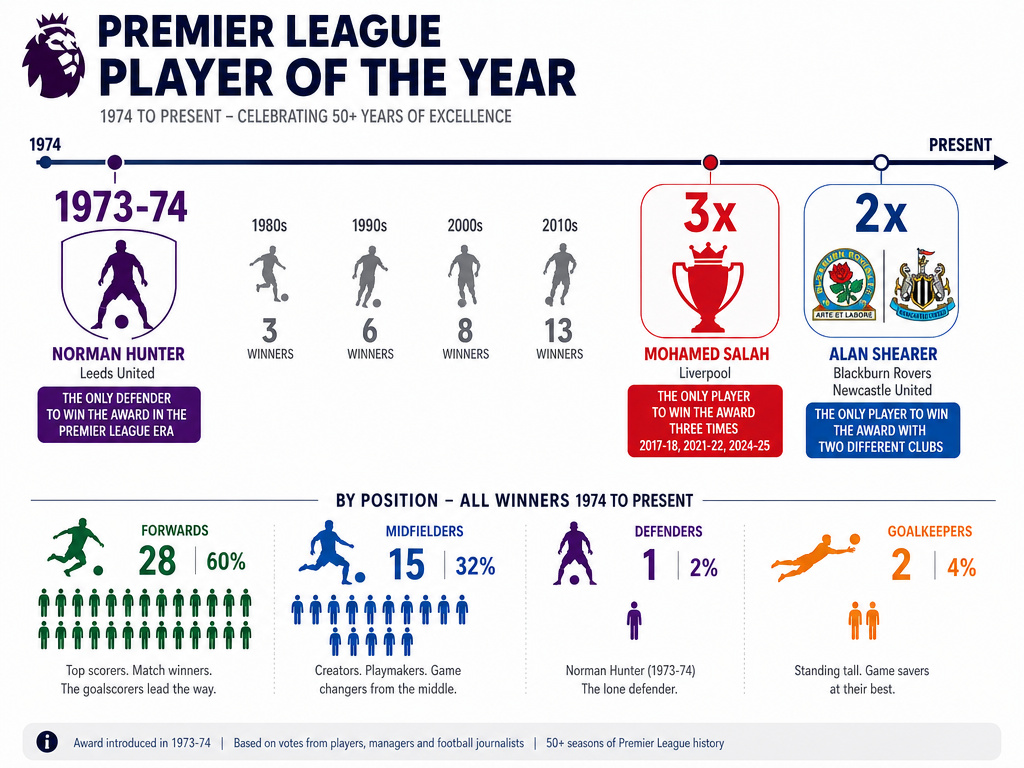
The first PFA Players’ Player of the Year award was handed out for the 1973–74 season, and the first winner was Leeds United’s tough-tackling defender Norman Hunter.
That history is a story told by players, for players. And the story they tell often prioritizes two things: sustained dominance and attacking play that changes the game.
Thierry Henry, Cristiano Ronaldo, and Kevin De Bruyne are the only players to have won the award in consecutive seasons. That’s the ultimate peer-respect, doing it once is great, but backing it up immediately forces everyone to take notice.
The record holder is Mohamed Salah, who stands alone as the only three-time winner (2018, 2022, 2025). His achievement breaks him out of a group of two-time winners that includes legends like Henry and Ronaldo. Only Alan Shearer won his two awards while playing for different clubs (Blackburn Rovers and Newcastle United).
The list also reveals certain biases. Only three non-European players have ever won: Luis Suárez (Uruguay), Riyad Mahrez (Algeria), and Mohamed Salah (Egypt). Goalkeepers and defenders are rare winners, with the honor overwhelmingly going to midfielders and forwards who directly influence the scoreline. Players, it seems, are as wowed by goals and assists as the rest of us.
How It Compares to Other Major Football Awards

The PFA award exists in a crowded field of individual honors. The Ballon d’Or considers a calendar year of global performance, including international tournaments. The PFA award is strictly for performance in English football over a season. One is a global media consensus; the other is a domestic industry peer review.
Then there’s the Football Writers’ Association (FWA) Footballer of the Year, also an English award. It’s voted on by journalists, not players. The FWA award often, but not always, goes to the same winner as the PFA award. When they diverge, it’s a fascinating clash between the media narrative and the dressing-room view.
FIFA’s Best award is another global contest, with a complex electorate of national team captains, coaches, journalists, and fans. Its process is more bureaucratic and far less insulated than the PFA’s simple player vote.
The PFA award’s unique power is its purity of source. There’s no clearer signal of respect than being chosen by the people you compete against every week. It’s why the trophy carries a different weight. A journalist can be impressed by a highlight reel. A fan can be swayed by passion. But a fellow professional knows the difference between a flashy season and genuine, sustained quality that makes their job a nightmare.
The Women’s PFA Player of the Year Award
The women’s game has its own parallel award, the PFA Women’s Players’ Player of the Year, first presented in 2013. As of 2026, there have been nine different winners.
The voting process mirrors the men’s award, with ballots distributed to players at the 10 Women’s Super League clubs. The same rules apply, no voting for teammates, independent verification, and it carries the same prestige within the women’s game.
The existence of a separate but equal award is significant. It recognizes the women’s game as its own distinct professional sphere with its own stars and narratives, rather than an adjunct to the men’s competition. Winners of the women’s award have seen their status skyrocket after earning this peer endorsement.
When does voting happen for the PFA Player of the Year?
The voting process takes place each spring as the season reaches its climax. PFA representatives visit all professional clubs to distribute ballots. The exact timing can vary, but the ceremony where the winner is announced typically follows in the weeks after the season concludes. For instance, a past ceremony was held in London on April 22, while the 2025 award was announced on August 19 at the Manchester Opera House. This schedule allows players to judge performances across nearly the entire campaign before casting their votes, with the winner revealed at a dedicated awards event.
Frequently Asked Questions
Can a player win both the PFA Player of the Year and Young Player of the Year?
Yes. Although there is a separate Young Player award for those 23 and under, a eligible player can win both in the same season. This has happened in the past, with examples including Andy Gray, Cristiano Ronaldo, and Gareth Bale.
Who has won the PFA Player of the Year the most times?
Mohamed Salah holds the record with three wins (2018, 2022, 2025). Several players have won it twice, including Thierry Henry, Cristiano Ronaldo, and Kevin De Bruyne.
Do players vote for the Team of the Year as well?
Yes. Section C of the ballot is for the divisional Team of the Year. The instructions specify it “should only be comprised of players from your own division.” This is why a player can be shortlisted for the main award but miss out on the Team of the Year if votes in their position are split within their own division.
How is the PFA award different from the Golden Boot?
They measure completely different things. The Golden Boot is a purely objective award for the top scorer in a league across Europe. The PFA Player of the Year is a subjective, peer-voted award for overall performance. A player can win the Golden Boot without being nominated for the PFA award, and vice-versa.
Has a defender ever won the PFA Player of the Year?
Yes, but it’s rare. The first winner, Norman Hunter (1974), was a defender. Other defensive winners include Liverpool’s Virgil van Dijk (2019) and Chelsea’s John Terry (2005). However, the vast majority of winners are attacking midfielders or forwards, reflecting the player evaluation criteria that often prioritize goals and creative output.
The Bottom Line
The PFA Player of the Year award works because its logic is beautifully simple. Ask the people who know best. The process, with its specific rules and independent count, is robust enough to be taken seriously, while the human elements, the friendships, the grudges, the last-minute WhatsApp reminders, keep it grounded in the reality of the dressing room.
For a player, winning it means you’ve earned the nod from the very people you train with and battle against. That’s a verdict that resonates louder than any headline or pundit’s praise. It’s the ultimate compliment from within the factory walls. And that’s why, more than fifty years after Norman Hunter first held the trophy, it still matters exactly who holds it next.
