
How the Golden Boot Award Works: Key Rules and Systems
This post contains affiliate links. As an Amazon Associate, we earn from qualifying purchases.
The Golden Boot award works by identifying the top goalscorer in a given competition, but the specific rules depend on the tournament. The FIFA World Cup uses a tie-breaker of most assists, then fewest minutes played, while the Premier League shares the award for joint top scorers, and the European Golden Shoe uses fewest minutes played, then most assists. The Premier League simply shares the award for joint top scorers. The European Golden Shoe uses a weighted points system based on league strength, with its own tie-break rules. A player’s goals are the primary factor, but the path to winning the trophy changes completely based on which award you’re chasing.
That “which award you’re chasing” part is where most explanations stop. They tell you it’s for the top scorer, list a few past winners, and call it a day. But the real story is in the mechanics, the small print that decides whether a player lifts a golden boot alone or shares it. This is essentially how the Golden Boot award works.
What follows is a breakdown of the three main Golden Boot awards, the exact tie-breakers that have decided them, and the surprising history behind how the Golden Boot award works. By the end, you’ll know why a player can score fewer goals than a rival and still win, and what the trophy is actually made of.
Key Takeaways
- The FIFA World Cup Golden Boot uses assists, then minutes played, as tie-breakers, goals in penalty shootouts do not count.
- The Premier League Golden Boot is the only major award that is automatically shared if players finish level on goals.
- The European Golden Shoe uses a weighted points system (goals x league coefficient), and since 2019, ties are broken by fewest minutes played, then assists.
- No player has ever won the FIFA World Cup Golden Boot more than once, making it one of football’s rarest feats.
FIFA World Cup Golden Boot: The Tie-Break Sequence
The World Cup’s top scorer prize is the most famous, and its rules are the most surgical. It’s not just about tallying goals at the end of the tournament. FIFA’s process has specific clauses that have decided winners and created shared awards.
The primary rule is straightforward: the player with the most goals wins the adidas Golden Boot. But the moment two players are level, a precise sequence kicks in.
The adidas Golden Boot is awarded to the player who scores the most goals in the final competition. If two or more players score the same number of goals, the number of assists (as determined by the members of the FIFA Technical Study Group) shall be decisive.. FIFA
The first tie-breaker is most assists. This was added after the 1994 tournament, where Oleg Salenko and Hristo Stoichkov both finished with 6 goals and 1 assist, forcing a shared award. The rule was meant to prevent that, but it needed a backup.
The second tie-breaker is fewest minutes played. If players are tied on goals and assists, the award goes to the more efficient scorer, the one who needed less time on the pitch to rack up their tally.
Here’s how that sequence looks in practice:
| Tie-Breaker Step | Criteria | Example (2010 World Cup) |
|---|---|---|
| 1. Goals | Most goals scored. | Thomas Müller, David Villa, Wesley Sneijder, Diego Forlán all had 5 goals. |
| 2. Assists | Most assists (as defined by FIFA’s Technical Study Group). | Müller had 3 assists. The others had 1 each. |
| 3. Minutes Played | Fewest minutes played (only used if still tied on assists). | Not needed—Müller won based on assists. |
Where this goes sideways: Goals scored during penalty shootouts after extra time do not count toward a player’s Golden Boot total. Only goals from regulation and extra time matter. This is a crucial edge case that keeps the award focused on open play.
The evidence for these tie-breakers isn’t theoretical. Look at the 2010 result: Thomas Müller won because of his three assists. Without that rule, the award would have been split four ways.
Premier League Golden Boot: The Simple Share
The Premier League’s approach is the most straightforward and, in a way, the most gracious. It’s also the only one of the three major awards that hasn’t adopted a complex tie-breaking system.
The rule is stated clearly by the league itself: at the season’s end, the Golden Boot is presented to the player (or players) who scored the most goals. If two or more finish level, the accolade is shared, with a trophy for each.
In the event of joint top scorers, the accolade is shared, with awards for each player.. Premier League
This has happened multiple times. The award has been shared by two players as recently as 2018-19 (Mohamed Salah, Sadio Mané, and Pierre-Emerick Aubameyang each with 22 goals). It reflects a philosophical difference, this is a seasonal award for a domestic league, not a knockout tournament where a single winner feels more necessary.
There’s no weighting, no minutes-played clause. It’s a pure numbers game, and if the numbers match, you share the glory.
The part nobody mentions: This simplicity can feel unsatisfying if you believe one scorer had a harder run of fixtures or played fewer minutes. But that’s the point, the Premier League chooses clarity over subjective efficiency metrics.
European Golden Shoe: The Weighted Points System
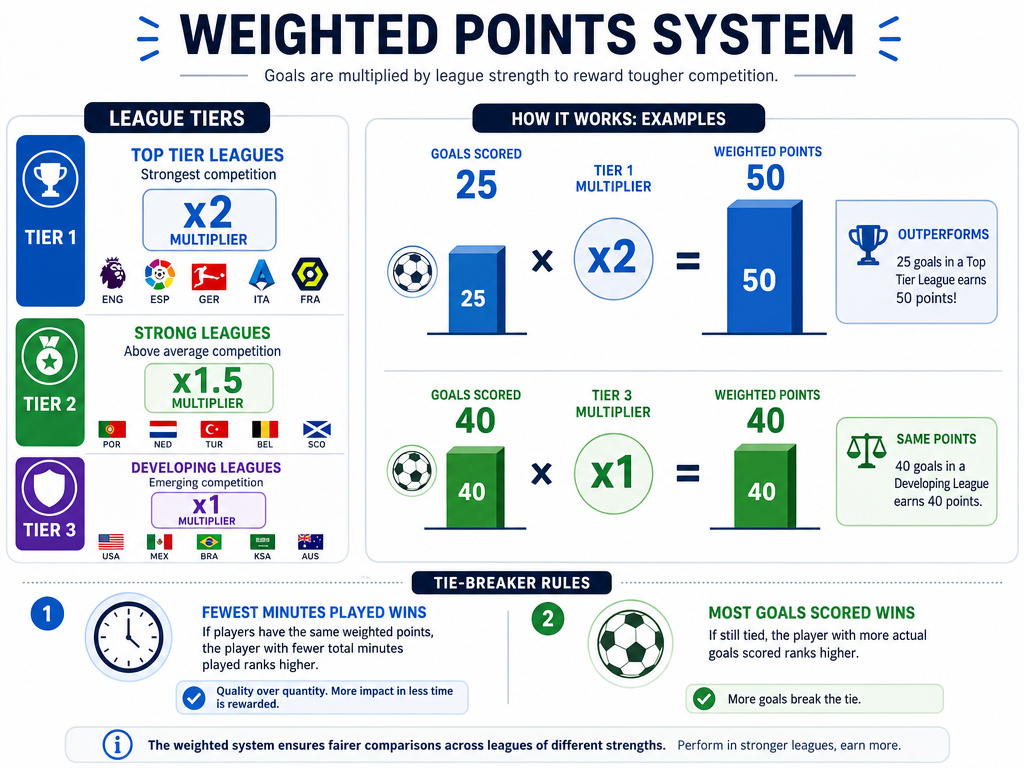
This is where things get mathematical. The European Golden Shoe (or Boot) isn’t just about who scores the most goals in Europe. It’s about who scores the most valuable goals, according to a league ranking system run by European Sports Media (ESM).
The system was introduced for the 1996-97 season to address a protest. Before that, the award went to the outright top scorer anywhere in Europe, which once led to a dispute when a player from Cyprus scored 40 goals. How do you compare 40 goals in the Cypriot league to 30 in the Spanish top flight? ESM’s answer was a multiplier.
Goals are assigned points based on the UEFA coefficient ranking of the league they’re scored in: * Goals in Top 5 Leagues (e.g., Premier League, La Liga): x2 points * Goals in Leagues Ranked 6 to 22 (or a similar range, e.g., Portuguese Primeira Liga): x1.5 points * Goals in Leagues Ranked below this range: x1 point
A player’s final tally is their goal count multiplied by the coefficient. This is why a player in a lower-ranked league can score more goals but still finish with fewer points than a player in a top league.
Since the 1996–97 season, European Sports Media have awarded the Golden Shoe based on a points system that allows players in tougher leagues to win even if they score fewer goals than a player in a weaker league.
The tie-break rules changed recently. Now, ESM uses a sequence starting with fewest minutes played, followed by tie-breakers such as most assists and fewest penalties scored.
If a tie persists after all that, the award would be shared. This shift explicitly rewards efficiency, mirroring the World Cup’s logic but putting minutes played first.
Comparing the Major Golden Boots
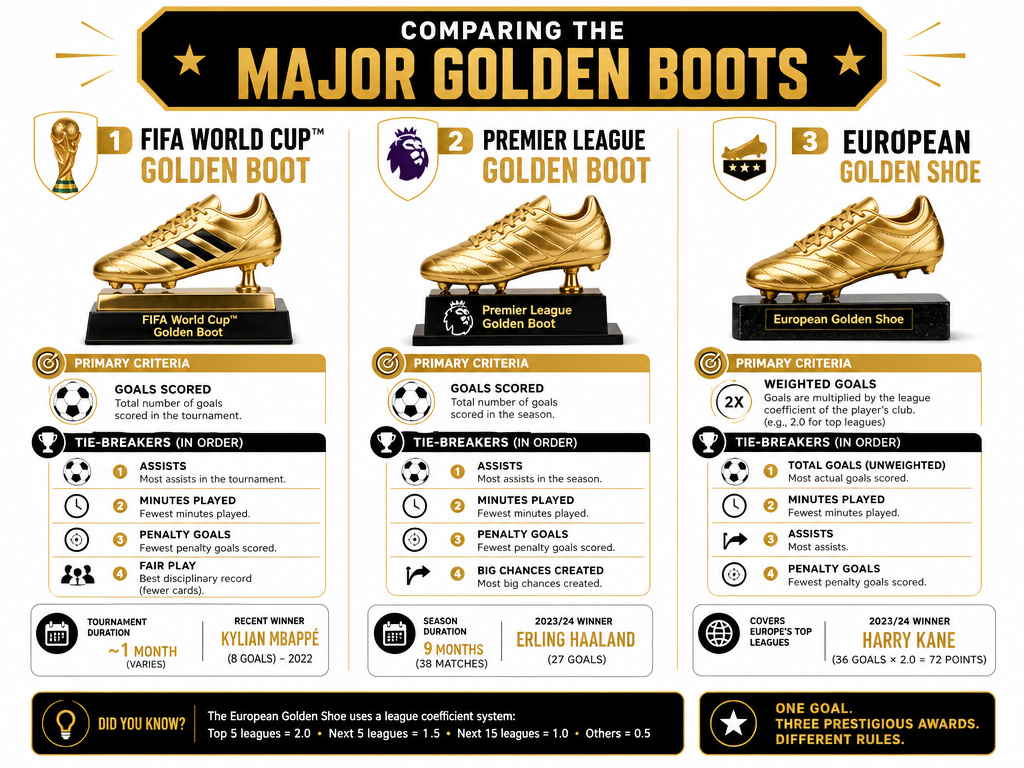
The three systems serve different purposes, which is the core of how the Golden Boot award works. A quick side-by-side shows how the same achievement, finishing as a joint top scorer, can have three different outcomes.
| Award | Primary Criteria | Tie-Breaker(s) | Shared Award? |
|---|---|---|---|
| FIFA World Cup | Most goals in the tournament. | 1. Most assists 2. Fewest minutes played |
Only if still tied after all tie-breakers. |
| Premier League | Most goals in the season. | None. Award is automatically shared. | Yes, frequently (e.g., 2018-19). |
| European Golden Shoe | Most points (goals x league coefficient). | 1. Fewest minutes played 2. Most assists 3. Fewest penalties scored |
Only if a tie persists after all tie-breakers. |
This table makes the philosophical differences clear. The World Cup needs a solitary winner for its narrative. The Premier League celebrates collective achievement. The European Shoe tries to balance league difficulty with individual efficiency.
Notable Records and One-Off Facts
The history of the Golden Boot is full of numbers that tell a story beyond the rules.
- Most European Golden Shoes: Lionel Messi has won it six times, a record.
- Most Premier League Golden Boots: Mohamed Salah and Thierry Henry share the record with four wins each.
- The Unrepeatable World Cup Feat: No player has ever won the FIFA World Cup Golden Boot more than once. It’s the rarest of the major scoring awards to win multiple times, highlighting the unique pressure and variance of a month-long tournament.
- Highest World Cup Tally: Just Fontaine scored 13 goals for France in the 1958 World Cup, a record for a single tournament that still stands.
- The Great Shared Award: In the 1962 World Cup, the top scorer prize (a precursor to the Golden Boot) was shared by six players who all scored four goals.
These records show context. Messi’s dominance in a league season is a testament to sustained excellence. No player has won the FIFA World Cup Golden Boot more than once.
The Trophy Itself: Is It Real Gold?
You see the winner lift it, a shimmering football boot on a base. What is it actually made of? The short answer is no, it’s not a solid gold boot.
This base metal is then electroplated with gold to give it its distinctive, prized appearance. It’s a common method for sports trophies, making them visually impressive and valuable without the exorbitant cost of solid gold.
So while it’s not “real gold” in the purest sense, its value is symbolic. It represents a tangible piece of history for the player who earned it.
Other Awards Often Confused With the Golden Boot
The Golden Boot exists in an ecosystem of individual awards. It’s easy to mix them up.
- Golden Ball: Awarded to the best overall player of the tournament (World Cup) or competition. This is a judgment-based award for performance, not just goalscoring. Lionel Messi won the 2022 World Cup Golden Ball, while Kylian Mbappé won the Golden Boot.
- Golden Glove: Awarded to the best goalkeeper of the tournament.
- Ballon d’Or: The most famous individual award in football, given by France Football to the best player in the world over a calendar year. It’s a global, cross-competition award, while the Golden Boot is strictly for goals in a specific league or tournament.
- The Best FIFA Awards: FIFA’s own annual awards for the best men’s and women’s players, coaches, and more. These are separate from the tournament-specific Golden Boot.
How does the European Golden Shoe points system work?
The European Golden Shoe uses a weighted points system to compare goalscorers across different leagues. A player’s goal tally is not the final score. Instead, their goals are multiplied by a coefficient based on the strength of their domestic league according to UEFA rankings. Goals scored in the continent’s top five leagues are multiplied by two. Goals from players in leagues ranked between sixth and the early twenties are multiplied by one point five. Goals scored in all remaining lower-ranked European leagues are multiplied by one. This system aims to balance the competition, recognizing that scoring in a more challenging league is a greater achievement. The winner is the player with the highest total points after this multiplication.
Frequently Asked Questions
How is the Golden Boot Award decided?
It’s decided by the total number of goals a player scores in that specific competition. The exact process differs: the World Cup uses assists and minutes played as tie-breakers; the Premier League shares the award for joint top scorers; the European Golden Shoe uses a weighted points system and a minutes-played tie-breaker.
Has Messi won a Golden Boot?
Yes, Lionel Messi has won the European Golden Shoe a record six times for his goal tallies in La Liga with Barcelona. He has not won the FIFA World Cup Golden Boot, finishing second in 2022 with seven goals.
How much is one Golden Boot worth?
The trophy’s monetary value isn’t officially stated and is secondary to its prestige. Physically, it is not solid gold but a metal alloy electroplated with gold. Its real worth is historical and symbolic to the player who wins it.
Is the Golden Boot Award real gold?
No, it is not made of solid gold. The trophy is typically crafted from a base metal like brass and then coated in a layer of gold via electroplating. This gives it the appearance of a golden football boot.
Can a player win the Golden Boot without winning the tournament?
Absolutely. Winning the team trophy and the individual scoring award are separate achievements. Many players have won the Golden Boot while their team was eliminated earlier, such as Harry Kane with England in 2018 or James Rodríguez with Colombia in 2014.
The Bottom Line
The Golden Boot isn’t one award with one rule. It’s three different ideas about how to crown a top scorer, each shaped by the competition it serves. The World Cup version is a high-stakes efficiency contest. The Premier League’s is a straightforward celebration of goals. The European Shoe is a complex equation balancing quantity and quality.
If you take away one thing, let it be this: always check which Golden Boot you’re talking about. The name is the same, but the paths to winning it, through sheer volume, through assists, or through a UEFA coefficient multiplier, are completely different. That’s what makes following the race each season or tournament more than just a numbers game. It’s a story of rules, context, and, ultimately, goals.
