
How the FIFA Best Awards Work: The Point System Explained
This post contains affiliate links. As an Amazon Associate, we earn from qualifying purchases.
*The FIFA Best Awards work through a four-part jury, national team coaches, captains, specialist journalists, and fans, each holding 25% of the vote.* Each juror ranks their top three nominees in a category, awarding 5, 3, and 1 point respectively. The nominee with the most total points wins. If two finish tied, the winner is decided by which player received more first-choice votes (5-point selections) from national team captains.
That 25/25/25/25 split is the entire architecture. It means a fan’s vote carries the same electoral weight as the collective opinion of every national team captain in the world. That’s not an intuitive system, and it deliberately balances insider expertise with public sentiment. This is a key part of how the FIFA Best awards work.
What follows is a walk through the mechanics: who gets to vote, the strict rules they follow, how a shortlist is built, and the one historic tie that forced the rulebook into the spotlight, which is central to understanding how the FIFA Best awards work. By the end, you’ll read the next winner’s name and know exactly which votes put them there.
Key Takeaways
- The voting jury is split into four equal groups: national team captains, national team coaches, specialist journalists, and fans, each controlling 25% of the total vote.
- Voters rank their top three nominees; points are awarded as 5 for 1st, 3 for 2nd, and 1 for 3rd place.
- If two nominees tie on total points, the tiebreaker is which player received more first-choice votes (5-point selections) from national team captains, as used in the 2023 Messi-Haaland deadlock.
- The eligibility period is different for men’s and women’s football and changes each award cycle; for example, for the 2023 awards it was 19 Dec 2022–20 Aug 2023 for men and 1 Aug 2022–20 Aug 2023 for women, while for an earlier cycle it was 8 Aug 2021–18 Dec 2022 for men.
- Votes from captains, coaches, and journalists are published on FIFA.com after the ceremony, creating a public record of every selection.
The Four Voting Groups and How They Vote
The system is a carefully weighted jury designed to give a voice to four distinct football constituencies, not a simple popular vote. The system is a carefully weighted jury designed to give a voice to four distinct football constituencies, not a simple popular vote. According to FIFA’s official Rules of Allocation, the international jury for the men’s awards comprises the current coaches of all men’s national teams (one per team), the current captains of all men’s national teams (one per team), one specialist journalist from each territory represented by a national team, and fans registered on FIFA.com. The women’s awards jury is identically structured with women’s national team coaches and captains.
Each of the four groups of voters within the jury has the same electoral weight irrespective of the actual number of voters in those groups (i.e. The votes of the coaches, the captains, the specialist journalists and the fans shall each make up one quarter of the poll).. FIFA Rules of Allocation
This 25% per group rule is the core. It doesn’t matter that there are over 200 national team captains and millions of fans; each bloc’s collective opinion is scaled to contribute exactly one-quarter to the final tally. This prevents any one group from dominating.
| Voting Group | Who They Are | Key Restriction |
|---|---|---|
| National Team Captains | The skipper of every FIFA member nation’s senior side. | May vote for teammates (players/coaches) but cannot vote for themselves. |
| National Team Coaches | The head coach of every FIFA member nation’s senior side. | May vote for their own players but cannot vote for themselves. |
| Specialist Journalists | One selected football media representative from each territory. | May only vote for nominees from their own country or who represent clubs affiliated to their country. |
| Fans | Any registered user on FIFA.com. | No geographical or affiliation restrictions; can vote for any nominee. |
Each member of the jury nominates, in decreasing order of merit, the three players, three coaches and three goalkeepers they consider most deserving. It’s a ranked ballot.
The Point System: 5, 3, 1
Once those ranked ballots are in, the counting begins. This is a points system that rewards higher placements, not a ‘most votes wins’ system.
Each voter’s rankings are converted into points:
- First-choice selection: 5 points
- Second-choice selection: 3 points
- Third-choice selection: 1 point
A nominee’s total score is the sum of all points awarded from every voter across all four groups. Since each group’s votes are first aggregated to form that group’s 25% share, the math ensures a broad consensus winner. A player who tops every fan vote but is ignored by captains, coaches, and journalists cannot win. They need to appeal across the spectrum.
This system inherently values consistency across the jury, a fundamental aspect of how the FIFA Best awards work. The frameworks are built to measure different things.
From Points to a Winner: The Tiebreaker That Mattered
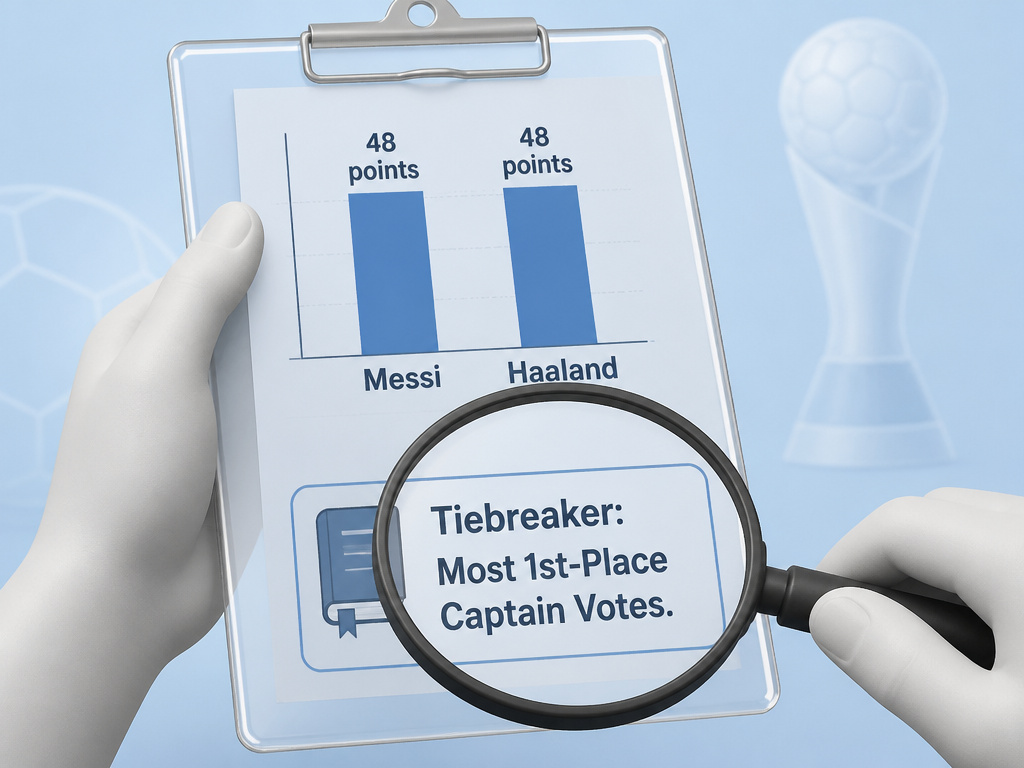
For years, the points system was theoretical. Then the 2023 men’s player award happened. Lionel Messi and Erling Haaland finished tied on 48 total points. The rulebook had a clause for this.
The tiebreaker for equal total points is which nominee received more first-choice nominations (5-point votes) from national team captains.
Messi had more captains place him first on their ballot, so he was awarded The Best FIFA Men’s Player 2023. This was the first time the tiebreaker had been used for this award since its 2016 inception. This made the award more than a pure points contest, giving the opinion of fellow professionals, specifically captains, the final say in a deadlock.
It’s a fascinating wrinkle. The fan vote, the coach vote, the journalist vote, all of them brought the race to a tie. The captains’ preferences broke it. This shows the award’s hybrid nature: it seeks public and expert validation, but in the closest calls, it defers to the judgment of on-field leaders.
The transparency here is critical. FIFA publishes the individual votes of every captain, coach, and journalist after the ceremony. You can go online and see that, as Argentina captain, Messi voted for Haaland first, then Kylian Mbappé, then his compatriot Julián Álvarez. He couldn’t vote for himself. That level of disclosure is rare in sports awards and acts as a check against frivolous voting.
Building the Shortlist: Expert Panels and Eligibility
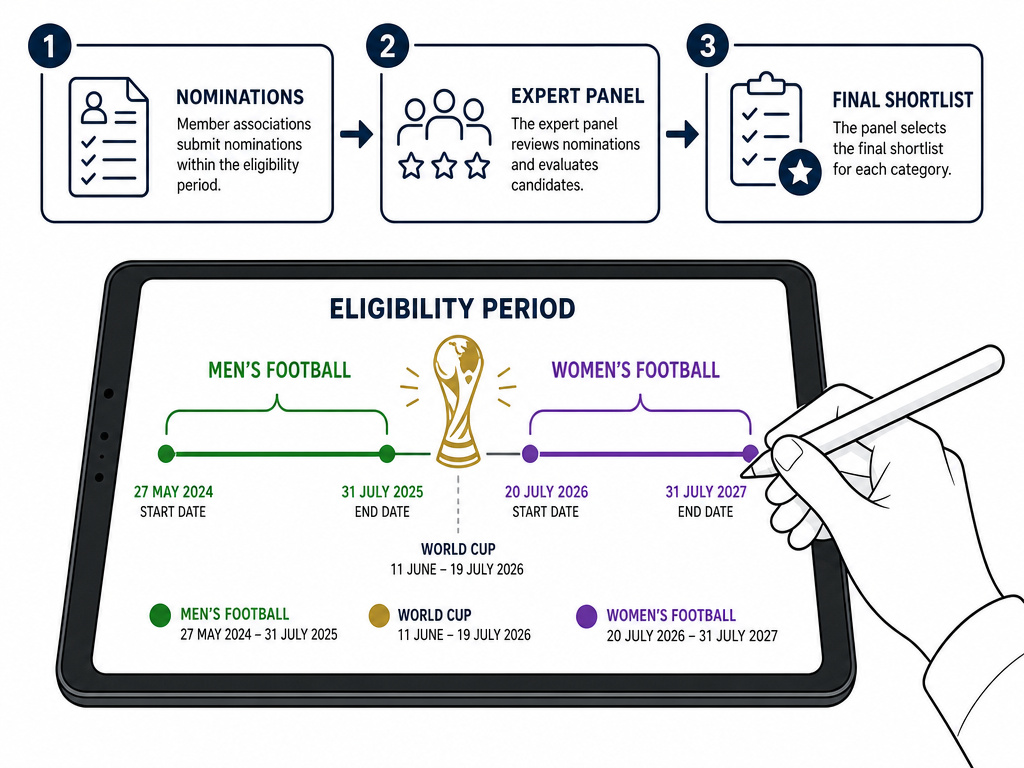
Before any voting happens, a group of nominees must be established. This isn’t a free-for-all. According to FIFA’s rules, nominations are first compiled by FIFA in collaboration with football stakeholders. These nominations are then reviewed by a panel of FIFA football experts.
Separate panels for men’s and women’s football then compile the final shortlists. These shortlists are published on FIFA.com to enable the public vote.
Crucially, the award is for a specific period of achievement, not a calendar year. This eligibility period changes with each award cycle. For the 2023 awards, the men’s performance period was from 19 December 2022 to 20 August 2023 inclusive. The women’s period was from 1 August 2022 to 20 August 2023. For the 2025 awards, the performance period was from 11 August 2024 to 2 August 2025.
This shifting window is important. It means the award can capture a specific tournament cycle, like a World Cup, in its entirety, unlike a calendar-year award that might split a tournament across two voting periods. It’s a nod to the modern football calendar, which rarely aligns neatly with January to December.
Awards Beyond Best Player
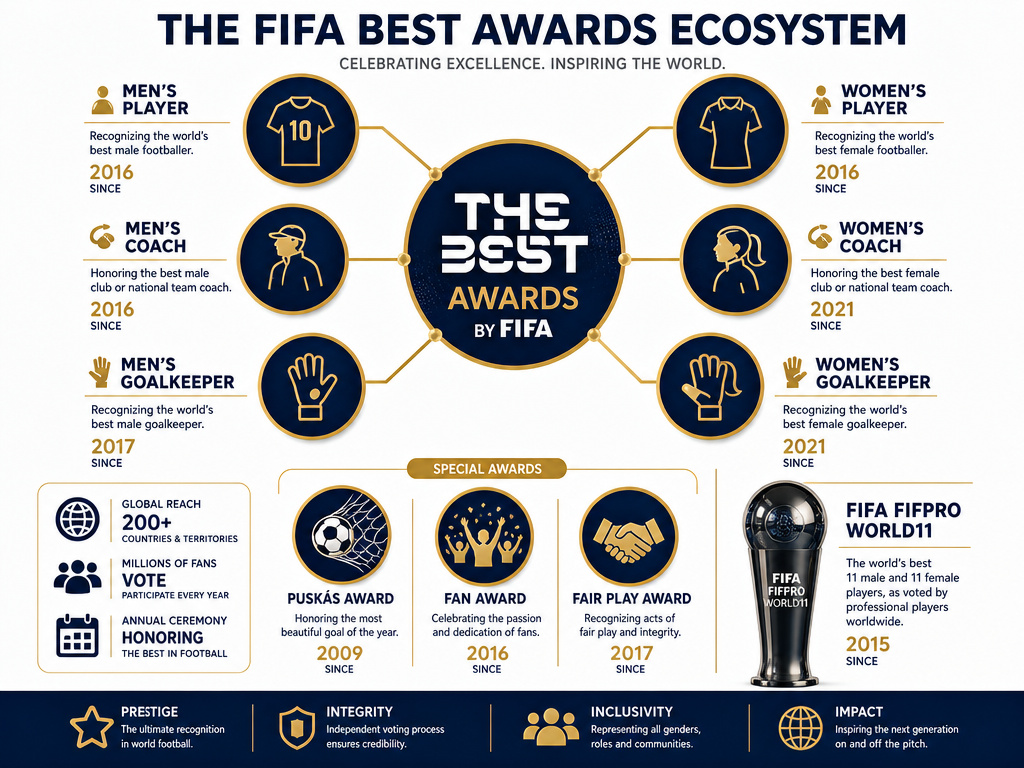
While the Best Men’s and Women’s Player awards grab headlines, the ceremony encompasses a wider range of honors, each with its own voting process on the same framework. The core six are:
- The Best FIFA Men’s Player
- The Best FIFA Women’s Player
- The Best FIFA Men’s Coach
- The Best FIFA Women’s Coach
- The Best FIFA Men’s Goalkeeper
- The Best FIFA Women’s Goalkeeper
Additionally, other awards like the FIFA Puskás Award (best goal), the FIFA Fan Award, and the FIFA Fair Play Award are presented. The FIFA FIFPRO World11, the best team of the year as voted by professional players worldwide, is also announced. This makes the night a broader celebration of the game’s moments, personalities, and community, not just its top stars.
It’s a matter of arithmetic, not opinion. The FIFA Best Awards operate in the messier, more debatable area of judging overall contribution and impact.
When and where is the awards ceremony held?
The awards ceremony is a standalone event organized by FIFA. While the specific date and location change for each edition, they are announced well in advance. For instance, the ceremony for the 2025 awards was held on Tuesday, 16 December 2025 at 17:00 GMT in Doha, Qatar. The ceremony typically takes place after the voting has concluded; for the 2025 awards, voting concluded on 28 November 2025 at 22:59 GMT. The event serves to reveal the winners across all categories, with the results determined by the aggregated points from the votes of coaches, captains, journalists, and fans.
Frequently Asked Questions
How is the FIFA Best Award different from the Ballon d’Or?
The key difference is the voting jury. The Ballon d’Or is voted on by an international panel of journalists. The FIFA Best Award uses a four-part jury of captains, coaches, journalists, and fans, with each group holding 25% of the vote. The different electorates and the FIFA Best’s inclusion of a fan vote and a tiebreaker rule mean the two awards can, and often do, produce different winners.
Can players vote for themselves?
No. The rules explicitly state that nominated captains and coaches are not permitted to vote for themselves. So Lionel Messi, as Argentina captain, could not list himself on his ballot for Best Men’s Player.
Do fans really have 25% of the vote?
Yes. The collective fan vote, aggregated from all registered votes on FIFA.com, is weighted to contribute exactly one-quarter of the final result. It carries equal weight to the collective votes of all national team captains.
Why do the eligibility dates change every year?
The award is based on-pitch performance and general conduct during a defined “performance period,” not a calendar year. FIFA sets this period to capture major tournaments (like World Cups or continental championships) in full, leading to windows that change from cycle to cycle to align with the football schedule.
Has a tie ever happened before 2023?
For The Best FIFA Men’s Player award, the 2023 tie between Messi and Haaland was the first since the award’s inception in 2016. The specific tiebreaker rule (most first-choice votes from captains) existed in the rulebook but had never been invoked until that moment.
The Bottom Line
The FIFA Best Awards are a deliberate attempt to democratize football’s highest individual honors. By giving equal say to players, managers, media, and supporters, it aims for a winner who commands respect across the entire football world. The system isn’t perfect, no voting system is, but its transparency and unique structure make it more than just a popularity contest.
The next time you see a winner crowned, you’ll know the story is about securing 5 points from a captain in Iceland, 3 points from a coach in Ghana, 1 point from a journalist in Uruguay, and a share of that massive fan vote, not just about goals and trophies. It’s a global conversation, distilled into a single name. And if that conversation ends in a deadlock, the captains get the final word.
