
History of the Football Shirt: From Caps to a Canvas
This post contains affiliate links. As an Amazon Associate, we earn from qualifying purchases.
The football shirt evolved from a simple coloured cap in the 1858 Sheffield Rules to a distinct, club-registered uniform by the 1891 Football League mandate, driven by the need for clear identification on muddy, crowded pitches. Its journey from heavy wool and cotton to lightweight synthetics mirrors technological change, while its transformation into a commercial canvas, from the first 1973 sponsor logo to a £281.8 million Premier League industry, reflects football’s shift from local sport to global entertainment.
That shift from functional garment to financial asset wasn’t smooth. It was a series of collisions between clubs, rule-makers, broadcasters, and fans. The story lives in the specific, often forgotten, details of the history of the football shirt: the exact price of a dozen flannelette shirts in 1897, the league rule that forced goalkeepers to wear red or blue, and the fan-led push that turned adult replica shirts from a novelty into a norm.
What follows is a walk through the key problems football had to solve, and how the shirt was the answer in the history of the football shirt. This section explains the Victorian rules that created club colours, the real cost of early kits, the birth of sponsorship, and the moment the shirt stopped being just for the players on the pitch.
Key Takeaways
- The first distinguishing garment wasn’t a shirt, but a coloured cap mandated by the 1858 Sheffield Rules.
- The 1891 Football League rule that no two teams could register similar colours created the modern idea of fixed club identity.
- In 1909, goalkeepers were first required to wear distinctive tops, initially red or blue, with green becoming the English standard soon after.
- The first UK shirt sponsorship deal, for Kettering Town in January 1976, was ordered removed by the FA in April 1976 under threat of a £1,000 fine.
- By the 2017-18 season, the combined value of Premier League shirt sponsorships reached £281.8 million.
The 1858 Sheffield Rules to the 1891 Colour Mandate
Before clubs, there were school and village games with no standard kit. When Sheffield FC, considered the world’s first football club, formed (sources cite 1857), the problem was simple: how do you tell teams apart? The solution, recorded in the 1858 Sheffield Rules, was specific. It specified “a red and dark blue flannel cap, one colour to be worn by each side” as the distinguishing garment.
Shirts came later, and they were a luxury. Early teams like Manchester United changed colours. United settled on red shirts in 1902. This wasn’t about branding. It was about availability and cost. A plain white shirt was cheap and easy to get. The exotic, multi-coloured designs of the Victorian era (described differently by sources as ‘quartered’ or ‘harlequin’) looked great in a team photo but were a nightmare to pick out on a gloomy, muddy winter afternoon. The game’s speed was increasing, and the offside rule was evolving to allow forward passes. You needed to spot a teammate at a distance.
The 1891 Football League AGM decree that “no two member teams could register similar colours” was the turning point. This formal rule, published in the first League handbook, forced clubs to commit to an identity. It turned the shirt from a piece of clothing into a club symbol.
The rule had teeth, but it also had a practical flaw. What happened when two teams with the same registered colours met? In 1892, the League altered the rule to allow same colours but mandated every club have a second set of all-white jerseys for clashes. The responsibility for changing finally settled on the away team in 1921. This simple, logistical solution created the entire concept of “home” and “away” kits.
Materials, Manufacturing, and the Real Cost of a Kit
Forget modern, feather-light synthetics. The early football shirt was workwear. Shirts and “knickerbockers” were made from tough, heavyweight natural fibres, usually cotton, sometimes wool. They were close-fitting, absorbed sweat and rain like a sponge, and turned stiff with mud. A surviving catalogue fragment from 1897 gives us the hard numbers.
| Material (1897) | Wholesale Price (per dozen) | 2024 Equivalent Value | |———————-|———————————-|—————————-| | Flannelette (brushed cotton) | 27 to 30 shillings | £225 to £250 | | All-wool Flannel | About twice the flannelette price | ~£450 to £500 | | Jerseys | 24 shillings | £330 |
Flannelette was the budget option. All-wool flannel, warmer and more durable, was for clubs with deeper pockets. By 1906, manufacturers like Wills & Co of Oldham offered an enormous range. Their catalogue listed everything from cheap jerseys for youths at 8 shillings and 3 pence per dozen (£62 at today’s prices) to top of the range four-thread merino wool shirts at 70 shillings per dozen (£528 at today’s prices) and finest cashmere shirts at 84 shillings per dozen (£633 at today’s prices).
Frank Sugg of Liverpool made bold claims, advertising their ‘Junior League’ shirts as untearable, colourfast, and capable of being worn for four or five seasons. The shirt was a consumable, not a collectible.
The Goalkeeper’s Shirt and Other Rule-Driven Designs
For decades, goalkeepers wore the same shirt as their teammates. In a crowded goalmouth scramble, officials struggled to identify them. The Football League’s 1909 rule change demanded a fix: goalkeepers were required to wear distinctive tops. The initial stipulation was red or blue.
Within a few years, green was permitted and became the standard in England. In Scotland, goalkeepers generally wore deep yellow. This wasn’t about fashion. It was a visibility and identification rule that created one of the most recognisable and often wildest parts of a club’s kit components.
Other rules subtly shaped the shirt’s form. Regulations requiring players to cover their knees were relaxed in 1904, allowing shorts to become shorter.
Sponsorship: From Local Tyres to a £282m Industry
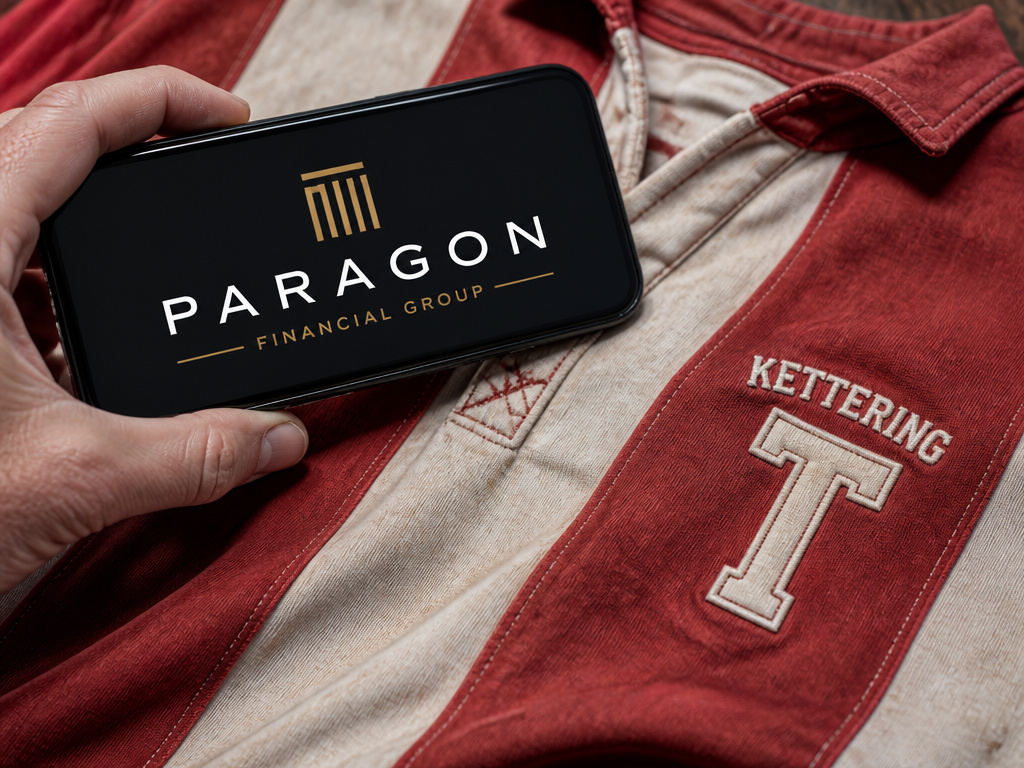
The shirt as a billboard seems inevitable now. Its path was anything but. An early recorded deal was in 1973, when German club Eintracht Braunschweig wore the Jägermeister logo, considered the first such deal. In the UK, the Football Association resisted fiercely.
The breakthrough came on 24 January 1976. Former Wolves striker Derek Dougan, then chief executive at non-league Kettering Town, brokered a deal with Kettering Tyres. Their name appeared on the shirts for a match against Bath City. Four days later, the FA ordered it removed. Dougan tried a loophole, shortening the wording to “Kettering T,” but by April the FA threatened a £1,000 fine and the sponsor’s name came off.
The dam broke quickly. By the 1983/84 season, almost all Football League clubs benefited from jersey sponsorship. Suddenly, a logo on a chest had national exposure. The value exploded.
| Era | Key Sponsorship Milestone | Financial Scale | |———-|——————————–|———————-| | 1976 | First UK deal (Kettering Town) | Local business agreement | | 1970s | Admiral’s deal with Leeds United | £10,000 initial fee + 5% royalty on sales of club’s branded leisurewear | | 2017-18 | Premier League combined deals | £281.8 million (an increase of more than £55 million from 2016/17) |
The history of shirt sponsors is a story of escalating value and space. The Football League allowed secondary sponsor logos on the back of shirts and shorts in 2006-07; the Premier League did not follow suit initially. Clubs like FC Barcelona held out for years, wearing the UNICEF logo and donating €1.5 million annually to the charity until 2011. The shirt had become the prime real estate in a global business.
From Pitch to Stands: The Replica Revolution
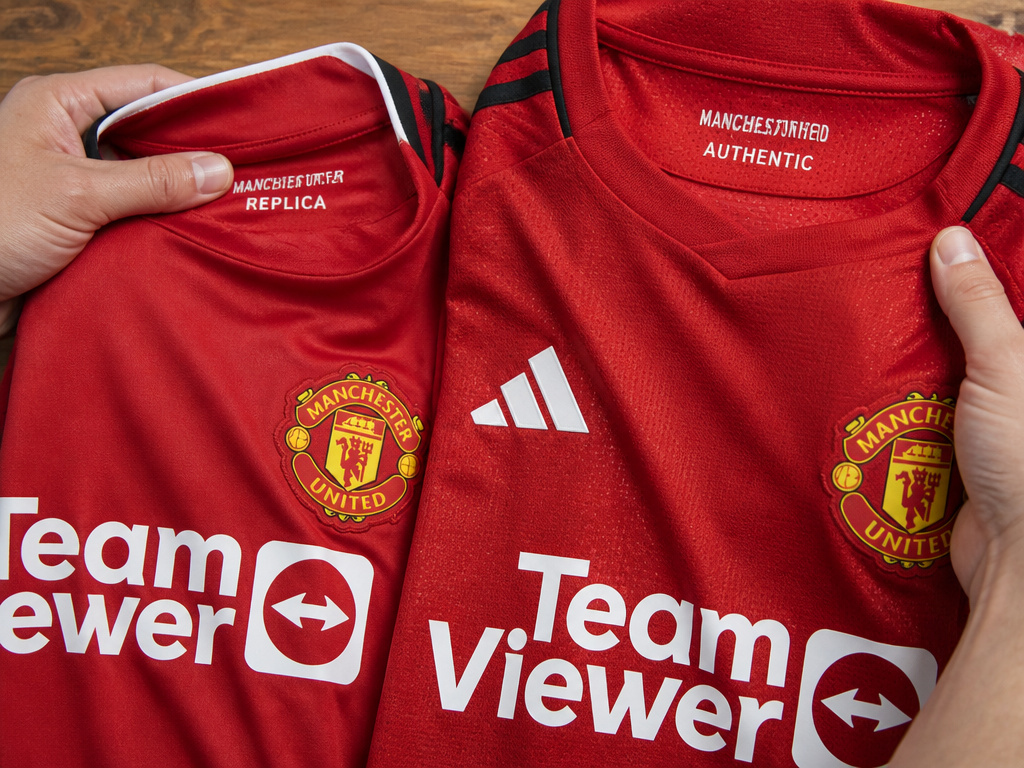
The replica kit industry is so vast it’s hard to imagine it didn’t always exist. For most of football’s history, the shirt was a tool for the player, not a product for the fan. Adult fans wearing replica shirts en masse is a surprisingly recent phenomenon.
Research indicates this shift was “not initially driven by an existing industry, but began as a fan-inspired process.” Fans, especially younger ones, began wearing replicas as a mark of identity. Manufacturers and clubs then capitalised on the demand.
The difference between what the players wear and what fans buy is now a whole category. Authentic shirts, with their tighter athletic cuts and technical fabrics, are distinct from the roomier, more durable replicas. This distinction itself is a product of the shirt’s dual role as professional equipment and mass-market merchandise.
Iconic Designs and the Rise of the Kit Cult
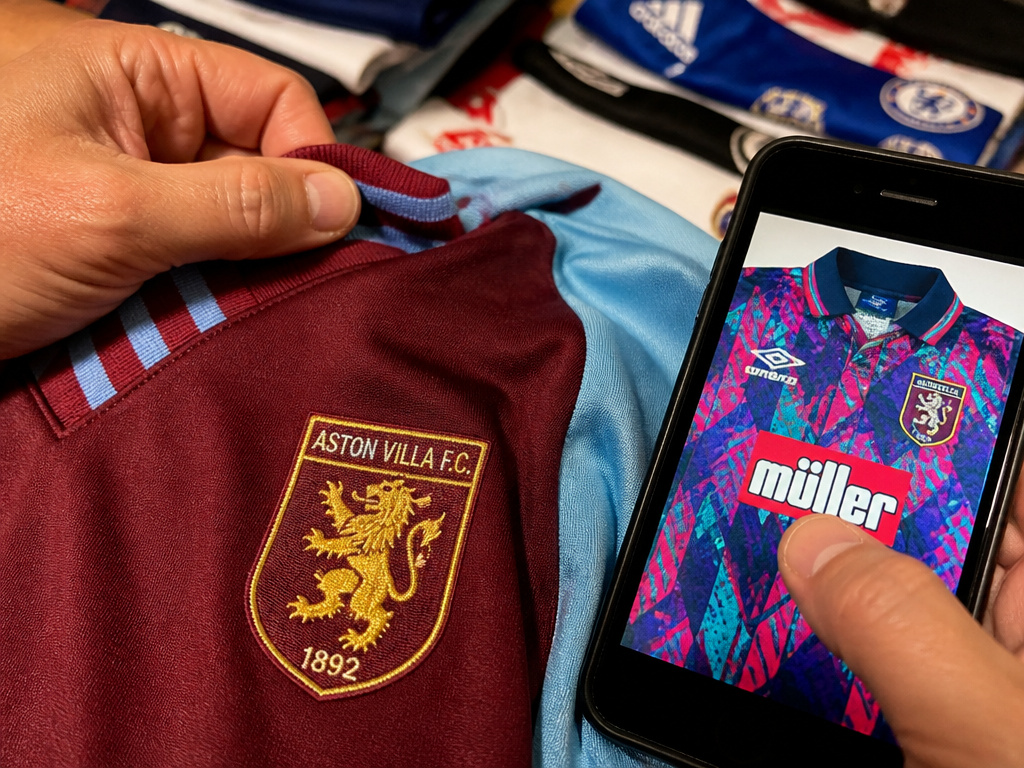
Certain shirts transcend their era. The 1892 Aston Villa claret and light blue design, with its contrasting sleeves and neck band, remained substantially unchanged for over 60 years. It was one of the first truly iconic jerseys. Celtic’s green and white hoops appeared in 1904, a strip that became globally recognisable.
These designs cemented club identity. They became fixed. While manufacturers could tweak templates, collar styles, and trim colours, the core identity. United’s red, Arsenal’s red and white, Chelsea’s blue, became an informal constraint. As one academic analysis notes, these traditional colours “took time to take root” but now act as marks of a club’s “own unique history.”
The modern cult of the kit, the hunt for retro jerseys and vintage jerseys, is a direct result of this established history. A shirt from a specific season evokes a specific moment, a cup win, a legendary player, a particular style of play. The design elements themselves tell a story: the broad collars of the 70s, the garish patterns of the 90s, the sleek minimalism of the 2010s. It’s a tactile history lesson.
Frequently Asked Questions
When did football shirts start having names and numbers?
Player names printed above numbers on the back of shirts became common in the 1990s, following the 1994 FIFA World Cup where the practice was used. Squad numbering, as opposed to the traditional 1-11 system, was gradually adopted by leagues throughout the 1990s to aid fan identification and commercial sales.
What is the most iconic jersey in football history?
Iconicity is subjective, but historically significant shirts include the 1970 Brazil yellow jersey, the 1894 Aston Villa claret and blue, Celtic’s 1904 green and white hoops, and the all-white of Real Madrid and Leeds United (adopted in the 1960s to mimic Madrid). Each represents a dynasty or a radical design choice that endured.
Why did football shirts used to be so baggy?
Early shirts were baggy because they were made from heavy, non-stretch natural fibres like cotton and wool. A tighter fit would restrict movement and, when soaked with sweat and rain, become unbearably heavy and uncomfortable. The shift to lighter, elastic synthetic fabrics in the late 20th century allowed for the skin-tight “athletic” fit seen today.
What is an original football shirt?
An “original” can mean two things: a match-issued or match-worn shirt (the actual garment made for players) or a period-accurate replica from the time of issue. Key tells for a genuine vintage shirt include fabric type, label design, manufacturer logos, and shirt sizing which was often smaller than modern equivalents. Fakes often fail on the details inside.
The Bottom Line
The history of the football shirt is a 150-year negotiation between practicality and commerce. It began with a rule to solve a simple problem, “who is on my team?”, and became a canvas for identity, then advertising, and finally, fan culture. Every change, from the 1891 colour registry to the 1976 sponsor logo, was met with resistance before becoming normal.
The next time you see a new kit launch, look past the hype. That shirt is the latest chapter in a story written by Victorian administrators, Lancashire textile mills, stubborn football associations, and fans who just wanted to wear their colours. Its evolution is inseparable from the history of football boots and the game’s own journey from chaotic pastime to polished spectacle. The story is stitched into the fabric itself.
