
History of Football Tactics: From Chaos to Modern Systems
This post contains affiliate links. As an Amazon Associate, we earn from qualifying purchases.
The history of football tactics is a story of problems and solutions, driven by rule changes more than by genius. The dominant 2-3-5 formation was rendered obsolete after the 1925 offside law change, leading to Herbert Chapman’s W-M innovation in the 1925/26 season. From there, each era’s dominant shape, from Alf Ramsey’s 4-4-2 to the modern 4-2-3-1, has been a direct answer to the tactical questions posed by its predecessor.
The 1925 rule shift didn’t just tweak the game; it doubled the number of goals in matches and made the old way of playing impossible. That’s the pattern. Every major leap, the rise of pressing, the spread of a back four, the current obsession with a single striker, starts with a new constraint or a failure exposed on a big stage. The story isn’t a smooth march of progress in the history of football tactics. It’s a cycle of attack, defense, and rediscovery.
What follows is a walk through the key moments in the history of football tactics that forced football to reinvent itself. We’ll look at the forgotten 19th-century arguments over passing, the law change that created modern defending, and why today’s most common formation might already be on its way out.
Key Takeaways
- Football’s first widespread formation, the 2-3-5 Pyramid, was perfectly suited to a strict offside law requiring three defenders between attacker and goal.
- The pivotal 1925 offside law change (reducing the requirement to two defenders) doubled scoring and made the 2-3-5 obsolete, directly leading to Herbert Chapman’s defensive W-M formation.
- Tactics often evolve in cycles, not a straight line; Antonio Conte reintroduced the back three to the Premier League in 2016, a shape considered outdated for decades.
- A 2020 study of 9,127 top-flight games confirmed the 4-2-3-1 as the dominant 2000s formation, chosen by managers based more on their own recent success than league-wide trends.
- True revolutions like Total Football are rare; most tactical “innovations” are clever re-combinations of old ideas adapted to new rules or player skillsets.
The 19th Century: Chaos, Passing, and the First Systems
Watch a re-enactment of a 1850s football match and you’d see a mob chasing a ball. There were no crossbars on the goals until 1875, and the first referee’s whistle wasn’t blown until 1878. Tactics, in any modern sense, didn’t exist. But even in this chaos, the seeds of structure were being planted, often in unexpected places.
The game wasn’t uniform. Sheffield and Scotland played with a more lenient offside rule than the London-based Football Association. This regional difference is crucial. In Sheffield, where a player could be forward without instantly being offside, passing the ball ahead became a viable, even superior, tactic as early as 1865. Meanwhile, prominent London figures like Charles Alcock were skeptical, calling systematic passing “as much an act of faith as a decisive tactic” compared to simple “kick and rush.”
Where this goes sideways: Assuming passing was an immediate, universally accepted improvement. In the 1860s and 70s, it was a contentious regional specialty, debated for its effectiveness against simpler, more physical styles.
The first international match in 1872, a 0-0 draw between Scotland and England, highlighted this clash. The smaller Scottish team used coordinated passing and positioning. The English, following Alcock’s advice, fielded a goalkeeper, two defenders, and eight forwards. The Scots’ structure neutralized England’s numerical attack, proving that organization could beat brute force. Out of this experimentation, the first true formation emerged: the 2-3-5, or the Pyramid.
| Era (Pre-1925) | Dominant Formation | Key Driver | Player Ratio (Def:Mid:Att) |
|---|---|---|---|
| 1850s-1860s | 1-1-8 / 1-2-7 | Basic rule creation | 1-2 Defenders, 8-9 Attackers |
| 1870s-1880s | 2-3-5 (The Pyramid) | Offside law (3 defenders) | 2 Def, 3 Mid, 5 Att |
This shape, two full-backs, three half-backs, and five forwards, wasn’t just an idea. By the 1888 Football League season, clubs like Preston North End were listing it on team sheets. It dominated for decades because it perfectly matched the 1856 offside law, which required three defenders between an attacker and the goal. With five forwards, you could always stretch the defense and keep at least one player onside. It was a system built for a specific rule. And when that rule changed, the entire football world had to scramble.
The 1925 Offside Law: The Trigger for Modern Tactics
Football can change in a summer. The 1924-25 season saw defensive, low-scoring matches. The average goals per game plummeted to around 2.58. The culprit was the offside trap, expertly used by teams like Newcastle United. Something had to give.
The Football Association’s solution was simple but seismic. In 1925, they changed the offside law from requiring three defenders to requiring only two defenders between the attacker and the goal-line.
The effect was instant and chaotic. The opening weeks of the 1925/26 season were wildly unpredictable. Arsenal beat Leeds 4-1 on September 26, then were demolished 7-0 by Newcastle a week later. The old 2-3-5 was now a defensive suicide note. Goals per game doubled almost overnight. Managers were forced to innovate or be humiliated.
The 1925 offside law change reduced the required defenders from three to two. This single amendment destroyed the attacking logic of the 2-3-5 formation, forced the centre-half to drop into a permanent defensive role, and directly precipitated the development of the more balanced W-M system that would dominate for the next thirty years.
Herbert Chapman, Arsenal’s visionary manager, provided the blueprint. He didn’t just drop a man back. He rethought the structure. He pulled his centre-half into a permanent third defender (creating the first true centre-back), dropped an inside forward to bolster midfield, and reshaped his team into a 3-2-2-3. Drawn on a chalkboard, the defensive line looked like a ‘W’ and the attack like an ‘M’. The W-M was born.
This wasn’t just a new formation. It created the defensive, midfield, and attacking units we take for granted today. Arsenal won the league with it in 1931, and it became the global standard for a generation. A rule change didn’t just tweak tactics; it invented the modern defender.
The Post-War Chess Match: 4-2-4, 4-4-2, and the Rise of Systems
By the 1950s, the W-M was the universal language of football. Then Hungary arrived at Wembley in 1953 and spoke something else. Their 6-3 victory, England’s first home defeat by continental opposition, was a tactical earthquake. Hungary, and soon Brazil with their 4-2-4, showed that fluid movement and withdrawing a centre-forward (like Nándor Hidegkuti) could dismantle a rigid defensive block.
Brazil’s 1958 World Cup win with the 4-2-4 cemented the back four as the new defensive ideal. But it also revealed a weakness: a gaping hole in midfield. The solution, pioneered by Soviet manager Viktor Maslov and later perfected by others, was to pull the two wide forwards back into midfield. The 4-4-2 was born.
This shape became the workhorse of football for thirty years. It offered balance, two banks of four that were hard to break down, and the potential for swift, direct attacking. Alf Ramsey’s Ipswich Town, using a clever deep-lying winger in Jimmy Leadbetter, won the 1962 league title with a version of it, proving a back four could be a title-winning formula.
The 4-4-2’s reign, however, set the stage for its own downfall. Its symmetry and reliance on two strikers created a vulnerability that the next wave of tacticians would exploit.
Tactical Philosophies: From Catenaccio to Total Football
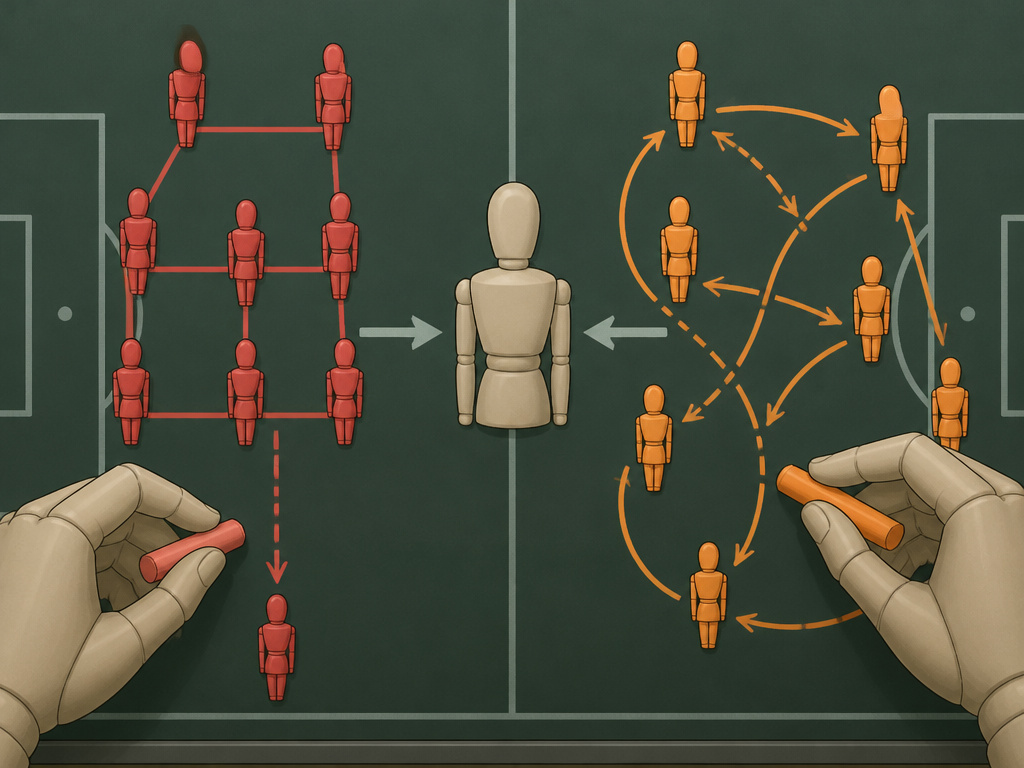
While formations provide the skeleton, philosophies give a team its soul. Two contrasting ideologies emerged in the mid-20th century that still define how we talk about the game: the defensive rigidity of Catenaccio and the fluid expression of Total Football.
Catenaccio (“door bolt” in Italian) was a system of extreme defensive organization. Its key innovation was the libero, a sweeper who played behind a man-marking back line to clean up any breakthroughs. Helenio Herrera’s Inter Milan used it to grind out 1-0 wins and European Cups in the 1960s. It was effective but earned a reputation for negativity.
Common mistake: Thinking Total Football was just players swapping positions randomly. The genius was in the covering movements. When a full-back surged forward, a midfielder dropped into his space. The structure remained perfectly balanced, like a rotating kaleidoscope that never loses its shape.
Total Football, perfected by Rinus Michels’ Ajax and the 1974 Dutch national team, was its polar opposite. The core principle was that no outfield player had a fixed position. Johan Cruyff might start as a centre-forward, drift wide, or drop into midfield. The system demanded incredible technical skill and intelligence, as every player had to understand every role. Ajax won three straight European Cups (1971-73) and went 46 home matches unbeaten during this period. The Dutch national team, playing the same style, scored 14 goals and conceded just once on their way to the 1974 World Cup final.
These philosophies showed that tactics were no longer just about where players stood, but about how they thought, moved, and controlled space. They set the stage for the data-driven, highly specialized modern game.
The Modern Era: Specialization, Data, and the 4-2-3-1
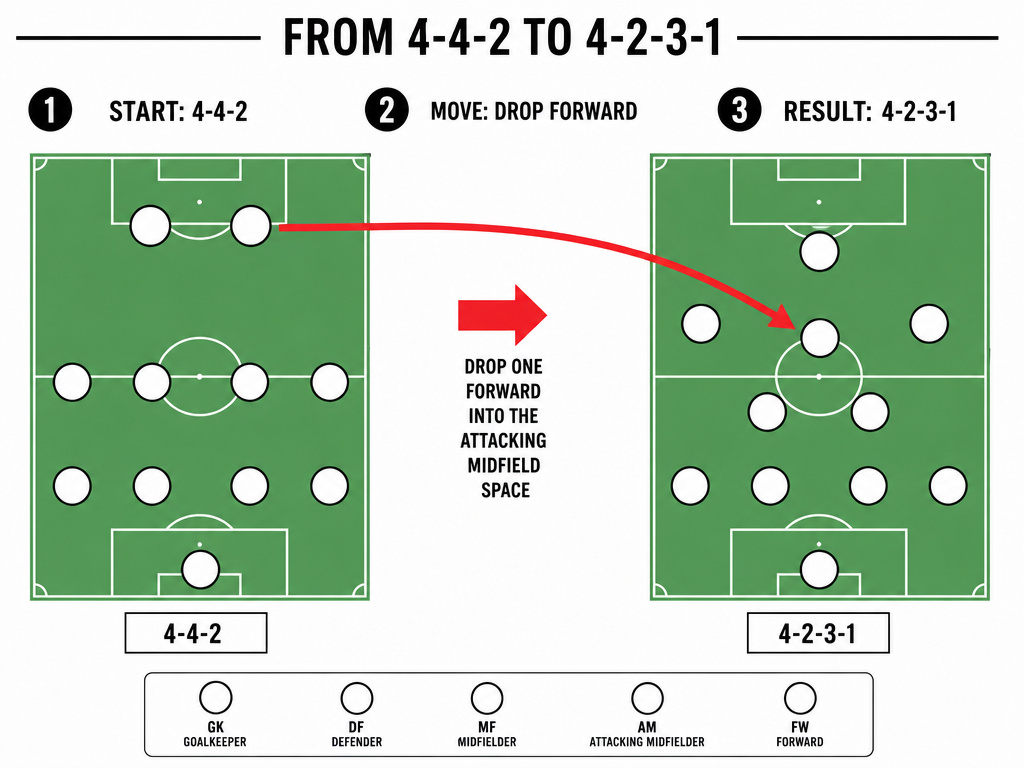
The modern tactical landscape is defined by specialization, intense pressing, and a formation that rose to dominance in the 2000s: the 4-2-3-1. This shape is essentially a 4-4-2 where one striker has dropped into an advanced midfield role, creating a compact bank of four in midfield and overloading central areas.
Its dominance isn’t just anecdotal. A 2020 cultural evolution study analyzed 9,127 games from Europe’s top five leagues (2012-2017) and identified the 4-2-3-1 as the clear formation of choice. Interestingly, the study found managers were more influenced by their own recent success with the formation than by its overall league-wide popularity.
So why did the 4-4-2 fade? The 4-2-3-1 directly attacks its main weakness: the two-man central midfield.
| Formation | Core Strength | Key Vulnerability | Modern Example |
|---|---|---|---|
| 4-4-2 | Balance, width, direct attack | Outnumbered in central midfield (2 vs 3) | Diego Simeone’s Atlético Madrid (variations) |
| 4-2-3-1 | Controls midfield, flexible in attack | Can be isolated lone striker; demands dynamic wingers | Peak José Mourinho teams, most 2010s Champions League sides |
By stationing a playmaker behind a lone striker, a 4-2-3-1 can gain an advantage in central midfield against a traditional 4-4-2. This control of the center is the single biggest reason for the older formation’s decline at the highest level.
Modern tactics have also seen the resurgence of old ideas. Antonio Conte’s use of a back three at Chelsea in 2016-17, leading them to a Premier League title, was a clear nod to the past. Today’s gegenpressing is a more systematized, intense version of the pressure applied by Total Football teams. The game doesn’t move forward in a straight line; it spirals, revisiting and refining old concepts with new athletes and new data.
Frequently Asked Questions
Why is 4-4-2 not used anymore at the top level?
The classic 4-4-2 is vulnerable to formations that pack the center of midfield, like the 4-2-3-1 or 4-3-3. With only two central midfielders, a 4-4-2 team can be consistently outnumbered and overrun in the most important area of the pitch. Top teams that use a variant of it today, like Atlético Madrid, heavily modify it with one striker dropping deep or midfielders shuttling wide.
Why is 4-2-3-1 so popular now?
The 4-2-3-1 offers control and flexibility, and a 2020 study identified it as the dominant formation in the 2000s. Its popularity is a direct response to the weaknesses of the previous dominant systems.
What was the most important rule change in football history?
The 1925 change to the offside law, reducing the required defenders from three to two, is arguably the most impactful. It immediately doubled scoring, rendered the dominant 2-3-5 formation obsolete, and directly forced the invention of the W-M, the formation that created the modern roles of centre-back and structured defensive units.
Is Total Football still used today?
Not in its pure, 1970s form. However, its core principles, fluid positioning, high pressing, and technical players comfortable anywhere, are foundational to modern football. The high-pressing, possession-based styles of coaches like Pep Guardiola are direct descendants of the Total Football philosophy, even if the formations on paper look different.
How do rule changes still affect tactics today?
Recent changes continue to shape the game. The 1992 back-pass rule forced goalkeepers and defenders to be better with their feet, directly enabling the rise of possession-based tactics. Interpretations of the offside rule and directives on tackling (punishing the “double footed” challenge) have progressively favored technical, agile attackers over physical defenders, encouraging the fast, intricate play we see now.
Before You Go
Tactical history isn’t a hall of fame for genius coaches. It’s a scrapbook of adaptations. The next time you see a team playing a back three, remember it’s not a futuristic innovation; it’s a revival of a pre-1925 idea, updated for players who are faster and fitter than ever. The real driver is rarely the manager’s manifesto. It’s the lawbook, the weather, the size of the pitch, or the failure of a previously perfect system.
The lesson for any fan is to watch the space, not just the ball. The shape of the game, the distance between the last defender and the striker, the gaps between the lines, tells you more about the battle of wills on the sideline than any possession statistic ever will. The history of football is the history of that space being discovered, controlled, and then conquered all over again.
