
Total Football Explained: The Three Core Principles
This post contains affiliate links. As an Amazon Associate, we earn from qualifying purchases.
Total Football is a fluid tactical system where any outfield player can take over the role of any other, requiring players to constantly switch positions while the team’s overall shape is maintained. It was perfected by Ajax Amsterdam and the Netherlands national team under Rinus Michels and Johan Cruyff in the early 1970s, leading to eight Eredivisie titles, three consecutive European Cups, and a World Cup final appearance. Its success depends entirely on intelligent, versatile players and a shared understanding of spatial control, high pressing, and possession.
That spatial control is the whole game. Cruyff talked endlessly about where to run, where to stand, and when not to move. It wasn’t chaos; it was a meticulously drilled language of movement, and when spoken fluently, it made pitches seem bigger for the team in possession and impossibly small for their opponents. This is total football explained.
What follows is a breakdown of that language, a total football explained. We’ll look at where these ideas came from, how Ajax and the 1974 Dutch team turned them into trophies, and the three essential principles every Total Football side lives by. We’ll also see why it’s so hard to pull off, how it eventually lost a World Cup final, and where you can still hear its accent in the football played today.
Key Takeaways
- The system’s success hinges on player intelligence and versatility, it fails without footballers who can read the game and play multiple positions.
- Total Football isn’t just about attack; its high defensive line and coordinated press are what enable the positional fluidity.
- The famous Ajax side of 1971-72 suffered just one league defeat in the entire season, showcasing the system’s dominance when executed perfectly.
- Despite its beauty, the system has a key vulnerability: disciplined man-marking of its chief playmaker can break its fluid structure, as seen in the 1974 World Cup final.
- Modern coaches like Pep Guardiola didn’t invent pressing or positional play; they refined principles first drilled by Michels and Cruyff half a century earlier.
The Origins: More Than a Dutch Invention
Most stories about Total Football start in Amsterdam in the late 1960s, where Rinus Michels is generally credited with introducing the system, a key moment in total football explained. However, the core ideas of fluidity and combination play had been cultivated decades earlier by coaches like Jimmy Hogan and Jack Reynolds, with some authors crediting teams such as the Austrian Wunderteam of the 1930s or the Hungarian Golden Team of the 1950s for playing a similar style.
The foundations were laid by Jimmy Hogan, a Burnley native whose coaching influenced the Austrian ‘Wunderteam’ of the 1930s and the Hungarian ‘Golden Team’ of the 1950s. Sandor Barcs, a president of the Hungarian Football Association, later said, “Jimmy Hogan taught us everything we know about football.” These teams played with a fluidity and focus on combination play that previewed what was to come. Then, at Ajax, another Englishman, Jack Reynolds, implemented a style bearing similarities to Total Football across three managerial spells beginning in 1915, focusing on technique, fitness, and a more fluid positional understanding in training.
So when Rinus Michels took charge of Ajax in 1965, he wasn’t starting from scratch. He was synthesising. He combined these inherited ideas with a new generation of talent, most notably a teenager named Johan Cruyff who had debuted a year earlier. Michels provided the discipline and the framework; Cruyff became the free-moving, on-pitch conductor. What they built together didn’t just win matches; it changed how people thought the game could be played.
Common mistake: Crediting Michels and Cruyff with inventing Total Football from nothing. The core ideas of fluidity and combination play were in circulation for decades, cultivated by coaches like Hogan and Reynolds. Michels’s genius was in refining these concepts and marrying them to a squad of uniquely gifted players capable of executing them at an unprecedented level.
How Ajax and the Netherlands Perfected It
The proof is in the silverware, and the sheer volume of it still staggers. Under Michels and then his successor Ștefan Kovács, Ajax from 1970 to 1973 became a machine. They won three consecutive European Cups during this period. They celebrated four titles in 1972 alone: two league titles, the KNVB Cup, the European Cup, and the Intercontinental Cup.
The numbers from their domestic dominance are almost cartoonish. Ajax completed a perfect home record, 46 wins, 0 losses and draws, for two consecutive seasons (1971-72 and 1972-73). In that first of those seasons, they suffered just one defeat in the whole Eredivisie campaign. This wasn’t just winning; it was a systematic dismantling of every opponent’s will.
| Ajax Amsterdam (1970-1973) Trophy Haul | Quantity | Notes |
|---|---|---|
| European Cups | 3 | Won consecutively in 1971, 1972, 1973. |
| Eredivisie Titles | 8 | Total across the peak period. |
| Intercontinental Cup | 1 | Won in 1972. |
| Undefeated Home Seasons | 2 | 1971-72 & 1972-73 (46 wins, 0 draws/losses). |
The 1972 European Cup final was a symbolic passing of the torch. Ajax beat Inter Milan 2-0, with both goals from Cruyff. Inter were the last great bastion of Catenaccio, the ultra-defensive Italian system. Total Football’s proactive, pressing style was seen as directly causing the “death of Catenaccio.”
The system then went global at the 1974 FIFA World Cup. Michels coached the Netherlands national team, with Cruyff as captain. Their march to the final was breathtaking. They played with a arrogance that felt new, a collective confidence that they were simply playing a better, more advanced game.
The Dutch started with a stunning move that ended with Cruyff winning a penalty, converted by Johan Neeskens within two minutes. They were 1-0 up without the Germans touching the ball. But West Germany, pragmatic and tough, fought back. Goals from Paul Breitner and Gerd Müller gave West Germany a 2-1 victory.
The better team on the day didn’t win. But the team that played the more influential football, the one that is still dissected 50 years later, wore orange.
The Three Core Principles of Total Football
Strip away the history and the legends, and Total Football operates on three simple, interlocking principles. Miss one, and the whole structure wobbles.
1. Positional Flexibility (The Famous Swaps)
This is the headline act. No outfield player has a fixed position. If a left-back drives forward, a midfielder drops into the space he left. If a centre-forward drifts wide, a winger cuts inside to occupy the central space. The team’s shape, usually a 4-3-3 on paper, remains constant, but the individuals inside it are in constant motion.
This is a chain reaction of covering, triggered by reading the game. The system relied on “technically skilled, intelligent players who could read the play and decide for themselves when to swap positions,” as one analysis notes. The major component was the use of space, with the need to consistently create space central to the concept.
When a player moved out of position to create space or join an attack, another player moved into the space they had left. The team kept its overall shape while the players within it constantly changed places.
This fluidity is what creates numerical advantages in different areas of the pitch, overloading defenders and pulling opposition structures apart.
2. High Pressing (Win It Back, Now)
Total Football is proactive. The moment possession is lost, the entire team engages in a coordinated press high up the pitch to win the ball back immediately. Forwards chase defenders, midfielders cut passing lanes. The aim is to “squeeze the pitch,” reducing the space the opposition has to play out.
This pressing is not optional; it’s the engine that makes the positional swaps possible. If you lose the ball and don’t win it back quickly, your players are caught out of position, stranded upfield. The press ensures the team usually regains possession while the opponent is still disorganised, ready to launch another fluid attack. This high-energy approach demands extreme fitness, another legacy of Jack Reynolds’s early training focus at Ajax.
3. Possession-Based Attack (Control as a Weapon)
When you have the ball, you keep it. Total Football teams attack through short, intricate passing and constant movement, designed to draw opponents out of position and carve open chances. The aim in possession is to “make the pitch big,” using the width and depth to stretch the defence and create passing lanes.
This possession is an active tool for manipulation. By controlling the ball, you control the game’s rhythm and force the opponent to react to you. It directly feeds back into principle one: as you pass and move, players naturally rotate positions, maintaining structure while probing for weakness. This style of build-up play, starting from the back, is a direct descendant of Cruyff’s belief that “the goalie is the first attacker, and the striker the first defender.”
Why It’s So Difficult to Execute (And How to Beat It)
For all its beauty, Total Football is a brutally demanding system. It has two major Achilles’ heels: the quality of the players and a specific tactical counter.
First, it is completely player-dependent. You need a squad of extraordinarily intelligent, technically gifted, and versatile footballers. They must have the spatial awareness to understand when to move and where to cover, the communication to coordinate these movements, and the engine to sustain the high press for 90 minutes. You can’t buy a Total Football system off the shelf; you must develop the players for it, which is why Ajax’s youth academy was so central to their success.
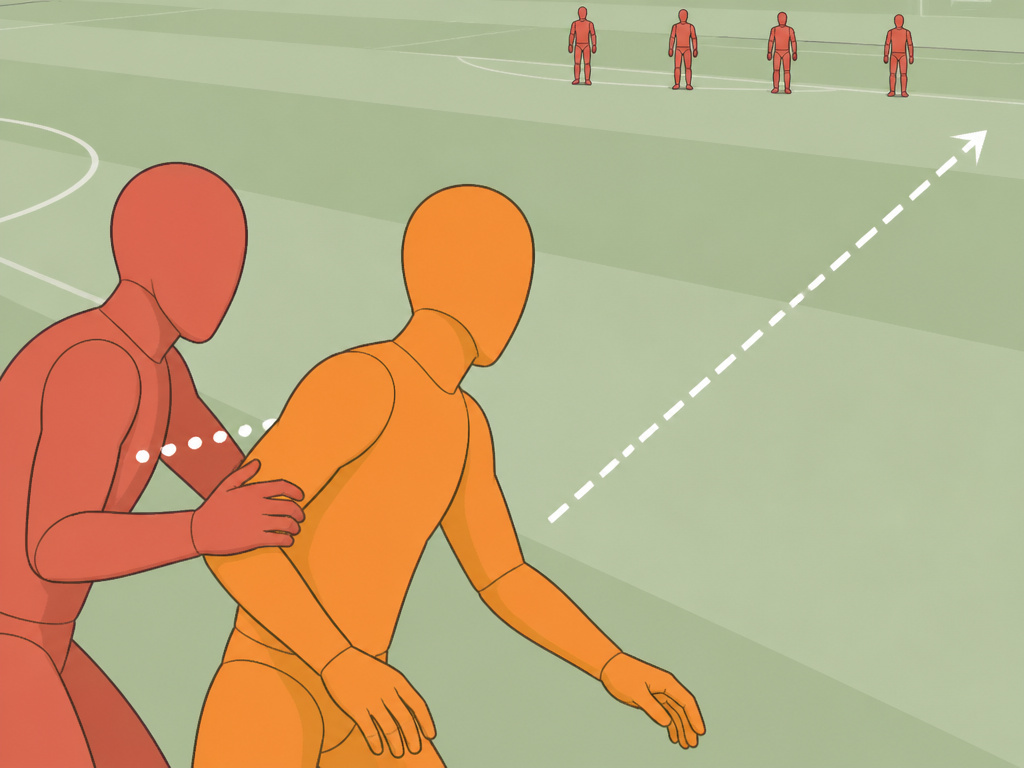
Second, the system can be broken by disciplined, pragmatic defending. The 1974 World Cup final is the textbook case. West Germany assigned man-marker Berti Vogts to shadow Johan Cruyff relentlessly, especially in the second half. By shutting down the primary playmaker and conductor, they disrupted the Dutch rhythm. The fluid passing chains stalled, and the positional rotations lost their purpose.
Where this goes sideways: The high defensive line, necessary for compactness, leaves massive space in behind. A well-timed through ball or a quick striker who beats the offside trap can punish the system catastrophically if the back line’s coordination fails.
| Total Football: Strengths vs. Vulnerabilities | Strengths | Vulnerabilities |
|---|---|---|
| Against Disorganised Defences | Overwhelms through constant movement and overloads. | Requires high player energy and coordination. |
| In Sustained Possession | Controls game tempo, tires opponents, creates chances. | Vulnerable to quick counter-attacks if possession is lost high up the pitch. |
| When Facing | Rigid, man-marking systems (like old Catenaccio). | Disciplined, zonal marking that doesn’t chase shadows. |
| When Facing | A single, mobile striker. | A fast strike partnership playing on the last shoulder of the high line. |
The Legacy: From Cruyff’s Barcelona to Guardiola’s City
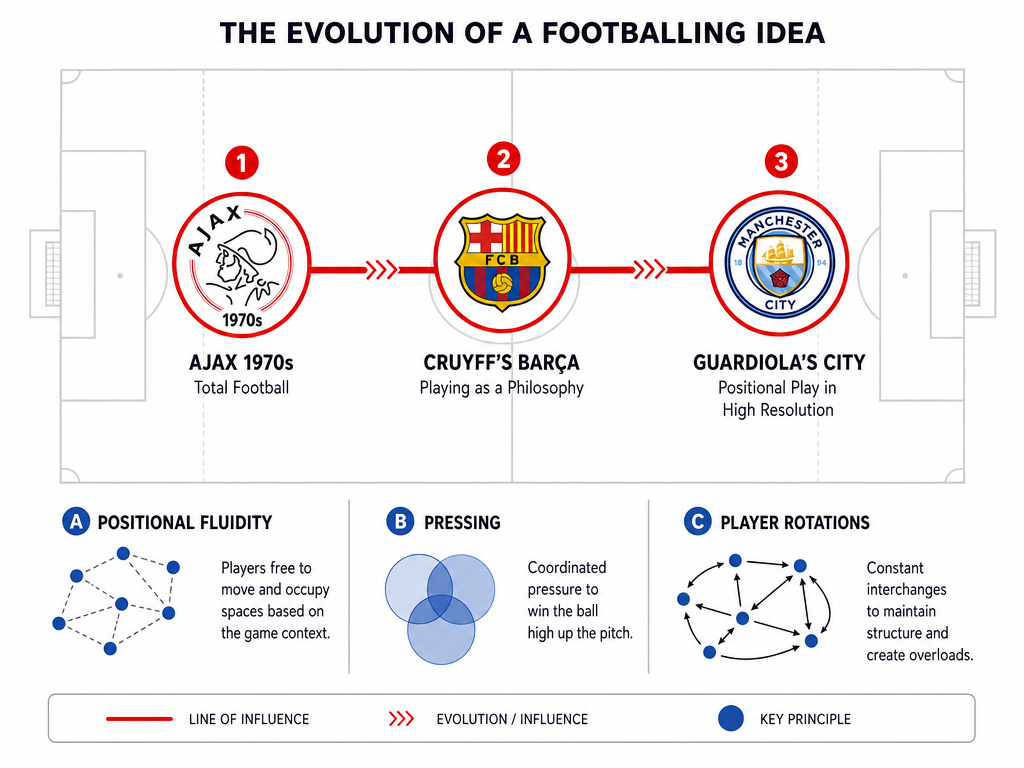
The Dutch didn’t win the 1974 World Cup, but they won the future. The clearest lineage runs through Barcelona. Rinus Michels coached there after leaving Ajax. Johan Cruyff later returned as manager from 1988 to 1996, creating the “Dream Team” that won the 1992 European Cup. More importantly, Cruyff overhauled Barcelona’s youth academy, embedding Total Football principles into the club’s DNA.
Pep Guardiola, a player in Cruyff’s Dream Team, is the system’s most famous modern disciple. He has called Cruyff “the most influential manager of all time.” Guardiola’s teams, at Barcelona, Bayern Munich, and Manchester City, are spiritual successors. The pressing, the positional fluidity (where full-backs tuck into midfield and wingers become strikers), and the obsession with possession all trace back to those Ajax training grounds.
You can see it in the way Manchester City use player rotations to create passing angles, or how they maintain compactness to enable their press. It’s not a direct copy; Guardiola added his own layers of complexity, but the foundational philosophy is unmistakable. Modern positional play is essentially Total Football refined with decades of additional data and analysis.
Other tactical movements absorbed its lessons. The high-pressing, gegenpressing style popularised by Jurgen Klopp and others owes a debt to that proactive Dutch defensive ideal. The idea that players should be versatile and tactically intelligent is now a scouting prerequisite at top clubs. Total Football didn’t just give us a few great teams; it fundamentally shifted the sport’s tactical axis.
What is a sweeper-keeper in Total Football?
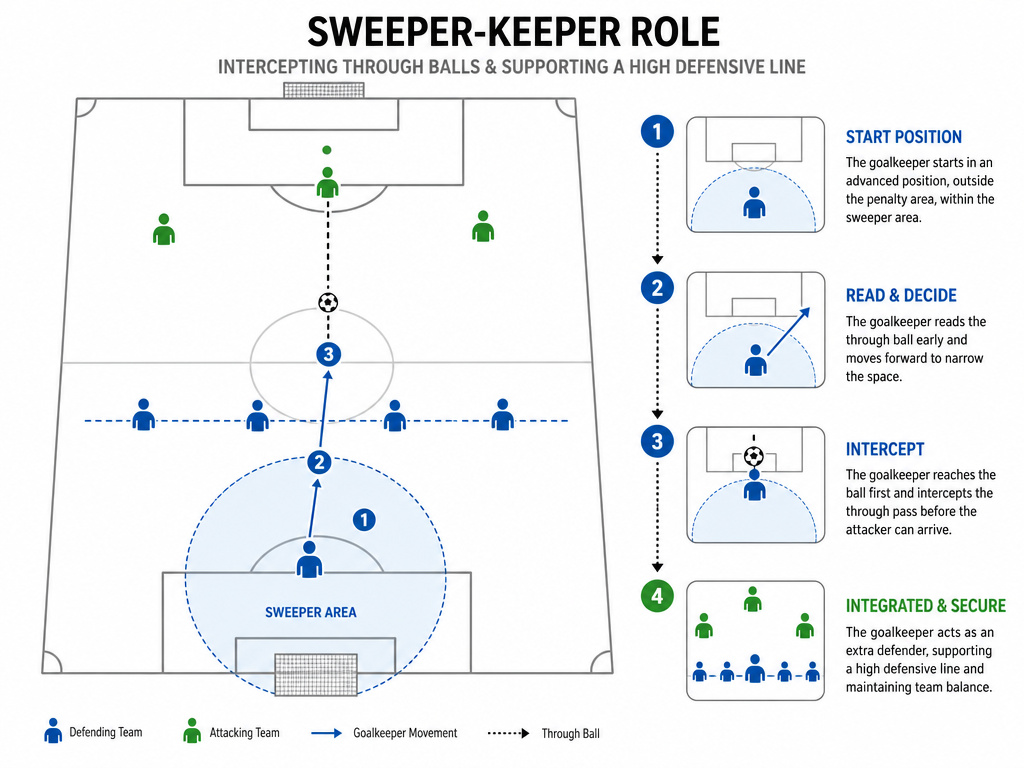
In this system, the goalkeeper is not just a shot-stopper but an active participant in the team’s tactical shape. Johan Cruyff famously described the philosophy as: ‘In my teams, the goalie is the first attacker, and the striker the first defender.’ This means the goalkeeper must be comfortable with the ball at their feet, ready to act as an extra outfield player to help maintain possession and start attacks. Their role is essential for the high defensive line, as they must sweep up any through balls that beat the defense. This demands high levels of football intelligence and technical ability, integrating the keeper fully into the team’s proactive, space-controlling strategy.
Frequently Asked Questions
What is the main concept of Total Football?
The main concept is that no outfield player is fixed to a single position. Players constantly interchange roles, a defender might become a winger, a midfielder might drop into defence, while teammates cover the spaces they leave. This maintains the team’s overall shape but creates a fluid, unpredictable attack and a coordinated, high press. It requires players with high football intelligence, technical skill, and versatility.
Does anyone still use Total Football today?
No team plays the pure, unadulterated 1970s Dutch version of Total Football. However, its core principles are now standard at the highest level. Pep Guardiola’s Manchester City is the clearest example, with its emphasis on positional rotation, high pressing, and possession control. The philosophy’s DNA is embedded in modern positional play, a direct descendant.
What is Total Football in Ted Lasso?
In the TV show Ted Lasso, the fictional AFC Richmond eventually adopts a tactics board labeled “Total Football.” It’s the show’s shorthand for a modern, fluid, attacking style of play where players are encouraged to be versatile and interchangeable. While simplified for television, it references the real-life system’s ethos of teamwork, flexibility, and proactive play over rigid, defensive structures.
How do you explain football to dummies using Total Football?
Imagine a basketball team where every player can dribble, pass, shoot, and defend. If the point guard drives to the basket, the center might pop out to the three-point line to cover his position, and the shooting guard might cut inside. They’re all constantly swapping jobs, but the team always has someone guarding the basket, someone on the perimeter, etc. Total Football is that idea on a soccer pitch, with the added rule that as soon as they lose the ball, they all swarm the opponent to get it back immediately.
Why did the Netherlands lose the 1974 World Cup final playing Total Football?
They lost for two key reasons. First, West Germany executed a perfect tactical counter by assigning Berti Vogts to man-mark Johan Cruyff out of the game in the second half, stifling the Dutch playmaking engine. Second, despite their dominant start and early penalty goal, the Netherlands couldn’t break down a disciplined, resilient German defence that exploited the few chances it got. The system’s vulnerability to neutralizing its chief conductor was exposed.
Before You Go
Total Football wasn’t a formation you could draw on a whiteboard. It was a shared belief system, a language of movement that required every player on the pitch to be fluent. That’s why it’s so rare and so beautiful when it clicks. It turns eleven individuals into a single, intelligent organism.
The next time you watch a Pep Guardiola team, don’t just watch the ball. Watch the weak-side winger holding his width until the exact moment the ball switches, or the full-back drifting into the half-spaces to create an overload. You’re seeing the direct inheritance of what Michels and Cruyff built. The scoreline might be modern, but the ideas controlling it are half a century old, proof that the best football tactics evolve.
This is what’s true about the game: the team that loses the final often dictates how the next generation learns to play. The Netherlands in 1974 didn’t get the trophy, but they won the argument. Everything since has been a footnote.
