
How the FIFA World Rankings Work: The SUM Formula Decoded
This post contains affiliate links. As an Amazon Associate, we earn from qualifying purchases.
The FIFA world rankings work on an Elo-based points system called SUM, where a team’s points after a match equal their previous points plus a match importance factor multiplied by the difference between the actual result and the expected result. The core formula is P = Pbefore + I * (W – We). This system, introduced in August 2018, rewards wins against stronger opponents in important matches and removes the confederation bias and points depreciation of the old model.
That formula is the engine. It converts every kick, every result, into a number that shuffles the global order. But the real story is in the tuning, how FIFA decided what makes a friendly in March less valuable than a World Cup qualifier in November, and why a penalty shoot-out win is worth more than a loss but less than a regulation victory. This tuning is central to understanding how the FIFA World Rankings work.
What follows is a breakdown of that tuning: the specific numbers behind the “I” factor, the clever bit of math that calculates the “We”, and the strategic wrinkles this creates for national teams, which is essential for anyone wanting to know how the fifa world rankings work. We’ll also walk through a real calculation, compare it to the old way of doing things, and look at how it shapes the tournaments we watch.
Key Takeaways
- The current SUM algorithm is a modified Elo system that adds or subtracts points after every match, replacing the old averaging method.
- Match importance (I) values range from 5 for an out-of-window friendly to 60 for a World Cup quarter-final onwards, making tournament matches massively consequential.
- A penalty shoot-out win is worth 0.75 (W) and a loss 0.50, a change from the pre-2018 system where a shoot-out win was worth 2 points and a loss 1 point in that system’s match result factor.
- Losses in knockout rounds after the group stage are excluded from the calculation, protecting teams from point deductions for losing in high-stakes elimination games.
- The expected result (We) uses a divisor of 600 in its formula: We = 1 / (10^(-dr/600) + 1).
The SUM Formula: P = Pbefore + I * (W – We)
We begin with the equation itself. It looks like algebra, but it’s really a story about reward and expectation.
P = Pbefore + I * (W – We)
P is the new points total after the match. Pbefore is the points before the whistle blew. The magic is in the last part: I (Importance) multiplied by (W – We).
(W – We) is the gap between what happened and what should have happened. If you win a game you were expected to win (W – We is a small positive number), you get a few points. If you pull off an upset (W – We is a large positive number), you get a lot. If you lose a game you were expected to win (W – We is negative), you lose points.
The I coefficient acts as the volume knob for that reward or penalty. A friendly match might have an I of 5 or 10. A World Cup final has an I of 60. The same level of upset in those two contexts yields massively different point swings.
The core ranking formula is P = Pbefore + I * (W – We). This Elo-type system, named ‘SUM’ by FIFA, was fine-tuned to give less importance to friendlies and more to final competitions, and was implemented in August 2018 after the FIFA World Cup.
The move to this Elo-based model was a direct response to the flaws of the old averaging system. The previous method could punish teams for playing too many friendlies or devalue points over time. Understanding how the fifa world rankings work reveals SUM is cleaner. Every match is a direct transaction.
Decoding the Match Importance Coefficient (I)
The ‘I’ value isn’t arbitrary. It’s a rigid scale that assigns a precise weight to every type of match a national team can play. This is where FIFA’s priorities are laid bare. Tournament football is everything.
Here is the full scale, directly from FIFA’s official procedure document.
| Match Type | Importance (I) |
|---|---|
| Friendly outside International Match Calendar window | 5 |
| Friendly during International Match Calendar window | 10 |
| Nations League group phase | 15 |
| Nations League play-off/final & World Cup/Confederation qualifiers | 25 |
| Confederation finals (e.g., Euros, Copa América) up to QFs | 35 |
| Confederation finals from QFs onwards & FIFA Confederations Cup | 40 |
| FIFA World Cup up to QFs | 50 |
| FIFA World Cup from QFs onwards | 60 |
The jump is the story. A World Cup quarter-final (I=60) has a much higher importance coefficient than a friendly played outside the International Match Calendar window (I=5). This makes sense, the stakes are infinitely higher, but it mathematically enshrines the gap.
Notice the distinction for friendlies. Playing a friendly during a designated International Match Calendar window, when clubs are obligated to release players, doubles the importance coefficient from 5 to 10.
Where this goes sideways: Assuming all friendlies are equal. Scheduling a showcase match outside the official window halves its potential points reward before a ball is kicked.
Match Result (W) and the Expected Result (We)
You know the importance. Now, what was the result, and what was expected?
The Actual Result (W)
This is straightforward for a standard match:
- Win (in regulation or extra time): W = 1
- Draw: W = 0.5
- Loss: W = 0
Penalty shoot-outs are different. FIFA treats them as a unique, slightly muted outcome:
- Penalty shoot-out win: W = 0.75
- Penalty shoot-out loss: W = 0.50
This is a change from the pre-2018 system, which awarded 2 points for a shoot-out win and 1 for a loss. For a match result (W), a win via penalty shoot-out is valued at 0.75.
The Expected Result (We)
This is the probability of you winning the match before it starts, based purely on the difference in ranking points between the two teams. It uses this formula:
We = 1 / (10^(-dr/600) + 1)
Where dr is the difference in rating points (your points minus your opponent’s points).
Don’t let the exponents scare you. The key is the 600 in the divisor. This is FIFA’s tuning parameter. The expected result (We) formula uses a divisor of 600: We = 1 / (10^(-dr/600) + 1).
If two teams have identical points (dr = 0), then We = 0.5. Each team has a 50% expected chance. If you have 100 more points than your opponent, the formula spits out an expected result (We) of about 0.64. You’re favored.
The expected result for one team is We; for the opponent it is 1 – We.
A Real-World Calculation
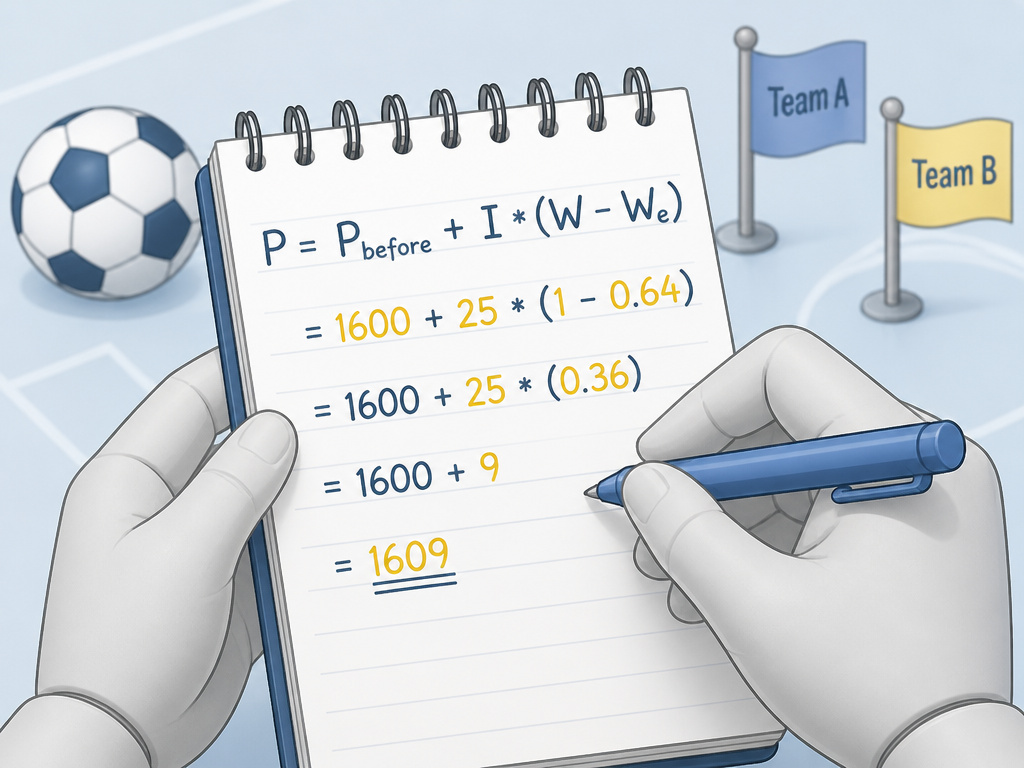
Let’s make this concrete. Imagine Team A (1600 points) plays Team B (1500 points) in a World Cup qualifier.
- Determine (I). A World Cup qualifier has an I = 25.
- Determine (W). For example, Team A wins 2-1 in regulation. So W = 1.
- Calculate (dr). 1600 – 1500 = +100 for Team A.
- Calculate (We). We = 1 / (10^(-100/600) + 1). This works out to We ≈ 0.64. Team A had a 64% chance of winning based on rankings.
- Plug into the formula. P = 1600 + 25 * (1 – 0.64) P = 1600 + 25 * (0.36) P = 1600 + 9
New Points = 1609
Team A gains 9 points. Team B, with an expected result of 0.36 (1 – 0.64), gets: P = 1500 + 25 * (0 – 0.36) = 1500 – 9 = 1491.
They lose 9 points. The zero-sum exchange is clear.
Now, what if Team B pulled off the upset? If Team B wins (W=1), their calculation is: P = 1500 + 25 * (1 – 0.36) = 1500 + 16 = 1516. Team A would lose 16 points: P = 1600 + 25 * (0 – 0.64) = 1600 – 16 = 1584.
The underdog gains more for the upset (16) than the favorite would have gained for an expected win (9). The system self-corrects.
The Knockout Round Exception & Strategic Implications
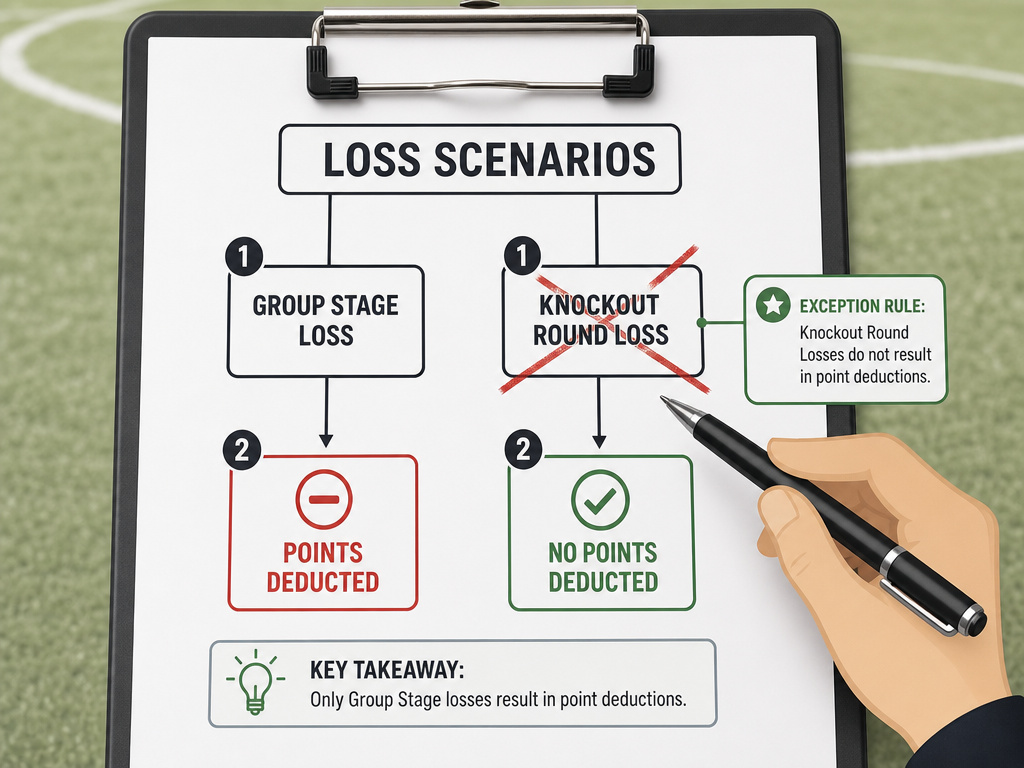
Here’s the most fascinating rule in the entire system, and it’s one most fans miss.
Losses in the knock-out rounds of final competitions are excluded from the ranking calculation.
Read that again. If you lose in the knockout stages of the World Cup, continental championship (like the Euros), or Confederations Cup, you do not lose any ranking points for that defeat.
Losses in the knock-out rounds of final competitions are excluded from the ranking calculation. The points gained on the path to the semi-final stand. The loss itself is ignored.
Losses in the knock-out rounds of final competitions are excluded from the ranking calculation.
Losses in the knock-out rounds of final competitions are excluded from the ranking calculation, while losses in the group stage are included.
How This Compares to the Old System
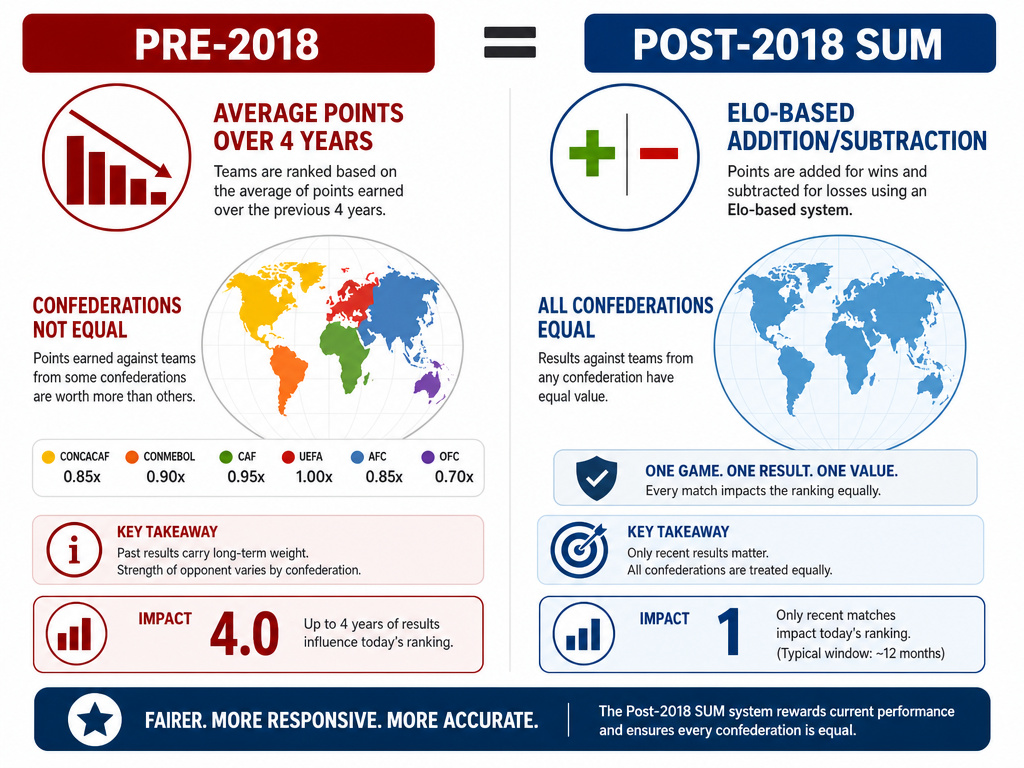
The SUM system replaced the pre-2018 ranking model. The differences between the pre-2018 and post-2018 systems are significant.
| Aspect | Pre-2018 System | Post-2018 SUM System |
|---|---|---|
| Core Method | Average points per match over a 4-year period, with yearly depreciation. | Simple addition/subtraction (Elo-based). No depreciation. |
| Match Points (M) | Win=3, Draw=1, Loss=0. PSO Win=2, PSO Loss=1. | Win=1, Draw=0.5, Loss=0. PSO Win=0.75, PSO Loss=0.5. |
| Confederation Weight (C) | Yes. Multiplied results by a coefficient (e.g., CONMEBOL=1.0, AFC=0.85). | Removed. All confederations treated equally. |
| Knockout Losses | Points were deducted. | Excluded from calculation. |
| Friendlies | Lower weight, but no distinction based on calendar. | Distinguished between in-window (I=10) and out-of-window (I=5). |
The removal of the confederation strength multiplier was a huge deal. Previously, a win for a South American team (CONMEBOL) was inherently worth more than a win for an Asian team (AFC), based on historical World Cup performance. SUM erased that bias, theoretically giving every nation an equal ladder to climb.
The pre-2018 system used an averaging method over a period with depreciation, while the SUM system uses direct addition/subtraction without depreciation.
The Women’s World Ranking: A Different Model
It’s crucial to know that the FIFA Women’s World Ranking operates on a different, though philosophically similar, system. It’s also Elo-based but has unique quirks.
Its basic formula is New rating points = old rating points + (Actual result – Expected result). The key differences are in the adjustments:
- Home/Away Advantage: The home team’s rating is enhanced by 100 points to account for home-field advantage before calculating the expected result. In the Women’s Ranking, home teams keep 66% of points available, away teams keep 34%.
- Match Importance: The multiplier works on a scale. A Women’s World Cup match has four times the importance of a friendly, while qualifiers have three times the importance.
- Top-10 Friendlies: Friendly matches between two top-10 ranked teams are given double importance.
The FIFA Women’s World Ranking operates on a different, though philosophically similar, Elo-based system.
What the Rankings Are Used For
The rankings aren’t just a debating tool for fans. They have real-world consequences that shape the biggest events in football.
Primarily, they are used for seeding in tournament draws. For the World Cup, the pots for the final draw are largely determined by the FIFA ranking at the time. Being in Pot 1 means avoiding other top-ranked teams in the group stage. Similarly, the rankings are used to seed teams in confederation championship draws and World Cup qualifying group stages.
This practical application is why the mathematical integrity of the system matters. A flaw in the formula doesn’t just produce a wrong list; it can unfairly shape the path of a tournament.
The rankings also determine annual awards like “Best Mover of the Year,” and in some countries, they are even used in bureaucratic processes like granting work permits to foreign players.
Where to find the current list of ranked teams
FIFA publishes an updated world ranking list each month. This official list shows the position and point total for every men’s national team that has played enough matches to be included. The ranking is used for practical purposes like seeding teams into pots for major tournament draws, including World Cup qualifying and the final tournament itself. The list is dynamic, changing after every set of international matches as points are added or subtracted based on results.
Frequently Asked Questions
How often are the FIFA world rankings updated?
FIFA publishes an updated ranking each month. The calculation includes all FIFA-recognized international ‘A’ matches played since the previous ranking list was released.
Why did my team’s ranking drop after they didn’t even play?
Because other teams around them did play, and won points. The ranking is a relative table. If you’re idle while teams below you earn points in competitive matches, they can close the gap and overtake you, even if your points total remains unchanged.
Are the rankings accurate?
They are accurate at measuring what they measure: a team’s consistent performance in official matches over a rolling period. They are less accurate at predicting one-off tournament winners, as they don’t capture current form, injuries, or tactical matchups. The 2018 SUM system removed confederation weighting and introduced a new scale for match importance.
How does the ranking handle a new national team?
New team needs to play five official matches against already-ranked opponents to receive an initial ranking. Their starting rating is calculated based on the results of those matches. For the women’s ranking, a team inactive for 48 months is removed entirely and must re-enter through the same process.
Has only one team ever been ranked number one?
No. Since the rankings began in 1992, only eight nations have reached the top spot: Argentina, Belgium, Brazil, France, Germany, Italy, the Netherlands, and Spain.
Before You Go
The ranking system is a machine for turning chaos into order. It takes the unpredictable beauty of a single match and distills it into a cold, logical number. The SUM formula’s elegance is in its directness, you see the transaction after every game.
But remember the loopholes and advantages. The knockout loss rule makes a tournament run pure gain. The friendly weightings create a calendar game within the game. And that 600 in the expected result formula is the hidden dial controlling how much an upset is really worth.
So next time you see a ranking update, look past the movement. Think about the I. Think about the We. You’re not just looking at a list; you’re reading the receipt for every international match played that month.
