
How the Olympic Football Tournament Works?
This post contains affiliate links. As an Amazon Associate, we earn from qualifying purchases.
The Olympic football tournament runs on a set of rules distinct from the FIFA World Cup, with the men’s event restricted to players born on or after 1 January 2001, plus a maximum of three overage exceptions. Sixteen men’s and twelve women’s teams qualify through continental competitions, play a group stage, then advance to a knockout round where draws go to a 30-minute extra time and then a penalty shootout. The men’s tournament is a U-23 competition because clubs are allowed to reject call-ups, while the women’s event features full senior national teams.
That age rule for men is the tournament’s most famous quirk, but it’s not the only one. The split format, the club release wrinkle, and even the tiebreaker order are all shaped by a single fact: this is an International Olympic Committee event run under FIFA’s laws. The rules live in the space between those two governing bodies, which explains how the Olympic football tournament works.
What follows is a breakdown of the format, the qualification maze, the match rules, and the practical realities that make Olympic football a unique beast on the international calendar, essentially explaining how the Olympic football tournament works.
Key Takeaways
- The men’s tournament is a U-23 competition with three overage players allowed, while the women’s event has no age restrictions.
- Clubs can refuse to release players for the men’s tournament, a key factor affecting team strength.
- Qualification is a continental free-for-all, with each confederation running its own preliminary competition to fill its allocated slots.
- Knockout matches that are tied after 90 minutes go to two 15-minute periods of extra time, followed by a penalty shootout if needed.
The Core Tournament Format: Men’s vs. Women’s
The most immediate difference is the field size. For Paris 2024, the men’s tournament featured 16 teams, while the women’s tournament had 12. This imbalance is temporary. That shift acknowledges the growth of the women’s game and the logistical challenges of fitting a larger men’s tournament into the packed summer calendar.
The group stage structure follows from those numbers. The 16 men’s teams are split into four groups of four. The top two from each group advance to the quarter-finals. Simple.
The women’s group stage format is slightly more complex to fill an eight-team knockout bracket. Twelve teams are divided into three groups of four. The top two from each group qualify, and they are joined by the two highest-ranking third-place teams. This system ensures every group match has high stakes, as even a third-place finish can be enough to progress.
Where this goes sideways: Assuming the men’s and women’s tournaments are identical. The squad rules, release obligations, and even the group stage math are fundamentally different. Treating them as the same event is how you miss the story.
The Infamous Age Rules and Squad Limits
The game’s constraints often create its most compelling stories. The men’s age limit is the prime example.
According to the official FIFA regulations approved in December 2022, all players in the men’s competition must have been born on or after 1 January 2001. That’s the U-23 rule. The critical exception? Each team can name a maximum of three overage players. Two of the 18 must be goalkeepers. Teams are also permitted four alternate players for injury replacement.
The women’s tournament has no age restrictions. It’s a full senior competition. This discrepancy has historical roots in the Olympic ideal of amateurism, but today it’s more about the football calendar. The summer of an Olympic year is already crammed with continental championships like the Euros and Copa America. Making the men’s event a youth tournament prevents direct conflict for player availability.
| Rule | Men’s Tournament | Women’s Tournament |
|---|---|---|
| Age Limit | U-23 (born on/after 1 Jan 2001) | No age limit |
| Overage Players | Maximum of 3 allowed | Not applicable |
| Squad Size | 18 players (2 must be GKs) | Not specified in fact sheet |
| Club Release | Clubs can refuse | Clubs cannot refuse |
| Tournament Size (2024) | 16 teams | 12 teams |
The club release rule is the silent disruptor. FIFA regulations for senior international windows don’t cover youth tournaments. So, while a club must release a Brazilian star for the Copa America, they can, and often do, block that same player from going to the Olympics. This is why you rarely see the absolute global elite at the Games. Their clubs say no. For the women’s competition, this barrier doesn’t exist; clubs are not allowed to refuse call-ups.
The Path to the Games: A Continental Puzzle
Qualification is not a single, unified process. FIFA delegates it entirely to the six continental confederations (AFC, CAF, CONCACAF, CONMEBOL, OFC, UEFA). Each one runs its own preliminary competition, leading to a patchwork of qualifying tournaments that can span years.
The host nation qualifies automatically. The remaining slots are allocated by confederation. For the 2024 men’s tournament, the breakdown was:
- AFC (Asia): 3.5 slots
- CAF (Africa): 3.5 slots
- CONCACAF (North/Central America): 2 slots
- CONMEBOL (South America): 2 slots
- OFC (Oceania): 1 slot
Those half-slots (.5) represent an inter-confederation playoff. In 2024, the fourth-place team from Asia faced the fourth-place team from Africa for one final spot.
The women’s tournament had a similar confederation-based allocation, with two slots each for AFC, CAF, CONCACAF, and CONMEBOL, and one slot each for OFC and UEFA.
Since the format is “delegated to the confederations,” the process of qualifying for the Olympics varies greatly by region. South American teams might emerge from a dedicated Pre-Olympic Tournament, while European men’s teams qualify through the final stages of the UEFA European Under-21 Championship. This decentralized system makes the Olympic football qualification system a fascinating study in how different regions organize their football.
Match Rules: From Kick-Off to Penalties

Once the teams arrive, the matches themselves follow FIFA’s Laws of the Game, with specific tournament regulations layered on top. A standard match lasts 90 minutes, split into two 45-minute halves with a 15-minute half-time interval.
The stakes rise in the knockout rounds. If a match is tied after 90 minutes, it proceeds to extra time. The FIFA regulations for Paris 2024 are clear: extra time consists of two periods of 15 minutes. There’s a five-minute break after full-time, but no interval between the two extra-time periods. If the score is still level, the match is decided by a penalty shootout.
There’s an ongoing debate about the bronze medal match. There is a disagreement among sources: the Wikipedia page on Olympic football notes a historical precedent of skipping extra time in the bronze medal match under specific conditions, while the official 2024 FIFA regulations prescribe extra time for all knockout matches with no such exception noted. For the 2024 tournament, the FIFA regulations are the governing text. This is a classic example of where sources disagree, and in such cases, the current FIFA document is the governing text.
The group stage tiebreakers are a meticulous eight-step process. If teams are level on points, the order is: 1) goal difference in all group matches, 2) goals scored in all group matches, 3) points in matches between tied teams, 4) goal difference in matches between tied teams, 5) goals scored in matches between tied teams, 6) fair play points (yellow/red cards), 7) drawing of lots. This detailed sequence is crucial in tight groups where goal difference can decide who advances.
Why the Tournament Exists in a World Cup World
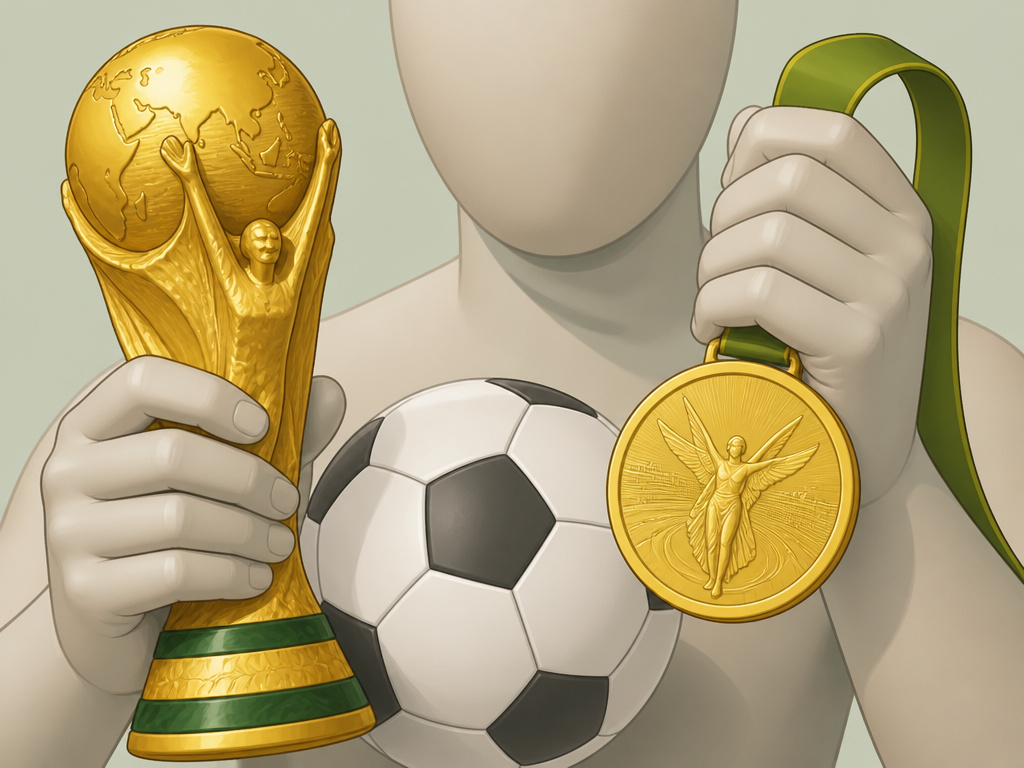
It’s a fair question. The FIFA World Cup is the clear pinnacle of international football. So what’s the point of the Olympic tournament?
For the women, it’s straightforward: it’s a second premier global championship, sitting alongside the Women’s World Cup in prestige. For the men, the answer is more nuanced. It’s a showcase for the next generation. You see future superstars on the Olympic stage years before they break through at a senior World Cup tournament. Think of players like Lionel Messi or Neymar, who won Olympic gold early in their careers.
It also offers a different kind of glory. An Olympic medal carries a unique weight, representing a multi-sport gathering of nations. For players from countries with less traditional football power, it can be their only chance at a major international podium. The tournament rewards adaptability and squad cohesion over pure star power, especially given the club release issues. A well-organized, hungry team of U-23 talents can often topple a squad of bigger names struggling for rhythm.
Frequently Asked Questions
What is the age limit for Olympic football?
For the men’s tournament, players must be born on or after 1 January 2001, making it a U-23 competition. Each team is allowed a maximum of three players older than that. The women’s tournament has no age limit.
How do teams qualify for the Olympic football tournament?
Teams qualify through their continental confederation (e.g., UEFA, CONMEBOL). Each confederation runs its own qualifying tournament, with a set number of slots allocated to each region. The host nation qualifies automatically.
Is Olympic football considered a major tournament?
For women’s football, absolutely, it is a top-tier global championship. For men, it is prestigious but sits below the FIFA World Cup and continental championships like the European Championship in the hierarchy, largely due to the age restrictions.
Do clubs have to release players for the Olympics?
For the men’s tournament, no. Clubs are allowed to refuse to release players for this youth competition. For the women’s tournament, yes, clubs are not permitted to block a player’s call-up.
What happens if a knockout match is tied?
If a knockout match is tied after 90 minutes, it goes to extra time: two periods of 15 minutes. If the score remains level after extra time, the winner is decided by a penalty shootout.
How many teams will be at the 2028 Olympics?
The format is changing for Los Angeles 2028. The men’s tournament will feature 12 teams, while the women’s tournament will expand to 16 teams, flipping the current model.
The Bottom Line
The Olympic football tournament isn’t a simpler version of the World Cup format. It’s a distinct competition built on a web of compromises, between club and country, between FIFA and the IOC, between a packed calendar and the desire for spectacle. Its rules, from the U-23 limit to the confederation-run qualifiers, create a unique event where narrative often trumps pedigree.
Watch for the teams that embrace that reality. The winner is rarely the one with the most famous names on paper. It’s the squad that best navigates the specific constraints of the tournament, turning its quirks into an advantage. That’s the real Olympic test.
