
How the AFC Asian Cup Works: Format, History, and Rules
This post contains affiliate links. As an Amazon Associate, we earn from qualifying purchases.
The AFC Asian Cup works through a four-year cycle of qualification and a finals tournament. The finals feature 24 teams divided into six groups of four, with the top two from each group and the four best third-placed teams advancing to a 16-team single-elimination knockout stage. It is the primary men’s national team competition for the Asian Football Confederation (AFC), determining the continental champion.
The tournament’s structure has evolved significantly since its four-team origins, most recently expanding to 24 teams in 2019. This shift wasn’t just about adding more teams, it fundamentally changed the tactical calculus for coaches and the narrative arc of the competition. The following outlines how the AFC Asian Cup works.
What follows: a breakdown of the modern 24-team format, the intricate qualification pathways, the tournament’s unique historical rhythm, and the specific rules, from squad registration to protest windows, that govern every match.
Key Takeaways
- The 24-team finals since 2019 use six groups of four, with 16 teams advancing to the knockout stage (top two plus four best third-placed teams).
- Qualification is a multi-stage process, and future cycles will integrate the new AFC Nations League into the pathway.
- The tournament is held every four years, deliberately scheduled to avoid clashing with the Summer Olympics and the UEFA European Championship.
- In the finals, teams can name up to 15 substitutes on the matchday squad list, a slight increase from the 12 allowed in qualifiers.
- A valid match protest must be submitted to the match commissioner within two hours of the final whistle, with a full report due within 24 hours.
The Finals Tournament Format (Since 2019)
The current format is a direct response to Asia’s growing depth. Before 2019, the 16-team setup felt restrictive. Now, with 24 teams, the group stage becomes a more complex puzzle.
The finals tournament comprises 24 teams. These are split into six groups of four. Each team plays the others in its group once. The top two finishers in each group automatically qualify for the Round of 16. They are joined by the four best third-placed teams from across all six groups. This creates a 16-team knockout bracket: Round of 16, Quarter-finals, Semi-finals, and the Final.
The 24-team format, as defined in the AFC Competition Regulations, creates a 16-team knockout stage from six initial groups. This structure guarantees at least three matches for every participant while allowing the strongest third-place teams a second chance, increasing competitive tension throughout the group phase.
This system rewards consistency but also injects drama into the final group matches. A team sitting third with three points knows its fate depends on results in other groups, goal difference, goals scored, and fair play points all become critical. It’s a format that encourages attacking play until the very end.
The knockout stage is pure single-elimination. If a match is level after 90 minutes, it goes to 30 minutes of extra time. If still tied, the outcome is decided by a penalty shootout. There are no replays. The stakes escalate with every round, and the physical toll is immense, a team that wins the trophy will have played seven matches in about a month.
How Teams Qualify for the Finals
Qualification is a marathon, not a sprint. It’s a separate competition entirely, often spanning two years before the finals. The host nation qualifies automatically, which for the 2027 edition is Saudi Arabia. The other 23 spots are fought for in a multi-round qualifying process.
The exact format can shift between cycles, but the foundational principle is a tiered system that gives lower-ranked nations a realistic pathway. It typically involves:
- Preliminary Round: The very lowest-ranked AFC members play off for a place in the next stage.
- Group Stage: The remaining teams (including those advancing from the preliminary round) are drawn into groups. Teams play home and away matches within their group.
- Direct Qualification: The group winners (and often the runners-up) secure their tickets to the finals.
The landscape is changing, though. The AFC has introduced its own AFC Nations League, mirroring UEFA’s successful model. This new competition will soon be woven into the Asian Cup qualifying framework. The Nations League will group teams by strength (League A, B, C, etc.), and performance in it will determine a nation’s qualifying path, or even grant automatic spots. It’s designed to replace meaningless friendlies with competitive matches that have tangible consequences.
| Qualification Stage | Primary Goal | Teams Advance |
|---|---|---|
| Preliminary Round | Filter lowest-ranked teams | Winners to group stage |
| Group Stage (Main Qualifying) | Determine top finishers | Group winners & best runners-up |
| AFC Nations League (Future) | Provide competitive fixtures & alternative qualification | High-performing teams may earn direct spots or favorable draws |
The process ensures the finals feature a mix of continental heavyweights and emerging football nations, which is central to how the AFC Asian Cup works. It’s how teams like the Kyrgyz Republic and the Philippines made historic first appearances in 2019.
Tournament History & Evolution
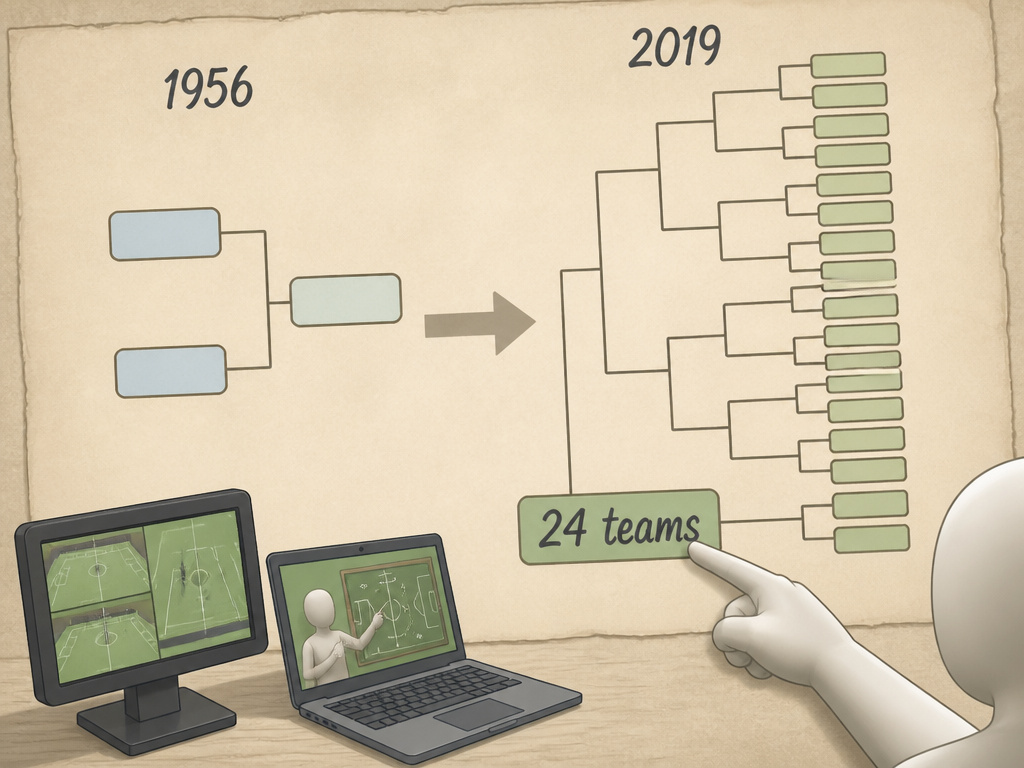
The tournament wasn’t born with its current scale or rhythm. The first AFC Asian Cup was held in 1956. The AFC History Book states that eight member associations vied in that first tournament, which was a simple four-team final event, though other sources report a different number of participants. For comparison, the first European Championship wasn’t held until 1960.
For decades, it operated on a steady four-year cycle. Then, the schedule hit a snag. The 2004 edition in China was moved to avoid clashing with the Summer Olympics and UEFA Euro 2004. This created a unique three-year gap, with the next tournament held in 2007. Since then, it has firmly settled into its current quadrennial schedule, deliberately avoiding Olympic and Euro years.
The 2007 edition was co-hosted by four Southeast Asian nations: Indonesia, Malaysia, Thailand, and Vietnam. This experiment in shared hosting created a unique logistical challenge and a fragmented “home” advantage, a model that hasn’t been repeated since.
Expansion has been the other constant theme. It grew to 8 teams, then 12 in 1996, and 16 in 2004. The jump to 24 teams in 2019 was the most significant. This allowed more nations to experience tournament football and acknowledged the competitive narrowing between Asia’s traditional powers and the chasing pack. It also increased the total number of matches, commercial appeal, and the sheer volume of stories generated.
Technological adoption has followed. The 2019 edition in the UAE was the first to use the Video Assistant Referee (VAR) system, from the quarter-finals onward. The AFC Asian Cup Qatar 2023™ also featured a notable collaboration with FIFA, where performance analysts provided detailed match data to teams via the FIFA Training Centre within 24 hours of matches concluding.
Tournament Rules & Regulations
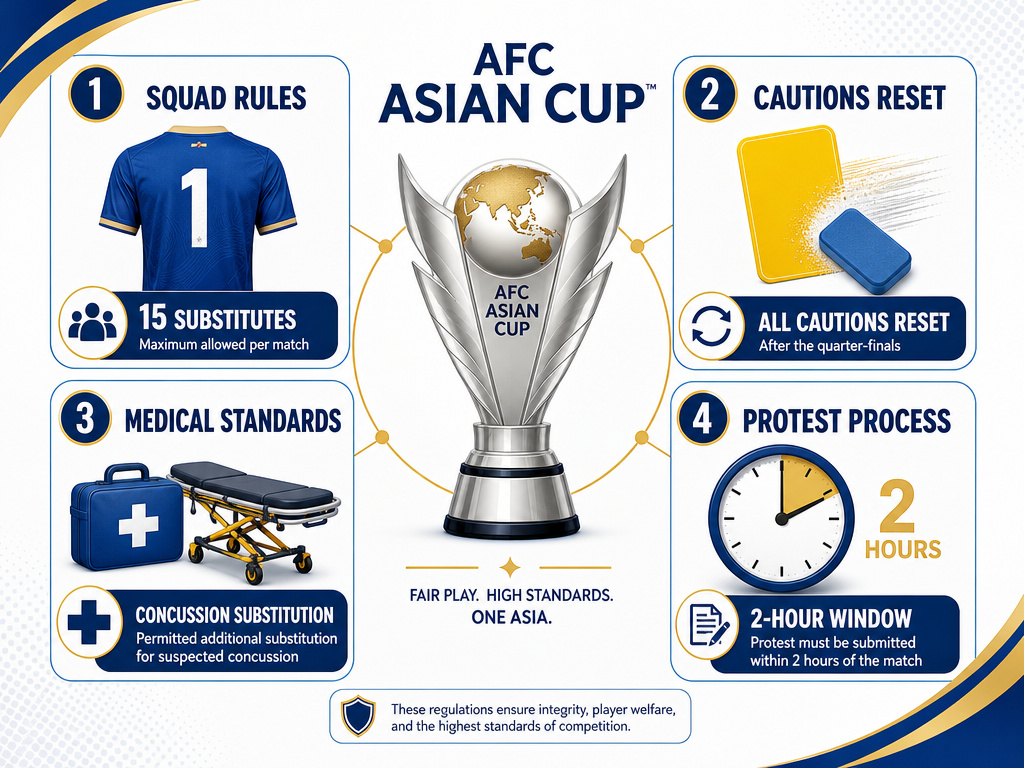
Beyond the format, the tournament is governed by a dense book of regulations. These aren’t just bureaucratic details; they shape how teams prepare and operate on the ground.
Squad and Matchday Logistics
For the finals, a team’s official delegation must include a minimum of 18 and a maximum of 23 players, plus 5 to 20 officials. Players must be assigned jersey numbers 1-26, with number 1 reserved for a goalkeeper. Teams can name up to 15 substitutes on the matchday list for finals matches, submitted 90 minutes before kick-off. In the qualifiers, that number is 12.
Player Replacement and Cautions
A team can request to replace a registered player due to serious injury or illness up until 24 hours before their first finals match. The caution system is also designed to prevent players missing a final for minor infractions. A player who receives only one yellow card during the Group Stage, Round of 16, and Quarter-finals does not carry that caution over to the Semi-finals.
Medical and Operational Standards
The AFC Competition Operations Manual mandates specific medical provisions for extreme environments, heat, cold, and haze, which is crucial for tournaments in desert climates like Saudi Arabia 2027. It also requires host organisations to prepare at least two teams of four stretcher bearers, all over 18 years old, positioned near the technical areas.
| Rule Category | Finals Specification | Consequence / Reason |
|---|---|---|
| Matchday Squad | Up to 15 substitutes | Allows greater tactical flexibility and player rotation during a congested tournament. |
| Player Registration | 18-23 players, numbers 1-26 | Ensures squad depth and standardized identification. Number 1 is for goalkeepers only. |
| Cautions (Yellow Cards) | Single caution wiped after Quarter-finals | Protects players from missing a final for a minor, isolated foul earlier in the knockout stage. |
| Injury Replacement | Allowed up to 24h before first match | Permits teams to replace seriously injured players without depleting their competitive options. |
The Protest Process
If a team wishes to formally protest a match event, the process is strict. A written protest must be submitted to the AFC Match Commissioner within two hours of the match ending. A full written report must then be sent to the AFC General Secretariat within 24 hours. This tight window forces teams to act quickly and decisively if they believe a serious error has affected the outcome.
The AFC Asian Cup vs. Other Continental Championships
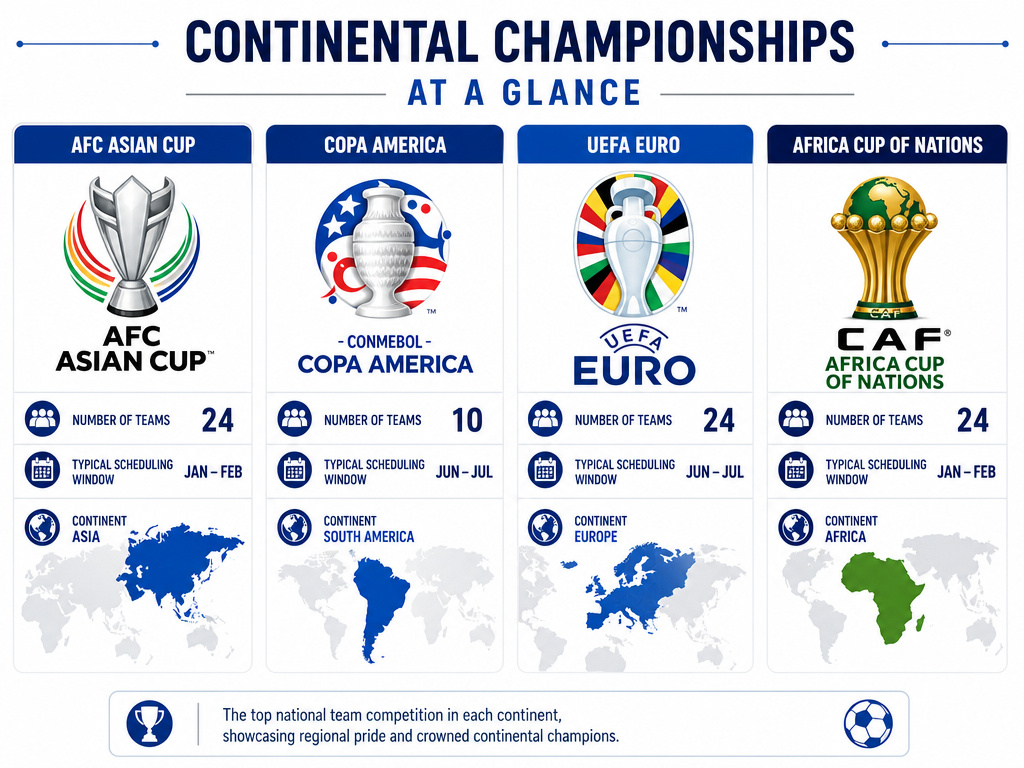
It’s useful to place the Asian Cup in a global context. Each continental championship has its own character, shaped by the number of member nations and their competitive balance.
The AFC Asian Cup is the second-oldest continental competition after South America’s Copa America. The 24-team finals it has used since 2019 match the size of the UEFA European Championship (which also expanded to 24 in 2016). However, Europe’s qualifying process is more straightforward, typically a straightforward group stage without the same tiered preliminary rounds Asia uses.
Africa’s Africa Cup of Nations (AFCON) also uses a 24-team format. A key difference is scheduling: AFCON moved to a mid-season slot in European leagues, causing significant club-vs-country tension, while the Asian Cup is generally held in January-February or the summer, depending on the host’s climate. North America’s CONCACAF Gold Cup is smaller (16 teams) and has a shorter, more concentrated finals tournament.
The Asian Cup’s unique challenge is geographical and climatic diversity. A tournament can span from the humid tropics to the dry desert, requiring immense adaptability from teams and strict medical protocols from organizers, as seen in the Operations Manual’s focus on extreme environment conditions.
Past Winners and Most Successful Teams
The tournament has crowned nine different champions, reflecting periods of regional dominance. Japan is the most successful nation in the modern era, with four titles (1992, 2000, 2004, 2011). Their technical, structured approach has often prevailed in tournament conditions.
Saudi Arabia and Iran each have three titles. Saudi Arabia’s wins came in a golden period (1984, 1988, 1996), while Iran’s dynasty was earlier (1968, 1972, 1976). South Korea has won twice, but not since 1960, a surprising drought for a nation that consistently qualifies for the FIFA World Cup. Other single-time winners include Kuwait (1980), Iraq (2007), Australia (2015), and Qatar (2019). Israel won in 1964 but is no longer an AFC member.
Qatar’s victory in 2019 was a landmark, signaling the rise of a new footballing project and breaking the long-held dominance of East Asian and West Asian powerhouses. It underscored how tournament football can be won by a cohesive unit with a clear tactical plan, not just a collection of star individuals.
Frequently Asked Questions
How often is the AFC Asian Cup held?
The AFC Asian Cup is held every four years. After the 2004 edition was moved to avoid clashes with the Olympics and UEFA Euro, a one-off three-year gap occurred, with the next tournament in 2007. It has been on a strict four-year cycle since.
What is the prize for winning the AFC Asian Cup?
The champion is crowned the continental champion and lifts the trophy. Historically, there has also been significant prize money. For the 2019 edition, the total prize fund was almost US$15 million, with champions Qatar receiving US$5 million.
Do yellow cards carry over in the AFC Asian Cup?
The rules are designed to prevent players from missing the final for minor offences. In the finals, a player who receives only one yellow card during the Group Stage, Round of 16, and Quarter-finals does not carry that caution over to the Semi-finals. Two yellows in separate matches within that same phase would still trigger a suspension.
How does hosting the AFC Asian Cup work?
The host nation qualifies automatically for the finals tournament. Hosting rights are awarded by the AFC to a member association through a bidding process.
What is the format of the knockout stage?
The knockout stage is a 16-team, single-elimination bracket starting with the Round of 16. Matches tied after 90 minutes go to 30 minutes of extra time. If still tied, the winner is decided by a penalty shootout. There is no second leg or replay.
Before You Go
The beauty of the AFC Asian Cup is in its blend of tradition and constant evolution, defining how the AFC Asian Cup works. It’s a tournament that remembers its four-team beginnings but now stages a 24-nation spectacle. The rules, from the 15-substitute list to the two-hour protest window, are the hidden architecture that keeps the competition fair and functional under immense pressure.
Watch for how the new AFC Nations League reshapes qualifying in the coming cycles. It promises to make the road to the finals more competitive and meaningful for every nation involved. And when the finals roll around, pay close attention to the third-place teams scrambling for those last knockout spots. That’s where the tournament’s unique format creates its most nerve-shredding drama. The details are where football lives.
