
Football Shirt Sponsor History Explained
This post contains affiliate links. As an Amazon Associate, we earn from qualifying purchases.
Football shirt sponsorship began on 24 January 1976, when non-league Kettering Town wore ‘Kettering Tyres’ on their shirts in a £4,000 deal. The Football Association ordered its removal, but by 1987 every league club had a sponsor, evolving from local businesses to global brands and, after 2026, facing a Premier League ban on gambling front-of-shirt logos.
That initial £4,000 fine and the FA’s 1977 decree for a small, non-detrimental logo set the commercial template for the next fifty years. The story isn’t just about money; it’s about how a club’s identity became a billboard, how sponsors shifted from selling beer to fans in the stands to targeting customers on another continent, and how the game’s regulators have chased a commercial train that left the station decades ago. This is the football shirt sponsor history explained.
What follows is the journey from that defiant day at Kettering to the multi-million pound global deals of today, the industries that have come and gone, and the new rules set to reshape shirts from the 2026-27 season in the football shirt sponsor history explained.
Key Takeaways
- The first recorded instance in England was Kettering Town in 1976, a £4,000 deal with Kettering Tyres that the FA initially banned, though some sources credit Coventry City in 1978.
- By the 1992-93 Premier League season, just over half of sponsors were UK-based and seven were within 100 miles of their club; by 2024-25, the average sponsor distance was 4,431 miles.
- Gambling became the top shirt sponsor industry in Europe (15% of deals), leading to a Premier League ban on front-of-shirt gambling logos from the 2026-27 season.
- Clubs have used sponsorship for social good, with FC Barcelona partnering with UNICEF and AS Roma displaying ‘Roma Cares’ for a season without a commercial deal.
- The longest unbroken Premier League partnership is Emirates and Arsenal, on the shirt every season since 2006-07.
The First Shirt Sponsorship: Who, When, and Why?
The accepted history points to 24 January 1976. Kettering Town, then of the Southern League, ran out with ‘Kettering Tyres’ printed across their chests. Their chairman, Derek Dougan, had secured a deal worth £4,000. The FA’s response was swift. They ordered the lettering removed. Dougan reportedly pared it back to just ‘Kettering T’, but that wasn’t enough either. The sponsor came off.
The FA’s initial ban on Kettering Town’s sponsor in 1976 was based on the principle that advertising was not permitted. This changed in June 1977 when they decreed a small logo would be permitted, provided it met the same non-detrimental standard.
That’s where the story gets interesting. Sources disagree on who truly pioneered the practice after the rules softened. The BBC News report on Kettering Town sponsorship firmly credits Kettering as the first English club. However, the Wikipedia entry on English football sponsorship states shirt sponsorship “was pioneered by Coventry City in 1978 after they were sponsored by Talbot.” It’s a classic football history debate: who was first on the pitch versus who first made it stick within the new regulations. Both were crucial.
The resistance didn’t end with rule changes. In October 1980, a scheduled TV broadcast of an Aston Villa vs. Brighton match was cancelled because both teams refused to play without their sponsored shirts. The following January, Newcastle United and Bolton Wanderers were each fined £1,000 for wearing ads in FA Cup games. UEFA fined Nottingham Forest £7,000 in February 1981 for the same offence in Europe. The message from clubs was clear: this revenue was essential. By 1987, every league club had a deal.
The Premier League Era: From Carling to Crypto
The formation of the Premier League in 1992 didn’t just change football; it changed the market for the space on a player’s chest. The inaugural 1992-93 season is a snapshot of a different commercial world. None of the 22 founding clubs had a gambling sponsor. Just over half of the sponsoring companies were headquartered in the UK. Seven sponsors were based within 100 miles of their club, with the average distance being 1,859 miles.
Look at the sponsors now: a global finance house, a Middle Eastern airline, an Asian travel platform. The local brewer is long gone. This shift is the single biggest change in the football shirt sponsor history explained. It moved sponsorship from a direct sales tool targeting local fans to a global brand-awareness play.
| Era | Typical Sponsor Industries | Club-Sponsor Relationship | Primary Audience |
|---|---|---|---|
| Early 1990s | Alcohol (Carling), Electronics (JVC), Retail (JD Sports) | Local/National, often within 100 miles. | Domestic fans in the stadium. |
| 2000s | Mobile Networks (Vodafone), Airlines (Emirates), Finance (AIG) | Global, multi-national corporations. | International TV audience. |
| 2010s-2020s | Gambling, Financial Services (Standard Chartered), Cryptocurrency | Remote, often based in tax havens or other continents. | Overseas markets (e.g., Asia). |
This table shows the complete transformation. The BBC Sport analysis of Premier League sponsors notes that by the 2024-25 season, the average distance between a Premier League club and its sponsor’s main office was 4,431 miles.
Globalisation and the End of Local Deals
Why does a club in the English Midlands have a sponsor based in Southeast Asia? The answer is in the Premier League’s broadcast reach. The league claims its matches are shown in 188 of the world’s 193 UN-recognised countries. Your shirt isn’t just seen in a pub in Bolton; it’s on a screen in a bar in Bangkok. This turned the shirt from a local billboard into a global one.
The financial incentives flipped. A sponsor isn’t trying to sell a physical product to the fan in row Z anymore. They’re after legitimacy, brand association, and access to a lucrative overseas market. This is the core of modern club revenue strategies. For example, Standard Chartered, Liverpool’s sponsor since 2010-11, does not offer current accounts to UK customers. Their target market is in Asia and Africa.
This globalisation directly enabled the rise of the gambling sponsor. Many of these firms are “white label” companies based in places like Curacao or Malta, targeting customers in regions like Asia where their advertising might otherwise be restricted. They use the Premier League’s global credibility to reach those audiences. As one lecturer told the BBC, they’re “advertising in the UK, not China, so the Chinese government can’t do anything about it.”
The Gambling Boom and the Coming Ban
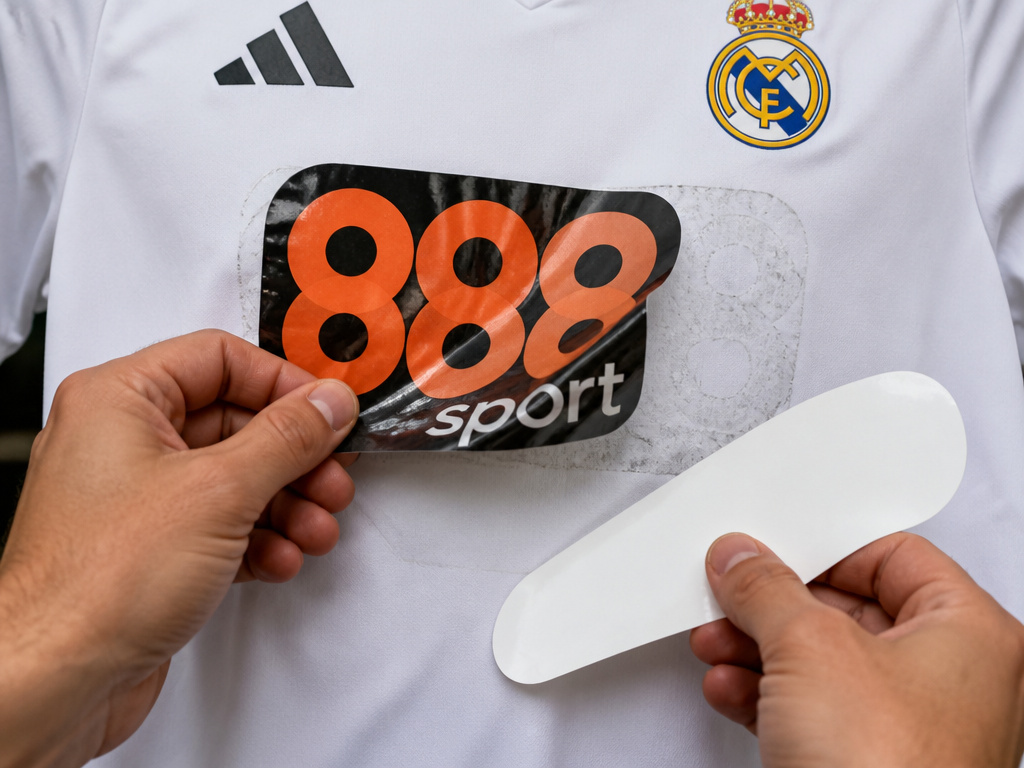
Gambling didn’t just become common in England. According to a UEFA report, it’s the most common shirt sponsor for top-division clubs in seven European countries: Belgium, Greece, Hungary, the Netherlands, Poland, Portugal, and Russia. Across Europe’s top divisions, 15% of all shirt sponsors are from the gambling industry.
In England, the peak came in the 2024-25 Premier League season, when 11 of the 20 clubs featured a gambling sponsor on the front of their shirts. The combined value of those deals was $135.43m (£101.1m). The Championship had six clubs with gambling sponsors, and three Scottish Premiership clubs (Celtic, Dundee United, Rangers) did too.
The part nobody mentions: The front-of-shirt ban, while significant, is narrow. Gambling logos can still appear on shirt sleeves, training kit, stadium hoardings, and as official club partners. The deals in place when the ban was agreed were worth roughly £60m a year.
The industry’s omnipresence led to a self-imposed correction. In April 2023, all 20 Premier League clubs agreed to withdraw gambling sponsorship from the front of matchday shirts. They gave themselves a three-season transition period, meaning the ban takes full effect from the 2026-27 season onwards. This was a voluntary move, a first for a UK sports league, following government and public pressure.
Iconic and Unusual Sponsorship Stories
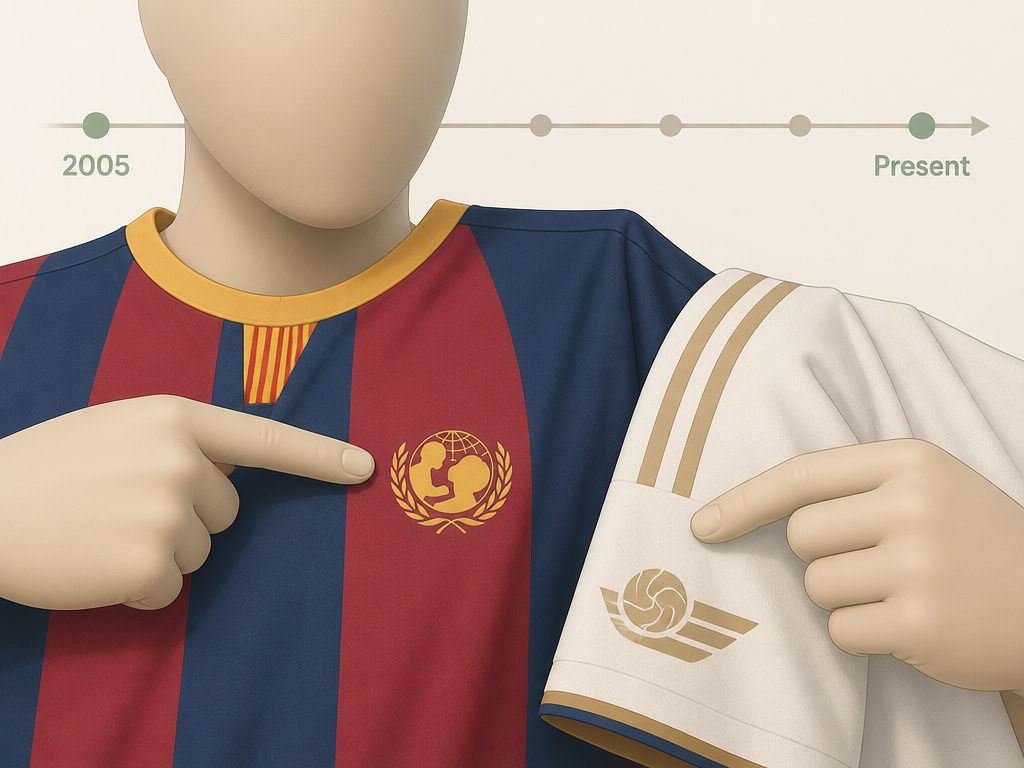
Not every deal follows the money. Some of the most memorable sponsorships have broken the mould entirely.
FC Barcelona famously refused commercial shirt sponsors for years. In 2005, they announced a groundbreaking partnership with global charity UNICEF. In a complete reversal of the standard model, Barcelona paid UNICEF for the privilege of wearing their logo, a gesture of social responsibility. It wasn’t until 2011 that they took a paying commercial sponsor (Qatar Foundation), and later a deal with Rakuten valued at around £47m per year.
AS Roma had its own principled pause. After their deal with Wind ended, the club went five years without a main commercial sponsor. For the 2013-14 season, they displayed their own charity, ‘Roma Cares’, on the front of the shirt. It was a statement of identity in a commercial age.
On the other end of the spectrum, longevity creates its own iconography. The longest unbroken shirt sponsorship in Premier League history is Emirates and Arsenal, a partnership that has been on the shirt every season since 2006-07. Liverpool, meanwhile, have used only two shirt sponsors in the Premier League era: Carlsberg and Standard Chartered (ongoing since 2010-11). These long-term deals become part of the club’s visual history, woven into the fabric of classic retro football jerseys.
Rules, Regulations, and Fan Identity
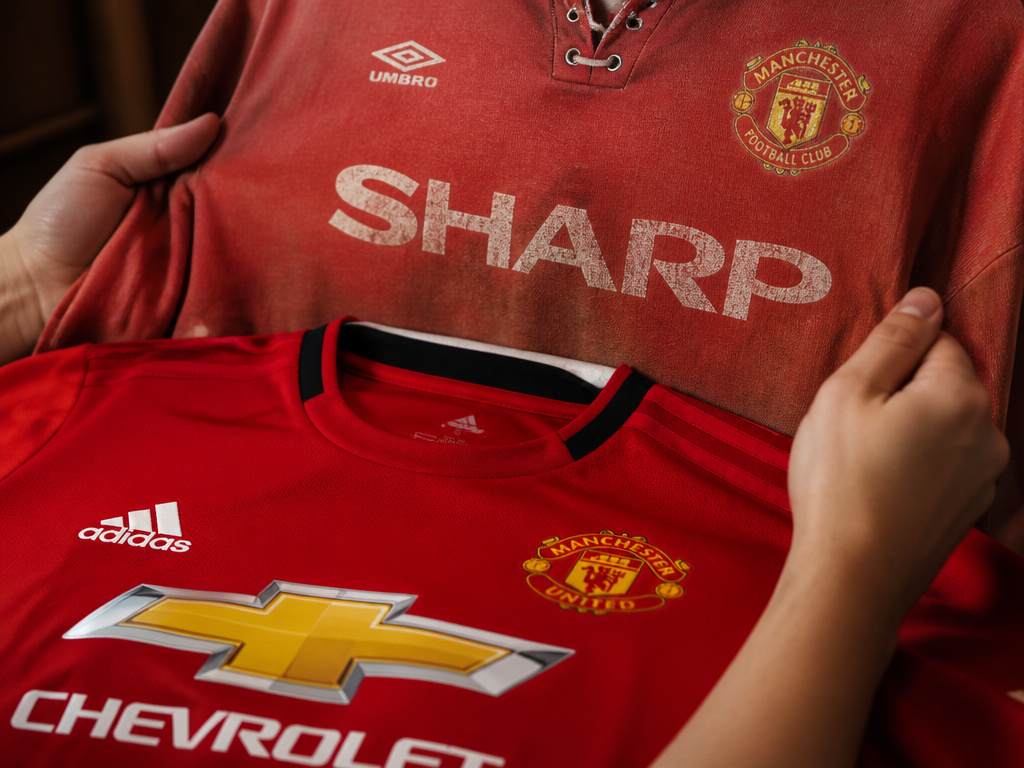
The relationship between fans and the sponsor on their chest is complex. For some, it’s a hated corporate intrusion. For others, a sponsor can become a nostalgic trigger, a key part of the kit’s identity. This emotional connection is why retro reissues sell so well.
The regulations have always tried to balance commercial reality with the sport’s image. From the FA’s 1977 “not detrimental” rule to UEFA’s strictures on sponsor size and placement, the framework is detailed. Modern football kit components include not just the front-of-shirt sponsor but often a sleeve partner, a technical supplier logo, and sometimes a charity badge. It’s a carefully managed asset.
This commercial layer also created a market for counterfeit shirts, something you learn to identify when you start to spot a fake shirt.
Frequently Asked Questions
When did football shirts start having sponsors?
The first recorded instance in England was on 24 January 1976, when non-league Kettering Town wore ‘Kettering Tyres’. The practice was immediately banned by the FA, but rules were relaxed in June 1977, allowing small logos. By 1987, every league club had a shirt sponsorship deal.
Who is the biggest shirt sponsor in football?
The ‘biggest’ can mean most valuable or longest-lasting. One of the most valuable annual deals was FC Barcelona’s partnership with Rakuten, reportedly worth around £47m per year. For longevity, the partnership between Emirates and Arsenal, ongoing since 2006-07, is the longest unbroken front-of-shirt deal in Premier League history.
Why do NFL teams not have shirt sponsors?
American sports leagues like the NFL have traditionally derived massive revenue from exclusive TV deals and merchandise sales, lessening the need for shirt sponsors. They also maintain stricter control over uniform aesthetics for brand consistency. Football (soccer), with its global club-based model, embraced shirt sponsorship early as a crucial direct revenue stream.
What are the rules for sponsoring football shirts?
Rules are set by governing bodies like the FA and UEFA. They typically govern the size of the logo (it cannot exceed a certain area), its placement (usually centered on the chest), and content (bans on tobacco, and from 2026 in the Premier League, front-of-shirt gambling ads). Clubs also have to ensure sponsors don’t conflict with league partners.
Before You Go
The journey from Kettering Tyres to the 2026 gambling ban tells the story of modern football itself: local roots, global explosion, commercial saturation, and eventual regulatory pullback. That little logo is a mirror.
One rule of thumb for the future: watch the sleeves and the training wear. With the front-of-shirt gambling gate closed, that’s where the next commercial battle will be fought. The space on a football shirt is finite, but the ingenuity of marketers is not. The story that started with a £4,000 tyre deal is far from over.
