
Football Shirt Sizing Guide: How to Get the Right Fit
This post contains affiliate links. As an Amazon Associate, we earn from qualifying purchases.
To find the right football shirt size, ignore the label and measure your chest circumference. Match your chest circumference in inches or centimeters to the specific chart for the exact shirt you’re buying, because a generic ‘M’ from Nike is not the same as an ‘M’ from Adidas, and a Player Version fits one size smaller than a Fan Fit. Always use the chart attached to the product listing, never a generic brand guide. For clarity, always consult the football shirt sizing guide provided with the product.
The chest measurement is the anchor, but what that number represents changes everything. Some charts tell you how to measure your body; others list the flat width of the shirt itself. Plugging your body number into a garment-width chart gets you a shirt that’s two sizes too small. The rest is about cuts, eras, and knowing when the standard advice flips.
What follows: how to read the two types of charts, why Player and Fan shirts fit differently, how to decode confusing numeric sizes, and what to do when your body type doesn’t match the standard mold.
Key Takeaways
- Ignore the generic “size up” rule. It fails for slim-fit Player Version shirts, where sizing up is actually correct, and for already-roomy replicas where it creates a sack.
- Match measurement type to chart type. Nike and Adidas official charts use body chest circumference; manufacturer spec sheets like Apparel4Print list flat garment width.
- Player Version shirts run one size smaller. For a comfortable, everyday fit in an authentic/match-spec shirt, order one size up from your usual Fan Fit size.
- Vintage shirts (pre-2010) tend to run larger. A modern size L will be tighter than an L from the 1990s, check individual listings for garment measurements.
- Kids’ sizing should use height and chest, not age. A size labelled “Age 9-10” can vary by 10 cm in chest measurement between brands.
The Two Types of Size Charts (Body vs. Garment)
A size chart is either a map of the human body or a blueprint of the shirt. Using the wrong one is how you order a shirt that fits like a borrowed jacket or a compression top.
This is the single biggest trap. Most official brand guides, like the current Nike and Adidas charts, use body chest measurements. You wrap a tape around the fullest part of your chest, under your arms, and keep it level. That number, say, 100 cm, is what you match to their table.
But many retailers and all manufacturer spec sheets use flat garment measurements. They lay the shirt flat, measure from armpit seam to armpit seam (the “half chest”), and sometimes double it for a “full chest width” circumference. If a chart lists a “Half Chest” of 50 cm, that means the shirt’s flat width is 50 cm, which translates to a 100 cm circumference.
Plugging your 100 cm body into a chart that expects a 100 cm garment circumference is a disaster. A shirt needs ease, room to move, so a 100 cm body needs a shirt with a chest circumference larger than 100 cm.
| Chart Type | What It Measures | Where You Find It | Example (Size M) |
|---|---|---|---|
| Body Measurement | Your chest circumference | Nike UK, Adidas UK official guides | Nike M: 93–100 cm body chest |
| Flat Garment | The shirt’s pit-to-pit width | Retailer size guides, manufacturer spec sheets (e.g., Apparel4Print) | Apparel4Print N3017 M: 42″ Full Chest (approx. 107 cm) |
Where this goes sideways: Assuming all ‘M’ labels are created equal. The Nike chart says an M fits a 93–100 cm chest. The Apparel4Print spec sheet says its M shirt has a 107 cm circumference. They’re both right, they’re measuring different things. Your job is to know which one you’re looking at.
How to Actually Measure Yourself (The Right Way)
Get a soft tape measure. Stand naturally. For chest, wrap the tape around the broadest part of your torso, usually across the pectorals and under the armpits. Keep it parallel to the floor, don’t let it dip in the back. Don’t suck in or puff out. The tape should be snug but not tight; you should be able to slide a finger underneath.
For length, find the highest point of your shoulder, near the base of your neck. Run the tape straight down to where you want the shirt to hem to end. For a traditional fit, that’s around the mid-hip.
Sources disagree on this advice: some recommend sizing up for comfort if you’re between sizes, while others advise against a blanket ‘always size up’ rule and recommend checking the specific product’s cut and the football shirt sizing guide. But that’s not a universal law. If you’re between sizes on a Player Version chart, and you want the athletic fit, consulting the specific chart is crucial as sizing can vary. The chart is a guide, not a prophecy.
The part nobody mentions: Your posture during measurement matters. If you slouch or stand unnaturally stiff, you’ll get a false number. Measure twice, in front of a mirror if you can, to check the tape’s level.
Replica vs. Player Version: The Fit That Changes Everything
The difference between these two shirts isn’t just fabric. It’s an entire philosophy of wear. A Fan Fit (replica) is built for the stands. It’s cut with more room through the chest and waist, uses slightly heavier, more durable polyester, and has a woven crest. It’s designed to survive washes and feel comfortable over a t-shirt.
A Player Version (authentic, match-spec) is built for the pitch. It uses lightweight, often perforated fabric like Vaporknit, has heat-pressed badges, and is cut with a slim, athletic silhouette designed to hug the body. There’s no extra room.
Sources like Futbolshop advise that Player Version shirts run one size smaller, so you should size up if in doubt. Similarly, footballshirts.com recommends ordering one size up from your usual size for a comfortable, everyday fit in an authentic shirt.
I learned this the hard way with a pair of goalkeeper gloves a size too big, fumbled shots, jammed fingers, the whole mess. The same principle applies: gear built for performance fits tighter. If you want to wear an authentic shirt for casual comfort, order one size up.
This isn’t a suggestion. It’s the consequence of the cut. The authentic vs replica shirts distinction is the most important fit decision you’ll make.
Decoding Numeric Sizes (44, 30/32, and EU Labels)
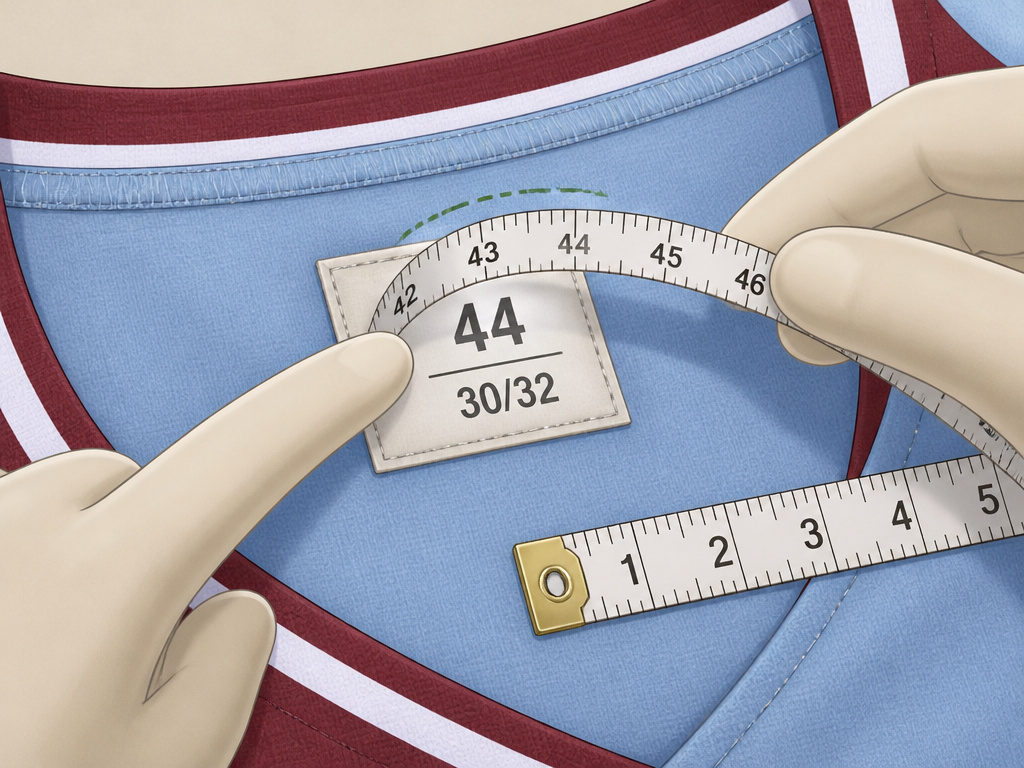
You see a size “44” or “30/32” on a vintage shirt or a European site and freeze. What does it mean?
- 44 (or 46, 48, 50): This is typically an EU size referencing the chest circumference in centimeters. A size 44 is typically an EU size that often corresponds to a garment chest circumference of approximately 88 cm. However, this is a garment measurement. To convert, your body chest should be several centimeters smaller. If your body chest is 96 cm, you would typically look for a garment with a chest circumference larger than that; a size 48 garment (approx. 96 cm chest) might be too tight without ease.
- 30/32: This is usually a combined size for shirts and shorts. The first number (30) is the neck size in inches; the second (32) is the sleeve length in inches. It’s common on older, formal-style kits and is not directly convertible to S/M/L.
The Erreà size guide states they “usually refer to EU sizes,” but they stress that measurements “may vary by club, product type and production year.” A numeric label is a starting point, not a guarantee.
Here’s a rough conversion for orientation, but always defer to the specific chart:
| EU Size | Approx. Garment Chest (cm) | Common Letter Equivalent |
|---|---|---|
Brand-by-Brand Sizing Tendencies
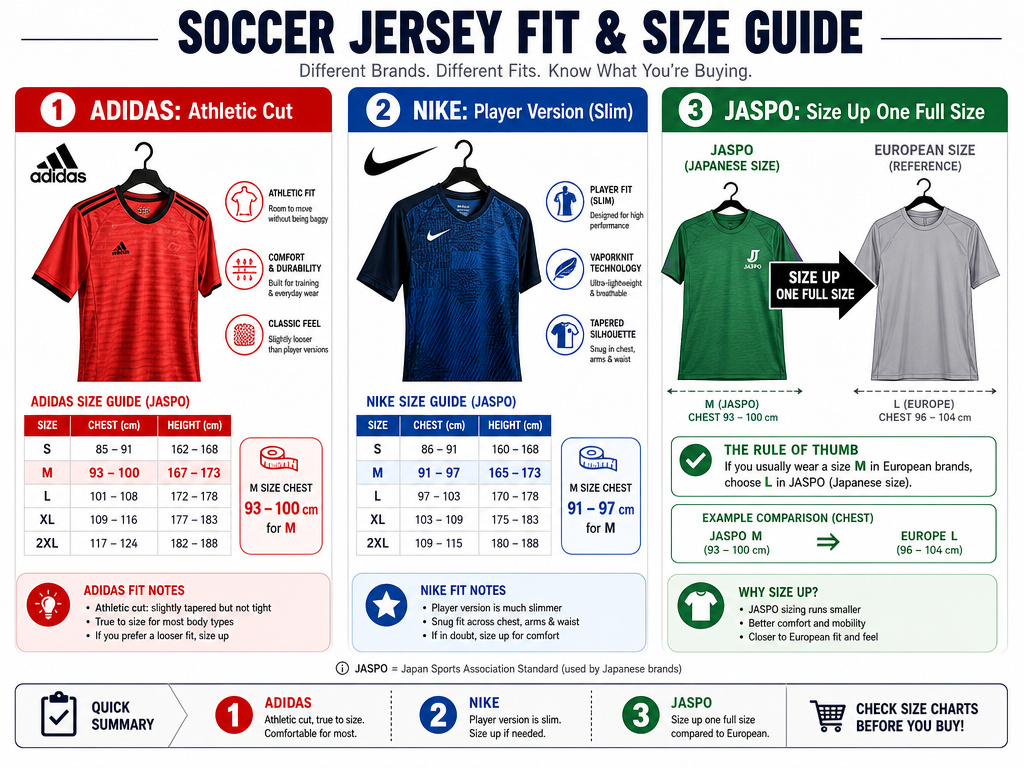
Brands have reputations, but models have minds of their own. The Puma guide explicitly says it “does not publish a generic body-chest range that safely decides a football-shirt size.” You must check the exact product.
Still, some patterns hold as tendencies:
- Player Versions (Vaporknit) are very slim.
- Adidas: Similar to Nike, with a slightly more athletic cut even in replicas. Adidas’s official chart for size M is 93–100 cm (body).
- JASPO Sizing: This is for the Asian market. It runs one full size smaller than European sizing. A JASPO L is roughly a European M. Always size up.
Shirts with the same size label can fit differently. The cut changes by era, template, and even the club.
Special Cases: Vintage, Goalkeeper, and Women’s Cuts
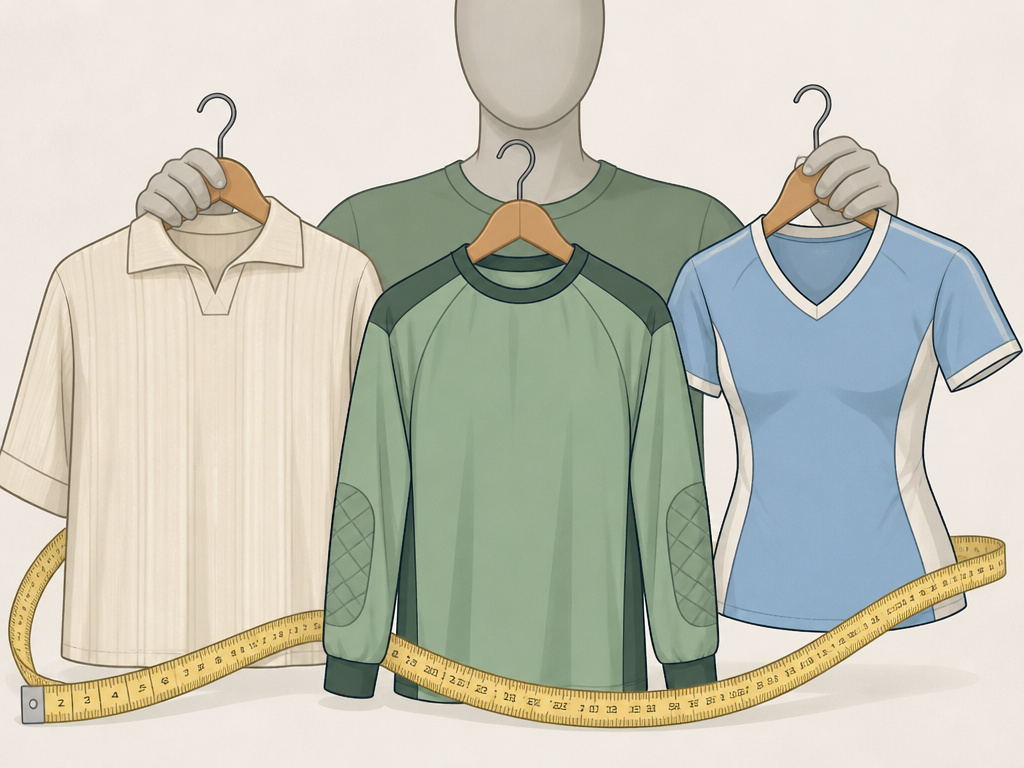
The rules bend, or break, for certain shirts.
Vintage (Pre-2010): Shirts from this era tend to run larger. Cuts were boxier, and fabrics were less stretchy. A size L from the pre-2010 era will likely be roomier than a modern size L. If you’re buying vintage, look for listed garment measurements or be prepared to size down.
Goalkeeper Kits: These are cut with more room through the shoulders, chest, and arms to allow for diving mobility. They generally fit one size larger than their outfield equivalents. Order your usual size for a standard fit.
Women’s Specific Kits: These are tailored with a shaped silhouette through the waist. Do not convert from a men’s size by “sizing down two.” That’s not a safe rule. Use your bust/chest measurement and the specific women’s size chart. If a dedicated women’s cut isn’t available, a men’s/unisex shirt will have a straighter, boxier fit.
For all these, the principle of checking the exact product’s football shirt sizing guide is paramount. It’s the only way to navigate the variables of club, template, and production year.
What If You’re Between Sizes or Have a Non-Standard Body?
The chart says you’re a 99 cm chest, right on the line between S and M. What now?
- Consider the cut. For a Player Version, size up to M for comfort. For a loose Fan Fit, you could possibly take the S for a tighter look.
- Think about layering. Will you wear it over a hoodie on matchday? Size up.
- Check the return policy. This is your safety net. Before you buy, especially online, know the return window for unworn, unpersonalized items. Some retailers, like Kickitshirts, are strict if the shirt matches their chart, so measuring correctly is your defense.
A shirt that fits your chest might be too short in the torso. Some brands offer “Tall” sizes, but they’re rare in football kits. Your best bet is to size up for length and accept a slightly roomier chest fit; a tailor can take in the sides if needed.
The care you take after buying is as important as the choice before. Once you have the right fit, follow the guide for washing football shirts to keep them looking sharp and fitting the same way wash after wash.
Nike and Adidas size charts
Official brand charts are your best starting point, but you must use them correctly. Nike’s current men’s tops chart uses body chest measurements, not the flat garment width. Adidas also uses body chest measurements for its UK men’s shirts. Their size M covers 93 to 100 cm. These ranges show that a ‘Medium’ is not a universal measurement. Always find the specific chart for the brand and product line you are buying, as a size M in one brand may not match another. Ignoring this and guessing based on a generic letter size is a common mistake.
Frequently Asked Questions
Should I always size up for a football shirt?
No. This is the most common piece of bad advice. Blanket “size up” rules fail for slim Player Version shirts (where sizing up is correct) and for already-roomy vintage or replica shirts (where it creates a baggy fit). Always check the specific shirt’s cut and dedicated size chart first.
What does size 44 mean in football shirts?
Size 44 is typically an EU size that often corresponds to a garment chest circumference of approximately 88 cm. It often aligns with a size Small. Remember, this is a measurement of the shirt itself, not your body. Your body chest should be several centimeters smaller than the garment’s listed chest.
How do I know if a shirt is a Player Version or Fan Fit?
Look at the product description. Player Versions are often called “Authentic,” “Vaporknit,” “Aeroready Authentic,” or “Match Spec.” They’re lighter, have heat-pressed badges, and are more expensive. Fan Fits are called “Replica,” “Stadium,” or “Fan Version.” They’re heavier, have woven crests, and are cut more generously.
Why does my old shirt fit bigger than my new one?
Football shirt cuts have become more athletic and slim-fitting over the past 10-15 years. Shirts from the 1990s and early 2000s were generally boxier and made from less forgiving materials. A size L from 2002 will almost certainly be larger than a size L from 2023.
What’s the most important measurement for getting the right size?
Your chest circumference is the primary anchor. However, you must match it to the correct type of chart, body measurement or garment measurement. Getting that right is more important than the number itself.
Before You Go
One rule to cut through the noise: if a retailer doesn’t provide a size chart with garment measurements for the exact shirt you’re buying, be very cautious. A generic brand table is only an orientation. The real fit lives in the pit-to-pit width and length listed on that product page.
To learn more about what makes a great kit beyond the fit, including design and history, explore our roundup of the best football jerseys and see how the classics hold up. And if you’re kitting out a whole team, understanding all the football kit components is the next step.
Measure twice, buy once. And always keep the tags on until you’re sure.
