
Types of Shin Guards Explained: Your Style and Fit Guide
This post contains affiliate links. As an Amazon Associate, we earn from qualifying purchases.
Soccer shin guards come in three main styles: slip-in, ankle-protection, and shin socks. The best type for you depends on the level of protection you need, your playing position, and the trade-off you’re willing to make between weight and coverage. By IFAB Law 4, every player must wear shin guards that provide reasonable protection, are made of suitable material, are an appropriate size, and are fully covered by the socks.
Right, here is the thing about shin guards. They are the only piece of equipment the laws of the game specifically mandate for every single player on the pitch. That mandate, Law 4, is not a suggestion. It is a hard rule. A player whose shin guard is uncovered during a match can be asked by the referee to leave the field to correct it. If you show up without them, you cannot take part. Full stop. The different types of shin guards explained can help players meet this requirement.
What follows is a breakdown of the three main styles, why they exist, and the practical trade-offs each one makes, which is essentially the core of the types of shin guards explained. We will also cover how to spot an illegal guard, a direct answer to a common ‘People also ask’ question, and sort out the contradictory advice you will find about cleaning them.
Key Takeaways
- The three main styles are slip-in (lightweight, minimal), ankle-protection (common, strapped), and shin sock (all-in-one, integrated).
- Proper fit is not negotiable. A guard must cover from just above the ankle to about two finger widths below the kneecap.
- Machine washing is a point of disagreement between sources. Nike warns against machine washing slip-in and sleeve-style guards, while Coaching American Soccer states that some shin guards may be placed in a washing machine.
- The European safety standard EN 13061 sets a maximum transmitted force of ≤ 2.0 kN from blunt impact.
- For youth players, re-measurement at least once per season is essential due to rapid growth.
How to Spot an Illegal Shin Guard
The referee’s check is not just for show. A shin guard that fails the Law 4 requirements is illegal, and you will be told to fix it or leave the pitch.
Common mistake: Buying a guard based on a cool design or a player endorsement without checking the size. A guard that is too small leaves the lower shin exposed to a direct blow; one that is too large bunches at the knee and gets in the way of a full stride. Both are illegal.
According to IFAB Law 4, a legal shin guard must be made of a suitable material, be an appropriate size to provide reasonable protection, and be covered entirely by the socks. That last part is the one referees catch most often. If your sock rolls down and the top of the guard is visible, you will hear about it.
The “appropriate size” clause is where it gets specific. A correctly sized guard, as detailed in the Guide to Football equipment guide, covers from just above the ankle to about two finger widths below the kneecap. Anything shorter than that fails the “reasonable protection” test. The material matters, too. While the law does not specify plastic over carbon fibre, the guard must have a protective shell. A piece of thin foam tucked in your sock is not a shin guard.
The Three Main Styles: Slip-In, Ankle, and Shin Socks
These are the categories every buying guide lists, but most just describe them without the deeper context the types of shin guards explained provides. The real question is what you give up and what you gain with each choice.
Slip-In Shin Guards
These are minimalist plates, often contoured, with no built-in straps. You slide them into a compression sleeve or directly under your sock. They are the choice of most professionals.
A slip-in guard is a trade. You get minimal weight and zero bulk, which means zero restriction. You give up some coverage and rely entirely on your sock or sleeve to keep it in place.
A classic example of a slip-in guard is a hard, perforated shell with foam backing. They are light enough that you forget they are there, which is the point. The risk is slippage. If your sock is loose or your sleeve is worn out, the guard can slide down, exposing your ankle or twisting sideways. That is why many pros use tape over the sock as a final lock. This style offers less protection for the ankle bones, a trade-off advanced players accept for feel and speed.
Ankle-Protection Shin Guards
This is the default for most amateur and youth players. It is a shin plate with permanently attached elastic straps that wrap around the calf, often with extended foam padding that cups the ankle bones.
Where this goes sideways: Assuming the ankle padding makes you invincible. It protects against glancing kicks and studs, not against twisted-landing sprains. It is impact protection, not structural support.
These guards stay put. The straps do the work so your socks do not have to. The ankle padding is a significant benefit for defenders and younger players who absorb more contact. The trade-off is bulk and weight. That extra material can feel restrictive, especially around the ankle joint, until the guard breaks in. For a complete look at the pros and cons of each design, our guide on the slip-in vs. Ankle shin guard debate breaks it down further.
Shin Socks (All-in-One)
This style integrates the protective plate into a full knee-high sock. It is a single piece of equipment. Nike’s all-in-one youth shin guards are built this way.
The major advantage is simplicity. There is nothing to strap or slide; you just put on the sock. They are also, according to Nike, machine-washable, which is a big plus for hygiene with growing kids. The downside is that if the plate breaks or the sock wears out, you replace the entire unit. It is also a warmer option, as your entire lower leg is in a sock. This style is overwhelmingly geared toward youth players. You can find specific models in our roundup of the best shin guards for youth soccer.
| Style | Best For | Protection Trade-Off | Key Consideration |
|---|---|---|---|
| Slip-In | Advanced players, wingers, those prioritizing feel | Lightest weight, least bulk. Minimal ankle coverage. | Requires a tight sleeve or sock; can slip. |
| Ankle-Protection | Defenders, youth players, physical leagues | Best overall impact protection, stays in place. | Bulkiest, can feel restrictive until broken in. |
| Shin Sock | Youth/recreational players, simplicity seekers | Integrated, no loose parts. Easy to wear. | Entire unit fails if part breaks; warmer on the leg. |
The Protection vs. Mobility Trade-Off (By Position)
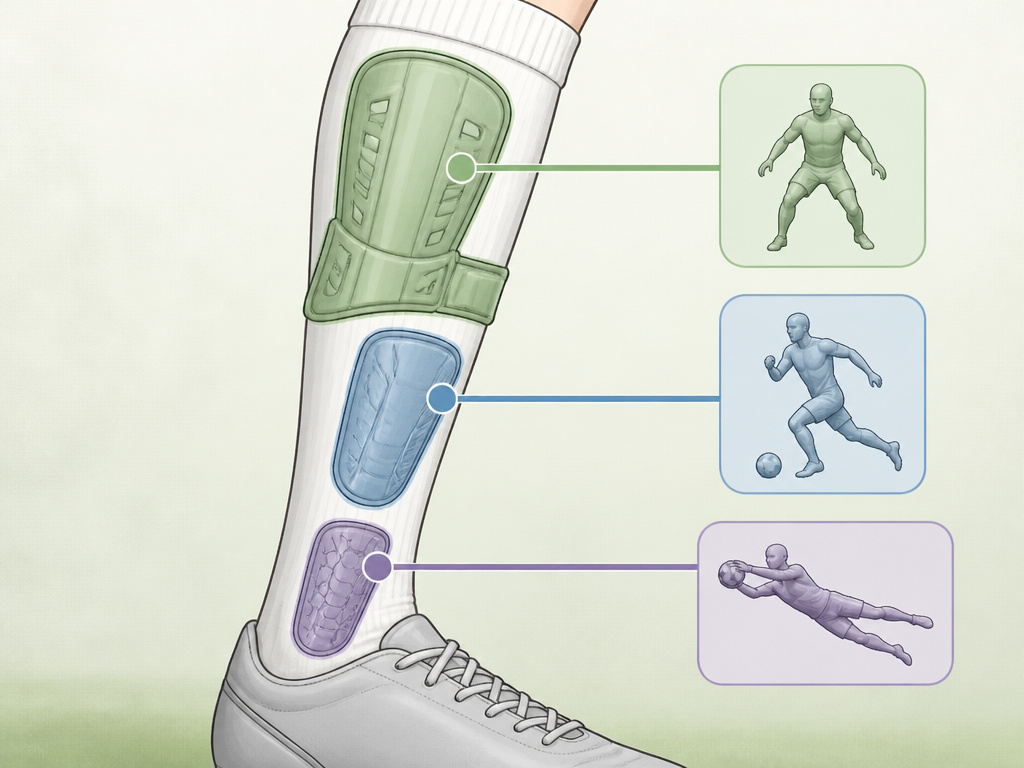
This is the part most guides gloss over. Your position on the pitch should influence your guard choice more than your favourite player’s brand.
Defenders and defensive midfielders take the most direct kicks. Ankle-protection guards are the default here. That extra foam around the malleoli is worth the slight weight penalty when you are consistently throwing your leg into tackles.
Wingers, attacking midfielders, and forwards are often more concerned with unrestricted movement. A slip-in guard removes a mental and physical barrier. When you are making a bursting run in the 85th minute, you do not want to feel a strap digging in or bulk around your ankle. The trade-off is acceptable because these players face less frequent, though not less dangerous, contact.
Goalkeepers are a special case. They need protection during collisions in the box but also require full flexion for diving. Many keepers prefer a slim ankle guard or even a slip-in, prioritizing knee and elbow protection instead. There is no one answer, but mobility is usually the higher priority.
Materials and What “Safety Standard” Actually Means
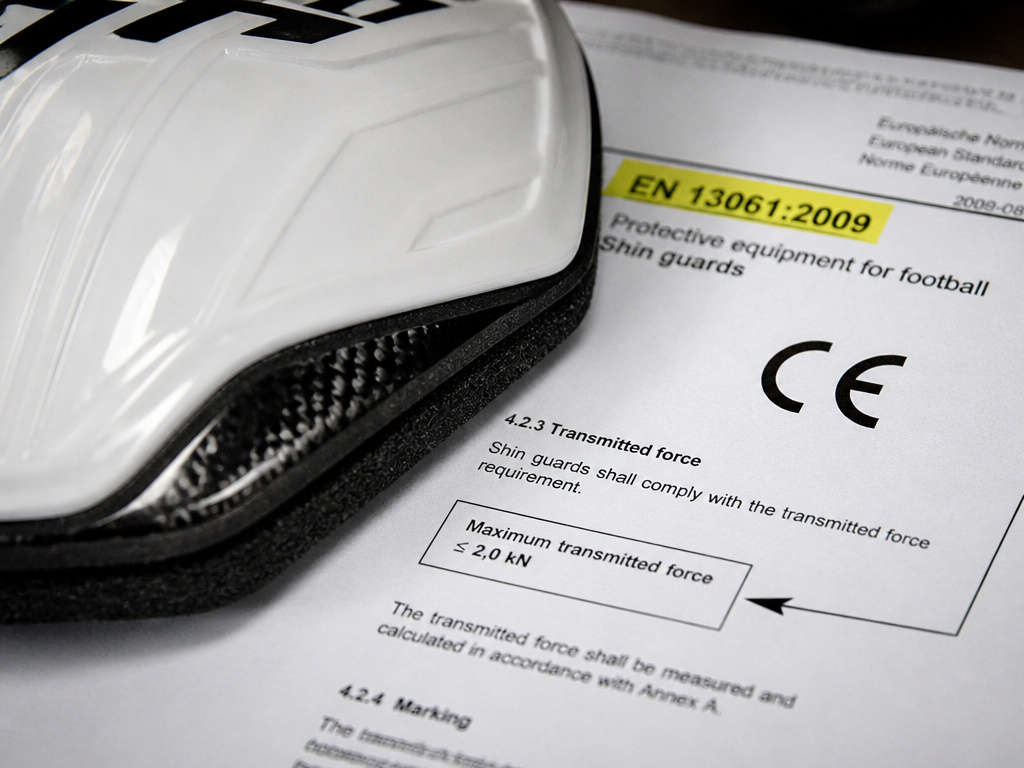
The shell is usually polypropylene plastic. The padding is foam. At the elite level, you will find carbon fibre or fibreglass composites — lighter and stiffer for the same thickness.
The term “safety standard” gets thrown around. In some markets, guards carry a CE mark indicating they meet the European standard EN 13061:2009. That standard defines a maximum transmitted force from a blunt impact as ≤ 2.0 kN.
These are not marketing terms. They are verified performance thresholds. The standard specifies samples are conditioned at 20 ±2 °C and 65 ±5% relative humidity for 48 hours, and testing is performed in an environment of 22°C ± 2°C.
The part nobody mentions: EN 13061 states it is for association football and “can be used in other sports only with supporting evidence.” A shin guard built for soccer is not automatically certified for rugby or field hockey.
Sizing and Fit: The Visual Guide Everyone Needs
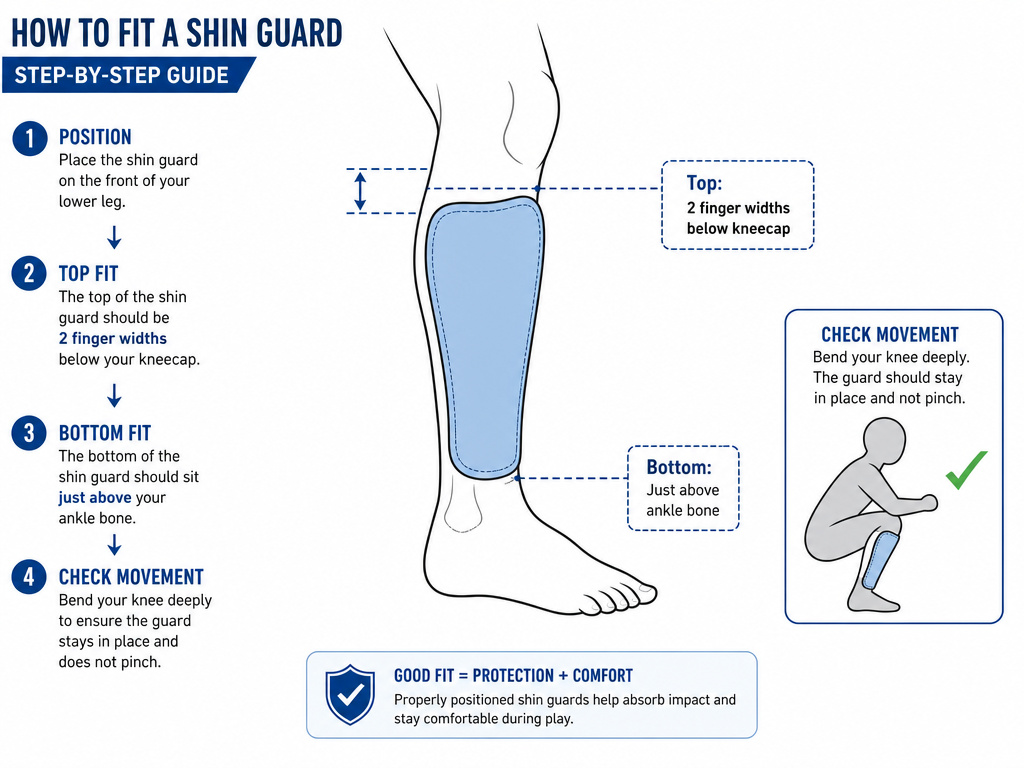
A size chart is a starting point. The real test is on your leg.
The rule is visual and tactile. With the guard positioned correctly, the bottom edge should sit just above the bump of your ankle bone. The top edge should end about two finger widths below the bottom of your kneecap. You should be able to flex your foot up and down and bend your knee deeply without the guard jamming or pinching.
Youth players change shape constantly. The Guide to Football notes that youth players require re-measurement at least once per season. A guard that fit in September can be dangerously short by May. This is why a complete sizing guide for shin guards is more useful than a one-time chart.
How do I know which shin guard goes on which leg?
Most ankle-protection guards are symmetrical and can go on either leg. Some high-end slip-in models are molded for a specific leg. Check the inside of the shell for an “L” or “R” marking. If there is no marking, they are universal.
Care, Cleaning, and Contradictions
This is where manufacturer advice directly conflicts, and you need to know it.
Nike is clear: for their slip-in and sleeve-style guards like the Mercurial Lite and Charge, spot clean with a damp cloth and mild soap, air dry. They warn against machine washing. However, Coaching American Soccer states that “some shin guards may be placed in a washing machine.”
Worth knowing before you start: When sources disagree on care, follow the manufacturer’s label for that specific product. Throwing a Nike slip-in guard in the wash because a general website said you could is a quick way to ruin the foam lining and straps.
For the all-in-one sock style, Nike says they are machine-washable. The general rule is to air dry everything — never use a tumble dryer, as the heat can warp the plastic shell and degrade the foam. For a deeper dive on maintenance, our guide on how to clean shin guards walks through the best practices.
A Quick Note on History
Sam Weller Widdowson, a Nottingham Forest player, is credited with introducing them to football in 1874. He adapted the idea from cricket leg pads, cutting them down and strapping them to the outside of his stockings with leather straps. He was mocked initially. By 1990, the IFAB had made them mandatory. The Wikipedia entry on shin guards covers this evolution from ancient greaves to modern sport.
How to keep shin guards from slipping
A shin guard that slips down during play is a nuisance and a potential violation. According to IFAB Law 4, your shin guards must be covered by your socks for the entire match. If they become uncovered, you can be asked to leave the field to correct the issue. To prevent this, many players use accessories. Shin guard sleeves are a common solution, providing a snug, elastic layer that holds the guard in place against your leg. Alternatively, some players use athletic tape wrapped around the sock and guard at the top and bottom. The key is to ensure the guard stays in its correct position, covering from just above the ankle to below the kneecap, without restricting movement.
Specific brand or product recommendations
We do not recommend specific brands or models. Instead, focus on finding a shin guard that meets the mandatory safety standards and fits you properly. Look for products that carry recognized safety certifications. In some markets, shin guards carry a CE mark and meet the European safety standard EN 13061. Other regions may have different standards. The most critical factor is fit. A correctly sized guard should cover from just above the ankle to about two finger widths below the kneecap. Sizes are often associated with player height and identified as XS, S, M, L, XL, correlating to a player-height of 3’3” through 6’9”.
Frequently Asked Questions
What are the three main types of shin guards?
The three main types are slip-in (minimalist, held by sleeve/sock), ankle-protection (strapped, with extra ankle padding), and shin socks (all-in-one, integrated into a sock). Each offers a different balance of protection, weight, and convenience.
Which shin guards are the most protective?
Ankle-protection shin guards generally offer the most thorough impact protection because they cover more surface area and include padding for the ankle bones. However, “most protective” depends on proper fit; a well-fitted slip-in guard can be more protective than a poorly fitted ankle guard.
Can you machine wash shin guards?
It depends on the type and brand. For most slip-in and strapped guards, manufacturers like Nike recommend against machine washing and advise spot cleaning. All-in-one shin sock styles are often machine-washable. Always check the specific care instructions for your model.
How often should youth players get new shin guards?
Due to rapid growth, youth players should have their shin guard fit checked at least once per season. The Guide to Football recommends replacing youth shin guards at least once a year for younger players.
The Bottom Line
Choosing a shin guard is a practical decision with real consequences. Do not buy the pair Cristiano Ronaldo wears if you are a 12-year-old centre-back. Get the guard that fits the job. For most amateur adults, a well-fitted ankle-protection guard is the sensible default. It stays put and covers what needs covering. If you are chasing that last gram of weight for a speed advantage, and you are willing to manage the slippage risk, move to a slip-in.
One final, essential check: before every match, pull your socks up. A guard hidden is a guard legal. Everything else is just details.
