
Slip-In vs Ankle Shin Guards: Which Should You Buy?
This post contains affiliate links. As an Amazon Associate, we earn from qualifying purchases.
Slip-in shin guards are minimalist plates that slide inside your sock, offering maximum mobility. Ankle shin guards have a hard shell with built-in padding and a stirrup strap that wraps around the ankle, providing more complete lower-leg coverage. For most youth and beginner players, ankle guards are often recommended; for advanced players and midfielders prioritizing speed, slip-in guards are frequently chosen.
The difference isn’t just about coverage. It changes how the guard sits on your leg, how you secure it, and what you feel during a match. The right pick depends on your age, position, and how much you value freedom of movement versus the security of a built-in strap. Consider the choice between slip in vs ankle shin guards.
What follows: a side-by-side breakdown of protection, weight, and fit, the one sizing rule every guide disagrees on, and the player profile that decides it all. By the end, you’ll know which guard goes in your kit bag.
Key Takeaways
- Ankle guards are often recommended for beginners and defenders. The built-in stirrup strap and wrapped padding provide secure, full protection for the shin and ankle bones, which is vital in chaotic, multi-player scrambles common at younger ages.
- Slip-in guards are for speed and touch. They offer maximum mobility and are the preferred choice for goalkeepers, according to Storelli, and are considered ideal for midfielders, forwards, and intermediate to advanced players by Lazada Sports.
- Sizing is not universal. Storelli advises that for ankle guards, you may need to move up a half-size from a slip-in guard measurement to accommodate the extra ankle padding, a rule many generic sizing charts miss.
- Retention is essential. A slip-in guard requires a compression sleeve, grip socks, or athletic tape to stay put. A guard that slides during play is useless and dangerous.
- Check the fit every 6-12 months for kids. Youth players who are still growing typically need new guards within this window. A guard that’s too small won’t cover the shin bone.
The Core Difference: What You’re Actually Buying
Ankle shin guards look like a small piece of leg armor. They have a hard plastic shell for the shin, connected to padded fabric extensions that wrap around the bony bumps on the sides of your ankle (the medial and lateral malleolus). A stirrup strap runs under your foot to lock everything in place. You’re buying a single, secure unit.
Slip-in guards are just the plastic shell, a lightweight plate, often with a foam backing. There are no straps or ankle wraps. You’re buying a component that needs a system (your sock, a sleeve, tape) to hold it against your leg.
The FIFA Quality Programme standard defines the job: shin guards must provide “fundamental protection” covering the area from just below the knee to above the ankle, made from suitable materials like polypropylene or polyethylene. Both types meet this bar, but they get there differently.
This isn’t a minor detail. It dictates everything from how hot you get to how you put them on. The slip in vs ankle shin guards question means ankle guards are a one-step process. Slip-ins are a two-step process: position the guard, then secure it. Forget the second step, and you’ll spend the first ten minutes of a match constantly hiking up your socks.
Slip-in vs Ankle: The Head-to-Head Breakdown
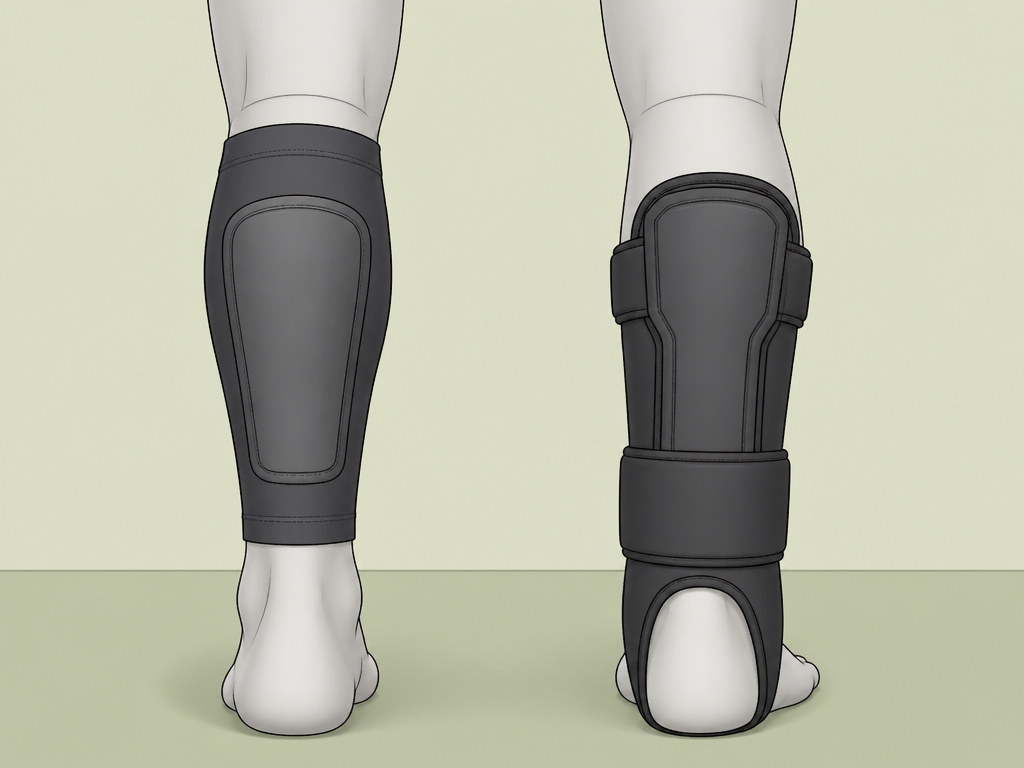
Most articles list pros and cons in paragraphs. You need to see the trade-offs in one place. Here’s what you’re choosing between.
| Feature | Slip-in Guards | Ankle Guards |
|---|---|---|
| Protection Coverage | Shin plate only. No ankle protection. | Shin plate + padded ankle wrap. Shields the vulnerable malleolus. |
| Weight & Bulk | Very lightweight, low-profile. | Heavier and bulkier due to added material. |
| Mobility & Feel | Maximum ankle mobility. Uninterrupted feel for the ball. | Restricted ankle flexion. Can feel bulky, especially in heat. |
| Security & Retention | Poor on its own. Requires compression sleeve, tape, or tight socks. | Excellent. Built-in stirrup strap and ankle wrap prevent shifting. |
| Best For (Player Type) | Advanced players, professionals, midfielders, forwards, goalkeepers. | Beginners, youth players (ages 4-7), defenders, players needing secure fit. |
| Ease of Use | More steps (guard + sleeve/tape). Requires knowledge to secure. | Simple. Strap on and go. Easier for kids to manage independently. |
The Lazada Sports review puts it bluntly: ankle guards provide “the most complete coverage,” while slip-ins offer “the highest level of mobility.” You cannot have both in one design. The slip in vs ankle shin guards choice is a priority call.
Where this goes sideways: Picking an ankle guard for a speedy winger because it seems “safer.” The added bulk will slow their footwork and frustrate them by halftime. The protection is ineffective if the player avoids wearing it.
The 3-Question Fit Test (and Why It Matters More Than the Guard)
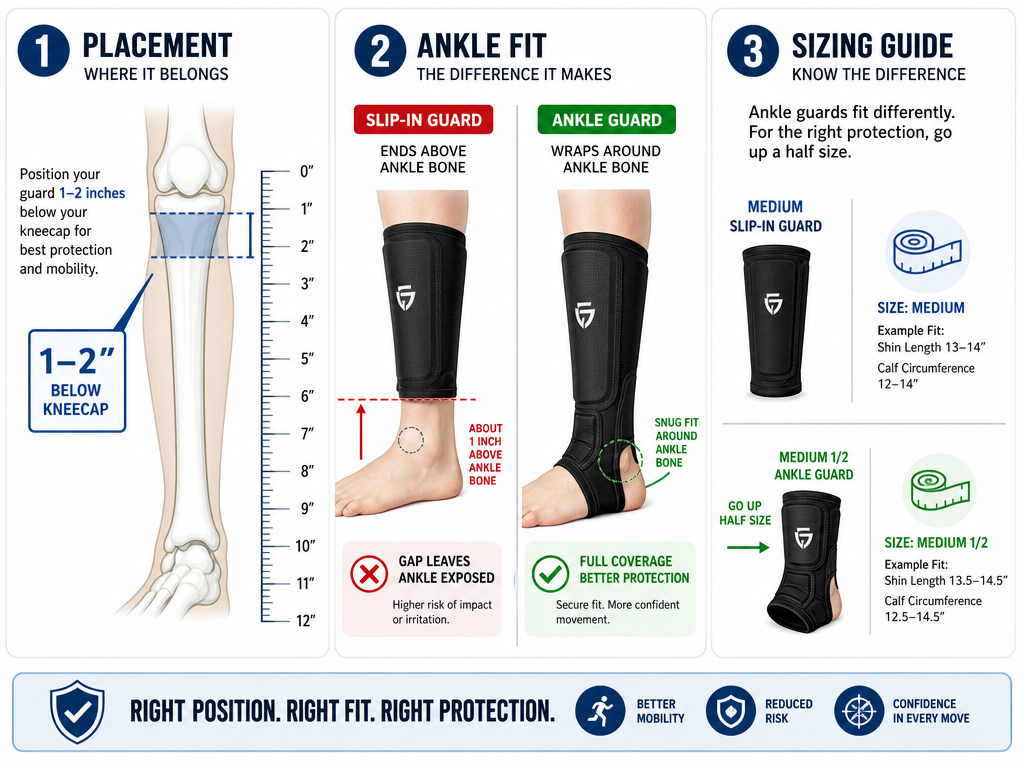
A perfect guard in the wrong size fails to provide proper protection. The rules aren’t as universal as brands suggest.
First, know where it should sit. According to Storelli’s fitting guide, the top of the guard should be one to two inches below your kneecap. The bottom? Here’s the first source disagreement. * Some Storelli fitting advice says it should end approximately one inch above your ankle, while other Storelli advice says roughly two inches above your ankle. * U.S. Soccer’s equipment guidance, cited by Best Soccer Gear Info, says it should fit snugly around the ankle bone.
That’s a meaningful gap, one prioritizes free movement, the other a snug seal. For ankle guards, I’d follow U.S. Soccer’s snug fit. For slip-ins, the inch-above rule makes sense to avoid rubbing.
Second, measure your shin. Don’t rely on height charts alone. Storelli notes that shin guards should cover 70-80% of your shin bone. A proper fit feels like a second skin, not a loose panel. If you feel a pressure point along the edge after a short period of walking, it’s too small or poorly contoured.
Third, and this is critical: sizing is not consistent between styles. Storelli explicitly advises that for ankle guards, “you may need to move up a half-size from slip-in guard measurement guides to accommodate the additional ankle coverage.” If you wear a medium slip-in, your ankle guard might be a half-size larger. Brands also vary. Nike shin guards tend to run smaller, while Adidas typically offers more room.
Who Should Wear What? The Player Profile Decoder
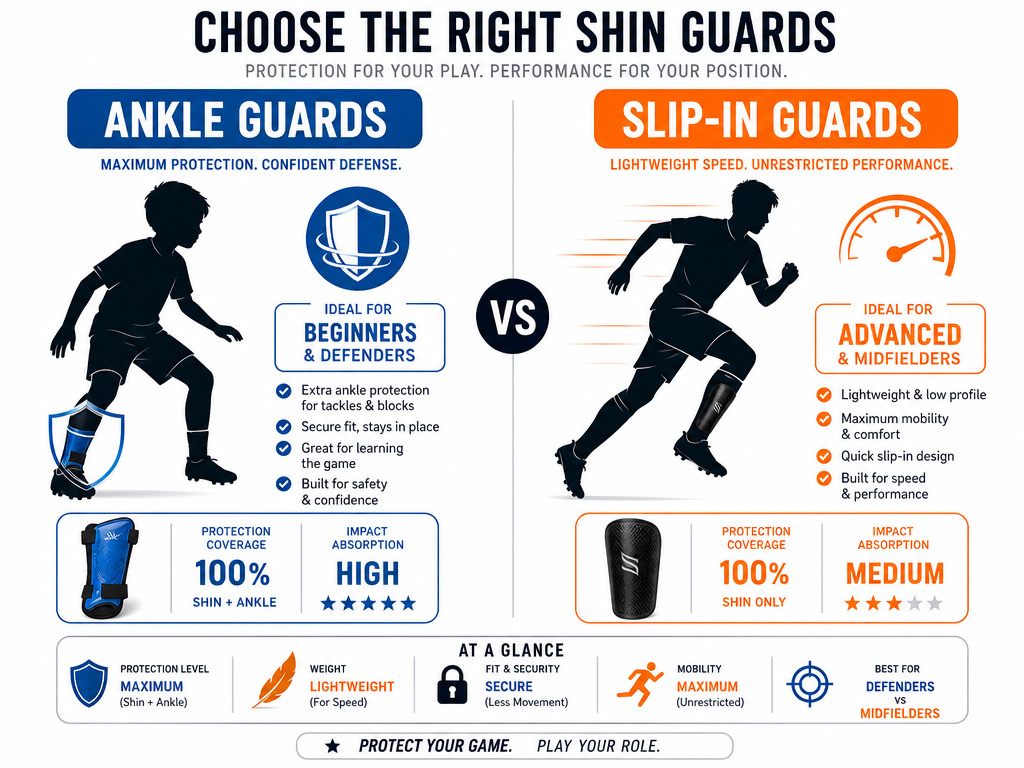
This is where cookie-cutter advice fails. Your position, age, and experience level flip the script.
Start with ankle guards if:
- You are a beginner or youth player (typically ages 4 to 7). Games at this level are chaotic. The secure stirrup strap and wrap-around padding are forgiving during accidental kicks and falls.
- You play defense. As BestReviews notes, defenders may want the “wrap-around protection” of an ankle guard for tackles and collisions.
- You value simplicity and security. The built-in system means less fuss. This is also why they’re “more secure, especially for children,” per Storelli.
Move to slip-in guards if:
- You are an intermediate to advanced player (typically ages 8 to 12 and up). Your game relies on agility, quick turns, and clean ball control. The bulk of an ankle guard becomes a hindrance.
- You play midfield, forward, or goalkeeper. Midfielders and forwards need that unimpeded mobility. Goalkeepers, as Storelli points out, choose them for “maximum mobility while wearing bulkier” gear.
- You’re comfortable using accessories. You don’t mind the extra step of a compression sleeve or tape for a superior fit.
The research shows a clear divide in player preference. A study in Sports Engineering found that experienced players often choose slip-in guards for “increased comfort and a perceived lack of interference with performance,” directly contradicting marketing that equates more material with necessary safety. They’ve learned what their game needs.
Slip-in vs Ankle: The Pro Player’s Choice
Do professional soccer players wear ankle guards? Almost never. Watch any top-flight match and you’ll see the low-profile outline of a slip-in guard under every sock.
The reason is sensory. A slip-in guard, when secured properly with a sleeve or the two-sock system, disappears. You feel the sweat wick away, your ankle rotates without a second thought, and your touch on the ball is direct. An ankle guard adds a layer of insulation, it’s warmer, and the padding can create a vague, mushy barrier between your foot and the ball.
The “two-sock system” some pros use is telling: thin grip socks against the skin, guards taped to the leg, then regular soccer socks over everything. It’s a custom-fit security system that prioritizes feel. It proves the point: at the highest level, mobility and precision are prioritized over extra padding.
That doesn’t make ankle guards “wrong.” It makes them a tool for a different job. Giving a pro’s slip-in to an eight-year-old is a recipe for a guard that ends up around their calf by the second half.
Common Mistakes and How to Avoid Them
Getting the guard is half the battle. Wearing it wrong undoes all the protection.
- Skipping the retention step for slip-ins. A loose sock is not enough. The guard will spin or slide down. Use a compression sleeve designed for guards, or learn to use athletic tape. A sliding guard exposes your shin and reduces its protective function.
- Ignoring the half-size rule for ankle guards. Following a generic slip-in size chart can leave you with an ankle guard that’s too short. Remember Storelli’s advice: you may need to move up a half-size.
- Wearing them directly on skin. This can cause discomfort and skin irritation. The sock is a mandatory barrier. It absorbs sweat and prevents the plastic or foam from rubbing your skin raw.
- Keeping outgrown guards. For youth players, a guard that’s too small is a hazard. Storelli’s guidance is clear: youth players typically need new guards every six to 12 months. Check the fit at the start of every season.
- Letting the guard peek out. Soccer rules for nearly all leagues require that a player’s shin guard is completely covered by an exterior sock. It’s a safety rule. Get longer socks if you need to.
How to wear/put on each type correctly
For ankle shin guards, put your foot through the built-in stirrup strap so the hard plastic shell sits on the front of your shin. For a fit following U.S. Soccer’s guidance, the guard should end just below your kneecap and fit snugly around your ankle bone. The padded extensions should cover the bony bumps on the sides of your ankle. Pull your soccer socks up over them to meet league rules. For slip-in guards, place the hard plastic insert into a compression shin guard sleeve before putting it on your leg. This prevents the guard from shifting. Some players use a two-sock system: first thin grip socks, then the guards taped to the leg, and finally regular soccer socks over everything. Slip-in guards should also cover most of your shin bone, ending below the knee and above the ankle.
Basic safety requirement of wearing shin guards under socks
Nearly all soccer leagues have a clear safety rule: a player’s shin guard must be completely covered by an exterior sock or stocking. This is mandatory for all youth players, including goalkeepers, during competitive game play. The sock holds the guard firmly in place against your leg, ensuring it doesn’t slip out of position during a tackle or run. Covering the guard also prevents its hard edges from catching on another player’s cleats or the ground, which could cause injury. Always check that your soccer socks are pulled up fully over the entire guard, with no plastic showing, before you step onto the field.
Frequently Asked Questions
Are slip-in shin guards better?
They are better for specific players: advanced players, midfielders, forwards, and goalkeepers who prioritize mobility and ball feel. They are not universally “better.” For a beginner or defender who needs secure, full coverage without fuss, ankle guards are the better choice.
Are shin guards with ankle protection better?
They are better at protecting the ankle bones (the malleolus). If your primary risk is accidental kicks to the side of the ankle, common in youth and beginner play, then yes, they offer better protection for that specific area. They trade off mobility and weight to get it.
Do pro soccer players wear ankle guards?
Rarely. The vast majority of professional and elite players wear slip-in shin guards, often secured with compression sleeves or tape. The need for maximum mobility, minimal weight, and unobstructed ball control outweighs the added ankle protection for players at that skill level.
What type of shin guards are better for kids?
For toddlers and early beginners, ankle guards are generally the better pick. The built-in strap makes them easy to put on correctly, and the wrap-around protection is ideal for less-coordinated play. As kids become intermediate youth players, transitioning to a sleeve-style or slip-in guard often makes more sense.
How do I keep slip-in guards from sliding?
You need a retention system. The most effective methods are a compression shin guard sleeve that you slide the guard into, or using athletic tape to secure the guard to your leg before putting your sock on. A tight soccer sock alone is often insufficient to keep slip-in guards from sliding during play.
The Bottom Line
The right gear for the game lets you forget about it and just play. For shin guards, that means a fit so secure and appropriate that you don’t think about them after the whistle blows.
If you’re buying for a young player or you’re newer to the sport, start with ankle guards. The protection is complete, and the strap eliminates the slippage headache. Look for models from Adidas or Nike, but remember their fits differ. As a player advances and prioritizes agility, moving to a slip-in guard with a sleeve may become appropriate.
For everyone else, the weekend warriors, the midfield engines, the keepers, the slip-in guard is your tool. Pair it with a compression shin guard sleeve from the start. Relying on just a sock is not recommended.
One final, essential check: before every season, have the player stand straight. The guard should cover from just below the knee to snug around the ankle bone, with no gaps at the edges. If it doesn’t, it’s time for a new pair. That’s not an expense; it’s the cheapest insurance policy on the pitch.
