
What Is a Clean Sheet in Football? Rules and Edge Cases
This post contains affiliate links. As an Amazon Associate, we earn from qualifying purchases.
A clean sheet in football is a match where a team concedes no goals, so a 0-0 draw and a 1-0 win both count. Any goal against ends it, own goals included. The clean sheet belongs to the whole team, though stats providers then credit individual players, and they don’t all do it the same way.
That last clause is where the arguments start. A goalkeeper comes off at 0-0 and the team concedes later. Fantasy Premier League and the Sportmonks data feed give different answers on whether he keeps the clean sheet.
What follows covers the scoreline cases, the crediting rules, the extra-time argument, and the record books. Each rule is tied to the body that wrote it.
Key Takeaways
- Penalty shoot-out goals never count against a clean sheet, because IFAB Law 10 puts the kicks after the match has ended.
- A substitute’s credit depends on the rulebook: Fantasy Premier League wants 60 minutes played, while the Sportmonks API mentions no minimum.
- Extra time is unsettled. Sportmonks excludes extra-time goals, but the IFAB text treats extra time as part of the match.
- Petr Cech holds the Premier League record with 202 clean sheets, and Edwin van der Sar’s 2008-09 run of 1,311 minutes passed Cech’s 1,025-minute mark.
What is a clean sheet in football, and does 0-0 count?
A 0-0 draw gives each team a clean sheet. One match can produce two of them. It always comes back to the basics: did the other side score?
A clean sheet is recorded when a team’s opponent fails to score during a match. The scoreline can be 0-0, 1-0 or 4-0, because the result doesn’t matter. Any goal against ends the clean sheet, own goals included, so a 2-1 win earns none. Statistics providers then credit individual players on the field.
The data provider Sportmonks puts what is a clean sheet in football in similar terms. In its clean sheet glossary, it says the defence and goalkeeper stop the other team scoring for the whole game, and that you get one in a win or a draw as long as no goals go in. The IFAB Laws of the Game, the rulebook behind every competition, don’t define the phrase. Law 10 only sets out how the outcome of a match gets decided.
| Scoreline | Clean sheet for | Why |
|---|---|---|
| 0-0 | Both teams | Neither side conceded |
| 1-0 | Winning team only | Loser conceded once |
| 2-1 | Neither team | Both sides conceded |
| 1-0, own goal by the losing side | Winning team only | Own goal counts as a goal against the team that scored it |
| 0-0, decided on penalties | Both teams | Kicks happen after the match has ended |
Read the table row by row and the logic is simple. A team that loses in normal play has always conceded. That is why people say you can’t lose and keep a clean sheet, with one odd exception covered below.
Picture the 85th minute at 0-0. Every cross into the box pulls a gasp from the stand, and a clearing header gets a cheer louder than most goals. Defending a zero is nervy work.
Who gets the credit: the team or the goalkeeper?
Sportmonks calls a clean sheet a team effort, with everyone from defenders to attackers helping to defend, even though the goalkeeper gets the spotlight. Think of a kitchen sending out a full service with no plate returned. The grill, the prep cooks and the pass all share it, but the person at the pass gets the shout. The goalkeeper role sits at the end of that chain, which is why his name lands next to the stat.
The trouble comes when the goalkeeper doesn’t finish the match. Two rulebooks give two answers.
Fantasy Premier League and the 60-minute rule
The Premier League’s own scoring page for its fantasy game says a substitution before a goal is conceded won’t affect clean sheet points, provided the player has played 60 minutes or more. The minute count is the gate.
Sportmonks and the on-field rule
Sportmonks credits a clean sheet to any player who was on the field while the team maintained it. Its example is a player substituted at 0-0, with the team conceding later. He still gets the clean sheet in his match statistics. Sportmonks notes that fantasy leagues like FPL add the 60-minute condition.
| Situation | Fantasy Premier League | Sportmonks API |
|---|---|---|
| Player subbed off at 0-0, team concedes later | Keeps points if 60+ minutes played | Keeps the credit |
| Minimum minutes | 60 | None mentioned |
| What the number feeds | Fantasy points | Player match statistics |
Where this goes sideways: Mixing a fantasy rule with a stats rule. The same substitution can earn points in one system and a credit in the other, and the mismatch shows up the moment you compare season totals from two sites.
I’d rather we said “the team kept a clean sheet” and gave the keeper a nod afterwards. I’m better with a pitch than a spreadsheet, but the shape in front of him does half the work.
Extra time, shoot-outs and own goals: where the definition gets argued over
A cup tie sits 0-0 at full time, then a deflection loops in during extra time. Does that goal count against the clean sheet? The sources split, so take the cases one at a time.
Penalty shoot-outs
This one is settled. Law 10 says kicks from the penalty mark are taken after the match has ended, and its FAQ says they are not part of the match. The IFAB Law 10 on determining the outcome of a match describes five kicks each, then sudden-death rounds if the scores are level.
So a 0-0 decided on penalties leaves both teams with a clean sheet, and the losing side is the odd exception to “you can’t lose with one”. That law also allows an injured goalkeeper to be replaced mid-shoot-out, a detail that fits better with the wider goalkeeper rules. None of it touches the clean sheet.
Extra time
Here the sources disagree. Sportmonks says goals in extra time or penalties don’t count against a clean sheet earned in the main part of the match. The IFAB text treats only the shoot-out as outside the match and refers to extra time as part of it, which implies an extra-time goal is conceded in the match.
I couldn’t find a published rule that settles this, and I haven’t seen Opta’s wording. Anyone quoting a single rule is guessing.
The part nobody mentions: A side that holds 0-0 for 90 minutes and concedes in extra time has a clean sheet under Sportmonks’s reading and not under the IFAB-based one. Check which rule a site uses before you settle a bet or a bar argument with its numbers.
Betting markets sell clean sheet bets too. I have no source for how any bookmaker settles them, so read the terms, and look at the extra-time wording first.
Own goals and replays
Own goals end a clean sheet no matter who scores them. IFAB’s own Q&A even has a goalkeeper catch a shot, stand up, and accidentally throw the ball into his own goal. The referee awards a goal. A match that is stopped and replayed doesn’t carry the first game’s clean sheet into the second, per Sportmonks.
What makes a clean sheet more likely?
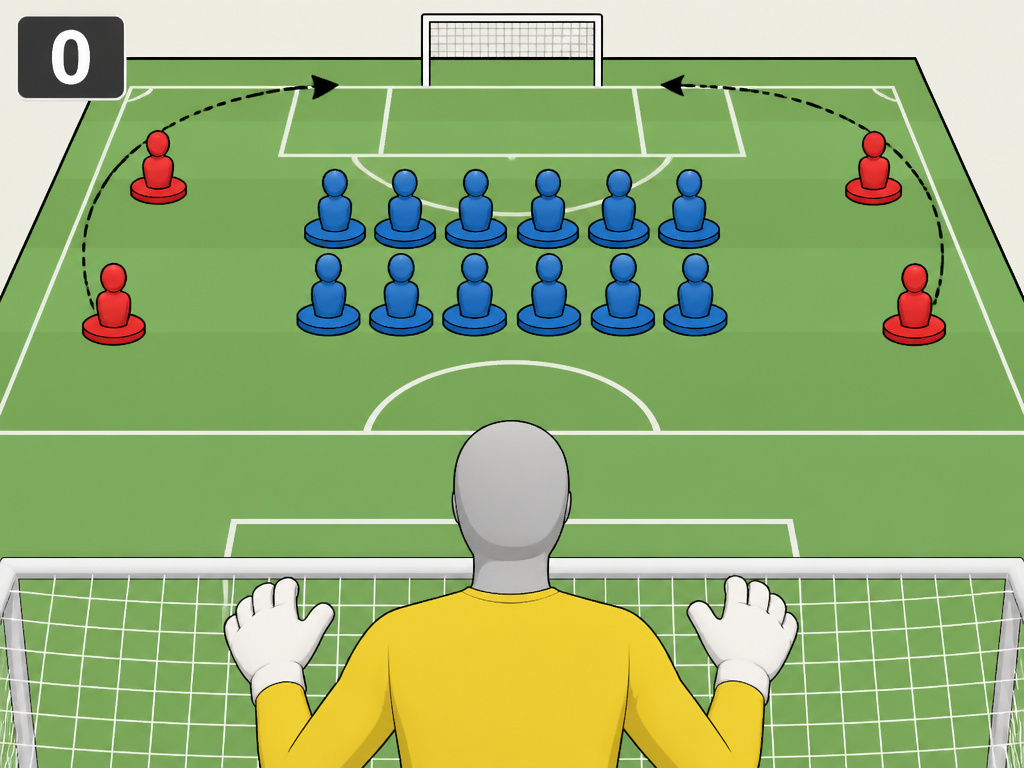
Sportmonks says a run of clean sheets signals a solid, organised defence, and that a steady run builds team morale. It also lists what shapes the odds in any one match:
- Weak opponent attack makes the job easier.
- Home or away matters, since some teams defend better with their own crowd behind them.
- Opponent strength changes the value. Shutting out a strong attack counts for more than shutting out a weak one.
- Defensive tactics are the lever a coach controls directly.
- Goalkeeper form helps, because a keeper in good form turns shots into saves.
Tactics is where defensive compactness lives. When the lines stay tight, the pitch looks narrow from the stand, and shooters run out of room and start trying efforts from distance. In my view, most 30-yard shots are a failed attack dressed up as ambition.
Two honest gaps. No source in my notes puts a points value on a clean sheet beyond fantasy scoring, so I won’t invent one. And I haven’t found a source I trust for where the phrase itself comes from, so I’ll skip the folklore.
Who holds the record for most Premier League clean sheets?
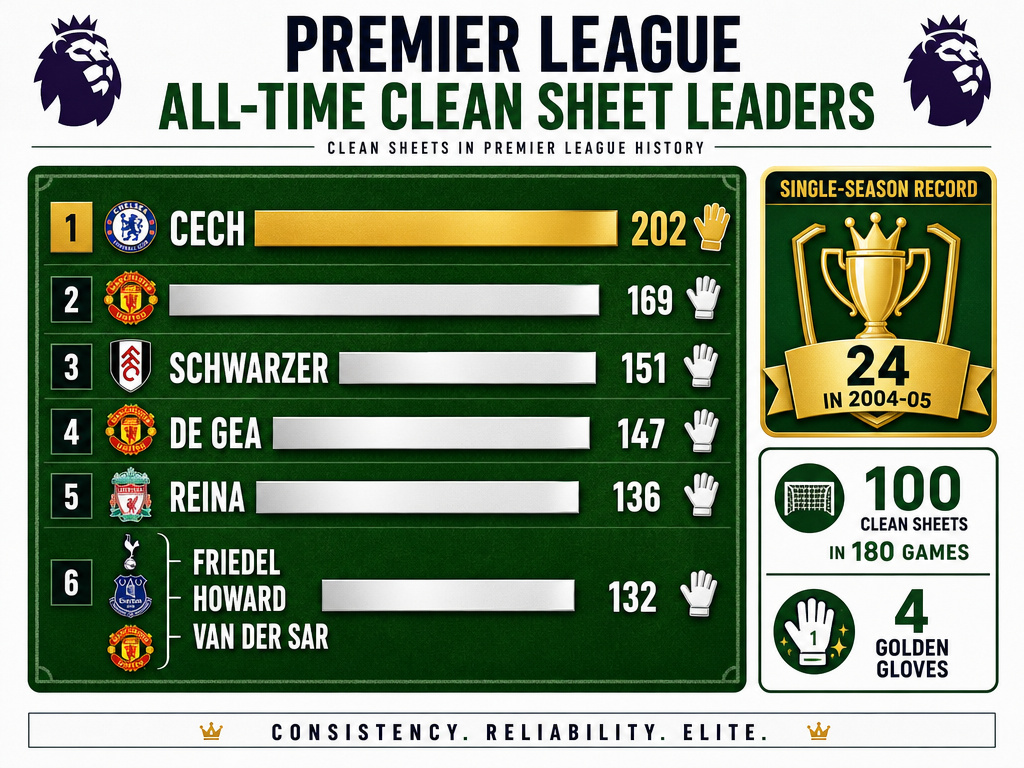
Petr Cech holds it with 202. Opta Analyst’s record list gives the shape of the top end:
- Cech, 202: his first came in a 1-0 win over Manchester United, Jose Mourinho’s first game in charge of Chelsea. He kept another 40 for Arsenal and is the only goalkeeper past 200.
- Cech again, 24 in 2004-05: the single-season record, three more than any other keeper.
- A former Liverpool, Aston Villa, West Ham, Manchester City and Portsmouth keeper, 169: that was 29.5% of his Premier League appearances.
- Mark Schwarzer, 151 in 514 appearances: his last game came aged 42 years 159 days, a goalless draw with Hull on 14 March 2015.
- David de Gea, 147: 12 years at Manchester United, fourth on the list.
- Pepe Reina, 136 in 297 appearances: the first keeper with 20 or more in multiple seasons.
- Brad Friedel, Tim Howard and Edwin van der Sar sit level on 132 each.
The Petr Cech Premier League clean sheets record also comes with a speed mark. Wikipedia says he reached 100 in 180 appearances, the fewest, and won the Golden Glove a joint-record four times (2004-05, 2009-10, 2013-14 and 2015-16). He is the only goalkeeper to win it with two clubs.
That is how clean sheets decide an individual award. Van der Sar won the Golden Glove in 2008-09 on 21 clean sheets.
Van der Sar’s 1,311 minutes, step by step
Edwin van der Sar’s 2008-09 run passed four earlier marks on its way to 1,311 league minutes without conceding. Wikipedia’s Edwin van der Sar career biography logs it game by game:
- 27 January 2009: a 5-0 win over West Bromwich Albion made it 11 games and 1,032 minutes. That beat Cech’s 10 matches and 1,025 minutes from 2004-05.
- Later in the run: it beat the English league record of 1,103 minutes, set by Steve Death of Reading in 1979.
- 8 February 2009: the run reached 1,212 minutes, past Bobby Clark’s British top-flight record of 1,155 (Aberdeen, 1971).
- 18 February 2009: it reached 1,302 minutes, beating Jose Maria Buljubasich’s single-season world record of 1,289 from the Chilean Clausura in 2005.
- 4 March 2009: it ended when Van der Sar’s error let Peter Lovenkrands of Newcastle score after nine minutes.
Right, so, one wrinkle. Cech’s Wikipedia page calls his 1,025 minutes a league record, which Van der Sar’s run clearly passed. The Van der Sar page calls 1,311 minutes a world record, but I only verified the chain of marks he beat. Treat the “world record” label with care.
Would anyone have noticed that error if it had come in the 80th minute of a different game?
How does clean sheet betting work and how are bets settled?
A clean sheet bet asks whether a team will concede during the match. You can usually back a side to keep one or to fail to keep one, and some markets cover both teams at once. The bet is won or lost on whether the opponent scores, so a team can lose its clean sheet by any goal against it, and an own goal ends it regardless of who scored.
The awkward part is extra time and penalties. Sportmonks says goals in extra time or penalties don’t count against a clean sheet earned in the main part of the match. The IFAB Laws of the Game, though, treat shoot-out kicks as outside the match, while extra time is still part of it. So an extra-time goal could be a goal conceded in the match, and sources differ on that point.
Because of this, check the rules of your bookmaker before placing a bet. Look for whether the market settles on 90 minutes or on the full match, and how it treats extra time. Shoot-out kicks sit outside the match under Law 10, so they should not affect settlement.
Frequently Asked Questions
What counts as a clean sheet in football?
Team earns one when its opponent scores no goals in the match. The scoreline can be 0-0 or a win. Own goals count as goals against, and shoot-out kicks don’t count at all.
What does “no clean sheet” mean?
It means the team conceded at least once. Take a 2-1 win: the winners scored twice but still gave up a goal, so neither side has a clean sheet.
Does a substitute goalkeeper get the clean sheet?
It depends on the rulebook. Fantasy Premier League keeps clean sheet points for a player who was substituted if he played 60 minutes or more. Sportmonks credits any player who was on the field while the team held the clean sheet.
Can a team lose and still keep a clean sheet?
Only through a shoot-out. A 0-0 match decided on penalties leaves both teams with a clean sheet, because the kicks are taken after the match has ended.
Who holds the record for most clean sheets?
Petr Cech holds the Premier League career record with 202 and the single-season record with 24 in 2004-05, according to Opta Analyst.
The Bottom Line
So, what is a clean sheet in football? A match where the other side scores nothing. The hard part is knowing which rulebook decides the credit.
Here is the threshold to remember: if a keeper comes off, check whether he played 60 minutes. That one number separates Fantasy Premier League’s rule from Sportmonks’s. Next time a site quotes a keeper’s season total, spend a minute finding out which provider’s rule sits behind it.
Extra time stays the open question. Until a governing body or a data provider spells it out, I’d treat any single rule as one reading, not the law. Tell that to the fan who insists the keeper “kept it” after he was subbed off, and watch the pub argument begin.
