
Plyometric Exercises for Football: Horizontal vs. Vertical
This post contains affiliate links. As an Amazon Associate, we earn from qualifying purchases.
Football is a game of explosive bursts – sprints, jumps, and sudden changes of direction. Plyometric exercises train your body to generate maximum force in minimum time, which directly translates to beating a defender, winning a header, or cutting across a passing lane. Research-backed protocols suggest effective doses such as 1–2 sessions per week for 7 weeks with ~80 jumps per session, or a minimal dose of one weekly session for at least 5 weeks with ~70 jumps per session. Rest between repetitions should be kept under 15 seconds.
The jump from knowing plyometrics are good to knowing exactly how to program them is the difference between generic advice and a plan that works. The rest intervals, weekly volume, and even the direction of your jumps matter more than just picking exercises from a list.
What follows is a research-backed blueprint. We’ll break down the proven benefits, pinpoint the exact dosing from systematic reviews, and build sample sessions you can slot into your week. We’ll also tackle the common disagreements in the science – like how long you need to train to see gains – so you know where the consensus sits and where you have room to experiment.
Key Takeaways
- Plyometric training improves jumping, sprinting, and change-of-direction ability in football players with moderate to large effect sizes, often within 4-7 weeks.
- An effective weekly dose is 1-2 sessions with 70-80 maximal-intensity jumps per session, using a 10% weekly increase in jump count for progressive overload.
- Rest <15 seconds between jumps and ≥30 seconds between sets; session recovery should be 24-48 hours. Treating plyometrics as cardio by shortening rest sabotages the power stimulus.
- Both horizontal-based (e.g., bounding) and vertical-based (e.g., box jumps) plyometrics are equally effective for improving speed and agility – choose based on your movement needs, not a false hierarchy.
- Your biological maturity and individual muscle elasticity influence your results; post-puberty players and those with higher baseline vastus lateralis elasticity tend to see greater sprint improvements.
What Are Plyometric Exercises and Why Do They Work?
Plyometrics are exercises that link a rapid eccentric (muscle-lengthening) action with an immediate concentric (muscle-shortening) action, and this principle is the foundation of plyometric exercises for football. Think of the quick dip before you leap for a header – that’s the stretch-shortening cycle in action. The muscle and tendon system stores elastic energy during the stretch phase and releases it, along with a powerful neural signal, during the shortening phase. This results in more force production than a concentric-only movement could generate.
In football, this isn’t an abstract concept. It’s the mechanism behind a winger’s explosive first step to get past a fullback, a midfielder’s reactive jump to win a second ball, or a striker’s quick change of direction to lose a marker. A systematic review published in the PMC notes this direct transference, stating plyometric jumps “mimic the specific short-duration high-intensity actions of soccer.” The goal isn’t to jump higher in a vacuum; it’s to train your nervous system and muscles to be more explosive in football-specific patterns.
A 2024 meta-analysis in PLOS One quantified the impact: plyometric training significantly improved jumping ability (standardized mean difference, SMD = 0.76), sprinting ability (SMD = -0.45), and change-of-direction performance (SMD = -0.76) in adolescent soccer players.
The “why” is neuromuscular. By overloading this stretch-shortening cycle with plyometric exercises for football, you teach your body to recruit muscle fibers faster and more efficiently. You also improve the stiffness and reactivity of your tendons, turning your leg into a more effective spring. Skip the slow, deliberate strength rep – plyometrics are about speed of force production.
The Plyometric Football Benefits Table
Here’s how the improvements break down across key performance metrics, drawing from the compiled research. This isn’t guesswork; these are the aggregated findings from controlled studies.
| Performance Metric | Average Improvement (Effect Size) | Primary Mechanism | Football Translation |
|---|---|---|---|
| Vertical Jump | Moderate to Large (SMD = 0.76) | Enhanced neural drive & tendon stiffness | Winning aerial duels, powerful shot power |
| **Sprint Speed (5-30m) | Small to Moderate (SMD = -0.45) | Improved rate of force development & stride mechanics | Beating defenders in a foot race, rapid acceleration |
| **Change of Direction | Moderate to Large (SMD = -0.76) | Enhanced reactive strength and force production | Sharp cuts to evade tackles, quick defensive shifts |
| Reactive Strength Index | Significant Improvement | Optimized stretch-shortening cycle efficiency | Reacting to loose balls, rapid successive jumps |
The timeline for these gains can be surprisingly quick. A 2024 meta-analysis (Chen et al.) concluded that “plyometric training can significantly improve jumping performance within just 4–7 weeks.” However, another 2024 meta-analysis (Moran et al.) found that strength gains were similar after shorter (<8 weeks) compared to longer (≥8 weeks) interventions. This makes it an excellent in-season training tool, not just a pre-season conditioning block.
What Does a Plyometric Football Session Actually Look Like?
Forget endless reps until you’re gassed. The research points to a specific sweet spot for volume, intensity, and rest.
The Effective Dose: A 2022 systematic review proposed an effective dose of ~80 jumps per session, performed at near-maximal or maximal intensity, done 1–2 times per week for 7 weeks. A separate 2024 meta-analysis suggested a “minimal initial effective” dose could be ~70 jumps per session, once weekly for at least 5 weeks. The takeaway: start with 70-80 high-quality jumps, 1-2 times a week.
Rest is Part of the Program: This is where most garage plans fail. To maintain the high-intensity, power-focused stimulus, rest intervals are essential. The review recommends <15 seconds rest between repetitions and ≥30 seconds between sets. A 2024 study protocol used 30 seconds rest between sets and 60 seconds between exercises. If you’re breathing too hard to perform the next jump with maximal intent, you’ve rested too little.
Progressive Overload: Simply doing the same thing for weeks leads to a plateau. The systematic review suggests a simple method: a 10% weekly increase in the total number of jumps. Week 1: 70 jumps. Week 2: 77 jumps. Week 3: ~85 jumps. This ensures a gradual, manageable increase in training stimulus.
Where this goes sideways: Cutting rest periods short to “work harder.” This shifts the stress from the nervous system to the cardiovascular system, training endurance, not peak power. Your jumps become slower, your technique suffers, and you miss the point.
Here’s how you might structure a session using these principles:
- Dynamic Warm-up (10 mins): Leg swings, high knees, butt kicks, walking lunges with twist.
- Plyometric Circuit (20 mins):
- Exercise 1: Tuck Jumps – 3 sets of 6 reps (Rest 30s between sets)
- Exercise 2: Single-Leg Hops (each leg) – 3 sets of 5 reps per leg (Rest 30s between sets)
- Exercise 3: Bounds for Distance – 3 sets of 4 reps (Rest 60s between sets)
- Cool-down & Mobility (5 mins): Light jog, quad/hamstring/calves stretch, hip rotations.
This sample hits roughly 72 foot contacts, uses appropriate rest, and focuses on maximal effort per rep.
Horizontal vs. Vertical Plyometrics: Which Is Better?
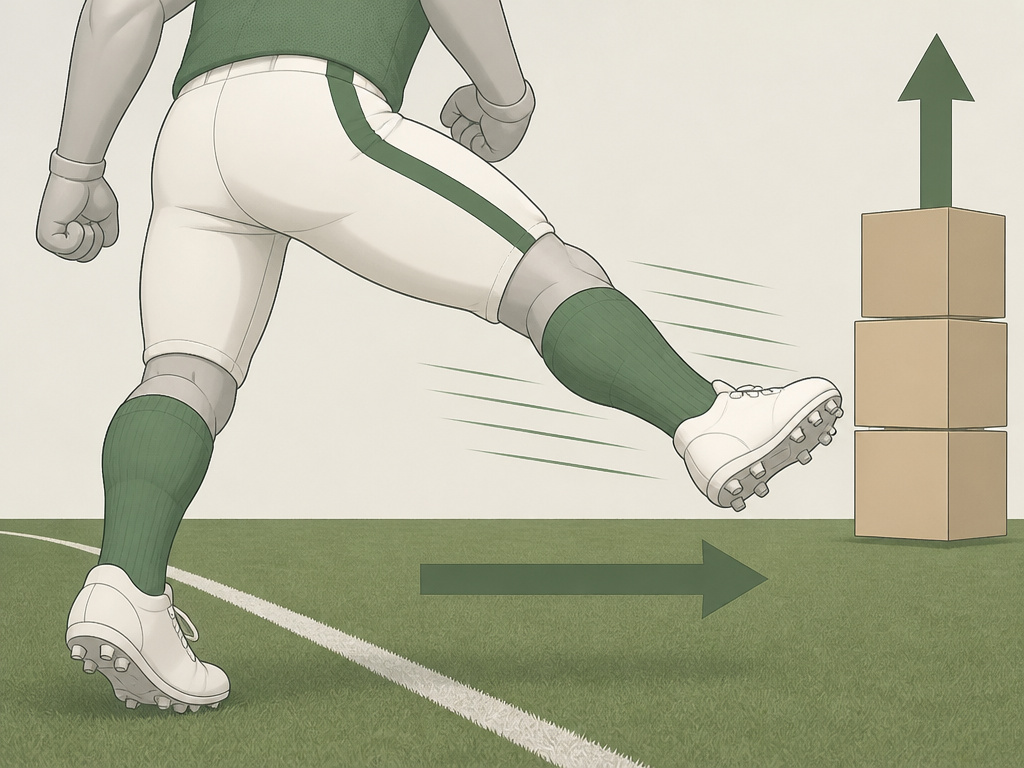
Coaches often get dogmatic: “Sprinters need horizontal plyos!” The research, however, tells a more nuanced story. A 2023 study in Scientific Reports compared horizontal-based (like standing long jumps) and vertical-based (like drop jumps) plyometrics in semi-professional players. The result? Both were effective for improving change-of-direction and linear sprint, with no significant difference between the two types.
| Plyometric Type | Example Exercises | Best For Emphasizing | Consideration |
|---|---|---|---|
| Vertical-Based | Box Jumps, Drop Jumps, Tuck Jumps | Force production against gravity, improving jump height | Excellent for general power development; can be higher impact. |
| Horizontal-Based | Bounds, Skater Hops, Standing Long Jumps | Force production in the horizontal plane, improving stride length/power | May have slightly greater transfer to straight-line sprint acceleration. |
The practical takeaway is liberating. You don’t need to overthink it. A mix is likely optimal. If you’re a centre-back who needs to win headers, prioritize vertical power. If you’re a winger focused on pure acceleration, lean into horizontal drills. For most players, a 50/50 split covers all bases. The key is intent and quality, not an arbitrary classification.
Advanced Variations: Microdosing and Loaded Plyometrics
Once you’ve mastered the basics, two research-backed strategies can help you break through plateaus or fit training into a busy schedule.
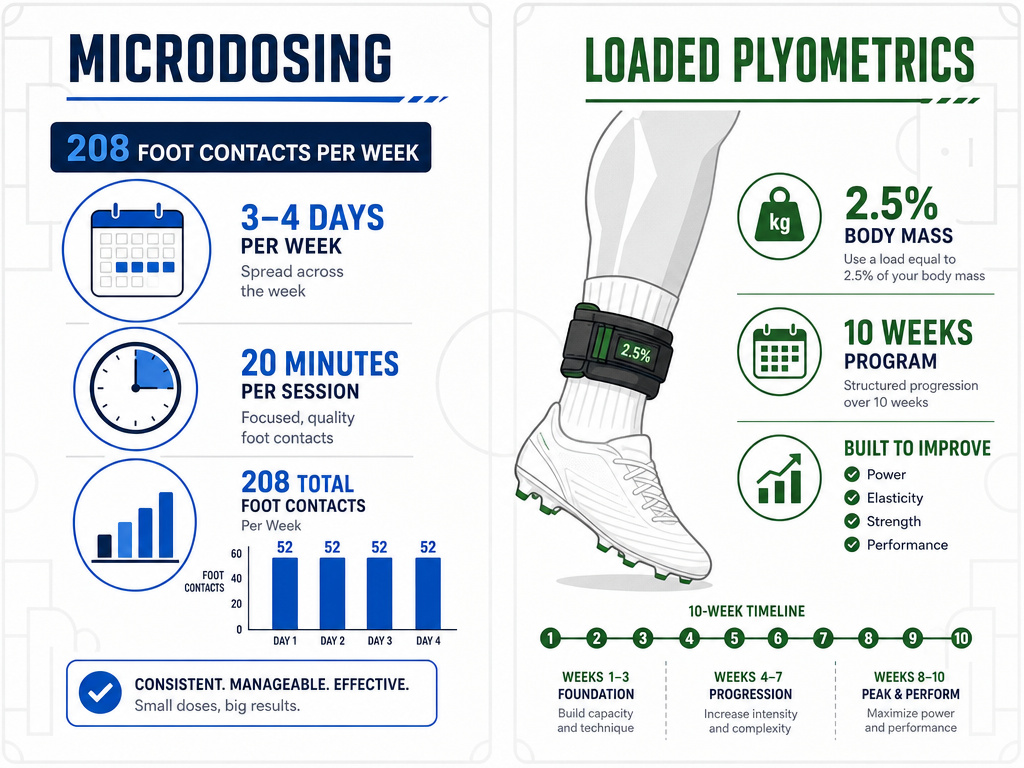
Microdosing involves distributing a smaller plyometric stimulus across more frequent sessions. A 2024 pre-season study used a Phase 1 protocol of 208 foot contacts per week across 3–4 sessions of ~20 minutes each. That’s an average of just 50-70 jumps per session, but done more often. This is a brilliant strategy for in-season maintenance – a short, sharp 15-minute plyo session after a light technical practice keeps the nervous system primed without causing fatigue.
Loaded Plyometrics add a small external weight to increase the demand. A 2020 study had players use ankle loading with 2.5% of body mass for 10 weeks, twice weekly. The weight was minimal but sufficient to provide a novel stimulus. Important: This is for advanced athletes with a solid foundation of bodyweight plyometric skill and strength. Never sacrifice jump speed or technique for added load.
Safety, Technique, and Common Mistakes
Plyometrics are high-impact by design. Doing them wrong is a shortcut to shin splints, knee pain, or worse. Here are the non-negotiables.
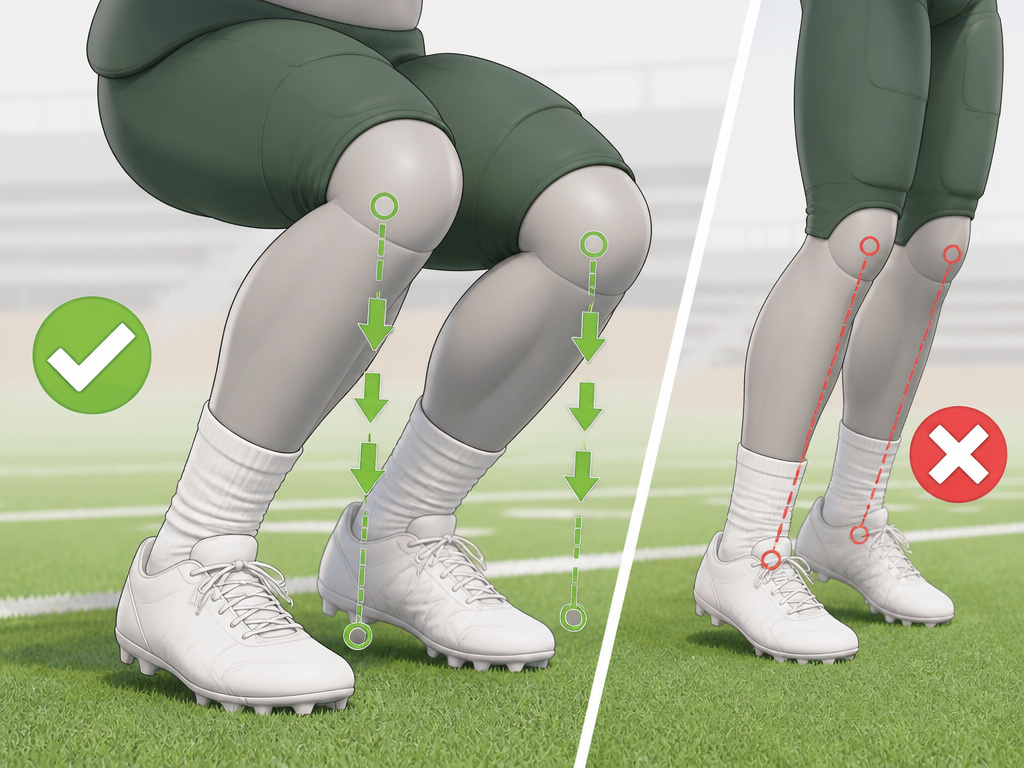
Landing Mechanics: Every jump ends with a controlled, soft landing. Knees should track over toes, not cave inward. Aim for a quiet landing – a loud “thump” means you’re absorbing force poorly. Your hips should sink back into a partial squat position to distribute force through the muscles, not the joints.
Surface Matters: A firm, forgiving surface is ideal. Grass, a sprung gym floor, or artificial turf are good choices. Concrete, asphalt, and hardcourt are high-risk and should be avoided. The difference in impact force is substantial.
Build a Base: You wouldn’t max out your squat on day one. Don’t do advanced plyometrics without a foundation of strength and landing competency. You should have a solid foundation of lower-body strength and landing competency before adding advanced plyometrics.
Common mistake: Focusing on the “up” and neglecting the “down.” The landing is where the eccentric strength is built and where injuries are prevented. Drill the landing position until it’s automatic before adding height or distance.
Warm-up and Recovery: Plyometrics are neural fireworks. A dynamic warm-up that raises core temperature and activates the glutes and hamstrings is essential. Post-session, prioritize recovery: hydration, nutrition, and 24–48 hours of recovery before your next intense plyometric or lower-body strength session. Your body adapts when you rest, not when you train.
Sample Plyometric Football Sessions
Here are two ready-to-use sessions, one for a power-focused day and one using the microdosing principle.
Session A: Maximal Power (Total ~80 contacts)
- Warm-up: 5 min light jog, dynamic stretches (leg swings, walking lunges, high-knee skips).
- Exercise 1: Drop Jumps (from a low to moderate height box) – 4 sets of 5 reps. Step off the box, land softly, and immediately explode upward. Rest 90s between sets.
- Exercise 2: Alternating Leg Bounds – 3 sets of 8 reps (4 per leg). Focus on distance and hang time. Rest 75s between sets.
- Exercise 3: Medicine Ball Chest Pass Throws (for upper body power) – 3 sets of 6 throws. Use a moderately heavy medicine ball, throw with maximal intent. Rest 60s.
- Cool-down: Static stretching for quads, hamstrings, glutes, calves.
Session B: In-Season Microdose (Total ~50 contacts)
- Integrated into a light training day. After passing drills, before cool-down.
- Circuit (2 rounds, minimal rest between exercises, 2 min rest between rounds):
- Lateral Hops over line: 10 reps per side.
- Squat Jumps: 8 reps.
- Single-Leg Hops in Place (each leg): 6 reps per leg.
- This takes <10 minutes, provides a potent stimulus, and won’t fry your legs for the next match.
Frequently Asked Questions
Should a 12 year old do plyometrics?
Yes, with appropriate supervision and scaling. A 2024 meta-analysis on adolescent soccer players included participants aged 10 to 18.99 years. The key is focusing on technique, using low-level exercises like skipping, two-footed hops, and jump rope, and avoiding excessive height or volume. A 2024 study in PLOS One highlighted that biological maturity (post-peak height velocity) influenced results more than age, so coaches should prioritize movement competency over chronological age.
How do I combine plyometrics with weight training?
Plyometrics are a form of power training. The best practice is to do them on the same day as your lower-body strength work, but perform the plyometrics first. Your nervous system is freshest, allowing for maximal speed and intent. Follow the plyometrics with your heavier, slower strength lifts (squats, deadlifts). Alternatively, you can separate them by at least 6-8 hours (e.g., plyometrics in the morning, weights in the evening).
What are the best no-equipment plyometric exercises for football?
You can build an excellent program with just your body and some space. The foundational trio: Squat Jumps (for vertical power), Bounding (for horizontal power), and Split Jump Lunges (for single-leg stability and power). Add Lateral Skater Hops for agility and Burpees (done with explosive intent) for a full-body challenge.
How long until I see results from plyometric training?
Can plyometrics improve my kicking power?
Indirectly, yes. Plyometrics improve the rate of force development in the muscles involved in the kicking kinetic chain (glutes, quadriceps, core). A more explosive plant leg and a faster, more powerful swing leg come from enhanced neuromuscular power. For direct transfer, include exercises like Medicine Ball Rotational Throws.
Before You Go
The single biggest mistake is treating plyometrics as a conditioning grind. The moment your jumps slow down, the session has lost its purpose. It’s not about burning lungs; it’s about shocking the nervous system with bursts of high-quality speed.
Start with the basic dosage: one session a week of 70-80 maximal jumps, with full rest between sets. Nail the landing mechanics on every single rep. After 4-5 weeks, if you’re recovering well, consider adding a second weekly session or exploring microdosing to maintain gains during a busy match schedule.
The research is clear on the outcomes, but it’s also clear on the individual variability. Your unique biomechanics – your muscle elasticity, your tendon stiffness – will influence your results. Pay less attention to the person next to you and more to your own progress from session to session. Track your broad jump distance or your vertical jump height. That’s your real scoreboard.
Finally, remember this is one ingredient in the larger recipe of football fitness. Pair it with smart strength training for football players, dedicated speed training, and a solid warm-up routine. Used correctly, plyometrics are the spark that turns raw strength into the explosive power that defines the modern game.
