
Jockeying in Football Explained: How to Coach Drills
This post contains affiliate links. As an Amazon Associate, we earn from qualifying purchases.
Jockeying in football is a defender’s technique of delaying an attacker by maintaining a controlled, side-on stance and using short shuffle steps to steer them away from goal. Its purpose, according to the BBC, is to deny the opponent time and space and allow teammates to get back into position. It is not about winning the ball immediately; it’s about containment, dictating the attacker’s path, and forcing an error.
That ‘denying time and space’ clause from the BBC is the entire philosophy of defending in two words. The moment a defender lunges and misses, time and space are gifts handed straight to the attacker. Jockeying flips the script. Jockeying in football explained: you’re not retreating; you’re actively herding.
What follows breaks the skill into its physical components, stance, footwork, focus, and the tactical decisions behind them, which is the core of jockeying in football explained. We’ll look at the drills that build the instinct, the common errors that break it, and how this one-on-one duel connects to your team’s overall defensive shape. By the end, you’ll see the tackle not as the highlight, but as the last resort you only take when the trap is perfectly set.
Key Takeaways
- Jockeying is active containment, not passive backing off. You use your body shape to show the attacker one safe path, usually wide.
- Your focus must stay locked on the ball, not the attacker’s shoulders or eyes. Body feints only work if you watch the body.
- Use a short “chop step” with your feet never coming entirely together. This keeps your weight on the balls of your feet for instant reactions.
- The best time to tackle is after you’ve channeled the attacker into a tight space or onto their weak foot, not when they first receive the ball.
- Jockeying is a team tactic. You’re buying precious seconds for teammates to recover their shape and provide defensive cover behind you.
What Jockeying Is (And What It Isn’t)
Watch a top defender like Virgil van Dijk. He doesn’t sprint at a forward who has back to goal. He approaches at a controlled pace, gets side-on, and starts shuffling. He’s managing the threat. That management is jockeying.
The Wikipedia article on jockeying defines it as the defender’s skill of keeping between the attacker and their intended target, usually the goal, by slowing them down. Some coaches call it shepherding or guiding. Think of a sheepdog. It doesn’t bite the sheep; it positions itself so the flock moves toward the pen. Your job is the same: use your position to make the attacker’s best option your team’s least dangerous option.
This is where most young defenders misunderstand the jockeying in football explained. They see a duel as a 50/50 challenge to be won instantly. Jockeying isn’t a 50/50. It’s a 70/30 in your favor, where you control the 70 by dictating the geometry of the attack. The tackle is just the final, confirming action. Lunge early, and you turn your 70/30 into a 0/100 sprint back toward your own goal.
Where this goes sideways: Treating jockeying as passive backing off. If you just retreat in a straight line toward your own goal, you’re giving the attacker a free run. Active jockeying means moving laterally to force them wide, buying time for your midfield to track back.
The Core Jockeying Technique: Body Shape & Footwork
The technique is a simple checklist that feels anything but simple under pressure. It breaks into two parts: how you hold your body, and how you move your feet.
Body Shape: The Angled Stance
There’s a healthy debate here. Sources disagree on the optimal stance: Wikipedia and general consensus advocate a low, side-on stance with knees bent, while the Sportplan coaching resource advises a ‘closed position,’ where the defender should ‘open’ (turn) her toes, hips, and shoulders toward the nearest side of the grid to channel the ball. The Sportplan coaching resource adds a specific nuance: the defender should ‘open’ (turn) their toes, hips, and shoulders toward the nearest side of the grid to channel the ball to the tightest area. The goal is the same either way. You are creating a barrier. Your angled body shows the attacker the “safe” path, usually toward the touchline or onto their weaker foot. A square-on stance opens a door straight through the middle.
The Physical Feel
Get low, knees bent. Now, lean your weight slightly forward onto the balls of your feet. If your weight shifts to your heels, a quick change of pace by the attacker leaves you flat-footed and beaten. You should feel ready to pounce forward or shuffle sideways, not fall backwards.
| Body Part | Correct Position | Why It Matters |
|---|---|---|
| Feet & Hips | Side-on, opened toward the channel. | Closes the direct path to goal, funnels attack wide. |
| Knees | Bent, weight forward. | Maintains balance and allows explosive lateral movement. |
| Focus | Locked on the ball. | Prevents being deceived by body feints or shoulder drops. |
| Arms | Comfortably at sides (or holding shorts). | Maintains balance and avoids careless handball calls. |
Footwork: The Chop Step
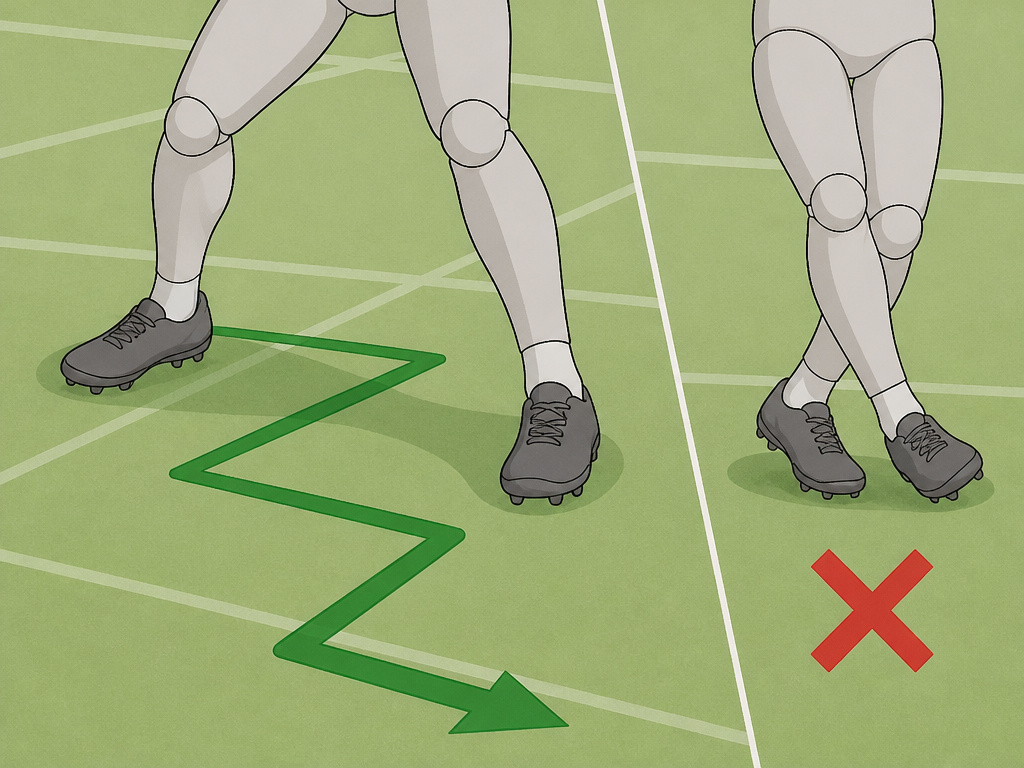
Your feet are your engine. The Sportplan drill calls for a ‘chop step’, short, quick steps that keep your feet underneath you. Long, crossing strides throw your balance off and make you vulnerable. This is the essential rule: your feet should never come entirely together. The moment they clap together, you are stuck, weight on both feet, unable to react powerfully. You are a statue. The attacker sees it and explodes past you.
“Top defenders keep their arms and hands comfortably at their sides while jockeying. Some coaches like the defender to hold the bottom of her shorts with the hand nearest the ball to avoid handball calls.” – Sportplan Coaching Resource
It’s not just about being in the way. It’s about being in the right way, with every part of your body under control, ready to react to the ball’s movement, not the attacker’s fake.
When to Jockey vs. When to Tackle
This is the decision that defines defensive intelligence. It’s not a feeling. It’s a checklist.
You jockey when:
- The attacker has the ball under control, facing you.
- You are isolated (no covering defender behind you).
- The attacker is in a wider area, with the touchline as an extra defender.
- You hear a teammate shouting “I’m coming!” – you are buying time for help.
You tackle when:
- The attacker has taken a heavy touch, and the ball is more than a stride away from their foot.
- You have successfully shepherded them into a tight corner or onto their weak foot, and their options are gone.
- You have clear, close defensive cover directly behind you.
- The attacker is facing their own goal, shielding the ball, and you can nick it cleanly.
The worst mistake? Diving in on an attacker’s first touch when they are still facing forward. You commit, they tap it past you, and now they’re running at your center-backs with you out of the play. Patience is the tactical understanding that a controlled delay is often a better outcome than a risky, all-or-nothing challenge.
This patience is a cornerstone of solid one-on-one defending. Winning the duel starts long before the tackle.
Drills to Lock In the Jockeying Instinct
You can’t learn this in a game. The pressure is too high. You need repetitive drills that build muscle memory until the right stance and footwork feel automatic.
1. The Mirror Drill
- Setup: Pair up in a 10×10 yard grid. One attacker (without a ball), one defender.
- Execution: The attacker jogs forward, changing speed and direction in a zig-zag. The defender mirrors them, focusing on maintaining the perfect side-on body shape, chop steps, and eyes forward.
- Coaching Point: The defender’s goal is to stay in front of the attacker all the way to the end of the grid. Look for crossed feet or feet coming together.
2. Channeled Jockeying
- Setup: Create a long, narrow channel (about 15 yards long, 5 yards wide). Attacker with a ball at one end, defender at the other.
- Execution: The attacker tries to dribble past the defender to the other end. The defender must jockey, using the touchlines as an extra defender, and can only tackle if the attacker makes a heavy touch.
- Coaching Point: This drill teaches defenders to use the pitch. Your job is to guide the attacker into the tightest space, where their mistake is more likely.
3. Trigger Tackle Drill
- Setup: Same as the mirror drill, but add a passive defender (coach or teammate) to the side.
- Execution: The jockeying defender must contain the attacker until the passive defender shouts “TACKLE!” Only then can they attempt to win the ball.
- Coaching Point: This builds incredible patience and trains defenders to listen for cues from covering teammates, integrating jockeying into a team defensive principle of compactness.
Common Mistakes and How to Fix Them
Everyone makes these errors. The trick is knowing what they look and feel like so you can self-correct.
-
Crossing Your Feet: This is the big one. It feels like a faster way to move laterally, but it robs you of balance. Your feet get tangled, and you can’t push off to change direction.
- Fix: Concentrate on the chop step. Short, quick steps where the feet never cross. It feels slower at first, but your recovery speed when the attacker moves will be twice as fast.
-
Watching the Attacker’s Eyes/Shoulders: An attacker can sell a dummy with their eyes. You look, you lean, you’re beaten.
- Fix: In training, literally say “ball, ball, ball” to yourself. Train your eyes to stare at the ball, even if it’s at the attacker’s feet. Their body can’t go anywhere without it.
-
Jockeying in a Straight Line Backward: This is passive retreating. You’re just giving up ground.
- Fix: Your default movement should be lateral. As the attacker advances, move at an angle that forces them toward the touchline. You’re not just blocking; you’re redirecting.
-
Standing Too Upright: A high center of gravity is a defender’s worst enemy. You’re a bowling pin waiting to be knocked over.
- Fix: Get into your stance and have a teammate give you a gentle push on the chest. If you stumble backward, your weight is on your heels. Get lower, lean forward.
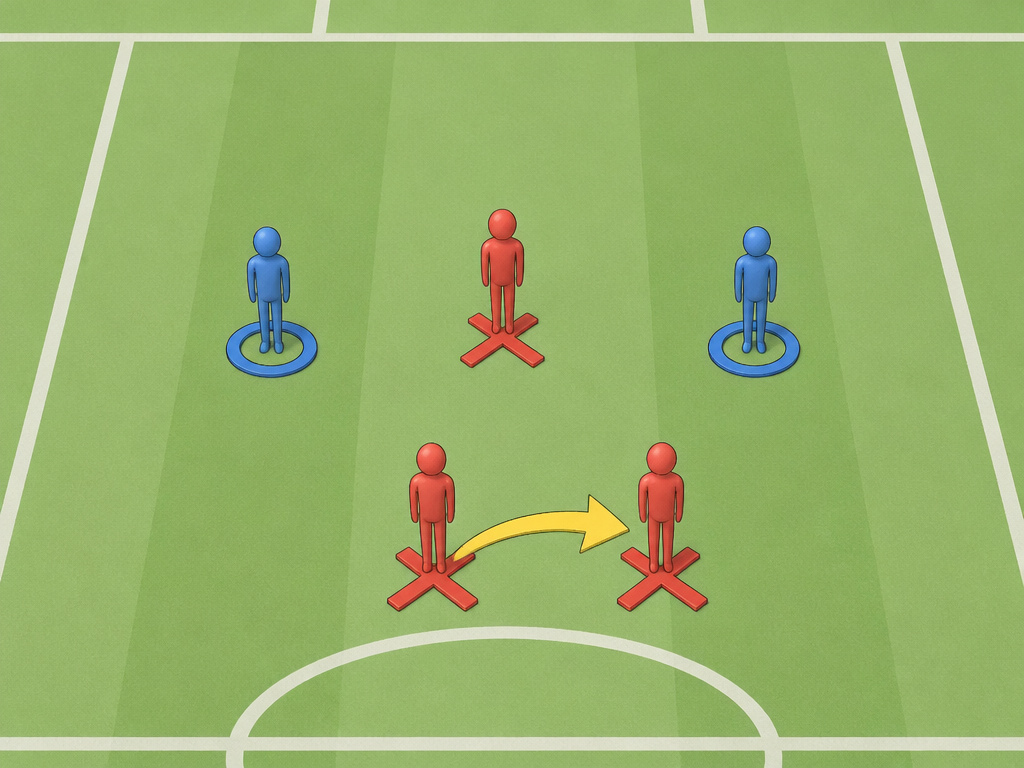
These mistakes break down completely when a team loses its compactness. If you’re jockeying with 20 yards of space behind you, you’re just a speed bump. The skill only works within a supportive defensive structure.
How Jockeying Fits Into the Bigger Picture
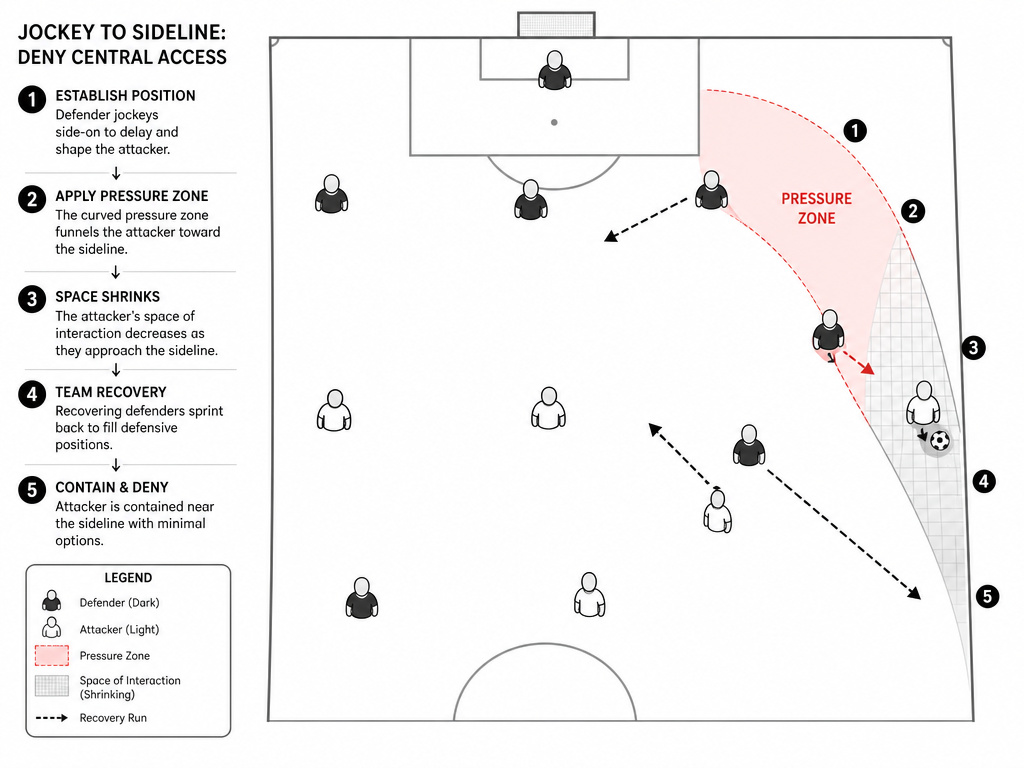
Jockeying is a fundamental gear in the defensive machine. Think about a team that presses high. The pressing triggers, a bad pass, a loose touch, are what start the collective press. But when that press is beaten, the last defender often finds themselves in a one-on-one. Their job isn’t to win it immediately; it’s to jockey, delay, and allow the pressing players to sprint back and recover their shape.
A Frontiers in Sports and Active Living study analyzed “pressure on the ball” in small-sided games. It found that applying pressure (like tight jockeying) increases the number of ball recoveries. But it also comes with a cost: players under pressure show lower decision-making and less spatial exploration. This is the high-wire act. Good jockeying forces the attacker into a mistake (a recovery). Poor jockeying, where you’re too frantic or too passive, leads to rushed decisions on your part.
Furthermore, research in PLOS One on player movement under spatial constraints shows that restricting space changes how players interact. When you jockey successfully, you are the one applying that constraint. You’re shrinking the attacker’s space of interaction, making the pitch feel smaller and more claustrophobic for them, which directly leads to those heavy touches and misplaced passes you can pounce on.
How to Coach Jockeying Drills
Effective drills isolate the defender’s stance and movement. The defender’s focus must be the ball. They should adopt a ready stance with weight on the front of their feet, leaning slightly forward with legs bent. Teach them to use a ‘chop step’, keeping their feet underneath them with short steps, ensuring their feet never come entirely together. Instruct the defender to open their toes, hips, and shoulders to channel the attacker toward a tight area like the sideline. This denies time and space, forcing the attacker into an error. Drills should emphasize patience, with the tackle as a final option after teammates recover.
Frequently Asked Questions
What does it mean to jockey in football?
To jockey in football means to delay an attacker in possession by using a side-on defensive stance and short shuffle steps. The defender aims to shepherd the attacker away from dangerous central areas, often toward the touchline, without diving into a tackle. The primary goal is to buy time for defensive teammates to recover their positions.
What are the 5 D’s of defending in football?
The “5 D’s” are a coaching framework for defensive principles. They are often cited as: Delay (jockeying), Deny (blocking shots/passes), Dictate (forcing the attacker where you want them), Defend (making the tackle or clearance), and Develop (transitioning to attack after winning the ball). Jockeying is the core “Delay” component.
Is jockeying just for defenders?
No. While central defenders use it most famously, it’s a crucial skill for any player in a defensive transition. A defensive midfielder might jockey to allow full-backs to get back. Even a forward, when counter-pressing after losing the ball, might use jockeying to slow down the opponent’s breakout before a teammate arrives to help.
How close should I get when jockeying?
The ideal distance balances being close enough to tackle if the attacker makes a mistake but far enough to react to a burst of pace. A 2026 Frontiers review noted that in training drills, players are often instructed to close down space within approximately 1.5 meters of the ball carrier to apply effective pressure.
What’s the biggest mistake beginners make?
The most common mistake is impatience, diving in with a tackle as soon as the attacker receives the ball. This often happens because the defender is watching the attacker’s eyes or upper body instead of focusing solely on the ball. The first touch is rarely the best time to win it.
Before You Go
The next time you watch a match, don’t watch the player with the ball. Watch the defender closest to them. See if they stand square and lunge, or if they get side-on, chop-step, and guide. That split-second choice is the difference between a controlled clearance and a goal-scoring chance.
For a clear, classic breakdown of the skill, the BBC Sport jockeying skills guide is still a perfect starting point. It captures the timeless principle: defending is a chess match, not a bar fight. Your best weapon isn’t your strength; it’s your patience and your angles. Master the art of the delay, and you’ll find yourself winning the ball far more often, usually without having to make a highlight-reel tackle at all.
