
How to Win Headers in Football: Step-by-Step
This post contains affiliate links. As an Amazon Associate, we earn from qualifying purchases.
To win headers in football, you need three things: correct contact point (forehead between eyebrows and hairline), precise timing (jump slightly before your opponent), and tactical positioning that anticipates the ball’s flight. The science shows headers from crosses or long balls over 35m deliver forces similar to rugby tackles, so training limits and technique matter more than raw strength.
Most guides talk about bravery and spring. They are not wrong, but they miss the physics. A header is a collision. The goal is to control the transfer of energy from the ball, through your neck and core, into the direction you choose. A key part of how to win headers in football is to win that transfer of energy, and you win the duel.
What follows is the mechanics behind that win. We will examine the measurable forces involved, the technique that manages them, and the position-specific decisions that separate a header from a game-winning one. By the end, you will know why a centre-back’s aerial win looks nothing like a striker’s, and how to train for both without crossing the safety limits now backed by data, which is central to how to win headers in football.
Key Takeaways
- Contact the ball with your forehead between eyebrows and hairline; hitting the temple or crown risks injury and offers zero control.
- The highest forces come from headers following passes over 35m; the Professional Football Heading Guidance from The FA, Premier League, and EFL recommends a maximum of 10 higher force headers per training week for professional players.
- To gain lift in a duel, jump slightly before your opponent; their upward momentum will boost you higher.
- Female players and younger male age groups may experience greater head accelerations, making technique and recovery even more critical. Sources differ: The FA guidance found the highest linear acceleration in U18 male groups, while a 2024 systematic review found greater head accelerations in female players.
- Traditional weight-room neck curls do little to reduce impact force; neuromuscular neck exercises that train reactive stability show more promise.
The Science Inside a Header
Consider g-force. Not the good kind from a sharp turn, but the kind measured inside a player’s mouthguard during a routine header. The data from the Professional Football Heading Guidance puts the mean acceleration at 16.8 g linear and 1,373 rad/s² rotational. For perspective, the mean acceleration from a header is significantly higher than that of many daily activities. Headers from long balls and crosses produce impacts of a “similar magnitude to the average values reported for sports such as rugby union and boxing.”
The 35-meter rule is your practical filter. Any header following a pass in excess of 35m, a goal kick, a switched cross, a deep free-kick, is categorised as a “higher force header.” These are the ones the guidance says to limit in training. They are also, not coincidentally, the headers that decide games.
This is the physical reality you are managing. Winning the header is about mastering this collision. The next layer is how your movement changes the force. The same study found headers taken after a player had run more than three steps onto the ball, or from a dive, resulted in higher acceleration. The very act of winning a ball you have sprinted to meet is the most punishing. The guidance’s advice is blunt: “Wherever possible limit the number of headers carried out when a player takes more than three steps and runs onto a ball.”
So how do you win these high-stakes duels safely? You start with the foundation every coach preaches, but with the biomechanics in mind.
The Non-Negotiable Technique
Good technique is about being efficient with force, which is the essence of how to win headers in football. Get this wrong, and you absorb the ball’s energy. Get it right, and you redirect it.
Eyes open, chin up. You cannot judge the ball’s spin or pace with your eyes closed. A lifted chin naturally brings the correct part of your forehead, the flat, strong plate between your eyebrows and your hairline, into the ball’s path. Let your neck muscles brace, not stiffen.
Arms up, elbows bent. This is not just for balance. Your arms act as pistons and a shield. They help you generate upward thrust against an opponent and protect your space. A player with their arms pinned down is a player who has already lost the mechanical advantage.
Get in the line of flight. This is the part most people miss. You must move your entire body into the trajectory of the ball. Do not just lean your head. Shift your feet, adjust your angle, and make your forehead the inevitable meeting point. This is the core of proper heading technique.
The final piece is the jump. And here, the coaching advice from experts like Jeff Tipping contains a small piece of genius that feels counterintuitive until you try it.
The Timing Trick That Wins Duels
A coaching tip from Jeff Tipping: Jump slightly before your opponent jumps. They will then jump into you, and their upward momentum actually lifts you higher. Note that safety guidance recommends limiting headers where a player runs more than three steps onto a ball.
It works because you are using their force against them. You establish your position in the air first. When they make contact, you are already ascending, and they propel you further. This is how shorter players like Tim Cahill consistently out-jump taller defenders. It is not spring; it is timing.
| Common Mistake | Technical Consequence | Game Result |
|---|---|---|
| Jumping at the same time as opponent | Upward forces cancel out; a 50/50 duel. | Ball often pops out uncontrollably. |
| Leading with the top of the head | Impact focused on a small, curved bone; high injury risk. | Ball deflects straight down or skyward; no directional control. |
| Standing flat-footed under a high ball | No force generated to meet the ball; you become a passive target. | Ball bounces off you to an opponent. |
Position-Specific Demands
A centre-back and a striker both need to win headers. They do it for completely different reasons, and their techniques diverge because of it. The Opta data in the Professional Football Guidance is revealing: in the Premier League, defenders averaged 7.02 headers per match, midfielders 4.93, and strikers 3.65. The nature of those headers is everything.
For Centre-Backs: The Clearing Header
Your job is distance and safety. You are often backpedaling, judging a ball dropping over your shoulder. The technique prioritizes power and height. You want to contact the ball at the highest point of your jump, neck extended, and propel it up and out, preferably towards the channels. Think of it like a goalkeeper’s punch, clearance first, precision second. Your run-up is your advantage; a central forward can negate it by backing into you and taking that space away.
For Strikers: The Scoring Header
Your job is redirection and surprise. You are often facing the goal, moving across the defender’s line of sight. The technique is about subtlety. You rarely need to win a clean, towering duel. Instead, you attack the space between defenders, often glancing the ball with a sharp neck movement, changing its pace and direction down towards the corners. The power comes from the cross, not your neck. Your best asset is the timing trick mentioned earlier, stealing a march on a defender who is ball-watching.
The link between these roles is the service. A striker depends on the quality of the cross delivery, just as a defender must often control a high ball under pressure before they can clear it. The cross dictates the type of duel.
Training Smart Within the Limits
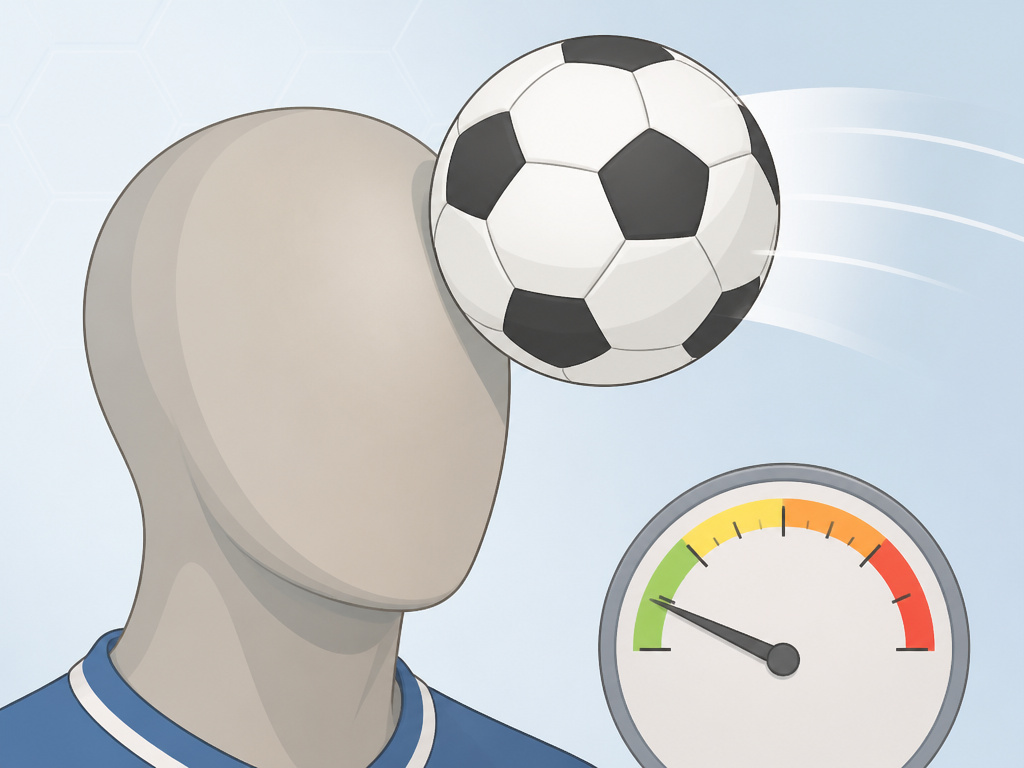
Given the known forces, how do you practice without crossing the line? The guidance provides a framework, and the research offers nuance.
First, respect the 10-per-week limit for “higher force headers” (long passes >35m, crosses, corners). For amateur players, the principle scales down. Do not spend your entire training session whipping balls at each other’s heads from 40 yards. It is inefficient and risky.
Second, use thrown passes for technique work. The guidance states plainly: “Practice technique using thrown passes as this leads to lower peak accelerations.” You can perfect your footwork, jump, and contact point with a softly tossed ball. Save the high-velocity reps for when the technique is automatic.
Where this goes sideways: Assuming neck strength alone is the answer. A 2024 systematic review in Sports Medicine concluded that while neck strength may influence head acceleration, “traditional neck strengthening exercises do not reduce head acceleration.” The exercises that show promise are neuromuscular, drills that train the neck to react and stabilize under dynamic, unexpected loads, not just to push weight in a controlled gym lift.
This is a sourced disagreement worth noting. The FA’s guidance mentions a “possible relationship between neck strength and head acceleration,” while the newer review draws a sharper distinction between strength and functional stability. The takeaway is not to skip neck work, but to choose neuromuscular exercises over traditional neck strengthening. Sources differ: The FA guidance suggests a possible relationship between neck strength and head acceleration, while a 2024 systematic review found traditional neck strengthening does not reduce head acceleration but that neuromuscular exercises do.
Navigating Physical Mismatches
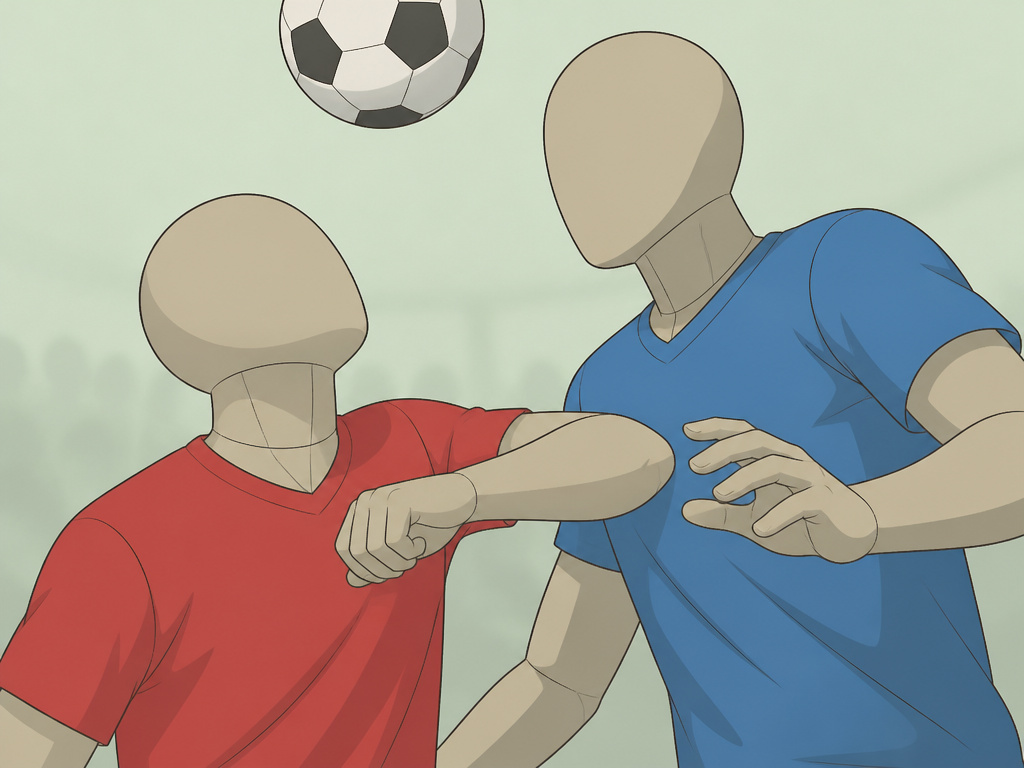
You will not always be the taller or stronger player. The art of winning headers then shifts from power to cunning.
Use the opponent’s momentum. If a taller player is backing into you, do not push back statically. Give a slight nudge just as they plant to jump. It disrupts their base without being a foul. Similarly, if you are being outmuscled, focus on the second ball. Anticipate where your opponent’s powerful, but often uncontrolled, clearance will land, and be first to that spot.
Create separation. Do not get tangled. Use your arm as a legal barrier to feel where they are and create a few inches of space. Those inches are where you generate the whip-like neck action for a glancing header. A defender who is glued to you has already won the positional battle.
Attack the ball early. This is the striker’s secret against a bigger centre-back. Do not wait for the ball to arrive in the contested space. Move early, before the defender can set their feet and judge their jump. Your first step is towards the ball’s future point, not its current location. It is the football equivalent of a boxer’s jab, it establishes control before the power is even thrown.
Health and safety concerns of heading
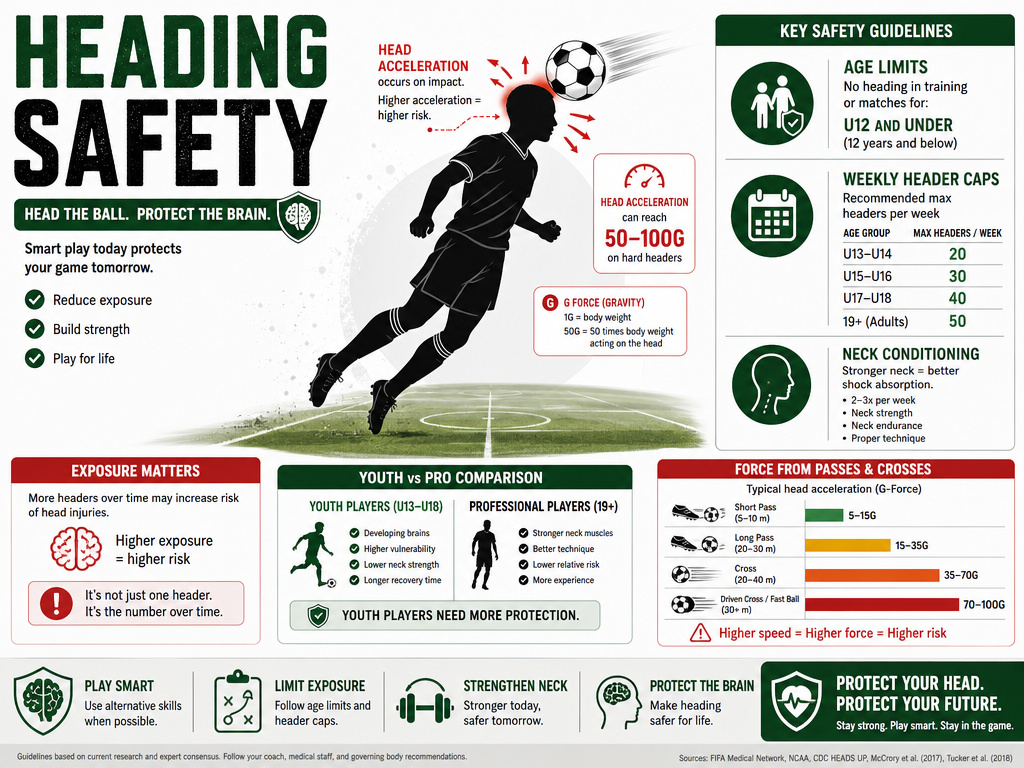
Heading the ball involves measurable forces on the head. Research shows these forces can be significant, with impacts from long passes and crosses registering similarly to averages in contact sports like rugby and boxing. To manage risk, structured guidance exists. For youth players, heading is not introduced in training until certain age groups, and even then with strict limits on frequency and force. In professional training, the number of higher-force headers is monitored and limited per week. The data indicates that head acceleration varies; it can be higher when a player runs onto a ball or dives, and differences are observed across age and gender. Practical safety measures include modifying training to use lighter serves for technique practice and incorporating specific recovery after matches. While a relationship between neck conditioning and impact management is explored, the focus remains on controlling exposure and using proper technique to mitigate forces.
Frequently Asked Questions
What is the best technique for a header in football?
The best technique uses the forehead between the eyebrows and hairline, eyes open, chin up, and arms raised for balance and protection. The body should be in the line of the ball’s flight, and the neck and core should brace to direct the impact. For power, jump; for direction, use a sharp neck movement.
Does neck strength help you win headers?
Physical neck strength helps with overall athleticism, but the latest research suggests traditional weightlifting for the neck does not directly reduce head acceleration during a header. Functional, neuromuscular neck exercises that improve reactive stability are more effective for both performance and potential risk mitigation.
Who is the best at headers in football historically?
Historically, players like Cristiano Ronaldo, Tim Cahill, and Sergio Ramos are renowned for their aerial ability. What defines the best is not always height. Cahill is 5’10”, but exceptional timing, spring, and the uncanny ability to attack the ball at its most vulnerable point in flight.
How can I practice heading safely?
Adhere to age-appropriate youth heading rules which limit or forbid heading for young children. For all ages, use thrown passes for repetition to perfect technique with lower force. Incorporate the recommended limits on high-force headers (from long balls/crosses) and always consider the broader heading safety context, ensuring adequate recovery after sessions with significant heading load.
The Bottom Line
Winning a header is a tactical, technical, and physical puzzle. The solution changes depending on your position, the type of service, and the opponent you face.
If you take one thing, let it be this: the difference between good and great in the air is rarely leap. It is the half-second of anticipation that gets you into the line of flight first. Watch any dominant aerial player, they are not reacting to the cross; they are moving to where the cross will be while everyone else is still watching the ball.
So next match, pick one player, a centre-back or a target striker, and watch only their movement in the ten seconds before a cross comes in. You will see the game within the game. The header itself is just the finish.
