
How to Take a Knuckleball Free Kick: Step-by-Step Guide
This post contains affiliate links. As an Amazon Associate, we earn from qualifying purchases.
To take a knuckleball free kick, you strike the center of a size-5 ball with the flat part of your instep and stop your foot dead at the moment of contact. This imparts minimal spin, letting aerodynamic forces create the ball’s late, unpredictable wobble. The technique is best from 25 to 40 yards out and demands a straight run-up, but sources disagree on the ideal plant foot distance (approximately 6 inches vs. 6 to 8 inches) and follow-through technique (complete halt vs. High leg lift).
That “stop” is the whole trick. It feels completely unnatural because every other shot you’ve ever taken rewards a full, flowing follow-through. For a knuckleball with minimal spin, many coaches say the follow-through is the enemy, as it can impart spin, though some sources (like the Sporting News guide for a Ronaldo-style kick) advocate a high leg lift on follow-through for power. The key is understanding how to take a knuckleball free kick.
What follows is a breakdown of that unnatural motion central to how to take a knuckleball free kick, from marking your ball to the strange hop-landing that finishes the kick. We’ll walk through the setup, the conflicting advice from different coaches on the perfect angle, and the science behind why a no-spin ball dances. By the end, you’ll know the drills to start practicing and a key adjustment for many failed attempts.
Key Takeaways
- Strike the dead center of the ball with the flattest part of your instep and stop your foot immediately, any follow-through imparts spin and kills the knuckle effect.
- Use a size-5 ball that is properly inflated and not out-of-round; marking a one-inch circle on a white panel can help you visualize the exact contact point.
- The knuckleball is most effective from 25 to 40 yards from goal, where its late, unpredictable movement gives a goalkeeper no time to react.
- Sources disagree on the ideal run-up angle (30 degrees vs. 35-45 degrees) and follow-through (stop vs. High leg lift), the “stop” method is the technical foundation for a true no-spin strike.
- Expect a steep learning curve requiring many repetitions; practice with multiple balls or against a wall to build the unique muscle memory.
The Physics of the Wobble: Why No Spin Works
A curling free kick uses the Magnus effect, spin creates air pressure differences that bend the ball’s path. The knuckleball does the opposite. A 2022 University of Technology Sydney study used an Adidas miCoach Smart Ball and Tracker motion analysis software to confirm that minimal spin is the key. With little rotation, the seams and panels of a modern ball interact chaotically with the air as it slows down in flight.
The term knuckleball in sporting jargon is used to describe a ball that has been launched with minimal spin, resulting in a trajectory that is erratic and unpredictable.
This aerodynamic instability is what creates the late dip and side-to-side wobble that baffles goalkeepers. The FIFA Training Centre notes this is a deliberate tactical solution for long-range free kicks. It’s not about guiding the ball; it’s about creating calculated chaos.
A 2022 University of Technology Sydney (UTS) research paper points out that players exploited this effect more after changes in soccer ball design post-2006. Thermally bonded panels and smoother surfaces on modern balls likely enhance the unpredictable airflow. So, you’re not just learning a tricky kick, you’re learning to use the equipment itself as a weapon.
Gearing Up: Your Ball and Your Mark
You can’t practice a knuckleball with a flat, under-inflated ball. The basics matter here. According to Coaching American Soccer, you need a proper size-5 ball that is fully inflated and perfectly round. An out-of-round ball will never fly true.
Here’s a pro tip from the same source that most weekend players skip: mark the ball. Use a permanent marker to draw a one-inch solid circle on a white panel, dead center. This isn’t for show. When you’re lining up your run, that black dot is your target. It forces you to focus on the exact point of contact, which is the single most important part of the entire technique. Keeping your head down and eyes on that spot through the strike is absolutely essential.
This kind of precise preparation separates hoping for a knuckleball from building a reliable method for how to take a knuckleball free kick. It’s the same attention to detail you’d apply when working on any basic free kick technique.
The Run-Up: Angle, Steps, and the Ronaldo Vault
Your approach sets everything up. The consensus is a three- to five-step run-up in a straight line. The goal is to arrive at the ball with your body aligned to strike through its center, avoiding any curve or lean that would impart spin.
| Source | Recommended Angle | Key Rationale |
|---|---|---|
| Coaching American Soccer | About 30 degrees, or less. Closer to straight-on is more effective. | Minimizes body lean and hip rotation, promoting a straight-through strike that reduces spin. |
| Shoot Score Soccer | 35 to 45 degrees. | Provides a better biomechanical angle for generating power while still striking the center. |
So which is right? Coaching American Soccer suggests that for a pure, no-spin knuckleball, the straighter approach (about 30 degrees or less) has the edge, while Shoot Score Soccer recommends a 35 to 45-degree angle for power. A sharper angle often introduces a slight swiping motion, which can lead to sidespin. Start at 30 degrees. If you struggle for power, gradually open your angle slightly, but monitor for any spin on the ball.
Then there’s the Cristiano Ronaldo signature: the vault step. He uses a four-step approach on his toes, incorporating a hop on the third step. This isn’t just flair. That hop allows for a fuller extension of the kicking leg, helping to generate the immense power he gets while still trying to stop his foot at contact. It’s a advanced compensation, and one to experiment with only after you’ve mastered the basic striking motion.
Plant and Posture: Building a Stable Platform
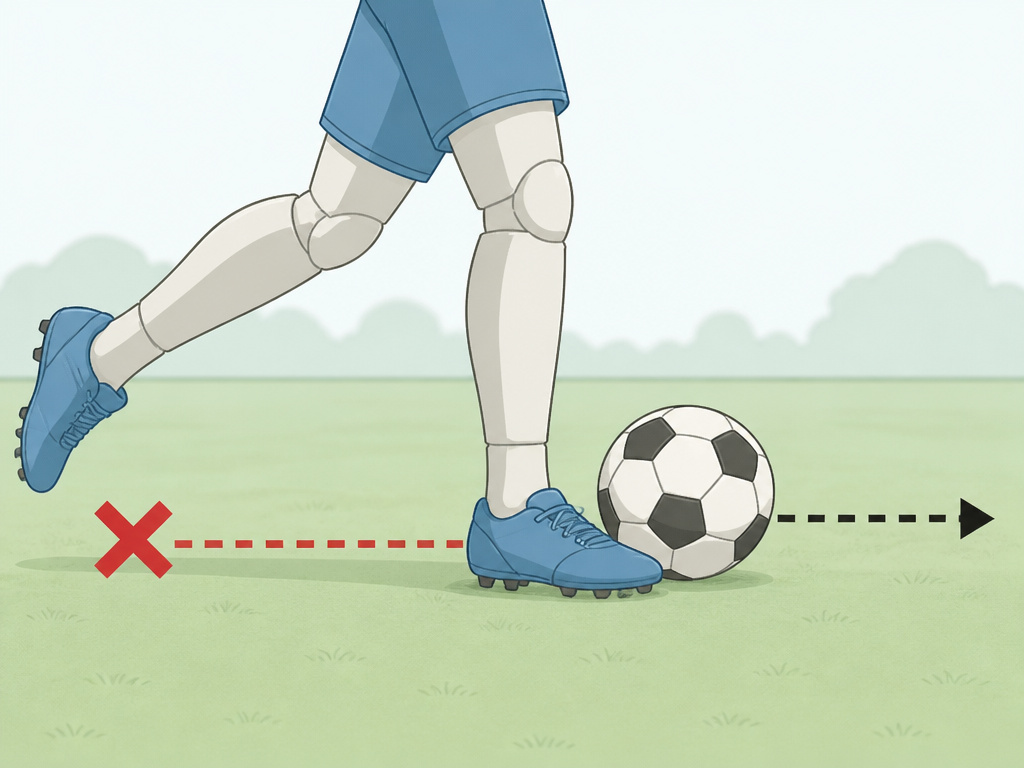
Your standing leg isn’t just along for the ride. It’s the anchor that allows your kicking leg to swing straight through the ball. Place your plant foot beside the ball, with your toes pointing where you want the ball to go initially.
The principle is the same, close enough to keep your torso over the ball and prevent leaning back (which causes sky-high shots), but not so close that you cramp your swing.
Common mistake: Planting your foot too far behind the ball. This causes you to lean back and strike underneath it, adding backspin and loft. You’ll get height, but not the knuckling dip.
Your body should be straight, with a slight forward lean. This ensures you strike through the ball’s center or even slightly on its lower half, keeping the shot low and hard. It’s the same upright, strong posture you’d use for a proper laces shooting technique, just with a radically different finish.
The Knuckleball Strike: No Spin, No Follow-Through
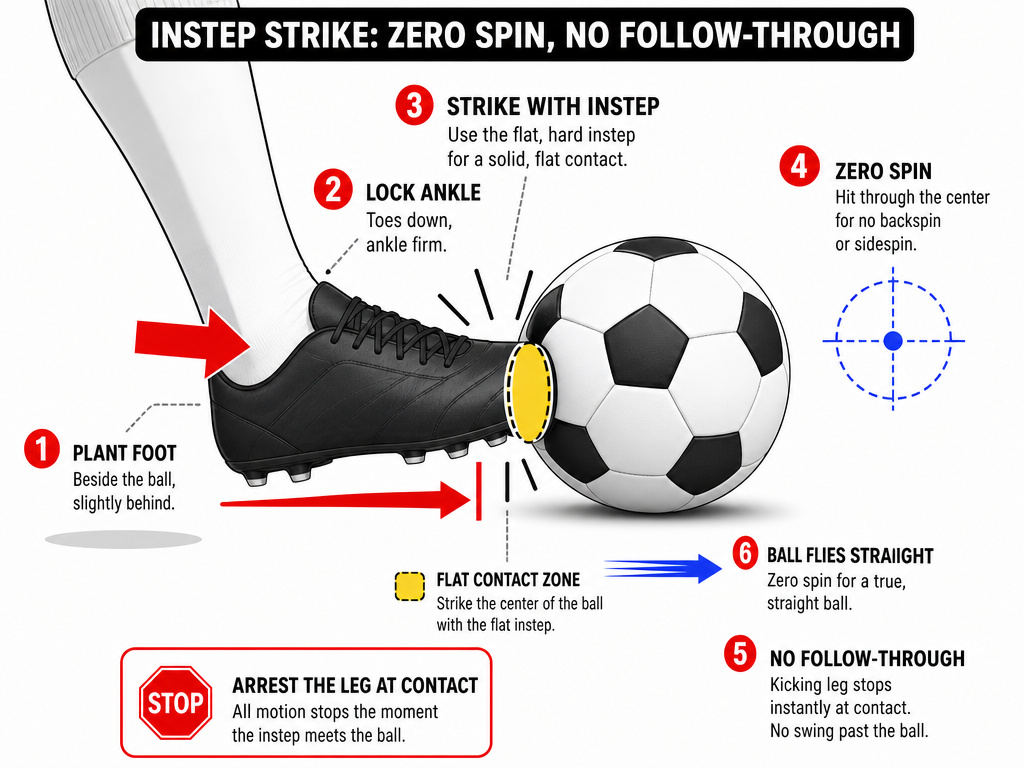
This is the moment. Everything you know about shooting with power gets flipped on its head. You sprint in, plant firmly, and swing your kicking leg with speed. You strike that marked center point with the flattest part of your instep, the area from your big toe to the top of your foot.
Then you stop.
Your brain will scream to follow through. You must override it. The forward motion of your foot must be arrested the instant after contact. This is the absolute core of the technique. The UTS knuckleball sensor study verified that this minimal-spin impact is what leads to the erratic trajectory.
The disagreement on follow-through is the biggest in knuckleball coaching. The Sporting News guide for the Ronaldo style explicitly says to “pull kicking leg high on follow-through.” That advice is for generating the extreme power Ronaldo uses, but it often comes at the cost of pure, clean knuckleball physics. It may produce a powerful, dipping shot, but it risks adding spin.
For the classic, unpredictable wobble, sources like Coaching American Soccer and Shoot Score Soccer consider the “stop” method foundational, while the Sporting News guide for a Ronaldo-style kick advocates a high leg lift on follow-through. Think of it not as a kick, but as a punch with your foot.
The Hop and the Landing
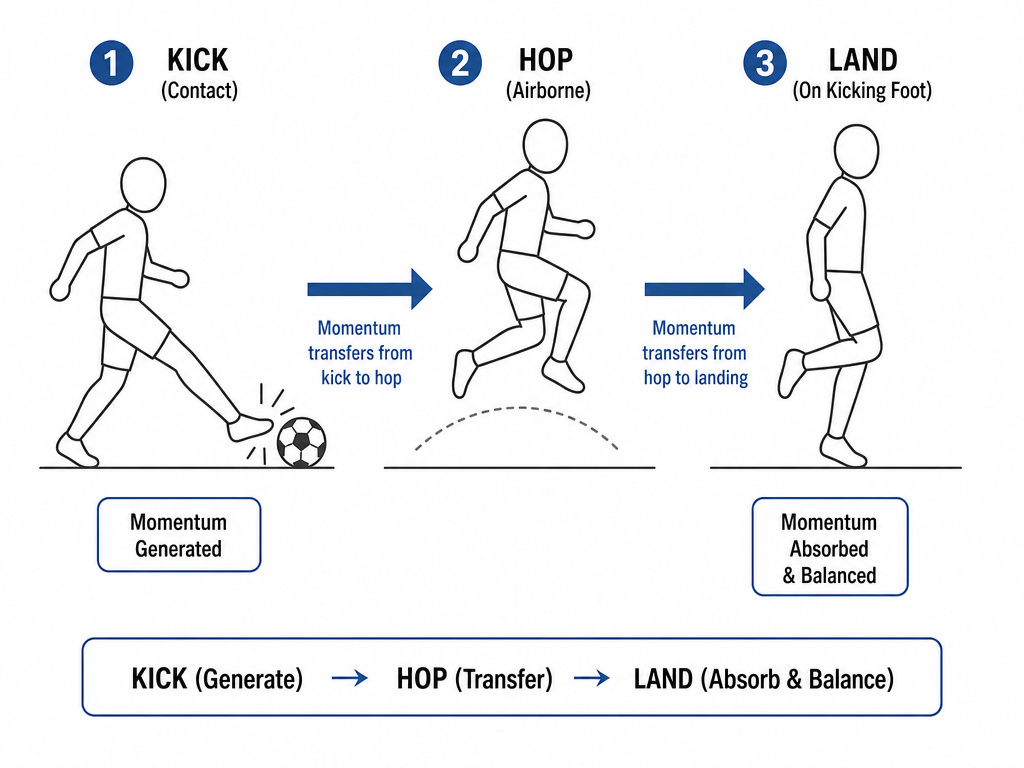
Since you’re stopping your leg, your momentum has to go somewhere. The result isn’t a traditional follow-through but a landing. Your kicking foot becomes your landing foot. This feels awkward and can throw you off balance.
Coaching American Soccer suggests a hop to manage this. After impact, quickly jump off your plant foot and land on your shooting foot. This little hop absorbs your forward energy and helps you stay upright. It’s also, coincidentally, what makes Ronaldo’s technique look so distinctive, that vault step in the run-up flows naturally into this stabilizing hop.
If you find yourself stumbling forward or falling over, you’re likely still carrying too much momentum through the ball. Focus even more on that abrupt stop. The power comes from the speed of your leg swing before contact, not from driving through the ball.
Practice Drills and Troubleshooting
You won’t master this in an afternoon. The skill requires hundreds of repetitions. Use multiple balls so you’re not fetching after every kick, or practice against a wall to work on strike consistency.
A great initial drill is to forget the goal. Place a ball 10 yards from a wall and focus solely on the strike and stop. Listen. A good, clean knuckleball strike has a distinctive, solid thud. If you hear a slapping or scraping sound, your foot is likely brushing across the ball, imparting spin.
Here’s a quick diagnostic table for when things go wrong:
| Observed Problem | Likely Cause | Immediate Fix |
|---|---|---|
| Ball has obvious backspin and balloons. | Leaning back, striking under the ball. | Move plant foot slightly forward; focus on keeping chest over the ball. |
| Ball has topspin and drills into the ground. | Leaning too far forward, striking over the ball. | Move plant foot slightly back; ensure a straight torso. |
| Ball spins sideways. | Foot is not striking dead center; body is rotating. | Re-focus on the marked spot; ensure run-up is straight and plant foot isn’t opening up. |
| Ball has no power. | Stopping foot too early, before contact. | Ensure leg swing is fast and stop happens after solid contact is made. |
| No wobble, just a straight flight. | Slight spin is still being imparted. | Exaggerate the stop; film your kick to see if your foot continues forward after contact. |
The frustration is real. You’ll have sessions where nothing works. That’s normal. The knuckleball has a steep learning curve. The key is isolating variables. Work on the strike alone from a short distance before adding power and range.
Knuckleball vs. Curved Free Kick: Choosing Your Weapon
When do you use this? The knuckleball is a specialist’s tool for direct free kicks from 25-40 yards. In this range, a traditional curling a free kick has to travel farther, giving the goalkeeper more time to track its bend. The knuckleball’s late movement gives him no time.
It’s a high-risk, high-reward choice. A curled shot offers more control and consistency. A knuckleball is less predictable for everyone, including you. But when it works, it’s unsaveable. Understanding the rules for free kicks also helps you pick your moment, knowing when you have a direct shot at goal.
For closer ranges, placement and power often beat the knuckleball. Inside 25 yards, you’re better off focusing on shooting precision or whipping the ball over the wall with spin.
How to use a hop step in your knuckleball run-up
Your final step before the plant foot is a distinct, short hop or vault onto the kicking foot. This isn’t a long jump; it’s a quick, controlled movement where you land on the foot you’ll use to strike the ball. The purpose is to set your body in a stable, powerful position while keeping your approach on a straight line. This hop helps you transfer your forward momentum upward into the ball and prepares your kicking leg for the short, stabbing motion required. Think of it as a way to gather yourself and ensure your plant foot lands firmly beside the ball, setting the stage for a clean, spin-stopping strike.
Frequently Asked Questions
How long does it take to learn the knuckleball free kick?
Expect to spend months, not hours. It can take a long time of consistent practice to reliably produce the effect in a game. It requires rewiring fundamental muscle memory, which is a slow process. Be patient and focus on quality of strike over distance or power in early sessions.
Can I use a knuckleball with a moving ball?
Yes, but it’s significantly more advanced. Some coaches even suggest starting with a gently rolling ball, as the motion can make the straight-on strike slightly easier. However, you should master the technique with a stationary ball first, especially for free kicks, before attempting it in open play.
Why is it called a knuckleball?
The term originates from baseball, where pitchers throw a ball with minimal spin using their knuckles to grip it, creating an erratic trajectory. The name was adopted in soccer (and other sports) to describe any ball that moves unpredictably in the air due to a lack of spin.
Did Cristiano Ronaldo invent the knuckleball?
No. The technique was pioneered by Brazilian legend Didi in the 1950s, who called it the “folha seca” (dry leaf). Later masters like Juninho Pernambucano and Andrea Pirlo used it to devastating effect. Ronaldo popularized a specific, powerful version of it in the modern era, making it synonymous with his name.
Is the knuckleball bad for your leg or knee?
The abrupt stopping motion places unusual stress on the muscles and joints of your kicking leg. If you don’t build up to it gradually, you can risk straining your quadriceps or hip flexor. Always warm up thoroughly, and if you feel sharp pain, stop. The hop landing is recommended partly to dissipate this force more safely.
Before You Go
The knuckleball free kick is a paradox. It demands immense power but requires you to halt that power instantly. It’s a shot of chaos born from rigid, precise technique. If you take one thing to the pitch, let it be this: your first fifty attempts should ignore the goal entirely. Find a wall, mark your ball, and listen for that clean thud. The wobble will come later.
And when it finally does, when you see that ball dip and swerve past a friend in goal, you’ll understand why players spend a year chasing that feeling. It’s not just a goal. It’s a little bit of physics-made magic. Now, who are you practicing it for this weekend?
