
Set Piece Coach Role in Football: The Numbers Don’t Lie
This post contains affiliate links. As an Amazon Associate, we earn from qualifying purchases.
A set piece coach in football is a specialist who designs, teaches, and optimises a team’s routines for corners, free kicks, throw-ins, and goal kicks. Their core job is to increase scoring and reduce conceding from these dead-ball situations by analysing data, creating choreographed movements, and running dedicated training sessions. In the Premier League, their work can decide results; Arsenal’s set pieces under Nicolas Jover were a significant factor in their 2023-24 campaign.
That goal difference isn’t abstract. It’s points on the board, league positions secured, and careers made or broken. The set piece coach operates where the game stops and a controlled, repeatable mini-game begins, a dynamic central to the set piece coach role in football.
What follows is a walk through the modern set-piece role: the split-second decisions on the touchline, the hours of video analysis, the training-ground repetitions, and the hard data that proves why this specialist now sits in every top dugout. We’ll look at what they do, how they work with analysts, where clubs have seen spectacular wins and quick failures, and why some managers still resist the trend.
Key Takeaways
- A set piece coach’s main output is choreographed movement, not just delivery; 80% of corner goals come from the second ball, so rehearsing phases is critical.
- The role is often split: the coach runs meetings and sessions, while the analyst handles individual player clips and opposition shadows.
- Premier League data shows the direct impact: 28% of all goals in the 2022-23 Premier League season came from set pieces (including penalties), according to a New York Times report.
- Success isn’t guaranteed; clubs like Wolves and Nottingham Forest have seen short-lived appointments coincide with poor set-piece records.
- Effective coaching depends on player buy-in; without it, even 5,000 pre-planned routines won’t work.
What Does a Set Piece Coach Actually Do?
Minute 87. Your team wins a corner. The set piece coach stands, makes a hand signal, and shouts a code word. In the next eight seconds, eleven players execute a sequence they’ve practiced forty times that week. That’s the job in its most visible form. But the real work started days earlier.
Their week is built around three pillars: analysis, design, and delivery. First, they dissect the upcoming opponent. What’s their defensive weak spot? Do they favour zonal or man-marking? Which of their players is a liability in the air? This process involves a forensic breakdown of hours of match footage, often using software like Hudl Sportscode or Wyscout to tag every defensive action.
According to one view, the set-piece coach devises routines and works on them with the players on the training ground, perhaps coming up with a signalling system. However, other sources like the BBC describe a split where the coach delivers meetings and sessions, while an analyst handles individual player work and opposition shadows.
Second, they design. This is where the notebook sketches come alive. If the analysis shows the opponent’s left-sided centre-back struggles with near-post flick-ons, the coach will craft a routine that isolates that exact matchup. Gianni Vio, the Italian set-piece guru, is famous for his vast library of options, reportedly holding almost 5,000 corner routines. But design isn’t about endless novelty. As Michele Aragona, a set-piece analyst, told the BBC, building something consistent over years means it “has to be something you can replicate.”
Finally, they deliver on the grass. This is the hardest sell. Players often see set-piece drills as a boring necessity. The coach’s personality and clarity are what secure buy-in. They need to translate complex diagrams into simple, physical actions. A typical session might isolate key players, like the taker and primary targets, and run the same movement repeatedly until the timing is unconscious.
Where this goes sideways: Skipping the ‘why’. If players don’t understand the strategic point of a decoy run, they’ll half-commit. The routine falls apart because three players are going through the motions. That’s why the best coaches, like Arsenal’s Nicolas Jover, spend as much time in team meetings explaining the reasoning as they do on the pitch.
The Day-to-Day Breakdown
Their schedule mirrors the matchweek cycle:
| Day | Primary Focus | Typical Output |
|---|---|---|
| Post-Match (Day 0) | Review | Analysis of set-piece execution from the game; success/failure rate. |
| Day 1 (Recovery) | Opponent Analysis | Initial report on next opponent’s set-piece tendencies, key defenders, goalkeeper positioning. |
| Day 2 (Training) | Routine Design | 2-3 new attacking routines drafted based on analysis; defensive organisation plans. |
| Day 3 (Training) | On-Pitch Rehearsal | First team run-through of new routines; focus on timing and spatial understanding. |
| Day 4 (Training) | Refinement & Repetition | High-intensity repetition of routines in 11v11 scenarios; set-piece triggers practiced. |
| Matchday | In-Game Adjustment | Delivers pre-agreed signals for specific routines; advises on in-game tweaks from the bench. |
The Set-Piece Analyst: A Different Role
People often use ‘set-piece coach’ and ‘set-piece analyst’ interchangeably. They’re wrong. The jobs are symbiotic but distinct. At clubs like FC Midtjylland, the split is clear: the coach delivers the meetings and the sessions on grass. The analyst, as Aragona explained, then “goes to individual players, making sure everything is correct on an individual level or taking care of opposition shadows.”
Think of it as macro vs. Micro. The coach designs the play for the whole team. The analyst takes that play and works one-on-one with the striker who keeps mistiming his near-post run, or with the defender who needs to see clips of how the opponent’s target man moves. They also prepare the “shadows”, training ground actors who mimic the upcoming opponent’s defensive set-up so the routine is tested under realistic pressure.
This separation matters because it changes who you hire for the set piece coach role in football. A brilliant analyst might be shy in front of the whole squad. A charismatic coach might lack the patience for detailed video editing. The most effective departments, like the one behind Aston Villa’s record-setting 20 set-piece goals in 2023-24, have both roles filled and working in lockstep.
Why the Role Has Exploded: The Numbers Don’t Lie
The rise of the set piece coach role in football is a direct response to the numbers, which have been shouting for attention for years. According to a New York Times report on Gianni Vio, 28% of all goals scored in the 2022-23 Premier League came from set pieces, including penalties. That’s over a quarter of the league’s goals coming from a moment the attacking team controls.
The disconnect comes in training time. The same report highlights the imbalance: teams “normally spend nearly two hours per week warming up, but just 10 minutes for set pieces.” When a third of your goals come from a phase of play you barely practice, hiring a specialist is basic resource allocation.
The BBC Premier League set-piece coaches article frames it as a search for “every possible small gain.” In a league where a single position can be worth millions, turning a 2% corner conversion rate into a 4% rate is a financial imperative as much as a sporting one. Brentford saw exactly this under Gianni Vio: their corner-to-goal conversion jumped from 1.7% to 4.1% in one season, an 80% increase.
The Proof is in the League Table
Look at the teams who have invested heavily and the direct correlation to their success:
| Club | Set-Piece Coach (Recent) | Notable Outcome |
|---|---|---|
| Arsenal | Nicolas Jover | +16 set-piece goal difference in 2023-24; were a major source of goals in 2023-24. |
| Aston Villa | Austin MacPhee | First team in Europe to score 20 goals from set plays in the 2023-24 season. |
| Brentford | Gianni Vio / Bernardo Cueva | Corner conversion increased by 80%; consistent top-half finishes. |
| FC Midtjylland | Various (pioneers) | 25 of 65 league goals (38%) from set pieces in their 2014-15 title-winning season. |
| Wolves (Counter-Example) | Jack Wilson (short tenure) | Scored 1, conceded 7 from set pieces after his departure, highlighting volatility. |
This table isn’t just a list. It shows the potential upside and the stark risk. For every Arsenal, there’s a warning like Wolves, who called time on Jack Wilson’s role after just a few months and immediately struggled.
Common Disagreements and Club Philosophy

Not every club boards the same train. There are two major fault lines in how teams approach the set-piece role.
1. Opponent-Specific vs. Repeatable Routines
This is the core strategic debate. Most top coaches likely blend both: a core set of bread-and-butter routines, with specific tweaks for vulnerable opponents.
2. Specialist Role vs. Integrated Coaching
Easy to miss: A set-piece coach needs authority. If the head coach doesn’t visibly back them in meetings and on the training ground, the players will spot the doubt and the drills become optional.
How Set-Piece Coaching Filters Down
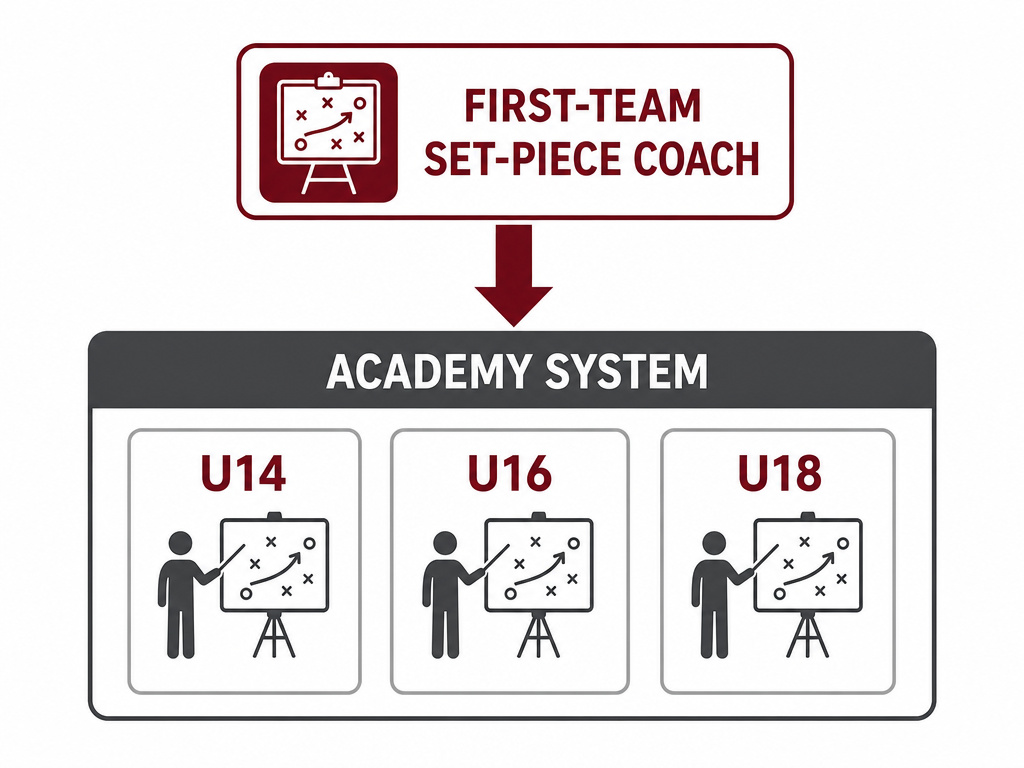
The real mark of a tactical revolution isn’t what happens in the Premier League, but what happens on the muddy pitches of the academy system. FC Midtjylland’s model is the blueprint here. They don’t just have a first-team specialist; they have a club-wide philosophy. Rune During oversees set-pieces at youth level, with “each age group having one coach whose remit includes set-pieces.”
This is long-term thinking. It’s not about teaching 14-year-olds elaborate corner routines. It’s about instilling foundational principles: body positioning for blocking, the timing of a near-post run, how to use your arms legally. By the time a player reaches the first team, set-piece awareness is a reflex, not a new subject. This is a massive, often overlooked, part of the assistant manager role and other specialist coaching roles within a modern academy structure.
The principles for planning a session or structuring training change when you bake in set-piece time. It moves from a dreaded ten-minute add-on to a integrated, competitive part of practice.
Defensive Organisation: The Other Half of the Job
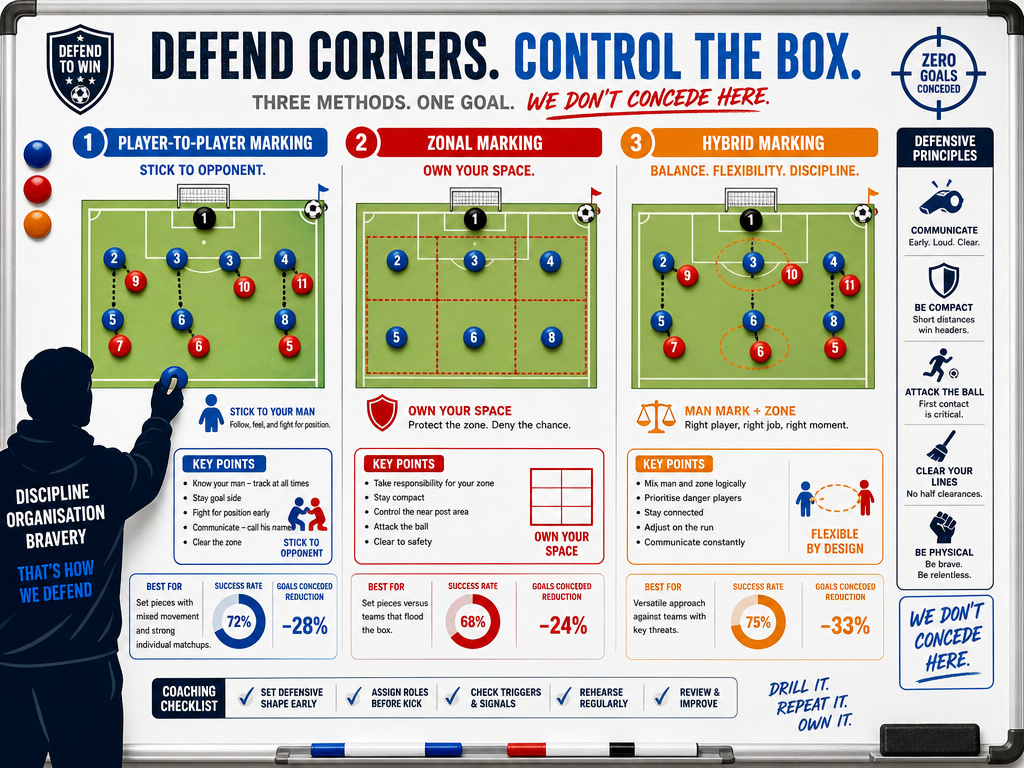
A great set-piece coach is both an attacking wizard and a defensive organiser. The Football Collective notes the three common defending methods: player-to-player marking, zonal marking, and a hybrid. Choosing the right one depends on your squad’s strengths.
A tall, physical team might excel in a zonal system where they own their space. A team with quick, aggressive defenders might prefer man-marking to stick to their opponent. The hybrid model, mixing both, is often the hardest to attack but also the hardest to coach without confusion. The set-piece coach must not only pick the system but drill it to the point where, when a corner is conceded, every player knows their job without a second’s hesitation. This defensive work is as much about psychology as positioning, instilling a collective “we don’t concede here” mentality.
For more on the nuances of this, our guide on defending corners breaks down the pros and cons of each approach.
Case Studies: When It Works and When It Doesn’t
The theory is neat. The reality is complicated. Looking at specific clubs shows why the role is powerful but precarious.
Success: Arsenal’s Jover Revolution
When Nicolas Jover arrived at Arsenal, the team’s set-piece output saw a marked improvement. His impact was immediate and sustained. He brought a clear identity: near-post inswinging corners, meticulous blocking schemes, and relentless repetition. The players bought in because the results were instant. This wasn’t a consultant offering ideas; it was a coach embedding a system. The Guardian set-piece coaches article traces this lineage back through Brentford and Manchester City, showing how a coherent philosophy can travel with a coach.
Failure: The Wolves Experiment
Wolves appointed Jack Wilson as their first set-piece coach in the summer of 2023. By the following spring, he was gone. Under Gary O’Neil after Wilson’s departure, Wolves scored just one set-piece goal while conceding seven. The timeline is damning, but the lesson isn’t that Wilson was a bad coach. It’s that installing a specialist into a system that isn’t ready, or into a club where the head coach isn’t fully committed, can backfire spectacularly. The role depends on a perfect alignment of philosophy, player receptiveness, and coaching authority.
The Throw-In Specialist: A Niche Within a Niche
Liverpool’s hiring of Thomas Gronnemark in 2018 raised eyebrows. A throw-in coach? But the Dane improved Liverpool’s possession retention from throw-ins from 45.4% to 68.4%. His point was logical: with 40-60 throw-ins per match, you spend roughly 20 minutes of game time on them. Ignoring that is like a baseball team ignoring baserunning. His work is a perfect example of how the set-piece field is sub-dividing into ever-smaller specialisms, a trend explored in our piece on long throw tactics.
The Tools and Skills Required
You don’t need a UEFA Pro License to be a great set-piece coach, but you do need a specific toolkit.
Technical Skills:
- Video Analysis Proficiency: Software like Hudl Sportscode, Wyscout, or even TacticalPad is essential for breaking down opponent tendencies and self-scouting.
- Data Literacy: Understanding basic metrics like xG from set pieces, conversion rates, and defensive success percentages is essential. You must speak the language of the data department.
- Design & Communication: The ability to translate a complex routine into a clear, visual playbook, using tools like PowerPoint or Apple Keynote, is as important as the routine itself.
Soft Skills:
- Teaching Ability: Can you explain the same movement five different ways to five different players?
- Persistence: Set-piece training is repetitive. You must love the grind of the tenth rep, knowing the eleventh might be the one that wins a match.
- Political Savvy: You are a specialist entering a world of generalists. You must earn the trust of the head coach and the respect of the players without overstepping.
The New York Times set-piece expert interview with Gianni Vio captures this blend perfectly: a deep archive of routines (the technical) combined with a focus on the taker’s quality and the need for player belief (the human).
What qualifications does a set piece coach need?
A formal coaching license is a common foundation, with higher qualifications linked to more thorough preparation. The role demands strong analytical skills to break down opponent weaknesses and design effective routines. Clear communication is critical, as the coach must deliver instructions in meetings and on the training pitch, translating complex video analysis into actionable plans for players. Practical experience in designing and rehearsing set plays is valued, alongside the ability to work collaboratively within a broader coaching and analysis team.
Frequently Asked Questions
How much do set piece coaches get paid?
Salaries are rarely disclosed and vary wildly based on the club’s level, league, and the individual’s experience. A set-piece coach at a Premier League club is likely a full-time, well-compensated member of the first-team staff. At a lower-league or academy level, the role might be part of a broader coaching remit with a corresponding salary. There is no public, standardized pay scale.
What is a set piece coach in football?
Set piece coach is a tactical specialist responsible for improving a team’s performance during dead-ball situations: corners, free kicks, throw-ins, and goal kicks. They analyse opponents, design attacking and defensive routines, and lead specific training sessions to drill those plans.
Why do they call it a set piece?
The term comes from the idea that the ball is “set” or stationary, and the situation is a “piece” of structured play. Unlike open play, which is fluid and reactive, a set piece is a planned, rehearsed moment that starts from a stopped ball. It’s a discrete “piece” of the game you can practice in isolation.
Do all Premier League clubs have a set piece coach?
No, but the majority now do. High-profile clubs like Arsenal, Manchester City, Aston Villa, and Brentford have dedicated specialists. Some, like Tottenham under Ange Postecoglou, intentionally do not, preferring the responsibility to remain with the general coaching staff. The trend, however, is strongly toward specialization.
What’s the difference between a set piece coach and a normal coach?
Normal (or general) coach oversees many aspects of play: attacking shape, defensive transitions, fitness, and psychology. A set piece coach has a hyper-focused expertise on one specific phase: dead-ball situations. They usually have deeper knowledge of the laws, biomechanics of jumping, and spatial design relevant to static starts.
The Bottom Line
The set piece coach represents the logical endpoint of football’s search for marginal gains. When 28% of goals come from a phase you can control, not hiring a specialist is a conscious choice to ignore low-hanging fruit.
But the title on the door guarantees nothing. The role lives or dies on three things: the head coach’s buy-in, the players’ willingness to learn, and the specialist’s ability to connect deep analysis with simple, repeatable actions. For every Nicolas Jover crafting a title challenge, there’s a Jack Wilson exiting after a few quiet months.
The next time you watch a match, don’t just watch the corner. Watch the bench. The person giving the signal holds a notebook of probabilities, a week of preparation, and a career made in those eight seconds of choreographed chaos. It’s a game within the game, and now you know who writes the rules.
